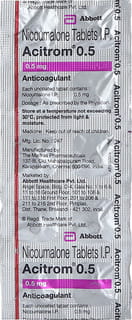
Acitrom 0.5Mg Strip Of 10 Tablets
10 Tablet(s) in StripMRP ₹86.92
₹66.06
24% OFF
Made by
ABBOTT HEALTHCARE PVT LTD
Dosage
TABLET
Expiry
Product Summary
| Uses | Deep vein thrombosis and blood clots |
| Therapy | Anti-coagulant |
| Side effects | Hemorrhage, bleeding, dizziness |
| Salt Content | Acenocoumarol(0.5 Mg) |
Assurance
available
Regulated
Medical Description
Acitrom 0.5mg Tablet is used to treat and prevent dangerous blood clots, including clots in the deep veins and lungs; to prevent stroke in people with atrial fibrillation; and to provide lifelong protection for people with a mechanical heart valve. It contains acenocoumarol, a vitamin K antagonist.
Vitamin K is needed by the liver to manufacture several clotting factors. Acenocoumarol blocks the enzyme that recycles vitamin K, so production of these factors falls, and the blood takes longer to clot. Because existing factors must first be used up, the full effect takes three to five days.
Treatment is guided entirely by an INR blood test, which must be checked regularly. Take the tablet at the same time each day, usually in the evening, and never change the dose yourself.
Bleeding is the main risk and follows directly from the medicine's purpose. Seek urgent help for black or tarry stools, blood in vomit or urine, coughing up blood, a severe headache, sudden weakness, or any bleeding that will not stop.
Keep your intake of green vegetables steady rather than avoiding them, tell every prescriber you take this medicine before starting antibiotics or painkillers, and avoid it entirely in pregnancy.
Uses
- Treatment and prevention of diseases where the blood vessels are obstructed (thromboembolic diseases), such as Deep vein thrombosis (mainly affects legs) and other disorders related to the heart, lungs and brain due to blood clot formation.
- As an adjuvant in the treatment of obstruction of blood flow through the heart due to blood clots (coronary occlusion).
Contraindications
- If you are allergic to Acenocoumarol or any ingredient of this medicine.
- If you are at a risk of bleeding due to blood disorders.
- If you have high blood pressure or accumulation of fluid around the heart.
- If you have a recent history of stroke due to bleeding in the brain or brain haemorrhages.
- If you have stomach ulcers or intestinal bleeding, urinary tract infection or respiratory tract problem.
- If you recently had or about to have surgery, have a liver or kidney problem, pregnant or planning a baby.
- People who are difficult to co-operate such as alcoholics, with mental deterioration or psychiatric disorders.
Side effects
- Bruising more easily than usual
- Bleeding from the gums or nose
- Heavier or prolonged menstrual bleeding
- Blood in the urine or stools
- Nausea or loss of appetite
- Hair loss with long-term use
- Rash
- Rarely, painful skin patches that darken, which need urgent assessment
Precautions and Warnings

Pregnancy

Breast Feeding

Driving

Alcohol

Other General Warnings
- You are suffering from a liver problem as the liver is the main site of the formation of blood clotting factors, and it can be affected. You may get a liver disorder.
- You have kidney or heart problem; the dose will be decided depending upon the severity of your underlying conditions.
- You are suffering from a blood disorder like abnormal bleeding after injury; caution is required for such patients.
- You are an older person or giving it to a child, be cautious and more frequent monitoring of PT/INR is recommended.
- You are suffering from a rare condition where calcium builds up in blood vessels in the skin, as these medicines contain calcium.
- You have disorders due to which absorption from the gut is not proper.
- You have increased thyroid levels, infection or inflammation, cancer or tumour.
- If you experience bleeding problems, reach out to your doctor.
Directions for Use
- Take Acitrom 0.5mg Tablet exactly as prescribed, in the dose stated at your most recent INR check.
- Swallow the tablet whole with water.
- Take it at the same time each day, usually in the evening so that dose changes after a daytime INR test can be applied the same day.
- Never change the dose yourself, and never take extra to compensate for a missed dose.
- Attend every INR appointment and keep your anticoagulant record book up to date.
- Carry an anticoagulant alert card at all times.
Storage and disposal
- Store Acitrom 0.5mg Tablet in a cool, dry place away from direct sunlight and moisture.
- Keep the tablets in their original strip, and take care not to confuse different strengths, as tablets look similar.
- Keep out of the sight and reach of children and pets; this medicine is extremely dangerous for a child.
- Do not use after the expiry date on the pack, and dispose of unused or expired tablets safely.
Quick Tips
- Attend every INR blood test; the dose of this medicine is set entirely by the result.
- Keep your intake of green leafy vegetables steady each week rather than avoiding them altogether.
- Avoid sudden diet changes, crash diets and week-long swings in how much salad or greens you eat.
- Avoid cranberry juice, large amounts of mango, and grapefruit juice, which can raise your INR.
- Tell any doctor prescribing an antibiotic that you take this medicine, and ask when to recheck your INR.
- Use paracetamol rather than ibuprofen or aspirin for pain, and tell your doctor if you need it regularly.
- Use a soft toothbrush and an electric shaver, and take care with knives and sharp tools.
- Seek urgent help for black stools, blood in urine or vomit, a severe headache, or bleeding that will not stop.
- Get medical assessment after any fall or blow to the head, even if you feel completely well.
- Avoid binge drinking, which can push your INR up sharply.
- Carry your anticoagulant alert card and record book at all times.
- Do not use ginkgo, high-dose garlic, ginger, turmeric or fish oil supplements without medical advice.
- Tell your doctor immediately if you are pregnant or planning pregnancy, as this medicine must be changed.
Dosage
Overdose
Missed a Dose
How does this medicine work?
- Acitrom 0.5mg Tablet contains acenocoumarol, which interferes with the way the body uses vitamin K. The liver needs vitamin K to finish making four of the proteins that drive blood clotting, known as factors II, VII, IX and X.
- Each time vitamin K is used in this process it is chemically altered and must be recycled back to its usable form by an enzyme called vitamin K epoxide reductase. Acenocoumarol blocks that enzyme, so the supply of usable vitamin K falls and the liver cannot complete production of these clotting factors.
- With fewer functioning clotting factors in circulation, the blood clots more slowly and existing clots are less likely to grow or new ones to form. Because clotting factors already in the bloodstream must be used up first, the full effect appears only after three to five days, and for the same reason the effect persists for several days after stopping.
Interactions
Interactions with other medicines
- Acenocoumarol interacts with a very large number of medicines, foods and supplements, and even small changes can move the INR into a dangerous range in either direction.
- Tell every doctor, dentist and pharmacist that you take this medicine before anything new is started or stopped, and ask when your INR should be rechecked.
- Life-threatening: Antibiotics and antifungals, particularly ciprofloxacin, metronidazole, co-trimoxazole, erythromycin, clarithromycin and fluconazole, can raise the INR sharply within days and cause major bleeding. An INR check is needed whenever one is prescribed.
- Life-threatening: Aspirin and anti-inflammatory painkillers such as ibuprofen, diclofenac and naproxen impair platelets and damage the stomach lining while the blood is already thinned, producing a high risk of severe gastrointestinal bleeding.
- Life-threatening: Amiodarone substantially increases the effect of acenocoumarol, and the raised INR can persist for weeks after amiodarone is stopped. The anticoagulant dose usually needs a large reduction.
- Severe: Other anticoagulants and antiplatelet medicines, including clopidogrel and heparin, greatly increase bleeding risk when combined and are only used together under specialist supervision.
- Severe: Carbamazepine, rifampicin, phenobarbital, phenytoin and St John's wort speed up the breakdown of acenocoumarol, dropping the INR and leaving you unprotected against a clot or stroke.
- Severe: Regular high-dose paracetamol raises the INR and is a frequently overlooked cause of unexpected over-anticoagulation. Occasional single doses are usually acceptable.
- Moderate: Thyroid hormones such as levothyroxine increase the effect of acenocoumarol, so the INR should be rechecked when a thyroid dose changes.
- Moderate: Statins, omeprazole, allopurinol and some antidepressants can modestly raise the INR.
- Moderate: Corticosteroids, oral contraceptives and azathioprine may reduce the anticoagulant effect.
Interactions with food items
- Vitamin K is the central dietary issue, and consistency matters far more than avoidance. Spinach, methi, mustard greens, cabbage, broccoli, coriander, mint and green tea are all rich in vitamin K, which works against this medicine. Eat a steady, moderate amount each week so your dose can be matched to it.
- Avoid sudden changes. Starting a green juice regimen, a crash diet, or a week of heavy salad eating can drop the INR and leave you at risk of a clot; abruptly cutting all greens can push it dangerously high.
- Cranberry juice, mango and grapefruit juice have all been reported to raise the INR and increase bleeding risk. Avoid large or regular quantities.
- Avoid binge drinking, which can raise the INR sharply. If your doctor allows alcohol at all, keep it small and consistent.
- Be careful with supplements. Ginkgo biloba, high-dose garlic, ginger, ginseng, turmeric, fish oil, vitamin E and dong quai all affect bleeding or the INR. Culinary amounts in cooking are not a problem; concentrated capsules are.
- Tell the anticoagulation clinic if illness, vomiting or diarrhoea stops you eating normally for more than a day or two, as this alone can move the INR.
Frequently Asked Questions (FAQs)
References:
- Sinthrome 1 mg Tablets (acenocoumarol) - Summary of Product Characteristics (SmPC) (emc). Accessed 31 Jul 2026.
- Sinthrome 1 mg Tablets (acenocoumarol) - Patient Information Leaflet (PIL) (emc). Accessed 31 Jul 2026.
- Acenocoumarol - Medicine Information. Patient.info. Accessed 31 Jul 2026.
- Warfarin - MedlinePlus Drug Information (vitamin K antagonist class reference). U.S. National Library of Medicine. Accessed 31 Jul 2026.
- Clinical Practice Guidelines on Atrial Fibrillation and Valvular Heart Disease. European Society of Cardiology (ESC). Accessed 31 Jul 2026.
- WHO Model List of Essential Medicines. World Health Organization. Accessed 31 Jul 2026.
Articles
View All









Chronic Condition Articles
View All





Did you find this helpful?
Explore More at Pharmeasy
Manufacturer Details
Brand:ACITROM
Manufacturer Name:ABBOTT HEALTHCARE PVT LTD
Address:The Madras Pharmaceuticals - 137 B, Old Mahabalipuram Road Karapakkam , Chennai - 600 096 India
Country of Origin:India
Vendor Details
Fulfillment Information: Acitrom 0.5 MG Tablet (10) will be delivered by a licensed retail pharmacy nearest to your location. Order acceptance and fulfillment are dependent upon the verification of your doctor's valid prescription (where applicable) and the current stock of this medicine.
In Case of Any Issues Contact Us
Email Id:care@pharmeasy.in
Phone Number:7666100300
Address:D-37/1, Opp. Sandoz, TTC Industrial Area, MIDC Industrial Area, Turbhe, Navi Mumbai, Maharashtra 400703
Disclaimer
The information provided herein is supplied to the best of our abilities to make it accurate and reliable as it is published after a review by a team of professionals. This information is solely intended to provide a general overview on the product and must be used for informational purposes only. You should not use the information provided herein to diagnose, prevent, or cure a health problem. Nothing contained on this page is intended to create a doctor-patient relationship, replace or be a substitute for a registered medical practitioner's medical treatment/advice or consultation. The absence of any information or warning to any medicine shall not be considered and assumed as an implied assurance. We highly recommend that you consult your registered medical practitioner for all queries or doubts related to your medical condition. You hereby agree that you shall not make any health or medical-related decision based in whole or in part on anything contained in the Site. Please click here for detailed T&C.