

5848+ orders placed in your location

100% NABL & ISO Certified Lab • 100% Accurate Reports
Thyroid Profile Test (T3, T4, UTSH) / TFT
Thyroid Function Test, Thyroid Panel
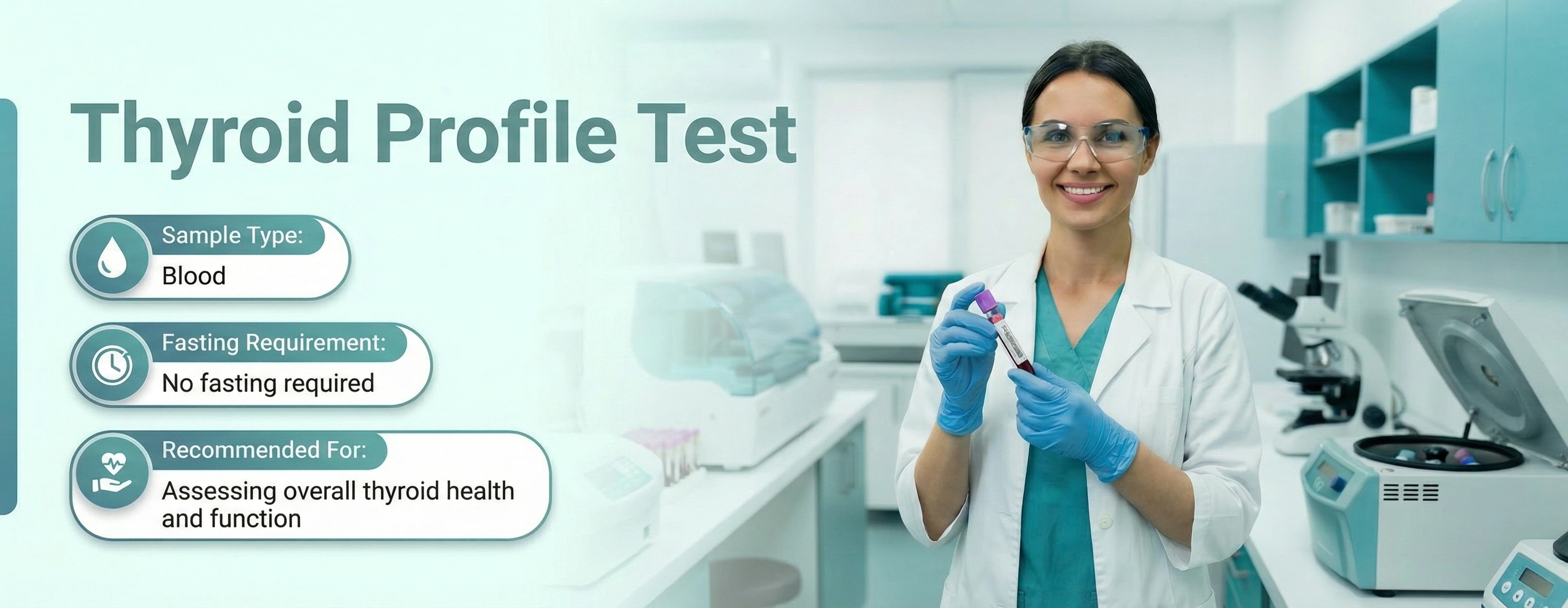
- SummaryThe Thyroid Profile Test (T3, T4, UTSH) assesses thyroid gland function by measuring levels of Total T3, Total T4, and Ultrasensitive TSH in the blood. It helps diagnose thyroid disorders like hypothyroidism or hyperthyroidism and monitor treatment effectiveness. Suitable for all ages and genders, this test requires a blood sample and no fasting is needed.Read more
- TestsIncludes 3 tests
- Reports Within24 HrsView Sample Report

 100% NABL & ISO Certified Labs
 - SampleBlood

- AgeAll Age Group
- GenderMale and Female
- FastingNot Required
PharmEasy Promises



Know More About The Test

A quick info on Thyroid Profile test

Overview
The Thyroid Profile test - also called the thyroid function test (TFT) or thyroid panel - measures three key thyroid hormones in a single blood draw: Total T3 (Triiodothyronine), Total T4 (Thyroxine), and UTSH (Thyroid Stimulating Hormone - Ultrasensitive). Together, these three values give your doctor the most comprehensive picture of how your thyroid gland is working.
Doctors order a Thyroid Profile test because measuring T3, T4, and TSH together identifies not just whether a thyroid problem exists, but exactly where in the thyroid-pituitary system the problem lies. TSH, produced by the pituitary gland, acts as the controller - signalling the thyroid to produce more or less hormone. T3 and T4 are the active thyroid hormones that regulate metabolism, energy, heart rate, weight, mood, and body temperature.
The Thyroid Profile test monitors the thyroid gland, the pituitary-thyroid communication axis, and - through the effects of thyroid hormones - the cardiovascular system, metabolism, reproductive system, and bone health. No fasting is required for the test, and it is suitable for all ages and genders.
When and Who Should Get a Thyroid Profile Test Done?
A Thyroid Profile test is performed when thyroid dysfunction is suspected or as a routine preventive screening for those at risk. Since thyroid disorders develop slowly and mimic many other conditions, this test is one of the most frequently ordered in India.
This test is usually recommended for:
- Anyone with unexplained weight gain or loss, constant fatigue, feeling cold or excessively hot, hair thinning, dry skin, or irregular periods.
- People with depression, brain fog, anxiety, palpitations, a puffy face, or visible swelling at the front of the neck.
- Adults above 40 years - especially women, who are 5 to 8 times more likely than men to develop thyroid disorders.
- Pregnant women or those planning a pregnancy - thyroid hormones are critical for foetal brain and nervous system development.
- Anyone with a family history of thyroid disease, autoimmune disorders, or diabetes.
- Patients already on thyroid medication - for regular monitoring of treatment response and dose adjustment.
- Individuals on medications that affect thyroid function, such as biotin, steroids, amiodarone, lithium, or antiepileptic drugs.
.png?dim=48x48&q=75)
How Frequently Should You Take the Thyroid Profile Test?
The frequency of the Thyroid Profile test depends on whether you have a known thyroid condition, are on treatment, or are at risk due to other health factors. Because thyroid hormones take time to respond to treatment changes, testing too frequently adds little useful information.
|
Health Scenario |
Context |
Recommended Frequency |
|
Routine Check |
Healthy adults, no thyroid history. |
Once a year, or once every 2 to 3 years if previous results were normal. |
|
On Thyroid Medication |
Patients on levothyroxine for hypothyroidism or anti-thyroid drugs for hyperthyroidism. |
Every 3 months until levels stabilise, then every 6 to 12 months. |
|
Pregnancy |
Critical for foetal development; TSH targets are stricter during pregnancy. |
Once per trimester, or more frequently if an abnormality is found. |
|
Subclinical Thyroid Disorder |
Borderline TSH with normal T3 and T4. |
Every 6 months to monitor for progression to overt disease. |
|
Post-Treatment or Post-Surgery |
After radioiodine therapy or thyroid surgery. |
Every 6 to 8 weeks initially, then every 6 to 12 months once stable. |
|
Family History or High Risk |
No current diagnosis, but elevated risk. |
Annually, especially for women above 40 or those with autoimmune conditions. |

What Conditions Can a Thyroid Profile Test Help Detect?
The Thyroid Profile test can diagnose, monitor, and differentiate between a wide range of thyroid conditions. The combination of T3, T4, and TSH together allows for a much more accurate diagnosis than TSH alone:
- Primary Hypothyroidism - the thyroid itself is underactive. TSH is high; T3 and T4 are low. The most common thyroid disorder in India, often caused by Hashimoto's thyroiditis or iodine deficiency.
- Primary Hyperthyroidism - the thyroid is overactive. TSH is low; T3 and T4 are high. Commonly caused by Graves' disease or toxic multinodular goitre.
- Secondary Hypothyroidism - the pituitary is not producing enough TSH. Both TSH and T3/T4 are low. Indicates a pituitary problem rather than a thyroid problem.
- Secondary Hyperthyroidism - the pituitary is over-stimulating the thyroid. Both TSH and T3/T4 are high. Rare, often due to a TSH-secreting pituitary tumour.
- Hashimoto's Thyroiditis - autoimmune thyroid disease causing gradual destruction of thyroid tissue. TSH rises over time; T3 and T4 fall.
- Grave's Disease - autoimmune hyperthyroidism. TSH is suppressed; T3 and T4 are elevated. Often associated with bulging eyes and goitre.
- Goitre - enlargement of the thyroid gland. The profile determines whether it is caused by hypothyroidism, hyperthyroidism, or non-toxic (normal thyroid function).
- Thyroiditis - inflammation of the thyroid, including postpartum thyroiditis. It can cause a temporary phase of hyperthyroidism followed by hypothyroidism.
Important Note: This test cannot evaluate changes at the organ level caused by thyroid dysfunction. Imaging and antibody tests are needed for a complete assessment.
.png?dim=48x48&q=75)
Thyroid Profile Test Preparation
What to Expect Before the Thyroid Profile Test
No fasting is required. You can eat and drink normally. Inform your doctor about: biotin supplements (stop at least 48 to 72 hours before the test - biotin interferes with the lab assay and can falsely alter T3, T4, and TSH values); thyroid medications - take levothyroxine after the blood draw if your doctor prefers the pre-dose level; other medications such as steroids, opioids, lithium, amiodarone, and oral contraceptives; and pregnancy, as thyroid reference ranges differ in each trimester.
What to Expect During the Blood Collection
A phlebotomist cleans the skin with an antiseptic, then places an elastic band around your upper arm to make the veins easier to access. A small needle is inserted into the vein - you may feel a brief pinch. Blood is collected into a labelled tube in under a minute. All three parameters are tested from a single blood sample.
What to Expect After the Thyroid Profile Test
A small cotton swab and bandage are placed over the site to stop any minor bleeding. You can return to normal activities immediately. Minor bruising is normal and resolves quickly. If dizzy, sit and rest for a few minutes before leaving.
What are the Parameters Included in a Thyroid Profile Test?
The Thyroid Profile test measures three interrelated hormones from a single blood sample. Each parameter provides a different piece of the thyroid health puzzle:
- Total T3 (Triiodothyronine) - T3 is the active thyroid hormone that directly affects the metabolism of every cell in the body. It regulates heart rate, body temperature, energy use, digestive function, and bone maintenance. Most T3 is converted from T4 in the body's tissues. Elevated T3 is a key marker of hyperthyroidism.
- Total T4 (Thyroxine) - T4 is the main hormone produced and released by the thyroid gland itself. It circulates in the blood and is converted to the more active T3 in body tissues. Low T4 with high TSH confirms hypothyroidism.
- TSH (Thyroid Stimulating Hormone) - TSH is produced by the pituitary gland in the brain. It is the master regulator that controls the thyroid's hormone output. TSH is the most sensitive thyroid marker - it rises even before T3 and T4 become abnormal, making it the earliest indicator of thyroid dysfunction.

Normal Range of Thyroid Profile Test Parameters
The table below shows the standard reference ranges for each parameter in the Thyroid Profile test. These ranges apply to non-pregnant adults unless otherwise specified.
|
Parameter |
Normal Range |
|---|---|
|
Total T3 (Triiodothyronine) |
60-181 µg/dL |
|
Total T4 (Thyroxine) |
4.5 - 12.0 µg/dL |
|
TSH (Thyroid Stimulating Hormone) |
0.4 - 4.0 μIU/mL (adults); stricter in pregnancy |
Important Note: Reference ranges can vary slightly between laboratories and methods. Pregnant women have different TSH targets for each trimester. Children and elderly individuals may also have slightly different ranges. Always refer to the specific ranges printed on your lab report and consult your doctor for interpretation.
.png?dim=48x48&q=75)
Thyroid Profile Test Result Interpretation
The key to accurate thyroid diagnosis is looking at the pattern of all three values together - not just one in isolation. The table below summarises the most common result patterns and their clinical meaning.
|
Result Pattern |
TSH |
T3 / T4 |
Most Likely Interpretation |
|---|---|---|---|
|
Normal |
0.4 - 4.0 |
Normal |
Thyroid is functioning well. No evidence of dysfunction. |
|
Primary Hypothyroidism |
High (above 4.0) |
Low |
Thyroid is underactive. Levothyroxine therapy is usually recommended. |
|
Subclinical Hypothyroidism |
Mildly High (4 - 10) |
Normal |
Early thyroid underactivity. Monitor or treat based on symptoms and pregnancy status. |
|
Primary Hyperthyroidism |
Low (below 0.4) |
High |
Thyroid is overactive. Anti-thyroid drugs or radioiodine therapy may be needed. |
|
Subclinical Hyperthyroidism |
Mildly Low |
Normal |
Early overactivity. Monitor and assess cardiovascular and bone risks. |
|
Secondary Hypothyroidism |
Low |
Low |
Pituitary gland is not producing enough TSH. Pituitary investigation required. |
|
Secondary Hyperthyroidism |
High |
High |
Pituitary is overstimulating the thyroid. Rare - pituitary tumour investigation needed. |
Disclaimer: This table is for educational purposes only. Interpretation must always be done by a qualified doctor alongside your symptoms, history, and other investigations.
Thyroid Profile Test Risks and Limitations
Potential Risks and Complications
The TSH test is a very safe, routine blood test. Complications are extremely rare, and most people feel only a brief pinch. Consult a doctor if:
- The puncture site does not stop bleeding after applying gentle pressure
- You notice unusual redness, swelling, warmth, or lasting pain at the needle site
- You feel persistently lightheaded after the blood draw - sit and rest for a few minutes before leaving.
Understanding TSH Test Limitations
TSH alone does not give the complete thyroid picture - in rare pituitary disorders or resistance to thyroid hormone, TSH may be normal even when hormone levels are abnormal, and Free T3 and Free T4 tests may be needed. Biotin supplements can falsely suppress TSH, mimicking hyperthyroidism - always stop biotin 48 to 72 hours before the test. Medications including steroids, opioids, lithium, and amiodarone can alter TSH independently of true thyroid function. TSH is also highest in the early morning and takes 6 to 8 weeks to stabilise after any medication dose change.

Related and Follow-up Tests
If your Thyroid Profile results are abnormal, your doctor will recommend further tests to identify the cause, confirm the diagnosis, and assess for complications.
|
Thyroid Profile Finding |
Suggested Follow-up Test |
Why It Is Ordered |
|---|---|---|
|
High TSH + Low T3/T4 |
Detects Hashimoto's thyroiditis - the most common autoimmune cause of hypothyroidism. |
|
|
Low TSH + High T3/T4 |
Confirms Graves' disease - the most common autoimmune cause of hyperthyroidism. |
|
|
Any Abnormal Profile |
Thyroid Ultrasound |
Assesses the structure of the thyroid - detects goitre, nodules, or irregular texture. |
|
Confirmed Hypothyroidism |
Hypothyroidism raises LDL and total cholesterol - cardiovascular risk must be assessed. |
|
|
Confirmed Hypothyroidism |
Thyroid disorders frequently co-exist with diabetes. Both affect metabolism. |
|
|
Confirmed Hyperthyroidism |
Prolonged hyperthyroidism causes bone loss. Bone health assessment is important. |
|
|
Nodule Detected on USG |
FNAC (Fine Needle Aspiration Cytology) |
If a nodule is found, tissue sampling may be needed to rule out thyroid cancer. |
Thyroid Profile Test Sample Collection: Home vs. Diagnostic Lab
|
Feature |
Home Collection (PharmEasy) |
Traditional Diagnostic Lab |
|---|---|---|
|
Convenience |
High - sample taken from your home or office at a time of your choice. |
Low - requires travelling to the lab and waiting in queues. |
|
Time Saving |
Maximum - no travel time. You pick the slot. |
Depends on distance, traffic, and lab rush hours. |
|
Fasting Required |
Not required - sample collected any time. |
Not required - but travel effort is still needed. |
|
Safety & Comfort |
Safe - avoids exposure to sick patients in waiting areas. |
Moderate - shared spaces with other patients. |
|
Process |
A certified phlebotomist visits you with sterile equipment. |
You must visit the facility during their working hours. |
|
Report Access |
Digital - sent directly to your app or email within 11 hours. |
Often requires a second visit to collect physical report copies. |
Pro Tip: The TSH test requires no fasting - making it one of the easiest tests to book at home. Schedule a slot with PharmEasy, get your sample collected at your doorstep, and receive your digital report the same day.
Thyroid Profile Test Price/Cost
A Thyroid Profile Test (TFT) is typically priced starting at around INR 499. The cost may vary depending on the city, laboratory, and additional services included. To better understand the pricing, you can compare TFT test prices across major cities in India.
|
City |
Offer Cost |
|---|---|
|
499 |
|
|
499 |
|
|
499 |
|
|
499 |
|
|
499 |
|
|
499 |
|
|
499 |
|
|
499 |
|
|
499 |
|
|
499 |
Was This Test Information Helpful?
Please rate your experience
 Yes Helpful (19)
 Not Helpful
References
Health packages containing 'Thyroid Profile Test (T3, T4, UTSH) / TFT'
 For full-body wellness, go for a comprehensive checkup
People Also Ask
What is the difference between a TSH test and a Thyroid Profile test?
Can a thyroid disorder cause infertility or irregular periods?
Do I need to stop my thyroid medication before the test?
Is thyroid disease more common in women?
Can hypothyroidism cause weight gain even with a healthy diet?
What happens if thyroid disease is left untreated during pregnancy?
Can stress cause an abnormal thyroid test result?
Popular Tests
 Explore the most booked tests in your location
 4.6 Stars| 7+ Lakhs Ratings & Reviews

Over 10 million happy users PharmEasy Labs
- Because the digital report is available on WhatsApp, there's no need to go back to the lab. Thanks, PharmEasy!
 Sachin sharma11 Jan ‘26
 - Thanks to the coupon discount, the blood test was done at a lower price.Komal04 Jan ‘26
- The lab technician was a good and knowledgeable professional.Rakesh Pandey06 Jan ‘26
- Due to bad weather, it's difficult to reach the lab. But home collection makes things easier.Arjun08 Jan ‘26
- Thanks to the Swasth AI feature, the report is easy to understand.Priya Mehta02 Jan ‘26
- The report is available on the same day. Wow!Vikas Patel05 Jan ‘26
Have any doubts? Ask us.
Ask us anything about the Thyroid Profile Test (T3, T4, UTSH) / TFT to understand it better
Explore More at PharmEasy
Top-Selling Healthcare Products
Top-Searched Medicines

We provide trusted, expert-curated health content to support better awareness,prevention, and care.
Backed by experienced doctors, medical experts, and strict editorial standards.