

15206+ orders placed in your location

100% NABL & ISO Certified Lab • 100% Accurate Reports
CBC Test in Bengaluru - Price & Details
CBC With Differential Counts, Haemogram, Complete Blood Picture, Full Blood Count
- SummaryA CBC Test measures the levels of different blood cells in your body, testing white blood cells, red blood cells, platelets, and haemoglobin and more related parameters. This test gives key insights about various infections, blood disorders and even some cancers. CBC test is done by taking a blood sample from the vein in your arm, fasting is not required for this test. Read more
- TestsIncludes 24 tests
- Reports Within7 HrsView Sample Report

 100% NABL & ISO Certified Labs
 - SampleBlood

- AgeAll Age Group
- GenderMale and Female
- FastingNot Required

PharmEasy Promises



Know More About The Test
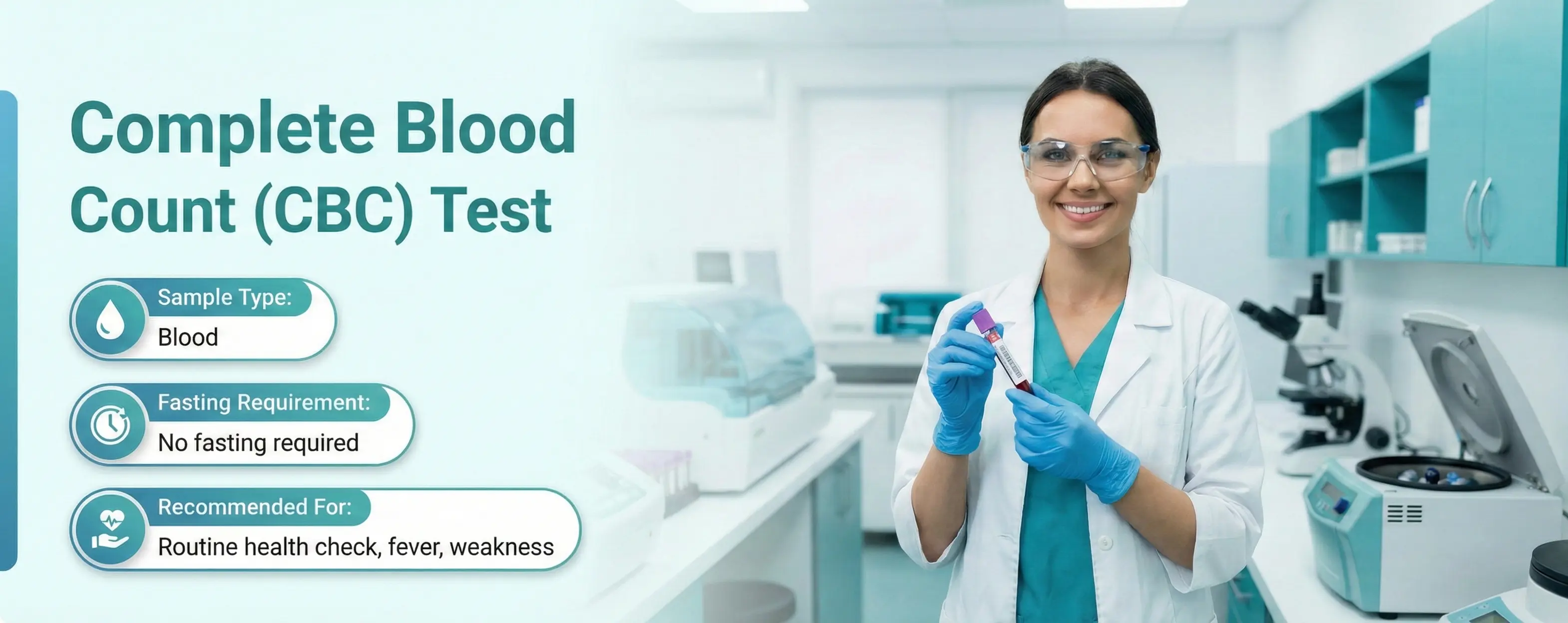
A quick info on CBC Test

Overview
A Complete Blood Count (CBC) test is a routine blood test also known as a complete blood picture, haemogram, or complete blood profile. It checks the size, number, and levels of various blood parameters, such as red blood cells (RBCs), white blood cells (WBCs), haemoglobin, and platelets. It helps detect conditions that can cause variations in these parameters, such as infections, nutritional deficiencies, certain cancers, and clotting disorders. It is often recommended alone or in combination with other tests. A blood sample is needed for this test, and fasting is usually not required.

When and Who Should Get a CBC Test Done?
The CBC test is often used as a part of annual health checkups or diagnostic tests. It is ideal for all age groups. Depending on the purpose, your doctor may recommend this test in the following situations:
- Evaluation of symptoms: Symptoms such as fatigue, sudden weight loss, nausea or vomiting, high fever, bleeding, pale skin, headaches, or fainting may indicate infections or anaemia. A CBC test can help evaluate these symptoms.
- Diagnose illnesses: A CBC test can help diagnose various acute or chronic illnesses alone or in combination with other tests.
- Pre-surgery evaluation: Before surgery or cancer therapy, a CBC test is essential to assess overall health status.
- Monitor health: The CBC test is often used for routine health checks or to monitor the health of those with pre-existing conditions or undergoing treatment.
- Prenatal testing: The CBC test is commonly advised during pregnancy to assess the mother's and baby’s overall health.

What Conditions Can a CBC Test Help Detect?
Variations in blood composition can suggest certain underlying health conditions, such as:
- Anaemia - Abnormal levels of certain parameters, such as haemoglobin, can help detect underlying anaemia.
- Infections - Changes in the white blood cell count may sometimes indicate bacterial or viral infections.
- Blood cancer - Significant changes in blood cell counts may help detect certain blood cancers, such as leukaemia or lymphoma.
- Platelet disorders - Abnormal platelet levels impair normal blood clotting and lead to bleeding or clotting disorders.
- Bone marrow disorders - Since the bone marrow forms blood cells, changes in blood cells can indicate bone marrow dysfunction.
- Autoimmune disorders - CBC can support the assessment of conditions such as arthritis, lupus, and vasculitis.
Disclaimer: The above information is for educational purposes only. Always consult an expert for guidance to better understand the variations in your blood composition.
.png?dim=48x48&q=75)
CBC Test Preparation
What to Expect Before the Test
- Fasting is usually not required before the test.
- Inform your doctor about any supplements and medicines prior to the test.
- Consult your healthcare provider for any special instructions to follow before the test.
What to Expect During the Sample Collection
A blood sample is collected using a routine procedure that takes only a few minutes. The steps involve:
- An elastic band is tied around your upper arm for better access to your veins.
- The area is cleaned with an antiseptic.
- A needle is inserted into a vein in the inner arm to collect the blood sample.
- The needle is withdrawn, and a bandage is placed over the puncture site to help stop any minor bleeding.
What to Expect After the Test
- Blood sample collection is usually safe with minimal to no risks.
- Feeling dizzy for a few seconds is normal and usually improves with a little rest.
- You can return to daily activities on the same day.
Note: If you notice anything unusual at the puncture site, such as persistent bleeding, a rash, or pain, consult your healthcare provider.

What are the Parameters Included in a CBC Test?
The CBC test measures the number, size, and levels of blood cells and related parameters, such as:
Red Blood Cell (RBC) Parameters
- RBC count - Number of red blood cells
- Haemoglobin (Hb) - A protein that carries oxygen
- Haematocrit (Hct/PCV) - Percentage of blood made up of RBCs
- MCV (mean corpuscular volume) - Average size of RBCs
- MCH (mean corpuscular haemoglobin) - Amount of haemoglobin per RBC
- MCHC (mean corpuscular haemoglobin concentration) - Concentration of haemoglobin in RBCs
- RDW (red cell distribution width) - Variation in RBC size
White Blood Cell (WBC) Parameters
- Total WBC count (TLC) - Total number of white blood cells
- Differential count (DLC) - Types of WBCs:
- Neutrophils
- Lymphocytes
- Monocytes
- Eosinophils
- Basophils
Platelet Parameters
- Platelet count (PLT) - Number of platelets
- MPV (mean platelet volume) - Average size of platelets
- PDW (platelet distribution width) - Variation in platelet size
- Plateletcrit (PCT) -Volume occupied by platelets in blood
- Platelet to large cell ratio (PLCR) -Percentage of large platelets among total platelets

Normal Range of CBC Test Parameters
RBC Parameters
|
Parameter |
Normal reference range |
|---|---|
|
RBC |
4.5 - 5.5 x 10⁶/μL |
|
Haemoglobin [Hb] |
|
|
Haematocrit |
40% - 50% |
|
MCV |
83 - 101 fL ( in femtolitre or cubic micrometres (µm3)) |
|
MCH |
27 - 32 pg/RBC (in picograms per cell) |
|
MCHC |
31.5 to 34.5 g/dL |
|
RDW-SD |
39 - 46 fL |
|
RDW-CV |
11.6 - 14% |
WBC Parameters
|
Parameter |
Normal reference range |
|---|---|
|
Total leucocyte count (WBC) |
4.0 - 10.0 x 10³/μL |
|
Neutrophils |
40 - 80% |
|
Lymphocyte percentage |
20 - 40% |
|
Monocytes |
2 - 10% |
|
Eosinophils |
1- 6% |
|
Immature granulocyte percentage (IG%) |
0 - 0.5% |
|
Neutrophils - absolute count |
2.0 - 7.0 x 10³/μL |
|
Lymphocytes - absolute count |
1.0 - 3.0 x 10³/μL |
|
Monocytes - absolute count |
0.2 - 1 x 10³/μL |
|
Basophils - absolute count |
0.02 - 0.1 x 10³/μL |
|
Eosinophils - absolute count |
0.02 - 0.5 x 10³/μL |
Platelet Parameters
|
Parameter |
Normal reference range |
|---|---|
|
Platelet count |
150,000 - 400,000/μL or mm3 |
|
MPV |
6.5 - 12.0 femtolitres (fL) |
|
PDW |
9.6 - 15.2 fL |
|
Platelet to large cell ratio (PLCR) |
19.7 - 42.4% |
|
Plateletcrit (PCT) |
0.19 - 0.39% |
Note: The normal values and reference ranges may vary from lab to lab. Please refer to the ranges mentioned in the report and consult a doctor to understand your lab reports.
.png?dim=48x48&q=75)
CBC Test Result Interpretation
A complete blood profile can reveal a lot about your health, your body’s coping ability to pre-existing conditions, and your response to ongoing treatments. It can also help detect various conditions.
The table below shows the parameters, their levels, and potential association with certain conditions:
|
Parameter |
Level |
Potential interpretation |
|---|---|---|
|
Total RBC count |
High |
Dehydration, heavy smoking, sleep apnoea, chronic lung disease, renal tumours, or living at a high altitude. |
|
Low |
Anaemia, chronic kidney disease, RBC destruction, bone marrow disorders or damage, chronic inflammatory disease, internal bleeding, or nutritional deficiencies. |
|
|
Haemoglobin (Hb) |
High |
Polycythaemia vera, heart failure, or living at high altitudes. |
|
Low |
Iron deficiency, pregnancy, or heavy menstrual bleeding. |
|
|
Haematocrit (PCV) |
High |
Severe burns, shock, or extreme dehydration. |
|
Low |
Overhydration, bone marrow failure, or nutritional deficiency. |
|
|
MCV |
High |
Vitamin B12 deficiency, folate deficiency, liver disease, hypothyroidism, or alcoholism. |
|
Low |
Thalassaemia, iron deficiency, or chronic lead poisoning. |
|
|
MCH |
High |
Macrocytic anaemia or overactive thyroid. |
|
Low |
Microcytic anaemia or copper deficiency. |
|
|
MCHC |
High |
Hereditary spherocytosis or autoimmune red cell breakdown. |
|
Low |
Sideroblastic anaemia, chronic inflammation, or iron deficiency anaemia. |
|
|
RDW |
High |
Mixed nutritional deficiencies (e.g., Iron and B12 together). |
|
Low |
Usually normal; cells are of very uniform size. |
|
|
Total WBC count |
High |
Viral or bacterial infections, tissue injury, intense physical stress, inflammation, leukaemia, myeloproliferative neoplasm, allergies, or asthma. |
|
Low |
Viral infections (HIV/AIDS, hepatitis), sepsis, bone marrow disorders, autoimmune conditions, lymphoma, dietary deficiencies, or the use of certain medications. |
|
|
Neutrophils |
High |
Acute bacterial infection, gout, inflammation, rheumatoid arthritis, trauma, heart attack, burns, stress, rigorous exercise, certain leukaemias, Cushing syndrome, or usage of steroids. |
|
Low |
B12 deficiency, sepsis, severe infections, especially viral, autoimmune disorders, bone marrow damage (chemotherapy, radiation therapy), or congenital neutropenia. |
|
|
Lymphocytes |
High |
Acute viral infections (chickenpox, CMV, EBV, herpes, rubella), whooping cough, TB, toxoplasmosis, ulcerative colitis, or lymphoproliferative disorders (CLL, lymphoma). |
|
Low |
Recent steroid treatment, malnutrition, radiation, autoimmune disorders, HIV, viral hepatitis, typhoid, influenza, COVID-19, or bone marrow suppression. |
|
|
Monocytes |
High |
Tuberculosis, fungal infection, malaria, bacterial endocarditis, collagen vascular diseases (lupus, rheumatoid arthritis), or monocytic leukaemia. |
|
Low |
Hairy cell leukaemia, severe bone marrow stress or damage, aplastic anaemia, or chemotherapy. |
|
|
Eosinophils |
High |
Asthma, hay fever, drug reactions, skin allergies, parasitic infections, coeliac disease, inflammatory bowel disease, some cancers, or connective tissue disorders. |
|
Low |
Acute stress or use of corticosteroid medicines. |
|
|
Basophils |
High |
Chronic inflammation (ulcerative colitis, rheumatoid arthritis), rare blood disorders, rare allergic reactions, certain leukaemias, or uraemia. |
|
Low |
Severe allergic reactions (anaphylaxis) or hyperthyroidism. |
|
|
Platelet count |
High |
After surgery, iron deficiency, cancers (lung, gut, breast, ovarian), lymphoma, rheumatoid arthritis, or chronic inflammation. |
|
Low |
Dengue, malaria, liver cirrhosis, vitamin B12 deficiency, sepsis, leukaemia, lymphoma, myelodysplasia, ITP, measles, hepatitis, or chemotherapy. |
|
|
MPV |
High |
Diabetes, heart disease, or early recovery from blood loss. |
|
Low |
Aplastic anaemia or certain cytotoxic drugs. |
|
|
PDW |
High |
Sickle cell disease or active platelet destruction. |
|
Low |
Normal indicates platelets are very similar in size. |
Disclaimer: This table shows the potential association of blood parameter levels with the above conditions and is for educational purposes only. Always consult an expert for a better interpretation of your test results.


Areas We Serve in Bengaluru
You can book CBC Test in Bengaluru through PharmEasy with convenient home sample collection across several localities, including :
- Indiranagar
- Koramangala
- HSR Layout
- Whitefield
- Marathahalli
- Electronic City
- Jayanagar
- JP Nagar
- Banashankari
- BTM Layout
- Yelahanka
- Hebbal
- Malleshwaram
- Rajajinagar
- Basavanagudi
- Bellandur
- Mahadevapura
- KR Puram
- Kalyan Nagar
- Richmond Town
You can also check service availability during purchase by entering your pincode.

CBC Test Sample Collection: Home vs. Diagnostic Lab
Check the table below to know more about the home sample collection service offered by PharmEasy Labs compared with other diagnostic labs.
|
Feature |
Home collection (PharmEasy) |
Traditional diagnostic lab |
|---|---|---|
|
Convenience |
High - sample collected from your home or office. |
Low - requires travelling and waiting in queues. |
|
Time saving |
Maximum - no travel time. You choose the time slot. |
Minimum - depends on traffic and lab wait time. |
|
Safety & comfort |
Safe - helps avoid exposure to other sick patients. |
Moderate - exposure to crowded waiting areas. |
|
Process |
A professional phlebotomist visits you. |
You must visit the facility during its hours. |
|
Report access |
Digital - reports are sent directly to your app or email. |
Often requires a second visit for physical copies. |
Was This Test Information Helpful?
Please rate your experience
 Yes Helpful (109)
 Not Helpful
References
Health packages containing 'CBC Test'
 For full-body wellness, go for a comprehensive checkup
People Also Ask
Why is the CBC test a part of my annual health checkup?
What is the price of the CBC test in Bengaluru?
Can I book a CBC test online in Bengaluru?
What type of sample is required for the CBC test?
Is home sample collection available in Bengaluru for the CBC test?
Is fasting required before the CBC test?
How long does it take to get my CBC test reports in Bengaluru?
Popular Tests in Bengaluru
 Explore the most booked tests in your location
 4.6 Stars| 7+ Lakhs Ratings & Reviews

Over 10 million happy users PharmEasy Labs
- Swasth AI feature was really good, it explained the lab report in very easy and understanding manner
 Vivek Sinha29 Oct ‘25
 - Liked the coupon discount and cheaper price, without any quality compromise.Ishita Chatterjee30 Nov ‘25
- Labs open early but still get crowded. Home testing saved me that early morning stress and I was way more relaxed.Neha Kapoor09 Sep ‘25
- if I had to go to the lab, I would’ve skipped my breakfast and rushed. Home testing happened calmly at home.Arjun Verma03 Dec ‘25
- going to the lab means hunting for parking first. With home sample pick-up I didn’t have to deal with that headache at all.Kavya Iyer25 Nov ‘25
- During weekends, in Mumbai the labs are full. Home testing helped me avoid all that chaos, and I could continue my work from home in between.Rohan Sharma07 Oct ‘25
Have any doubts? Ask us.
Ask us anything about the CBC Test in Bengaluru - Price & Details to understand it better

View top questions
( Total 1 Questions asked)Do I need to fast before a CBC test?
No, fasting is usually not required for a CBC test. You can eat and drink normally unless your doctor has advised additional blood tests along with the CBC that require fasting.Harsh Raj23 Dec ‘25
Nearby Labs
Lab tests made easy!
- Quick Collection
- Trusted Accuracy
- Hassle-free Services
PharmEasy Labs (Covid RTPCR) - Bengaluru
D-37/1, MIDC, Turbhe, Opp. Sandoz,, Maharashtra
 grievance-officer@docon.in
 7022000900
PharmEasy Labs (Thyrocare powered) - Bengaluru
Kailash Heights, C.T.S No.636, Wing ‘A’, Karnataka
grievance-officer@docon.in7022000900
Agilus Diagnostics Limited - Bengaluru
Agilus Diagnostics, Sri Narayani Arcade, 1St Floor, Above Bata Showroom, Near Hyper City, Brooke Field Main Road,, Karnataka
grievance-officer@docon.in7022000900
Medall Healthcare pvt ltd - Bengaluru
Sri Lakshmi Towers, 68/150/3, 9th Main Rd, Jaya Nagar 1st Block, Jayanagar 3rd Block East, Karnataka
grievance-officer@docon.in7022000900Medall Healthcare pvt ltd - Bengaluru
Krishna Quoin, 80 Feet Road, HAL 3rd Stage, New Tippasandra, opp. Veer Hanuman Temple, Karnataka
grievance-officer@docon.in7022000900Medall Healthcare pvt ltd - Bengaluru
D.No66 2nd Main Rd, Sankey Cross Road, Opp Sangam Petrol Pump, Vyalikaval, Karnataka
grievance-officer@docon.in7022000900Aarthi Scans and Labs - Bengaluru
156, 9th Main Rd, Jaya Nagar 1st Block, Jayanagar 3rd Block, Jayanagar,, Karnataka
grievance-officer@docon.in7022000900Aarthi Scans and Labs - Bengaluru
499, Chinmaya Mission Hospital Rd, Indira Nagar 1st Stage, Stage 1, Indiranagar,, Karnataka
grievance-officer@docon.in7022000900Agilus Diagnostics Limited - Bengaluru
NO.49/2 , Nittoor Square , Kariyappa Road Opp. Balaji Medicals, Basavanagudi Landmark – After Surana college, , Nittur circle, Opp. Philips lighting, Karnataka
grievance-officer@docon.in7022000900Prima Diagnostics - Bengaluru
4/16, 9th Main, 3rd Block, Opp to Jos Alukkas & Next to Jain University, Jayanagar, Bairasandra Extension,, Karnataka
grievance-officer@docon.in7022000900Prima Diagnostics - Bengaluru
#28/4, Siddapura Village, Varthur - Whitefield main road, Karnataka
grievance-officer@docon.in7022000900Prima Diagnostics - Bengaluru
93, 1st A Main Rd, Sector A, Yelahanka Satellite Town, Yelahanka,, Karnataka
grievance-officer@docon.in7022000900Aarthi Scans and Labs - Bengaluru
New No 141, Old No 1022, 20th Main, Ward No 22 Sriram Mandira, Chord Rd, 5th Block, Jedara Halli, Rajajinagar,, Karnataka
grievance-officer@docon.in7022000900Vasavi Hospital - Bengaluru
#15, 1st Stage, Opp. to 15E Bus Stop, 70th Cross Rd, Kumaraswamy Layout,, Karnataka
grievance-officer@docon.in7022000900Prima Diagnostics - Bengaluru
828, Jawaharlal Nehru Road, 3rd Stage, BEML Layout, Rajarajeshwari Nagar,, Karnataka
grievance-officer@docon.in7022000900Prima Diagnostics - Bengaluru
97, Champaka, Doddakallasandra Village, Kanakapura Rd, Munireddy Layout, Uttarahalli Hobli,, Karnataka
grievance-officer@docon.in7022000900Aarthi Scans and Labs - Bengaluru
17, Subramanya Pura Rd, Radha Krishna Layout 1st Stage, Padmanabhanagar, Karnataka
grievance-officer@docon.in7022000900Neuberg Diagnostics - AHC - Bengaluru
Aanand Tower, 54, Bowring Hospital Rd, Shivaji Nagar, Bengaluru, Karnataka 560001, Karnataka
grievance-officer@docon.in7022000900Parkmed Hospital - Bengaluru
Ecospace, Pritech Foodcourt, Pritech Park, SEZ, Outer Ring Rd, Bellandur,, Karnataka
grievance-officer@docon.in7022000900Ecotown Diagnostics Pvt.ltd - Bengaluru
NO 7,1st Floor, AVR Arcade Yaranpalya Bus Stop, Diagonally, Ramamurthi Nagar Main Rd, opp. to Shell Petrol Bunk,, Karnataka
grievance-officer@docon.in7022000900Suraj Diagnostics & Health care centre - Bengaluru
98 & 99, Sandeep Unnikrishnan Main Road M S Palya, Vidyaranyapura,, Karnataka
grievance-officer@docon.in7022000900Aarthi Scans and Labs - Bengaluru
Bus depot, 897/F, 80 Feet Rd, near Koramangala, National Games Village Complex, 6th Block, Koramangala,, Karnataka
grievance-officer@docon.in7022000900Vikram Hitech Diagnostics - Bengaluru
First floor, 37/28, Hosur Rd, above DC Car Show Room, Singasandra,, Karnataka
grievance-officer@docon.in7022000900Apoorva Healthcare - Bengaluru
& 2, 1st Floor, 325, Chinmaya Mission Hospital Rd, near Metro Station, Indiranagar,, Karnataka
grievance-officer@docon.in7022000900United Hospitals - AHC - Bengaluru
No.30, Madhavan Park Circle, 10th Main Rd, Jayanagar 3rd Block,, Karnataka
grievance-officer@docon.in7022000900Apoorva Healthcare - Bengaluru
Indian Express, 1 and , 4th Floor,, Queens Rd,, Karnataka
grievance-officer@docon.in7022000900Tenet Diagnostics - Bengaluru
40/43, 8th Main Road 5th Cross Rd, Raj Mahal Vilas Extension, Sadashiva Nagar, Armane Nagar,, Karnataka
grievance-officer@docon.in7022000900Tenet Diagnostics - Bengaluru
643, 11th Main Rd, 7th Cross, HAL 2nd Stage, Indiranagar,, Karnataka
grievance-officer@docon.in7022000900Aarthi Scans and Labs - Bengaluru
Sri Raghavendra Layout, Silver Springs Layout Rd Munnekolala, Varthur, Hobli, Marathahalli,, Karnataka
grievance-officer@docon.in7022000900Plus Alpha Diagnostic - AHC - Bengaluru
Raj Towers, 125, MM Road, opposite Rahhams Hotel, Pulikeshi Nagar,, Karnataka
grievance-officer@docon.in7022000900Aarthi Scans and Labs - Bengaluru
581 Lakshmi Nivasam,5th main road, Bellary Rd,, Karnataka
grievance-officer@docon.in7022000900Aarthi Scans and Labs - Bengaluru
XG59+F9, Nagarabhavi Main Rd, 2nd Block, Manasanagar, Chalukya Nagar, Naagarabhaavi, Karnataka
grievance-officer@docon.in7022000900Isha Diagnostics Pvt Ltd - Bengaluru
311, Isha Diagnostics Between 15Th And 16 Th Cross Sampige Main Road Malleswaram, Opp. To Axis Bank And Tanishq Jewellery,, Karnataka
grievance-officer@docon.in7022000900Elbit Medical Diagnostics - Bengaluru
137/138, Infantry Rd, Shivaji Nagar, Karnataka
grievance-officer@docon.in7022000900Neuberg Diagnostics - AHC - Bengaluru
No.53, Ground floor, 16th Main, 4th T Block East, Pattabhirama Nagar, Jayanagar, Karnataka
grievance-officer@docon.in7022000900My Health Diagnostics - Gubbalala - Bengaluru
VGVQ+F9V. 35, Swami Vivekananda Road, HA Muniraju Layout Rd, Gubbalala, Karnataka
grievance-officer@docon.in7022000900Aarthi Scans and Labs - Bengaluru
XG59+F9, Nagarabhavi Main Rd, 2nd Block, Manasanagar, Chalukya Nagar, Naagarabhaavi, Karnataka
grievance-officer@docon.in7022000900Aarthi Scans and Labs - Bengaluru
2JHJ+MPC, HBR Layout 4th Block, HBR Layout, Karnataka
grievance-officer@docon.in7022000900Konnect Diagnostic Center - Bengaluru
Pillanna Complex, 2nd Cross Rd, Dodsworth Layout, Whitefield,, Karnataka
grievance-officer@docon.in7022000900Medicover Hospitals - AHC - Bengaluru
351 ITPL Main Road, Whitefield Road, ITPL Main Road, HOODI VILLAGE, KRISHNARAJAPURA HOBLI, HOODI VILLAGE, KRISHNARAJAPURA HOBLI, Hoodi, Bengaluru 560048, Karnataka
grievance-officer@docon.in7022000900Aadya Labs - Bengaluru
dhanvantari 2B 80 ft road KHB colony, 2, stage Basaveshwarnagar, Karnataka
grievance-officer@docon.in7022000900Health Buddy Diagnostic Pvt Ltd - Bengaluru
No 4, Nagarbhavi, Main Road, Prashanth Nagar Beside Shoper City,Bangalore , Next to Dominios, Karnataka
grievance-officer@docon.in7022000900Health Buddy Diagnostic Pvt Ltd - Bengaluru
No. 5,3rd Floor Rajapalya Hoodi, Mahadevapura Post,Opp. To Pursuit of Radical Rhapsody Apartment, Mahadevpura Bangalore - 560048, Near Bus Stop, Karnataka
grievance-officer@docon.in7022000900Famphy Clinics - Bengaluru
Lower ground floor, Bhartiya Mall of Bengaluru, Bhartiya City, Kannuru,, Karnataka
grievance-officer@docon.in7022000900Cadabam’s Diagnostics Centre - Bengaluru
No. 1/A, Bhavani HBCS, near Devegowda petrol Bunk, 1st Block, Banashankari 3rd Stage,, Karnataka
grievance-officer@docon.in7022000900Cadabam’s Diagnostics Centre - Bengaluru
No. 7/2, 14th Cross Rd, 2nd Block, Jaya Nagar East, Jayanagar,, Karnataka
grievance-officer@docon.in7022000900Docube Healthcare Private Limited - Bengaluru
Docube Healthcare, Second Floor, KEERTHI SURYA SHAKTI TOWERS, Circle, ITPL Main Rd, near Hoodi,, Karnataka
grievance-officer@docon.in7022000900Docube Healthcare Private Limited - Bengaluru
365 1st floor, Sulochana Building, 1st Cross Road, 3rd Block, Santhosapuram, Koramangala 3 Block, Karnataka
grievance-officer@docon.in7022000900Docube Healthcare Private Limited - Bengaluru
1st Floor, #15, Bannerghatta Rd, Sarakki Industrial Layout, 3rd Phase, Karnataka
grievance-officer@docon.in7022000900Ecotown Diagnostics Pvt.ltd - Bengaluru
#608, 5th A Cross Rd, opposite Royal Concorde International, HRBR Layout 2nd Block, HRBR Layout, Kalyan Nagar,, Karnataka
grievance-officer@docon.in7022000900QXL Diagnostics - Bengaluru
SLN Complex, Mysore Rd, Fort Kengeri, Kengeri,, Karnataka
grievance-officer@docon.in7022000900Care Diagnostics - Bangalore - Bengaluru
3rd Cross Road, opposite to ICICI Bank, Neeladri Nagar, Electronics City Phase 1, Electronic City,, Karnataka
grievance-officer@docon.in7022000900GOPRIME TECH-HEALTH PRIVATE LIMITED - Bengaluru
GROUND, VILA NO-58, DONATA COUNTY, 1st main Hesaraghatta main road, NEAR SAMBHRAM COLLEGE, Vidyaranyapura Post, vaderhalli, Bengaluru, Karnataka
grievance-officer@docon.in7022000900Commvault - AI Screening - Bengaluru
9th Floor, Quay Building, Bagmane tech park, 186-22-49, 8th B Cross Rd, Bhuvaneswari Nagar, Karnataka
grievance-officer@docon.in7022000900PGK Healthcare Services Pvt Ltd - Bengaluru
TRIAN DIAGNOSTICS (Brand Name, 198, 12th Main Rd, above Namma MTR, next to SBI, 3rd Block, Rajajinagar,, Karnataka
grievance-officer@docon.in7022000900Sun Diagnostics Centre - Jayanagar - Bengaluru
36/9, 1st floor, 11th Main Rd, above dominos, 4th Block, 5th Block, Jayanagar,, Karnataka
grievance-officer@docon.in7022000900Prima Diagnostics - Bengaluru
WARD NO 65, BBMP Khata:, 802, 65-94-802, 7th Cross Rd, BTM 2nd Stage, BTM Layout,, Karnataka
grievance-officer@docon.in7022000900Nest Diagnostics - Bengaluru
21/8, Siddanna Layout, Konanakunte,, Karnataka
grievance-officer@docon.in7022000900Plus Alpha Diagnostic - AHC - Bengaluru
building 3rd floor 302, Krishna Summit, 18, Outer Ring Rd, Aswath Nagar, Marathahalli,, Karnataka
grievance-officer@docon.in7022000900Docube Healthcare Private Limited - Bengaluru
survey number 25, SGR -3, Docube Healthcare 2nd Floor, 1A4, Sarjapur Main Rd, Janatha Colony,, Karnataka
grievance-officer@docon.in7022000900Tenet Diagnostics - Bengaluru
Spice Garden Compact, SI, S2, Varthur Main Rd, Spice Garden Layout, Lakshminarayana Pura, Silver Springs Layout, Marathahalli,, Karnataka
grievance-officer@docon.in7022000900Tenet Diagnostics - Bengaluru
Ward No.78, Ground Floor, 3/1, PID No.91, 91, Wheeler Rd, Frazer Town,, Karnataka
grievance-officer@docon.in7022000900Neuberg Diagnostics - AHC - Bengaluru
Address: Anand Diagnostic Laboratory No.141,Sri Shanthi Towers, 3rd Main,East of NGEF Layout, Bangalore-560043., Karnataka
grievance-officer@docon.in7022000900Neuberg Diagnostics - AHC - Bengaluru
Address: Anand Diagnostic Laboratory No.2/A,Venkataswamappa Layout, Near Nanjappa Circle, Vidhyaranyapura, Bangalore 560097., Karnataka
grievance-officer@docon.in7022000900Neuberg Diagnostics - AHC - Bengaluru
Anand Diagnostic Laboratory, NO:1003 9th Main, HSR layout, 7th Sector, Bangalore - 560102, Karnataka
grievance-officer@docon.in7022000900Neuberg Diagnostics - AHC - Bengaluru
Parvathipuram, Nagercoil, K.K. District 629003, Karnataka
grievance-officer@docon.in7022000900Neuberg Diagnostics - AHC - Bengaluru
Ground Floor, Unit -8, Neelkanth Corporate Park, Neuberg Oncopath lab, Ramdev Pir Rd, Vidyavihar West, Vidyavihar, Mumbai, Maharashtra 400086, Karnataka
grievance-officer@docon.in7022000900Neuberg Diagnostics - AHC - Bengaluru
Address: 52/A, 17th Main,4th Block, 100Ft Road,Koramangla, Bangalore, Karnataka
grievance-officer@docon.in7022000900Neuberg Diagnostics - AHC - Bengaluru
Address:Anand Diagnostic Laboratory Balu Arcade,No.15, 8th main road, 19th cross,CHBS Layout, Vijayanagar, Bangalore 560040., Karnataka
grievance-officer@docon.in7022000900Neuberg Diagnostics - AHC - Bengaluru
Address: No. 277, Ground Floor MICO Employee's HBCS Layout, Bengaluru, Karnataka 560076, Karnataka
grievance-officer@docon.in7022000900Neuberg Diagnostics - AHC - Bengaluru
Address: Anand Diagnostic Laboratory Address: No.71, Ground Floor, 4th Cross, 14th Block, Nagarbhavi II stage, Bangalore 560072., Karnataka
grievance-officer@docon.in7022000900Neuberg Diagnostics - AHC - Bengaluru
Address: Anand diagnostic Laboratory New #33, Ground Floor, 10th Cross (CBI Main Road), Opp. M.K.Ahmed Store, Ganganagar North (), Bangalore 560032, Karnataka
grievance-officer@docon.in7022000900Neuberg Diagnostics - AHC - Bengaluru
Address: Anand diagnostic Laboratory #453, 1st Stage, 3rd Block, HBR Layout, Bangalore 560043, Karnataka
grievance-officer@docon.in7022000900Neuberg Diagnostics - AHC - Bengaluru
Address: ANAND DIAGNOSTIC LABORATORY, Ground Floor, No.1118, 8th Main Road,Kengeri Satellite Town, Bangalore - 560060, Karnataka
grievance-officer@docon.in7022000900Neuberg Diagnostics - AHC - Bengaluru
Address:Anand Diagnostic Laboratory No.476,SHASHWATHA 1st Floor, HAL 3rd Stage,10th Main, Jeevan Bheema Nagar Main Road, Indiranagar,Near Bsnl Office, Bangalore 560075., Karnataka
grievance-officer@docon.in7022000900Neuberg Diagnostics - AHC - Bengaluru
Address: ANAND DIAGNOSTIC LABORATORY, No.2403/1, Ground Floor,E Block, SahakarNagar, Bangalore - 560092, Karnataka
grievance-officer@docon.in7022000900Neuberg Diagnostics - AHC - Bengaluru
Anand Diagnostic laboratory, No.252/1, Shop No: 5, 3Rd Main Road, GMR layout, D. Rajagopal Road, Sanjaynagar, bangalore - 560094, Karnataka
grievance-officer@docon.in7022000900Neuberg Diagnostics - AHC - Bengaluru
No 29, Vijayashri Layout, Syndicate Bank Colony, Omkar Nagar,Near Hulimavu gate, Bannerghatta Main Road, Bangalore - 560076, Karnataka
grievance-officer@docon.in7022000900Neuberg Diagnostics - AHC - Bengaluru
Address: ANAND DIAGNOSTIC LABORATORY, #52,80 Feet Ring Road,KHBColony, Basaveshwaranagar, Banglore-560079, Karnataka
grievance-officer@docon.in7022000900Prima Diagnostics - Bengaluru
403, Tradex-1, Near Alpha-1 Metro Station, Greater Noida, Karnataka
grievance-officer@docon.in7022000900DocNetz Diagnostics - Bengaluru
road 168, Garia Main Rd, Nazrul Pally, Mahamaya Tala, Garia, Rajpur, Karnataka
grievance-officer@docon.in7022000900Unique Healthcare - AHC - Bengaluru
125-126, La cetadel complex Near CNG gas pump Parvat patiya, Magob,, Karnataka
grievance-officer@docon.in7022000900Unique Healthcare - AHC - Bengaluru
No 2477, 1st Floor, 15th Cross, next to Mychicken, D Block Sahakaranagr, Sahakar Nagar,, Karnataka
grievance-officer@docon.in7022000900DoCube Healthcare - Bengaluru
1/N-10, Arunadoyo Market, Arunadoyo Nagar, Karnataka
grievance-officer@docon.in7022000900DoCube Healthcare - Bengaluru
Address: F6 Astha Bunglow Near Sola Overbridge Science City Road Ahmedabad Gujarat 380060, Karnataka
grievance-officer@docon.in7022000900DoCube Healthcare - Bengaluru
2nd floor, Sulochana Building, 365, 1st Cross Rd, 3rd Block, Santhosapuram, Koramangala 3 Block, Koramangala, Karnataka
grievance-officer@docon.in7022000900DoCube Healthcare - Bengaluru
Docube Healthcare, Second Floor, KEERTHI SURYA SHAKTI TOWERS, Circle, ITPL Main Rd, near Hoodi, Whitefield, Karnataka
grievance-officer@docon.in7022000900Famphy Clinics - Bengaluru
1st Floor, 15, Bannerghatta Rd, Sarakki Industrial Layout, 3rd Phase, J. P. Nagar, Karnataka
grievance-officer@docon.in7022000900Rubits Healthcare - Bengaluru
Govind Puram Colony, behind collector office, Burhanpur, Karnataka
grievance-officer@docon.in7022000900Rubits Healthcare - Bengaluru
A-19, Maharishi College Rd, Saheed Nagar, Karnataka
grievance-officer@docon.in7022000900HealthRoute - Bengaluru
B- 14, VIDHYADHAR ENCLAVE -2, VIDHYADHAR NAGAR,NEAR CINE STAR PICTURE HALL, PNB BANK, CENTRAL SPINE, Karnataka
grievance-officer@docon.in7022000900Medall Healthcare pvt ltd - Bengaluru
Shop No 10,Road No G3, Rajendra Nagar, Karnataka
grievance-officer@docon.in7022000900HealthRoute - Bengaluru
C3, Nirmal Nagri, Nr. Shital Mata Mandir, Umred Road,, Karnataka
grievance-officer@docon.in7022000900HealthRoute - Bengaluru
A/101, Madhumangal Building, Next To Chitamani Mandir, Above Hdfc Bank, Virar (E), Karnataka
grievance-officer@docon.in7022000900Docube Healthcare Private Limited - Bengaluru
208, Ashoka Enclave Main Rd, Ashoka Enclave, Ashoka Enclave 1, Karnataka
grievance-officer@docon.in7022000900DoCube Healthcare - Bengaluru
170A, 170B, D-170, D Block, Karnataka
grievance-officer@docon.in7022000900Explore More at PharmEasy
Top-Selling Healthcare Products

We provide trusted, expert-curated health content to support better awareness,prevention, and care.
Backed by experienced doctors, medical experts, and strict editorial standards.