

48+ orders placed in your location

100% NABL & ISO Certified Lab • 100% Accurate Reports
Troponin I Rapid Test
Trop-I Rapid, cTnI Rapid
- SummaryThe Troponin I Rapid Test is a qualitative test which detects troponin I in blood and indicates a heart attack or if the muscles of your heart are under strain. The Troponin I Rapid test is done by taking a blood sample from the vein in your arm, fasting is not required for this test. Read more
- Reports Within23 HrsView Sample Report

 100% NABL & ISO Certified Labs
 - SampleBlood

- AgeAll Age Group
- GenderMale and Female
- FastingNot Required

PharmEasy Promises



Know More About The Test


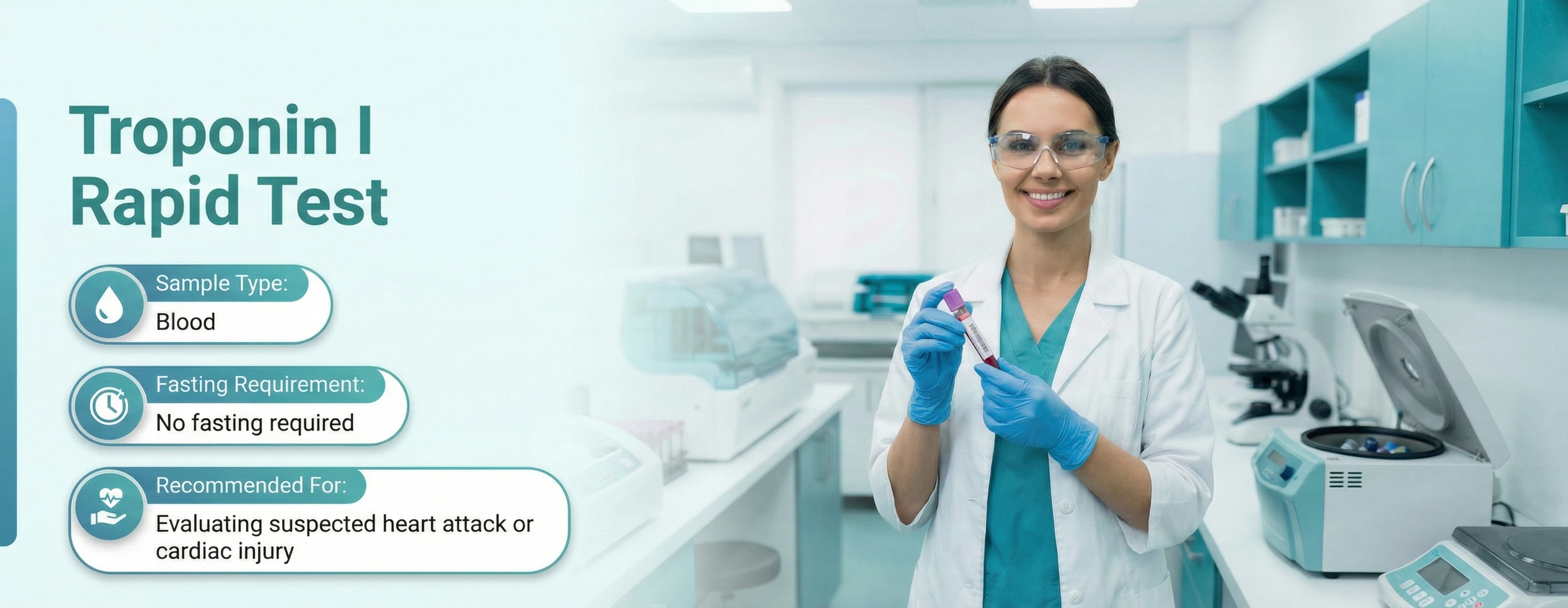
A quick info on Troponin I Rapid test

Overview
The Troponin test measures the level of troponin proteins, specifically troponin I (cTnI) or troponin T (cTnT), in your blood. Cardiac troponins are structural proteins inside heart muscle cells that play a critical role in muscle contraction. Under normal conditions, only trace amounts circulate in the blood. When heart muscle cells are damaged during a heart attack, these proteins are released into the bloodstream in large quantities, making the Troponin test the most sensitive and specific blood marker available for diagnosing heart muscle damage.
Doctors order a Troponin test as the first-line emergency blood test when a heart attack or acute coronary syndrome (ACS) is suspected. Unlike older cardiac markers (CK-MB and LDH), troponin is almost exclusively found in heart muscle cells, making it far more specific for cardiac injury. Modern high-sensitivity assays detect damage within 1 to 2 hours of symptom onset, enabling faster life-saving treatment decisions.
The Troponin test monitors heart muscle cell integrity. It is the cornerstone of emergency evaluation for acute coronary syndrome, which includes unstable angina, NSTEMI, and STEMI. No fasting is required for this test. Serial testing at 3 to 6 hour intervals is performed to track troponin trends over time.

When and Who Should Get a Troponin I Rapid Test Done?
A Troponin test is an emergency test ordered in acute clinical situations, not a routine screening test. It is performed whenever there is clinical suspicion of heart muscle injury.
This test is usually recommended for:
- Anyone with chest pain, tightness, pressure, or a squeezing sensation - the most classic heart attack symptom.
- Anyone with pain radiating to the left arm, jaw, neck, back, or upper abdomen, alongside chest discomfort.
- Anyone with sudden shortness of breath, cold sweats, nausea, or severe unexplained fatigue - particularly in women, who often present with atypical symptoms.
- Patients presenting to an emergency department with suspected acute coronary syndrome (ACS).
- Patients with known heart disease, previous heart attacks, or bypass surgery who develop new or worsening symptoms.
- Individuals with severe heart failure, pulmonary embolism, or severe sepsis - where troponin guides prognosis.
- After cardiac procedures such as angioplasty, ablation, or cardiac surgery - to detect procedure-related cardiac injury.
.png?dim=48x48&q=75)
How Frequently Should You Take the Troponin I Rapid Test?
The Troponin test is not a routine screening test. Its use is governed entirely by the clinical situation. In an emergency, it is repeated at specific intervals to track the troponin trend, as a single reading is not always sufficient for diagnosis.
|
Health Scenario |
Context |
Recommended Frequency |
|---|---|---|
|
Suspected Heart Attack (Emergency) |
Patient with chest pain or ACS symptoms. |
At presentation (Time 0), then at 3 to 6 hours. |
|
Monitoring After Heart Attack |
During hospitalisation post-confirmed MI. |
Every 6 to 12 hours for the first 24 hours, then as directed by the cardiologist. |
|
Post-Cardiac Procedure |
After angioplasty, stenting, or bypass surgery. |
24 to 48 hours post-procedure to assess for procedure-related cardiac injury. |
|
Severe Heart Failure |
Hospitalised heart failure patients. |
Once on admission; repeated if clinical deterioration occurs. |
|
Sepsis or Critical Illness |
ICU settings with suspected cardiac involvement. |
On admission and as directed by the treating intensivist. |

What Conditions Can a Troponin I Rapid Test Help Detect?
The Troponin test is the gold standard for diagnosing heart muscle damage. Beyond heart attacks, elevated troponin can indicate several other serious conditions:
- Acute myocardial infarction (heart attack) - Troponin rises within 3 to 6 hours, peaks at 12 to 24 hours, and remains elevated for 7 to 14 days, providing a diagnostic window even in late-presenting patients.
- NSTEMI (Non-ST Elevation MI) - A heart attack where the ECG does not show classic ST elevation, but troponin is clearly elevated. The Troponin test is the key diagnostic tool, as an ECG alone can miss it.
- Unstable angina - In true unstable angina, troponin is normal or only minimally elevated, distinguishing it from NSTEMI.
- Myocarditis - Inflammation of the heart muscle (including from COVID-19). Troponin rises as inflamed heart cells are destroyed.
- Pulmonary embolism (PE) - A blood clot in the lungs causes right ventricular strain and troponin elevation, indicating a higher-risk presentation.
- Acute heart failure - Severe decompensated heart failure can elevate troponin from chronic heart muscle stress.
- Takotsubo cardiomyopathy (Stress Cardiomyopathy) - Triggered by extreme emotional stress, causing temporary left ventricular ballooning with troponin elevation mimicking a heart attack.
- Cardiac contusion - Blunt chest trauma, such as from a car accident, can bruise the heart muscle and elevate troponin.
Important Note: Elevated troponin always requires urgent medical evaluation. All causes involve significant cardiac or systemic stress requiring immediate clinical assessment.
.png?dim=48x48&q=75)
Troponin I Rapid Test Preparation
What to Expect Before the Troponin Test
No fasting is required. You can eat, drink, and take your regular medications. Inform your doctor about: all current medications, especially heart medications, blood thinners, and blood pressure drugs; history of kidney disease, CKD can cause chronically mildly elevated troponin unrelated to a heart attack; the exact time since chest pain or symptoms began; and any recent strenuous exercise or physical trauma, which can mildly elevate troponin without a cardiac event.
It is important to inform about biotin supplements, as biotin may cause a false decrease in troponin I levels.
What to Expect During the Blood Collection
A phlebotomist cleans the skin with an antiseptic, then places an elastic band around your upper arm to make the veins easier to access. A small needle is inserted into the vein; you may feel a brief pinch. Blood is collected into a labelled tube in under a minute. In emergencies, this is done simultaneously alongside ECG and clinical assessment.
What to Expect After the Troponin Test
A small cotton swab and bandage are placed over the site. You can continue normal activities if this is a planned test. In a cardiac emergency, do not leave the hospital while awaiting results. Inform the doctor immediately if symptoms worsen.

What are the Parameters Included in a Troponin I Rapid Test?
- Troponin I (cTnI) - Qualitative Result: Reported as positive (detected) or negative (not detected) in the rapid test format. Troponin I is found almost exclusively in heart muscle cells, its detection confirms cardiac muscle damage.

Normal Range of Troponin I Rapid Test Parameters
The Troponin Rapid test reports a qualitative result. The table below shows standard reference values used in clinical practice.
|
Test Type |
Normal Result |
Positive / Significant Result |
|---|---|---|
|
Troponin I Rapid Test (Qualitative) |
Negative / Not Detected |
Positive / Detected - any detectable troponin is clinically significant. |
Important Note: Any detectable troponin in the context of chest pain must be evaluated urgently. Normal ranges vary between assay platforms and laboratories. Always have your result interpreted by the treating physician alongside your clinical presentation and ECG findings
.png?dim=48x48&q=75)
Troponin I Rapid Test Result Interpretation
The troponin result must never be interpreted in isolation. It must always be assessed alongside symptoms, time elapsed since onset, ECG findings, and the serial troponin trend.
|
Result Scenario |
Troponin Finding |
Clinical Interpretation and Action |
|---|---|---|
|
Negative at 0 hours - Low Probability |
Not detected or very low |
Acute MI is unlikely. Repeat at 2 to 3 hours if symptoms are recent. |
|
Negative at 0 hours - Early Presentation |
Not detected; symptoms began less than 2 hours ago |
Troponin may not yet have risen. Repeat at 3 to 6 hours is mandatory before ruling out MI. |
|
Positive Rapid Test (Symptomatic Patient) |
Detected - Positive |
Strong evidence of heart muscle damage. Treat as acute coronary syndrome until proven otherwise. Urgent ECG and cardiologist review needed. |
Disclaimer: This table is for educational purposes only. Troponin interpretation requires the expertise of a trained emergency physician or cardiologist. Never self-interpret a troponin result. Always seek immediate medical care if you have chest pain or cardiac symptoms.

Troponin I Rapid Test Risks and Limitations
Potential Risks and Complications
The Troponin test involves a simple blood draw and is very safe. Most people feel only a brief pinch. Seek medical attention if:
- The puncture site does not stop bleeding after gentle pressure.
- You notice unusual pain, redness, swelling, or warmth at the needle site.
- You feel persistently faint or lightheaded; sit or lie down and inform the medical team immediately.
Understanding Troponin Test Limitations
Troponin is not 100% specific for a heart attack. Myocarditis, pulmonary embolism, severe heart failure, kidney failure, and even marathon running can all elevate troponin, making clinical context and ECG findings essential. Testing within the first 2 hours of symptom onset can produce false-negatives as troponin may not yet have risen; serial testing at 3 to 6 hours is always mandatory. The rapid test is less sensitive than the high-sensitivity assay. CKD patients may have chronically elevated baseline troponin, requiring serial testing to detect a rising pattern that confirms an acute event.

Related and Follow-up Tests
A positive troponin marks the beginning of a rapid cardiac investigation. The following tests are typically ordered alongside or immediately after a positive troponin.
|
Troponin Finding |
Suggested Follow-up Test |
Why It Is Ordered |
|---|---|---|
|
Positive Troponin |
Identifies the type and location of the heart attack (STEMI vs NSTEMI) and guides the urgency of intervention. |
|
|
Positive Troponin |
Serial Quantitative Troponin (Repeat at 3 to 6 hours) |
A rising trend confirms active MI; a stable or falling trend suggests the peak has passed. |
|
Positive Troponin |
2D Echocardiogram (2D Echo) |
Assesses heart muscle function and identifies abnormal wall motion. Critical for management planning. |
|
Positive Troponin |
Rises earlier and falls faster than troponin - useful for timing the heart attack. |
|
|
Confirmed MI + Positive Troponin |
Coronary Angiography |
It is the gold standard for identifying the blocked artery. Allows immediate angioplasty and stenting in the same procedure. |
|
Post-MI Discharge |
Cholesterol and blood sugar must be assessed and aggressively managed to prevent a second cardiac event. |
|
|
Elevated Troponin + No ST Elevation |
Rules out pulmonary embolism as an alternative cause of troponin elevation and breathlessness. |
Note: A confirmed heart attack requires immediate specialised cardiac care, including angioplasty or thrombolysis in a hospital with a cardiac catheterisation laboratory. Always call emergency services immediately at the onset of chest pain.

Troponin I Rapid Test Sample Collection: Home vs. Diagnostic Lab
|
Feature |
Home / Planned Lab Collection |
Hospital Emergency Department |
|---|---|---|
|
When Appropriate |
Post-discharge monitoring, stable cardiac follow-up, or planned testing on cardiologist advice. |
Any acute chest pain, suspected heart attack, or cardiac emergency. Go to the hospital immediately. |
|
Serial Testing |
Not appropriate for serial testing at home. |
Mandatory in the emergency department for accurate ACS diagnosis. |
|
ECG Availability |
Not available at home. |
Immediate ECG alongside troponin is standard in any emergency cardiac evaluation. |
|
Report Access |
Digital - sent to your app or email. |
Immediate result communicated to the treating team. |
Pro Tip: For cardiac emergencies, always go to the nearest hospital emergency room. Do not book this test online. For planned post-cardiac event monitoring (such as after hospital discharge), book on PharmEasy for convenient doorstep collection and fast digital reports.

Troponin I Rapid Test Price/Cost
A Troponin test is generally available at a starting price of around INR 1649. However, the final cost may vary depending on the city and the laboratory you choose. For better clarity, you can compare Troponin test prices across major cities in India.
|
City |
Offer Cost |
|---|---|
|
1649 |
|
|
1649 |
|
|
1649 |
|
|
1649 |
|
|
1649 |
|
|
1649 |
|
|
1649 |
|
|
1649 |
|
|
1649 |
|
|
1649 |
Was This Test Information Helpful?
Please rate your experience
 Yes Helpful (3)
 Not Helpful
References
People Also Ask
Is a positive troponin always a heart attack?
How quickly does troponin I rise after a heart attack?
What does a normal troponin mean if I have chest pain?
Can exercise raise troponin levels?
What is the difference between the Troponin I Rapid test and high-sensitivity troponin?
Can kidney disease affect troponin levels?
If my troponin is positive, will I definitely need a stent?
What does the Troponin test not measure?
Popular Tests
 Explore the most booked tests in your location
 4.6 Stars| 7+ Lakhs Ratings & Reviews

Over 10 million happy users PharmEasy Labs
- Because the digital report is available on WhatsApp, there's no need to go back to the lab. Thanks, PharmEasy!
 Sachin sharma11 Jan ‘26
 - Thanks to the coupon discount, the blood test was done at a lower price.Komal04 Jan ‘26
- The lab technician was a good and knowledgeable professional.Rakesh Pandey06 Jan ‘26
- Due to bad weather, it's difficult to reach the lab. But home collection makes things easier.Arjun08 Jan ‘26
- Thanks to the Swasth AI feature, the report is easy to understand.Priya Mehta02 Jan ‘26
- The report is available on the same day. Wow!Vikas Patel05 Jan ‘26
Have any doubts? Ask us.
Ask us anything about the Troponin I Rapid Test to understand it better
Explore More at PharmEasy
Top-Selling Healthcare Products
Top-Searched Medicines

We provide trusted, expert-curated health content to support better awareness,prevention, and care.
Backed by experienced doctors, medical experts, and strict editorial standards.