
Introduction
You may notice your son suddenly growing taller, developing body hair, or experiencing changes in his voice. For teenagers, these changes can sometimes be exciting, confusing, or even embarrassing. However, these are just some common changes that occur during puberty, a natural stage of development as the body transitions from childhood to adulthood1.
Male puberty is driven by hormonal changes and involves gradual changes in the body, sexual development, emotions, and behaviour2. The timing and pace of puberty can vary from one boy to another, so there is no single age when everyone starts or finishes.
This blog covers the first signs of male puberty, its different stages, typical age ranges, physical and emotional changes, when puberty ends, and when to seek medical advice about early or delayed puberty.
Advertisement
What Is Puberty in Males?
Puberty in males is a stage of development when a boy’s body gradually changes into an adult male body. It begins when hormonal signals stimulate the testicles to produce more testosterone. This leads to changes such as growth of the penis and testicles, development of body and facial hair, a deeper voice, increased muscle mass, and a rapid increase in height2,3. Puberty also brings emotional and psychological changes as the body and brain continue to mature4.
Puberty Age for Males
Puberty in males usually begins between 9 and 14 years of age, with most boys starting around 11 to 12 years1,2. However, the timing can vary considerably from one person to another.
- Early puberty: Puberty that begins before age 9 may be considered early or precocious puberty5.
- Delayed puberty: If there are no signs of puberty by age 14, it may be considered delayed puberty6.
Puberty age for males is influenced by genetics, nutrition, overall health, and other environmental factors7,8. However, starting earlier or later than peers does not necessarily mean something is wrong, as long as development progresses normally. If you have any concerns, you should discuss them with your doctor.
First Sign of Puberty in Males
The first noticeable sign of puberty in boys is usually enlargement of the testicles and scrotum. The scrotal skin may become thinner and darker, while the testicles gradually increase in size. It is also common for one testicle to hang slightly lower than the other.
Other early changes may include the appearance of small amounts of soft, lightly coloured pubic hair around the base of the penis and scrotum. Over time, this hair becomes darker, thicker, and coarser and spreads across the pubic area. It may eventually extend toward the inner thighs and, in some boys, upward toward the lower abdomen9.
Note: At this early stage, the penis may not increase in size immediately. As puberty progresses, the penis gradually grows in length and thickness9.
Advertisement
Stages of Male Puberty (Tanner Stages)
Puberty does not happen all at once. It progresses through a series of predictable physical changes. Doctors commonly use the Tanner stages, also called Sexual Maturity Rating (SMR), to describe and monitor development. The system divides stages of male puberty into five stages, from Stage 1 to Stage 5:10,11
- Tanner Stage 1 (Before Puberty): This is the prepubertal stage. The external genitals and testicles (less than 2.5 cm in long axis) remain in their prepubertal state. No pubic hair is yet present.
- Tanner Stage 2 (Early Puberty): This is when puberty begins in boys. The testicles start to grow, reaching about 2.5 to 3.3 cm long, and the scrotum begins to change. A small amount of fine, lightly coloured pubic hair may also appear. Penis growth does not occur in this phase.
- Tanner Stage 3 (Mid-Puberty): The testicles continue to grow (3.4 to 4.0 cm long). In this stage, the penis also starts to grow. Pubic hair becomes darker, thicker, and more widespread. Boys also typically experience a noticeable growth spurt and start to grow taller.
- Tanner Stage 4 (Late Puberty): The penis and testicles continue developing and approach adult size (testicles 4.1 to 4.5 cm in long axis). Pubic hair becomes coarser and more adult-like, covering most of the pubic area. Peak height velocity occurs during this stage. Voice also changes, and facial hair becomes noticeable.
- Tanner Stage 5 (Adult Development): This is the final stage of puberty, when the external genitals reach their adult size and appearance (with testicles growing up to 4.5 cm long). Pubic hair has an adult distribution and may extend onto the inner thighs.
Changes in Males During Puberty
Puberty involves changes that go beyond physical development. As hormone levels increase, boys gradually experience physical, sexual, and emotional changes. Below are some important observable changes in males during puberty:
1. Physical Changes
Common physical changes during male puberty include4,6,9:
- Growth spurt: Height increases rapidly, while the shoulders and chest become broader and muscles become stronger. Different body parts may grow at different rates, which can temporarily make you feel awkward or clumsy.
- Body and facial hair: Hair develops around the pubic area and underarms and may later appear on the face, chest, arms, and legs. It usually becomes darker and thicker over time.
- Voice changes: The voice box grows, causing the voice to gradually become deeper. The voice may temporarily crack or sound uneven.
- Skin changes: Increased hormone activity can make the skin oilier and may lead to acne, particularly on the face, chest, shoulders, and back.
- Increased sweating and body odour: Sweat production increases during puberty, making regular bathing and personal hygiene important.
- Breast changes: Temporary breast enlargement or tenderness can occur because of hormonal changes. This usually settles as puberty progresses.
2. Sexual Changes
Hormonal changes, particularly increasing testosterone, lead to sexual maturation. These changes include2,4,9:
- Erections: Erections may become more frequent and can occur spontaneously, even without sexual stimulation.
- Sperm production: The testicles begin producing sperm as they mature.
- Ejaculation: Semen may be released from the penis during ejaculation.
- Wet dreams: Ejaculation can sometimes occur during sleep. These are called wet dreams (or nocturnal emissions) and are a normal part of puberty.
- Sexual feelings: Boys may begin experiencing stronger sexual feelings or attraction toward others.
3. Emotional Changes
Puberty also involves emotional and psychological development. Boys may experience2,4,9:
- Mood changes: Feelings and moods may seem stronger or change more quickly at times.
- Greater independence: There may be a growing desire to make decisions independently and spend more time away from parents.
- Changes in relationships: Friendships may become increasingly important, and some teenagers may develop romantic interests or crushes.
- Self-consciousness: Changes in appearance, body shape, acne, or other aspects of puberty may sometimes affect confidence.
- Developing identity: Teenagers gradually develop a stronger sense of themselves, their values, preferences, and goals.
- Changes in thinking: The brain continues to mature, supporting improvements in decision-making, problem-solving, impulse control, and understanding of consequences.
Remember: Not every boy experiences these changes at exactly the same time. Differences in the timing and pace of puberty are usually normal.
When Does Male Puberty End?
Male puberty usually takes about 3.5 to 4 years to complete, although the exact timing varies from person to person12. Delayed puberty in males means that the physical changes of puberty have not started by age 14 or have started but are not progressing normally.
In many boys, delayed puberty is simply due to constitutional delayed puberty, sometimes called being a late bloomer. This tendency can run in families, and puberty usually begins naturally and progresses normally. However, delayed puberty can sometimes be related to conditions affecting hormone production, the testicles, or the parts of the brain that control puberty12.
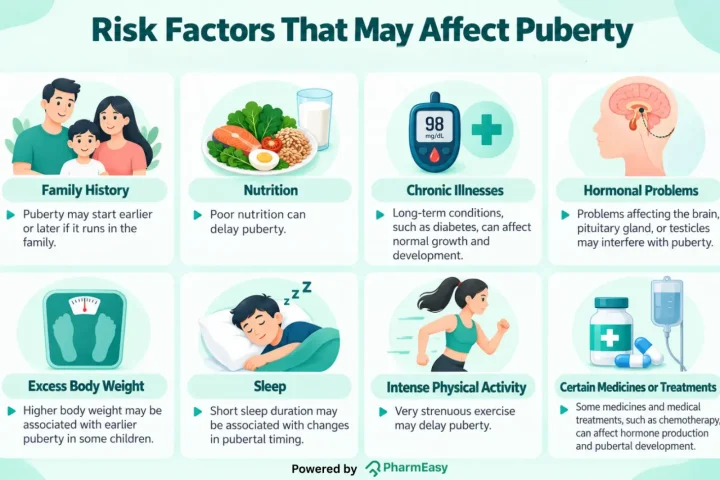
Risk Factors That May Affect Puberty
Several factors can influence when puberty starts and how it progresses. These include:
- Family history: Puberty may start earlier or later if it runs in the family1,13.
- Nutrition: Poor nutrition can delay puberty8.
- Chronic illnesses: Long-term conditions (such as diabetes) can affect normal growth and development12.
- Hormonal problems: Problems affecting the brain, pituitary gland, or testicles may interfere with puberty12.
- Excess body weight: Higher body weight may be associated with earlier puberty in some children14.
- Sleep: Short sleep duration may also be associated with changes in pubertal timing13.
- Intense physical activity: Very strenuous exercise may delay puberty15.
- Certain medicines or treatments: Some medicines and medical treatments (such as chemotherapy) can affect hormone production and pubertal development12.
When to See a Doctor?
You should see a doctor if puberty has not started by age 14, puberty starts but does not progress normally, or growth is unusually slow. Common indications of delayed puberty in males include12:
- Testicles remain small by age 14
- Penis remains small or immature by age 13
- Very little (or absence) of body hair by age 15
- Voice remains high-pitched
- Slow growth, with a shorter or thinner body
- More fat around the hips, abdomen, pelvis, or breasts
Conclusion
Male puberty is a natural process that brings gradual physical, sexual, and emotional changes as the body develops into adulthood. It usually begins between 9 and 14 years, but the timing and pace may vary from one boy to another.
Therefore, knowing the common signs and stages of puberty can help young boys and parents understand these changes with confidence. If puberty starts unusually early, has not started by age 14, or does not seem to be progressing normally, it is important to speak with a doctor for proper evaluation.
Also Read: Male Infertility: Causes, Symptoms, Treatment and More
Frequently Asked Questions (FAQs)
Is acne a normal part of male puberty?Hormonal changes during puberty may increase production of oil in the skin. This may lead to acne and is common in teenage boys,4,9.
Is breast enlargement in boys during puberty normal?Temporary breast enlargement or tenderness (called pubertal gynecomastia) is common during puberty and usually settles on its own9,16.
Can nutrition or chronic illness affect puberty?Poor nutrition and some chronic illnesses (such as celiac disease, inflammatory bowel disease, underactive thyroid, etc.) can affect growth and may delay or alter normal pubertal development1,8.
Can delayed puberty affect fertility?Delayed puberty does not necessarily mean a boy will have fertility problems. However, if delayed puberty is caused by an underlying hormonal or testicular problem, fertility may sometimes be affected. In such cases, treatment of the underlying cause can help support normal reproductive development17.
Can a boy’s final height be predicted during puberty?An approximate adult height can be estimated using growth patterns, family height, and bone-age assessment18,19. However, these methods cannot predict final height with complete accuracy.
References
- Puberty. Medline. Accessed October 1, 2026. https://medlineplus.gov/puberty.html
- Puberty for boys. Healthdirect. Accessed October 1, 2026. https://www.healthdirect.gov.au/puberty-for-boys
- Nassar GN, Leslie SW. Physiology, Testosterone. StatPearls Publishing; 2026. Accessed October 1, 2026. http://www.ncbi.nlm.nih.gov/books/NBK526128/
- Puberty. Better Health Channel. Accessed October 1, 2026. http://www.betterhealth.vic.gov.au/health/healthyliving/puberty
- Eunice Kennedy Shriver National Institute of Child Health and Human Development. NICHD. Accessed October 1, 2026. https://www.nichd.nih.gov/health/topics/factsheets/puberty
- Alenazi MS, Alqahtani AM, Ahmad MM, Almalki EM, AlMutair A, Almalki M. Puberty Induction in Adolescent Males: Current Practice. Cureus. 14(4):e23864. doi:10.7759/cureus.23864. https://pubmed.ncbi.nlm.nih.gov/35530907/
- Wehkalampi K, Silventoinen K, Kaprio J, et al. Genetic and Environmental Influences on Pubertal Timing Assessed by Height Growth. Am J Hum Biol. 2008;20(4):417-423. doi:10.1002/ajhb.20748. https://pubmed.ncbi.nlm.nih.gov/18293372/
- Soliman A, De Sanctis V, Elalaily R. Nutrition and pubertal development. Indian J Endocrinol Metab. 2014;18(Suppl 1):S39-S47. doi:10.4103/2230-8210.145073. https://pubmed.ncbi.nlm.nih.gov/25538876/
- Puberty: Adolescent Male. John Hopkins. June 20, 2024. Accessed October 1, 2026. https://www.hopkinsmedicine.org/health/wellness-and-prevention/puberty-adolescent-male
- Krishna KB, Witchel SF. Figure 2. [Tanner Staging for pubertal development…]. April 9, 2024. Accessed October 1, 2026. https://www.ncbi.nlm.nih.gov/books/NBK279024/figure/norm-abnorm-puberty.F2/
- Emmanuel M, Bokor BR. Tanner Stages. StatPearls Publishing; 2022. Accessed October 1, 2026. https://www.ncbi.nlm.nih.gov/sites/books/NBK470280/
- Delayed puberty in boys. MedlinePlus. Accessed October 1, 2026. https://medlineplus.gov/ency/article/007695.htm
- Dong Y, Dai L, Dong Y, et al. Analysis of risk factors of precocious puberty in children. BMC Pediatr. 2023;23:456. doi:10.1186/s12887-023-04265-x. https://pubmed.ncbi.nlm.nih.gov/37697362/
- Zhou X, Hu Y, Yang Z, et al. Overweight/Obesity in Childhood and the Risk of Early Puberty: A Systematic Review and Meta-Analysis. Front Pediatr. 2022;10:795596. doi:10.3389/fped.2022.795596. https://www.frontiersin.org/journals/pediatrics/articles/10.3389/fped.2022.795596/full
- Wang RY, Needham LL, Barr DB. Effects of Environmental Agents on the Attainment of Puberty: Considerations When Assessing Exposure to Environmental Chemicals in the National Children’s Study. Environ Health Perspect. 2005;113(8):1100-1107. doi:10.1289/ehp.7615. https://pmc.ncbi.nlm.nih.gov/articles/PMC1280355/
- Lemaine V, Cayci C, Simmons PS, Petty P. Gynecomastia in Adolescent Males. Semin Plast Surg. 2013;27(1):56-61. doi:10.1055/s-0033-1347166. https://pubmed.ncbi.nlm.nih.gov/24872741/
- Abacı A, Besci Ö. A Current Perspective on Delayed Puberty and Its Management. J Clin Res Pediatr Endocrinol. 16(4):379-400. doi:10.4274/jcrpe.galenos.2024.2024-2-7. https://pubmed.ncbi.nlm.nih.gov/38683021/
- How Tall Will My Child Be? Predicting a Child’s Adult Height. HealthyChildren.org. September 30, 2026. Accessed October 1, 2026. https://www.healthychildren.org/English/health-issues/conditions/Glands-Growth-Disorders/Pages/Predicting-a-Childs-Adult-Height.aspx
- Reinehr T, Carlsson M, Chrysis D, Camacho-Hübner C. Adult height prediction by bone age determination in children with isolated growth hormone deficiency. Endocr Connect. 2020;9(5):370-378. doi:10.1530/EC-20-0090. https://pmc.ncbi.nlm.nih.gov/articles/PMC7219136/
Disclaimer: The information provided here is for educational/awareness purposes only and is not intended to be a substitute for medical treatment by a healthcare professional and should not be relied upon to diagnose or treat any medical condition. The reader should consult a registered medical practitioner to determine the appropriateness of the information and before consuming any medication. PharmEasy does not provide any guarantee or warranty (express or implied) regarding the accuracy, adequacy, completeness, legality, reliability or usefulness of the information; and disclaims any liability arising thereof.
Links and product recommendations in the information provided here are advertisements of third-party products available on the website. PharmEasy does not make any representation on the accuracy or suitability of such products/services. Advertisements do not influence the editorial decisions or content. The information in this blog is subject to change without notice. The authors and administrators reserve the right to modify, add, or remove content without notification. It is your responsibility to review this disclaimer regularly for any changes.
































Comments