




Is Heel Pain a Sign of Cancer? Causes, Warning Signs, and Treatment Options
By Dr. Parth Mehta +2 more

Medically reviewed by Dr. Parth Mehta
Last updated: Oct 21, 2026 Published on: Oct 21, 2026


Get,

to manage your symptom
Get your,

4 Cr+ families
benefitted

OTP sent to 9988776655



You’ve successfully subscribed to receive
doctor-approved tips on
Whatsapp

Get ready to feel your best.


Register to Avail the Offer
Send OTPBy continuing, you agree with our Privacy Policy and Terms and Conditions
Hi There,
Sign up on PharmEasy now!!


Trusted by 4 crore+ families

OTP sent to 9988776655
You have unlocked 25% off on medicines


Code: NU25

By Dr. Parth Mehta +2 more
Table of Contents
Have you ever felt a nagging pain in your heel and wondered, could this be something serious, like cancer?
While heel pain can be uncomfortable and worrying, cancer is an extremely rare cause of heel pain1,2. In most cases, heel pain is linked to common problems such as overuse, injuries, or conditions affecting the tissues around the heel3,4.
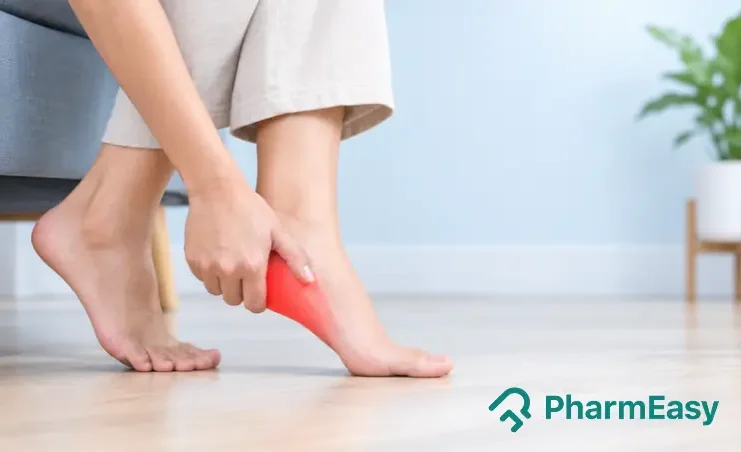
Therefore, understanding the different types and causes of heel pain, their symptoms, possible warning signs of cancer-related pain, and how heel pain is diagnosed and managed can help you know what to expect. It can also help you recognise when pain needs medical attention, so that you can manage it appropriately and protect your overall foot health.
Heel pain can be broadly classified based on where the pain occurs5:
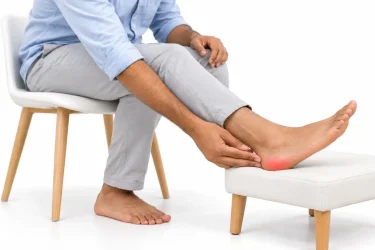
This type of heel pain occurs on the bottom of the heel and is one of the most common patterns of heel pain.
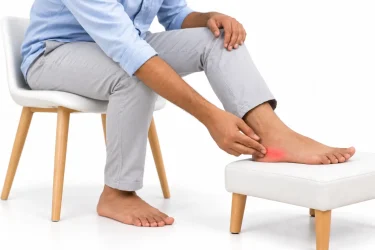
Pain around the middle or sides of the foot may arise from structures such as tendons, joints, or nerves.
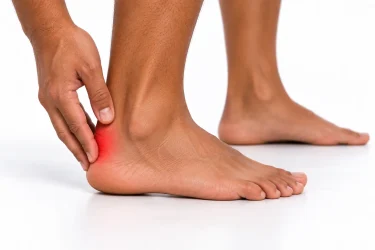
This type of heel pain occurs at the back of the heel, often around the Achilles tendon (tendon connecting the calf muscles to the heel bone).
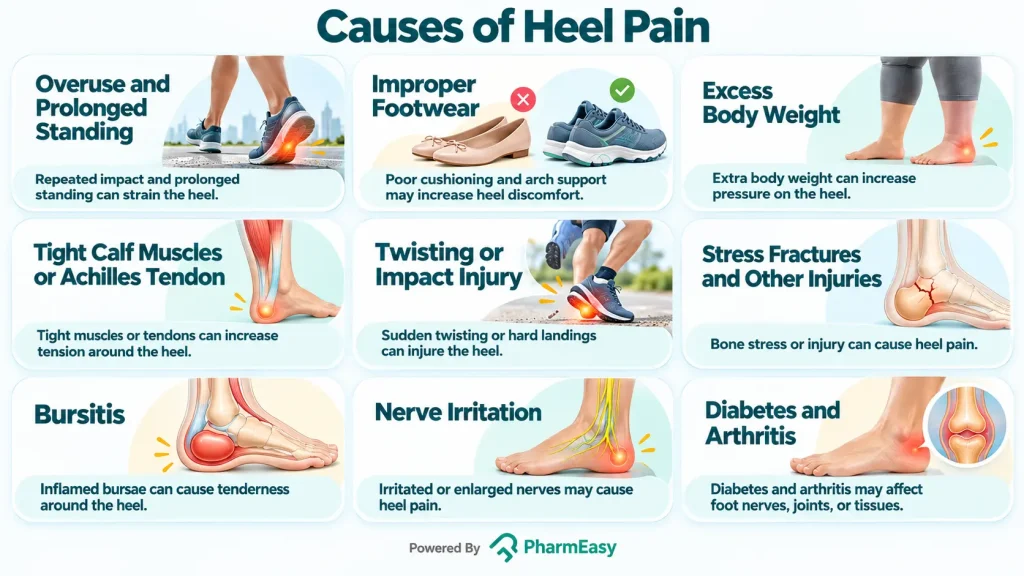
Heel pain can have many causes, ranging from everyday strain and improper footwear to injuries and underlying health conditions. Common causes include:
The symptoms of heel pain can vary depending on its underlying cause. Common symptoms may include4,5,8:
If you are wondering, ‘Is heel pain a sign of cancer?’, the good news is that cancer is a rare cause of heel pain.
Although, in very few cases, heel pain may be associated with cancers sometimes. These include:
Note: The term heel pain cancer may sound concerning, but cancer is a rare cause of heel pain. Most cases are caused by conditions such as plantar fasciitis, injuries, overuse, or problems involving the Achilles tendon3,6.
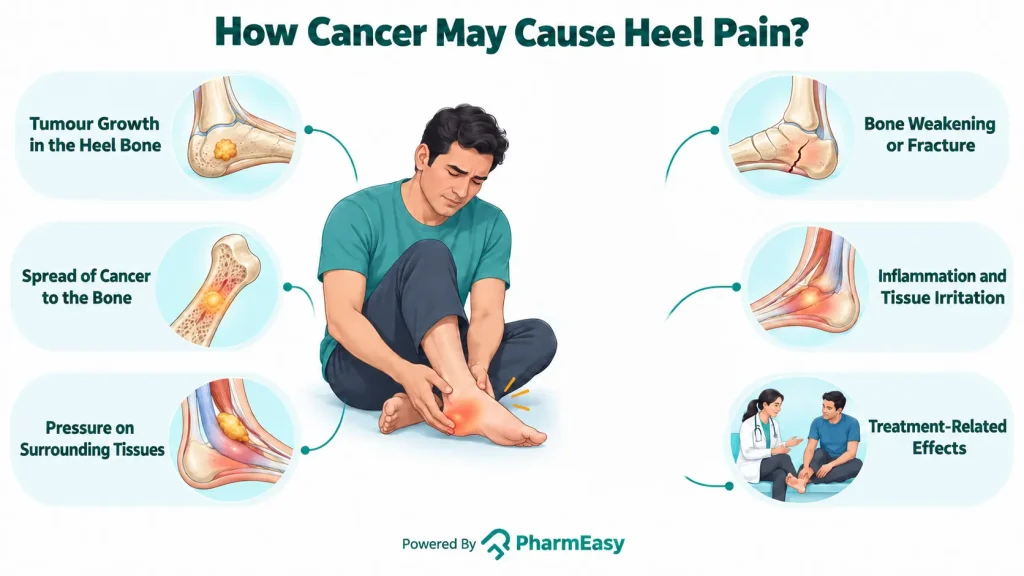
Although cancer is a rare cause of heel pain, it could sometimes affect the heel directly or indirectly. Pain may develop in several ways, such as:
Note: If you are wondering, ‘Is heel pain a sign of breast cancer?’, breast cancer does not usually cause heel pain. However, in rare cases, breast cancer can spread to the bones and may cause bone pain15. Therefore, it’s ideal to not neglect persistent or unexplained heel pain and get it evaluated by a doctor, especially when accompanied by pain or lump in the breasts.
Although rare, cancer-related heel pain can mimic common symptoms of heel pain and usually does not improve with usual measures. Some symptoms of heel pain that could be related to cancer and need medical evaluation include:
Important: These symptoms do not necessarily mean that cancer is present. Many non-cancerous conditions can also cause similar symptoms. So, only a doctor can determine the underlying cause through a proper medical evaluation and, if needed, appropriate tests.
Since heel pain can result from many causes, a doctor will assess the location, duration, severity, and pattern of pain. They will usually perform a5:
Depending on the suspected cause, the doctor may further recommend5:
Management of heel pain depends on the underlying cause and may include:

Reduce or temporarily avoid activities such as running, jumping, or prolonged standing that worsen pain4,6.
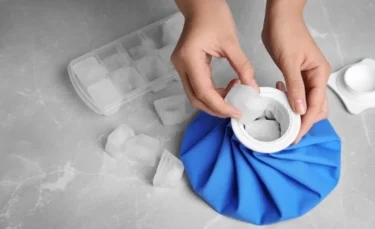
Applying ice to the affected area can help relieve pain and inflammation3,6.

Analgesics or anti-inflammatory medicines may be used when appropriate, as per your doctor’s advice8.
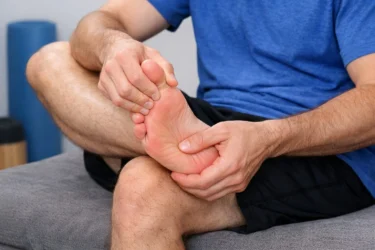
Exercises targeting the calf, Achilles tendon, plantar fascia, and surrounding muscles can improve flexibility and strength5.
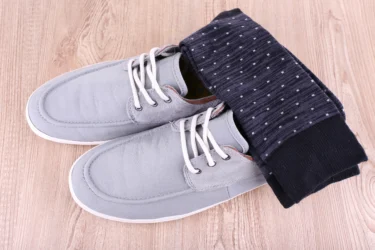
Choose well-fitting shoes with adequate cushioning, support, and shock absorption. Also, avoid footwear that puts pressure on the heel7,8.

These can cushion the heel and reduce pressure on painful areas3,5.

May help improve how the bones, muscles, tendons, and ligaments of the foot interact to support your body weight and move you forward. It may also help to reduce pressure/stress on the heel5.

May be considered in selected conditions when conservative treatment does not provide sufficient relief4,5. These should be strictly done under a doctor’s supervision.
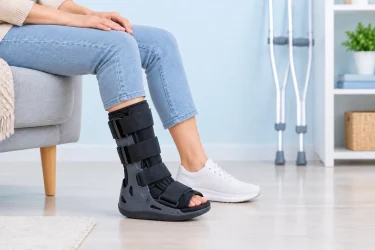
In some persistent or severe cases, temporary casting or other forms of immobilisation may be considered4

This is generally reserved for persistent cases that do not respond to appropriate nonsurgical treatment8.
Also Read: Effective Home Remedies For Heel Pain
Most heel pain improves with appropriate home care, but medical advice is recommended if the pain3,8:
You should also see a doctor if3,8:
Heel pain is usually related to everyday mechanical stress, overuse, injury, or problems affecting the muscles, tendons, nerves, and other structures of the foot.
Although cancer can affect the heel in rare cases, it is not a typical cause of heel pain. Therefore, paying attention to persistent or unusual changes can help ensure that conditions requiring medical attention are not overlooked. Additionally, timely evaluation is particularly important when pain is severe, worsening, unexplained, or interferes with walking or weight-bearing.
Rarely, heel pain may be associated with bone cancers affecting the heel bone or with cancer that has spread to the bone (bone metastasis). In addition to this, tumours involving the soft tissues around the heel may also cause pain1,2,9.
Although it is rare, cancer can develop in the heel bone or in the soft tissues surrounding the heel1,9. So, persistent or unexplained heel pain, swelling, or a lump should be checked by a doctor2,9.
1. Taslakian B, Issa G, Saab R, Jabbour MN, Khoury NJ. Calcaneal osteosarcoma: a rare cause of heel pain in the paediatric population. BMJ Case Rep. 2013;2013:bcr2012008497. doi:10.1136/bcr-2012-008497 https://pubmed.ncbi.nlm.nih.gov/23386499/
2. Angelini A, Biz C, Cerchiaro M, Longhi V, Ruggieri P. Malignant Bone and Soft Tissue Lesions of the Foot. J Clin Med. 2023;12(8):3038. doi:10.3390/jcm12083038 https://pubmed.ncbi.nlm.nih.gov/37109375/
3. Heel pain. MedlinePlus Medical Encyclopedia. Accessed September 24, 2026. https://medlineplus.gov/ency/article/003181.htm
4. Agyekum EK, Ma K. Heel pain: A systematic review. Chin J Traumatol Zhonghua Chuang Shang Za Zhi. 2015;18(3):164-169. doi:10.1016/j.cjtee.2015.03.002 https://pubmed.ncbi.nlm.nih.gov/26643244/
5. Tu P. Heel Pain: Diagnosis and Management. Am Fam Physician. 2018;97(2):86-93. https://pubmed.ncbi.nlm.nih.gov/29365222/
6. Foot problems – heel pain. Better Health. Accessed September 24, 2026. http://www.betterhealth.vic.gov.au/health/conditionsandtreatments/foot-problems-heel-pain
7. Choosing the right shoe. Better Health. Accessed September 24, 2026. http://www.betterhealth.vic.gov.au/health/healthyliving/Choosing-the-right-shoe
8. Heel pain. Nidirect. February 16, 2018. Accessed September 24, 2026. https://www.nidirect.gov.uk/conditions/heel-pain
9. Macedo F, Ladeira K, Pinho F, et al. Bone Metastases: An Overview. Oncol Rev. 2017;11(1):321. doi:10.4081/oncol.2017.321 https://pubmed.ncbi.nlm.nih.gov/28584570/
10. Dai H, Qiang M, Chen Y, Zhai W, Zhang K. Lung cancer presenting as heel pain: A case report. Oncol Lett. 2014;8(2):736-738. doi:10.3892/ol.2014.2164 https://pubmed.ncbi.nlm.nih.gov/25009652/
11. Horner KJ, Smith CJ, Laziuk K, Summerhays B. Chronic Heel Pain Found to Be Diffuse Large B-cell Lymphoma of the Calcaneus. Cureus. 14(5):e25282. doi:10.7759/cureus.25282 https://pubmed.ncbi.nlm.nih.gov/35755567/
12. Kourtis E, Zygogiannis K, Fanourgiakis I, Koulalis D, Stathopoulos KD. Understanding and Managing Fracture Risk in Patients With Cancer: A Literature Review. Cureus. 17(4):e83082. doi:10.7759/cureus.83082 https://pubmed.ncbi.nlm.nih.gov/40438830/
13. Wang WL, Hao YH, Pang X, Tang YL. Cancer pain: molecular mechanisms and management. Mol Biomed. 2025;6(1):45. Published 2025 Jun 28. doi:10.1186/s43556-025-00289-0 https://pubmed.ncbi.nlm.nih.gov/40579593/
14. Nerve Problems (Peripheral Neuropathy) and Cancer Treatment – Side Effects. NCI. April 29, 2015. Accessed September 29, 2026. https://www.cancer.gov/about-cancer/treatment/side-effects/nerve-problems
15. Groves MJ, Stiles RG. Metastatic breast cancer presenting as heel pain. J Am Podiatr Med Assoc. 1998;88(8):400-405. doi:10.7547/87507315-88-8-400 https://www.mdpi.com/1930-8264/88/8/400
16. Endara-Mina J, Kumar H, Ghosh B, et al. Comparative use of ultrasound and radiography for the detection of fractures: a systematic review and narrative synthesis. Ann Med Surg. 2023;85(10):5085-5095. doi:10.1097/MS9.0000000000001229 https://pubmed.ncbi.nlm.nih.gov/37811018/
17. Arthritis. National Institute of Arthritis and Musculoskeletal and Skin Diseases. April 14, 2017. Accessed September 29, 2026. https://www.niams.nih.gov/health-topics/arthritis
Disclaimer: The information provided here is for educational/awareness purposes only and is not intended to be a substitute for medical treatment by a healthcare professional and should not be relied upon to diagnose or treat any medical condition. The reader should consult a registered medical practitioner to determine the appropriateness of the information and before consuming any medication. PharmEasy does not provide any guarantee or warranty (express or implied) regarding the accuracy, adequacy, completeness, legality, reliability or usefulness of the information; and disclaims any liability arising thereof.
Links and product recommendations in the information provided here are advertisements of third-party products available on the website. PharmEasy does not make any representation on the accuracy or suitability of such products/services. Advertisements do not influence the editorial decisions or content. The information in this blog is subject to change without notice. The authors and administrators reserve the right to modify, add, or remove content without notification. It is your responsibility to review this disclaimer regularly for any changes.


Comments

Leave your comment...
You may also like
























Comments