Click to see full view
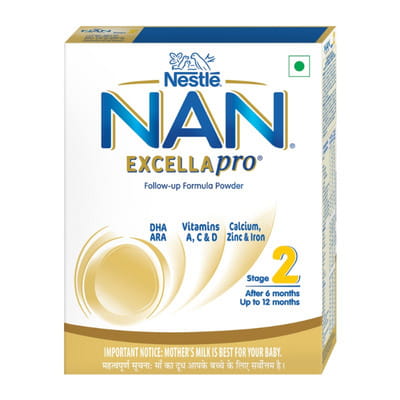
Nestle Nan Excella Pro 2 Follow-Up Formula With Dha & Ara | For 6-12 Months | 400G Pouch In Box


Assurance
available
Regulated
Other Information
 Description
Important notice: Mother's milk is best for your baby. Nestle NAN EXCELLAPRO 2 is a spray-dried Stage 2 follow-up formula for babies from 6 to 12 months when they are not breastfed. It contains DHA, ARA, vitamins, minerals, milk solids and vegetable oils. Contains milk and soy.
 Benefits
- Contains DHA, which helps support normal brain development.
- Contains Iron, which helps support normal cognitive development.
- Contains vitamins A and C, along with zinc, which contribute to the normal functioning of the immune system.
- Contains calcium and vitamin D, which support normal bone growth and development.
 Ingredients
- Milk solids
- Soyabean oil
- Low erucic rapeseed oil
- Minerals
- High oleic sunflower oil
- Coconut oil
- Sunflower oil
- Soya lecithin
- Arachidonic acid (ARA) from Mortierella alpina oil
- Docosahexaenoic acid (DHA) from Schizochytrium sp. oil
- Vitamins
- Citric acid and potassium hydroxide
How to Use
- Wash your hands before preparing a feed.
- Wash the feeding bowl, spoon or bottle thoroughly. Boil the equipment in water for 5 minutes and keep it covered until use.
- Boil clean drinking water for 5 minutes, then allow it to cool to lukewarm, around 40*C or body temperature.
- Check the feeding table on the pack and pour the exact amount of cooled water into the sterilised feeding vessel.
- Use the provided scoop. Level the powder without compacting it, then add the exact number of level scoops for your baby's age.
- Stir or shake until the powder dissolves completely.
- Feed immediately. Prepare only one feed at a time and discard any leftover feed.
 Side Effects
- There are no known side effects reported for this formula when it is prepared and used correctly.
- Using unboiled water, unclean utensils, or preparing feed incorrectly can put your baby at risk of infection.
- Overfeeding may lead to spit-up, gas, fussiness, or irritability in some babies.
Nutritional Facts
| Nutrient | Per 100 g |
|---|---|
| Energy | 472 kcal |
| Protein | 14.2 g |
| Carbohydrate | 58.8 g |
| Total sugars | 41.0 g |
| Added sugars | 25.6 g |
| Total fat | 20.0 g |
| Sodium | 99.00 mg |
 Precautions and Warnings
Always boil and cool water before mixing the formula, and ensure utensils and bottles are thoroughly cleaned to reduce the risk of infection.
Prepare only one feed at a time, and discard any leftover feed immediately to avoid contamination.
Use only the enclosed scoop and follow the recommended quantity exactly, because wrong dilution can cause discomfort, nutritional imbalance, or reduce the water needed for your baby.
Hold the baby while feeding and never leave them unattended, as there is a risk of choking.
Infant formula should be used only on medical advice, and is not meant to be the sole source of nutrition. Breast milk is best whenever possible.
 Safety & Storage Information
Unboiled water, unboiled utensils, or incorrect dilution can make your baby ill.
Incorrect storage, handling, preparation, and feeding can potentially lead to adverse effects on the health of your baby.
Only prepare one feed at a time. Feed immediately and follow the instructions exactly.
Boiled and cooled water shall be used to prepare this product, and any leftover product must be discarded to help reduce the risk of infection.
Always hold the baby while feeding. Leaving the baby unattended may cause choking.
Infant food should be used only on the advice of a health worker as to the need for its use and the proper method of its use.
Infant food is not the sole source of nourishment for an infant. "Infant food shall be introduced only after the age of six months and up to the age of two years."
Consult your healthcare professional before introducing any new food to the baby's diet. If an earlier introduction of new foods is recommended by your healthcare professional, reduce formula intake as advised.
Use only the enclosed scoop. Do not change proportions without medical advice. Careful and hygienic preparation of infant milk substitutes is essential for health.
- Do not use fewer scoops than directed, since diluted feeding will not provide the adequate nutrition needed by your infant.
- Do not use more scoops than directed, since concentrated feed will not provide the water needed by your infant.
- Retain the feeding table/instructions given on the pack.
- Ensure the enclosed scoop is washed and thoroughly dried before use.
- After opening, use the contents within 3 weeks or the use-by date, whichever is earlier.
Features
- Spray-dried Stage 2 follow-up formula.
- Contains DHA, ARA, vitamins and minerals.
- Vegetarian formulation.
Uses
- Follow-up formula for babies from 6 to 12 months when they are not breastfed.
- Infant milk substitute to be used only on the advice of a doctor or health worker.
Brand and Manufacturer Details
Brand:
Expires on or After: 29/09/2027
NESTLE INDIA LTD
FAQs
Ratings & Reviews
Nan excella pro was not charged as per the revised GST price
My baby started to have loose motion after this formula it doesn't suited him
Product is fine but discount is bad
Talk to our support and they'll help you out!
Email Id:care@pharmeasy.in
Phone Number:7666100300
Address:D-37/1, Opp. Sandoz, TTC Industrial Area, MIDC Industrial Area, Turbhe, Navi Mumbai, Maharashtra 400703