

2049+ orders placed in your location

100% NABL & ISO Certified Lab • 100% Accurate Reports
Prostate Specific Antigen Test (PSA For Men) In Ahmedabad - Price & Details
Total PSA, Complex PSA, Free PSA
- SummaryThe Prostate-Specific Antigen (PSA) test is a blood test that measures the level of PSA in your blood. PSA is a substance produced by the prostate gland in males. The PSA levels can be elevated in benign prostatic hyperplasia, and prostate cancer. This test is done by taking a blood sample from a vein in your arm, fasting is not required for this test. Read more
- Reports Within24 HrsView Sample Report

 100% NABL & ISO Certified Labs
 - SampleBlood

- Age35+ years
- GenderMales
- FastingNot Required

PharmEasy Promises



Know More About The Test


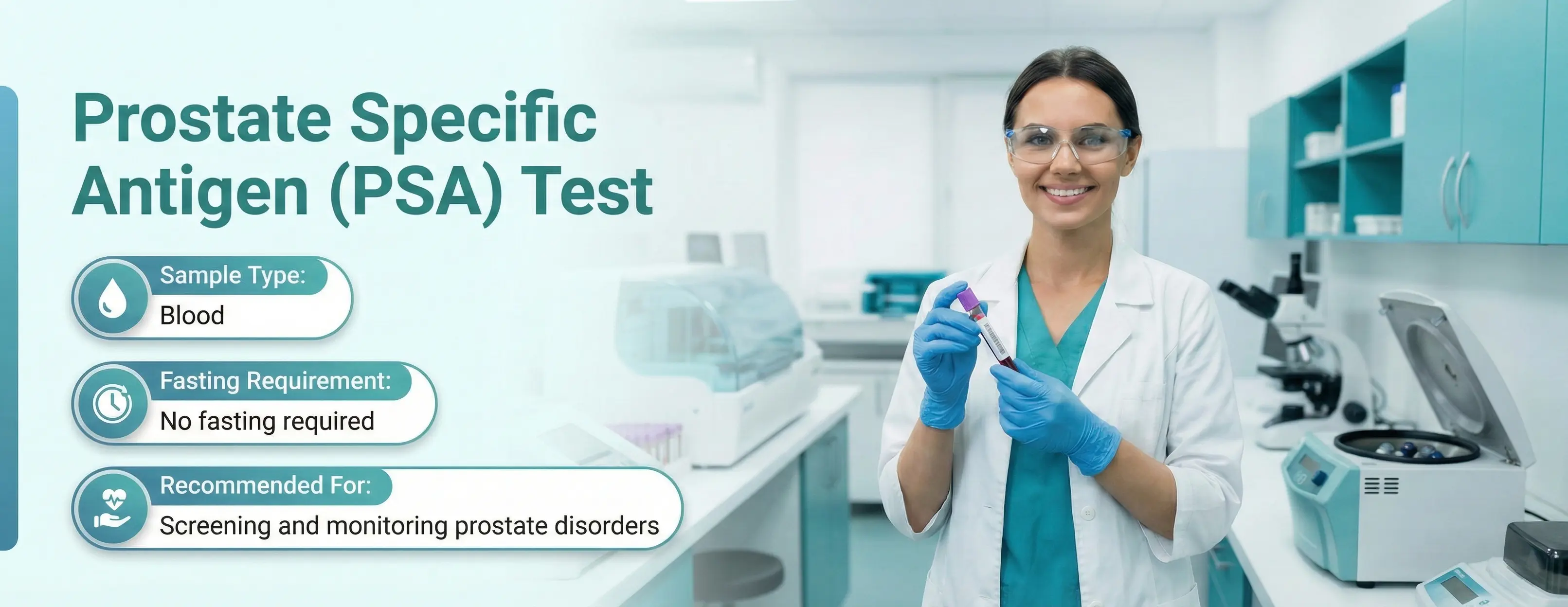
A quick info on PSA test

Overview
The Prostate-specific antigen (PSA) test is a blood test mainly used to screen for prostate cancer. It measures the level of PSA, a protein produced by the prostate gland, in the blood. Small amounts of PSA normally circulate in the bloodstream, but elevated levels may indicate prostate cancer or other prostate-related conditions.
A high PSA level does not always mean cancer. Non-cancerous conditions such as benign prostatic hyperplasia, prostatitis, and urinary tract infections can also increase PSA levels. Therefore, the PSA test is considered a sensitive screening tool but is not specific for prostate cancer and cannot confirm the diagnosis on its own.
Prostate cancer is one of the most common cancers in men, and early detection can improve treatment outcomes. The PSA test helps identify people who may require further evaluation and is often used along with other assessments, such as a digital rectal examination. In addition to screening, PSA testing is valuable for monitoring disease progression, assessing treatment response, and detecting cancer recurrence.

When and Who Should Get a PSA Test Done?
- Adult males above the age of 50.
- Adult males above the age of 40, who are in the high-risk category (If father or brother has prostate cancer).
- Men undergoing treatment for prostate cancer may be prescribed this test to monitor the effectiveness of treatment.
- Men who previously had prostate cancer may be advised to undergo this test to ensure that the cancer has not come back.
.png?dim=48x48&q=75)
How Frequently Should You Take the PSA Test?
|
Age |
Recommendation |
|---|---|
|
40-45 years |
A single baseline PSA test |
|
45 years onward (in adult males with high risk) |
Testing once a year |
|
50 years onward (in all other adult males) |
Testing every 2 to 3 years |
|
From 75 years onwards, or a life expectancy of less than 10 years |
Routine testing may be discontinued |
|
Any age with abnormal results |
The test will be repeated Follow-up testing every 6 to 12 months for monitoring |

What Conditions Can a PSA Test Help Detect?
PSA levels may be elevated in:
- Prostate cancer
- Enlarged prostate gland
- Swelling and pain in the prostate gland
- Urinary tract infections
- Certain medications, like hormone replacement therapy
- Recent urological or pelvic procedures, like cystoscopy or colonoscopy
If your PSA level is high, you may need other tests to confirm prostate cancer or determine the cause of increased PSA levels.
Disclaimer: The above list is for educational purposes only and does not confirm a diagnosis or the presence of any condition. Always consult your doctor about your test results and diagnosis.
.png?dim=48x48&q=75)
PSA Test Preparation
- Refrain from sexual activity 1-2 days before the test.
- Avoid riding a bicycle, which puts pressure on the prostate gland.
What to Expect Before the Test
Fasting is not required for this test, and it can be done at any time of the day.
Inform your healthcare provider if you:
- Take medications such as finasteride or dutasteride.
- Had a prostate biopsy in the last 6 weeks.
- Have recently undergone prostate surgery or any urinary tract procedures.
- Have had a urinary tract infection recently.
- Have a liver condition such as cirrhosis, hepatitis, or cystic fibrosis.
What to Expect During the Sample Collection
- A phlebotomist will arrive at your home for the test at the scheduled time.
- A tourniquet will be placed around your arm, and you may be asked to make a fist. Using a sterile needle, a small blood sample will be drawn from a vein in your arm.
- The procedure usually takes only a few minutes.
What to Expect After the Test
- The phlebotomist will then apply pressure on the blood collection site using a clean cotton ball. A bandage may be placed on the site. Keep the bandage on for a few hours and keep the area dry. You should also drink plenty of fluids and avoid exercising for a few hours.
- The collected sample will be taken for analysis in the laboratory, and results are usually available within a few hours on the PharmEasy platform.
Note: If you notice anything unusual at the puncture site, such as persistent bleeding, a rash, or pain, consult your healthcare provider.

What are the Parameters Included in a PSA Test?
The PSA test measures a single key parameter:
- Total PSA (prostate specific antigen) - measured in ng/mL (nanograms per millilitre).

Normal Range of PSA Test Parameters
PSA normal values are age-dependent:
|
Age group |
Normal PSA range |
Clinical interpretation |
|---|---|---|
|
40 - 49 years |
0 - 2.5 ng/mL |
PSA within this range is reassuring for this age group. |
|
50 - 59 years |
0 - 3.5 ng/mL |
PSA within this range is reassuring. Above 3.5 warrants further evaluation. |
|
60 - 69 years |
0 - 4.5 ng/mL |
PSA within this range is acceptable. Above 4.5 requires urological evaluation. |
|
Above 70 years |
0 - 6.5 ng/mL |
Slightly higher PSA is expected with age. Above 6.5 warrants clinical evaluation. |
Important note: Normal PSA ranges may vary between laboratories and between Indian and Western reference populations. Studies show PSA ranges tend to be lower in Indians.
.png?dim=48x48&q=75)
PSA Test Result Interpretation
The PSA result must be interpreted in the context of your age, symptoms, digital rectal examination findings, and the free/total PSA ratio. A single elevated PSA reading is not sufficient for diagnosis.
|
PSA level |
Risk category |
Potential interpretation and action |
|---|---|---|
|
Below 4 ng/mL |
Low risk |
Generally reassuring. Routine monitoring as per age-specific schedule. |
|
4 - 10 ng/mL |
Borderline/moderate risk |
Grey zone. Prostate cancer is possible, but so are BPH and prostatitis. Free PSA ratio and urological evaluation recommended. |
|
Above 10 ng/mL |
High risk |
Significantly elevated. High suspicion of prostate cancer. Urological referral and prostate biopsy are typically recommended. |
|
Rapidly rising PSA (>0.75 ng/mL/year) |
PSA velocity concern |
Even if the absolute value is below 4, a rapid annual rise warrants urgent evaluation. |
|
Low free PSA/total PSA ratio (<15%) |
Higher cancer risk |
A lower free-to-total PSA ratio suggests a higher likelihood of prostate cancer over benign conditions. |
|
Post-treatment - rising PSA |
Biochemical recurrence |
A rising PSA after prostatectomy (above 0.2 ng/mL) or after radiation suggests cancer recurrence. |
Disclaimer: This table is for educational purposes only. PSA interpretation requires the expertise of a qualified urologist. A high PSA does not confirm prostate cancer; false positives are common. Never make treatment decisions based on PSA alone.

PSA Test Risks and Limitations
Potential Risks and Complications
- Nausea, mild pain, slight bleeding, bruising, dizziness, or light-headedness may sometimes occur during blood sample collection. Rarely, vein access may be challenging. You can walk for a bit, relax, and drink something warm to aid in easier sample collection.
Understanding Prostate Specific Antigen Test Limitations
- Elevated PSA levels are not specific to prostate cancer: Conditions such as benign prostatic hyperplasia, prostatitis, and urinary tract infections can also increase PSA levels, potentially leading to additional testing.
- Normal PSA levels do not completely rule out prostate cancer: Some prostate cancers may not cause a significant rise in PSA levels and can be present despite a normal test result.
- Risk of overdiagnosis: PSA screening may detect slow-growing prostate cancers that are unlikely to cause symptoms or affect lifespan. In such cases, treatment may lead to side effects such as urinary incontinence, bowel problems, and sexual dysfunction without substantial benefit.

PSA Test Price in Ahmedabad
In Ahmedabad, the typical price for a PSA test at PharmEasy ranges from INR 649. However, the cost can vary depending on various factors such as location and the diagnostic provider. Feel free to compare PSA test prices across different major Indian cities for better understanding.
|
City |
Offer Price |
|---|---|
|
649 |
|
|
649 |
|
|
649 |
|
|
649 |
|
|
649 |
|
|
649 |
|
|
649 |
|
|
649 |
|
|
649 |
|
|
649 |

Areas We Serve in Ahmedabad
You can book Prostate Specific Antigen Test (PSA For Men) in Ahmedabad through PharmEasy with convenient home sample collection across several localities, including :
- Satellite
- Bodakdev
- Science City
- Navrangpura
- Paldi
- Naranpura
- Ambawadi
- Prahlad Nagar
- Isanpur
- Thaltej
- Bopal
- Ranip
- Gota
- Chandkheda
- Motera
- Shahibaug
- Maninagar
- Naroda
- Nikol
- Vastral
You can also check service availability during purchase by entering your pin code.

PSA Test Sample Collection: Home vs. Diagnostic Lab
The PSA test at PharmEasy offers convenient features as compared to traditional labs.
|
Feature |
PharmEasy home collection |
Traditional labs |
|---|---|---|
|
At-home sample collection |
✅ |
❌ |
|
No travel required |
✅ |
❌ |
|
Saves time |
✅ |
❌ |
|
Flexible appointment slots |
✅ |
❌ |
|
Comfortable testing experience |
✅ |
❌ |
|
Reduced exposure to crowds |
✅ |
❌ |
|
Professional home visit by a phlebotomist |
✅ |
❌ |
|
Easy digital report access |
✅ |
❌ |
|
Waiting in queues |
❌ |
✅ |
Pro tip: To get the advantage of home sample collection for the test in Ahmedabad, visit the PharmEasy website or app. Search for the prostate specific antigen test, enter your location, and confirm the booking.
Was This Test Information Helpful?
Please rate your experience
 Yes Helpful (12)
 Not Helpful
References
People Also Ask
Is PSA testing recommended for men with a family history of prostate cancer?
Can PSA levels increase with age?
Should a PSA test be repeated if the result is high?
Is the PSA test used only for cancer screening?
What is a digital rectal examination (DRE)?
How can I book a PSA test in Ahmedabad?
How quickly are reports available in Ahmedabad?
 4.6 Stars| 7+ Lakhs Ratings & Reviews

Over 10 million happy users PharmEasy Labs
- Because the digital report is available on WhatsApp, there's no need to go back to the lab. Thanks, PharmEasy!
 Sachin sharma11 Jan ‘26
 - Thanks to the coupon discount, the blood test was done at a lower price.Komal04 Jan ‘26
- The lab technician was a good and knowledgeable professional.Rakesh Pandey06 Jan ‘26
- Due to bad weather, it's difficult to reach the lab. But home collection makes things easier.Arjun08 Jan ‘26
- Thanks to the Swasth AI feature, the report is easy to understand.Priya Mehta02 Jan ‘26
- The report is available on the same day. Wow!Vikas Patel05 Jan ‘26
Have any doubts? Ask us.
Ask us anything about the Prostate Specific Antigen Test (PSA For Men) In Ahmedabad - Price & Details to understand it better
Nearby Labs
Lab tests made easy!
- Quick Collection
- Trusted Accuracy
- Hassle-free Services
PharmEasy Labs (Thyrocare powered) - Ahmedabad
Kailash Heights, C.T.S No.636, Wing ‘A’, Gujarat
 grievance-officer@docon.in
 7022000900
PharmEasy Labs (Covid RTPCR) - Ahmedabad
D-37/1, MIDC, Turbhe, Opp. Sandoz,, Gujarat
grievance-officer@docon.in7022000900
Agilus Diagnostics Limited - Ahmedabad
Agilus Diagnostics, 1St Floor, 101 To 108, The Grand Mall, Opp. Sbi Zonal Office, Ambawadi, Nehru Nagar,, Gujarat
grievance-officer@docon.in7022000900
Curovis Healthcare - Ahmedabad
B Block Safal Mondeal, Nr. Gurudwara, S.G. Highway, Bodakdev, Ahmedabad, Gujarat 380054, Gujarat
grievance-officer@docon.in7022000900Aarthi Scans and Labs - Ahmedabad
1st Floor, Dev Complex, near, Chimanlal Girdharlal Rd, opp. Parimal Garden, Shanti Sadan Society, Ellisbridge,, Gujarat
grievance-officer@docon.in7022000900Shree Sai Diagnostics - Ahmedabad
No. 108, Sundaram Arcade, Science City Rd, Sola, Gujarat
grievance-officer@docon.in7022000900Jarnav Pathology & Diagnostic centre - Ahmedabad
403, Naroda Business Hub, Naroda - Dehgam Rd, Hanspura, GIDC Naroda,, Gujarat
grievance-officer@docon.in7022000900Arogyam Health Centre - Ahmedabad
30, M.K. Nagar, Sattadhar Cross Rd, near Saibaba Mandir, opp. Kalasagar Mall, Sarvodaya Nagar, Ghatlodiya,, Gujarat
grievance-officer@docon.in7022000900Dr. B. Lal Clinical Laboratory - Ahmedabad
401, Sheetal Varsha Complex, Opposite Harit Zaveri Showroom, Shivranjani cross road,, Gujarat
grievance-officer@docon.in7022000900Neuberg Diagnostics - AHC - Ahmedabad
near, Thombra Arcade Metro Station, Kaloor, Ernakulam, Kerala 682017, Gujarat
grievance-officer@docon.in7022000900Neuberg Diagnostics - AHC - Ahmedabad
Twaiba Complex,Near Medical College, Vandanam, Alappuzha, Kerala, Gujarat
grievance-officer@docon.in7022000900Neuberg Diagnostics - AHC - Ahmedabad
Ravish Complex, Above Sales India, Maninagar Cross Road, Ahmedabad - 380008, Gujarat
grievance-officer@docon.in7022000900Neuberg Diagnostics - AHC - Ahmedabad
White House, 20, Sarvadarshan Society, Opp. Anand Party Plot, Opp. Kalupur Bank, Bopal Main Road, Ahmedabad - 380058, Gujarat
grievance-officer@docon.in7022000900HealthRoute - Ahmedabad
Pristine Colony, Bhondve Corner, Shop no. 1 and 2 Opp. to Ojas Hospital, Ravet, Gujarat
grievance-officer@docon.in7022000900HealthRoute - Ahmedabad
S.NO 21/4 - Hadapsar Bypass Rd, near Manipal Hospital, Raghoba Patil Nagar, Santipur, Thite Nagar, Pune, Gujarat
grievance-officer@docon.in7022000900Health Buddy Diagnostic Pvt Ltd - Ahmedabad
A1/13, Quarsi Bypass Road, Opp. Green Park Apartment, Aligarh Up -202001, Gujarat
grievance-officer@docon.in7022000900
We provide trusted, expert-curated health content to support better awareness,prevention, and care.
Backed by experienced doctors, medical experts, and strict editorial standards.