

1873+ orders placed in your location

100% NABL & ISO Certified Lab • 100% Accurate Reports
Prostate Specific Antigen Test (PSA For Men) In Patna - Price & Details
Total PSA, Complex PSA, Free PSA
- SummaryThe Prostate Specific Antigen (PSA) Test measures PSA levels in the blood to help assess prostate health. It is commonly used to screen for prostate disorders such as prostatitis, benign prostatic hyperplasia, or prostate cancer, and to monitor treatment response. The test uses a blood sample, does not require fasting, and is recommended for adult males, especially those with urinary symptoms or increased risk factors.Read more
- Reports Within8 HrsView Sample Report

- SampleBlood

- Age35+ years
- GenderMales
- FastingNot Required

PharmEasy Promises



Know More About The Test


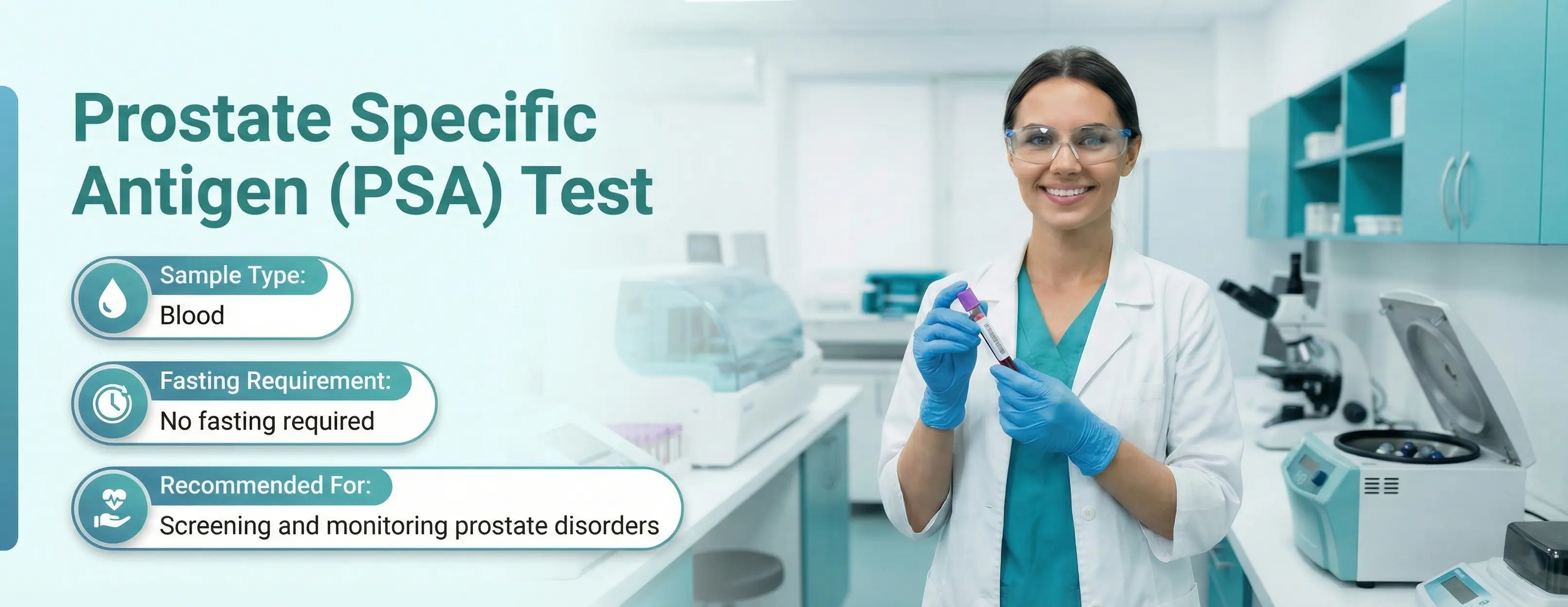
A quick info on PSA test

Overview
The prostate-specific antigen (PSA) test checks the amount of PSA in your blood. It helps detect prostate cancer. It is also used to monitor men who already have prostate cancer and to see if the cancer has come back after treatment. The prostate is a small gland, about the size of a walnut, found only in men. It is present below the bladder and surrounds the tube (urethra) that carries urine out of the body. The prostate produces a fluid that forms part of semen and helps protect sperm. This fluid contains a protein called PSA. The prostate often grows bigger with age. Many men over 50 have a non-cancerous enlargement of the prostate, which can press on the urethra and cause urine problems. Normally, only a small amount of PSA enters the blood. But cancer, infection, swelling, or enlargement of the prostate can cause more PSA to enter the blood. The PSA test checks for this increase. PharmEasy Labs usually provides PSA test results in about 8 hours to within the day, depending on your location in Patna.

When and Who Should Get a PSA Test Done?
- Men above 50 years of age and those with a family history of prostate cancer. Discuss the potential benefits, risks, and limitations of testing with your doctor before deciding whether to undergo PSA screening.
- Men experiencing symptoms suggestive of a prostate condition, such as difficulty urinating, frequent urination, blood in the urine or semen, pelvic or back pain, or urinary incontinence.
- To monitor disease progression, treatment response, or recurrence in men diagnosed with prostate cancer.
- When the doctor feels a lump, hardness, or enlargement of the prostate during a digital rectal examination (DRE).

How Frequently Should You Take the PSA Test?
The frequency of PSA testing depends on individual age and risk factors and should be decided after discussion with your doctor.
|
Frequency of testing |
Age |
|---|---|
|
A single test to establish baseline PSA |
If you are a 40 to 45-year-old male |
|
Annual testing |
If you are a high-risk male, 45 years or older |
|
Testing every 2 to 3 years |
If you are a male, 50 years or older |
|
Routine testing not required |
If you are a male, 75 years or older or have less than 10 years of life expectancy |
|
Test will be repeated Follow-up testing every 6 to 12 months for monitoring |
If PSA test results were abnormal |

What Conditions Can a PSA Test Help Detect?
Elevated PSA values may occur in the following conditions. Further investigations will be advised to determine the cause of elevated PSA levels.
- Screening for prostate cancer.
- Monitoring treatment progression in those undergoing treatment for prostate cancer.
- Checking for recurrence in patients who had prostate cancer and are in remission.
- Benign prostatic hyperplasia (BPH), a non-cancerous enlargement of the prostate gland, common in older men.
- Prostatitis, inflammation or infection of the prostate gland.
Disclaimer: The above list is for educational purposes only and does not confirm diagnosis or the presence of any condition. Always consult your doctor for your test results and diagnosis.

PSA Test Preparation
What to Expect Before the Test
- No fasting is needed before the PSA test. You can eat and drink normally before the test unless your doctor advises otherwise.
- You can take the test at any time of day.
- Tell your doctor about all medicines and supplements you take regularly, any underlying disorders, recent procedures (such as urinary catheter insertion, cystoscopy, or prostate biopsy), and any urinary tract infections.
- For 48 hours before the test, avoid sex, masturbation, and workouts, especially riding a bicycle or motorcycle.
- Do not undergo the test soon after a prostate massage or rectal exam.
What to Expect During the Sample Collection
- You will be asked to sit comfortably while the PharmEasy phlebotomist cleans the inside of your arm with an antiseptic.
- The phlebotomist will tie an elastic band around your upper arm to make the vein easier to find.
- A small needle will be used to collect the blood sample. You may feel a quick prick or mild sting.
- Once the sample is collected, the needle will be removed, gentle pressure will be applied, and a small bandage will be placed over the area.
- If you are afraid of needles or feel dizzy, tell phlebotomist before the test. They can help you feel more comfortable.
- Stay relaxed during the blood draw. Looking away from the needle or taking slow, deep breaths may help.
What to Expect After the Test
- After the blood sample is collected, the phlebotomist will apply gentle pressure and place a small bandage over the site. Keep the bandage on for 1 to 2 hours or as advised.
- Avoid lifting heavy objects or doing strenuous activity with that arm for the rest of the day to reduce bruising or bleeding.
- Your blood sample will be sent to the laboratory for testing.
- A laboratory expert will review your test report before sharing it.

What are the Parameters Included in a PSA Test?
The PSA test measures total prostate-specific antigen (PSA) levels in your blood.

Normal Range of PSA Test Parameters
|
PSA level |
Classification |
|---|---|
|
Less than 4.00 ng/mL |
Normal |
|
4.01 to 10.00 ng/mL |
Borderline |
|
Above 10.00 ng/mL |
High |
Important Note: Normal PSA ranges may vary between laboratories and between Indian and Western reference populations.

PSA Test Result Interpretation
The PSA result must be interpreted in the context of your age, symptoms, and digital rectal examination findings. A single elevated PSA reading is not sufficient for diagnosis.
|
PSA level |
Risk category |
Potential interpretation and action |
|---|---|---|
|
Below 4 ng/mL |
Low risk |
Generally reassuring. Routine monitoring as per age-specific schedule. |
|
4 - 10 ng/mL |
Borderline/moderate risk |
Grey zone. Prostate cancer is possible, but so are BPH and prostatitis. |
|
Above 10 ng/mL |
High risk |
Significantly elevated. High suspicion of prostate cancer. |
|
Rapidly rising PSA (>0.75 ng/mL/year) |
PSA velocity concern |
Even if the absolute value is below 4, a rapid annual rise warrants urgent evaluation. |
|
Post-treatment - rising PSA |
Recurrence |
Any rising PSA after prostatectomy (above 0.2 ng/mL) or after radiation suggests cancer recurrence. |
Disclaimer: This table is for educational purposes only. PSA interpretation requires a qualified urologist.

PSA Test Risks and Limitations
Potential Risks and Complications
Blood sample collection is generally safe, and most people have no problems afterward.
- Common: Mild pain, slight bruising, tenderness, or brief dizziness after the blood draw. These usually go away on their own.
- Rare: A larger bruise, infection, swelling of the vein (phlebitis), or temporary nerve irritation.
- When to see a doctor: Get medical advice if you have severe or persistent pain, increasing redness or swelling, excessive bleeding, or signs of infection at the blood draw site. However, these problems are uncommon.
Understanding Prostate-Specific Antigen Test Limitations
- The PSA test is specific to the prostate gland but is not specific for prostate cancer, as it can also increase in other conditions of the prostate such as enlarged prostate, prostate infection, or urinary tract infection.
- In some cases of prostate cancer, PSA levels can be within the normal range.
- The test cannot distinguish between slow-growing cancers that may never cause harm and aggressive cancers that need treatment, which may lead to unnecessary tests and treatment.
- Factors like recent ejaculation, cycling, a rectal examination, urinary catheter use, or a prostate procedure can temporarily raise PSA levels.
- Certain medicines can significantly lower PSA levels, which may hide a problem.
- PSA levels naturally increase with age, making results harder to interpret.
- The test cannot confirm cancer on its own, and further tests such as an MRI scan or biopsy are needed for diagnosis.


Areas we serve in Patna
You can book PSA Test in Patna through PharmEasy with convenient home sample collection across several localities, including :
- Boring Road
- Rukanpura
- Kankarbagh
- Rajendra Nagar
- Patliputra Colony
- Ashiana Nagar
- Danapur
- Khagaul
- Phulwari Sharif
- Fraser Road
- Bankipore
- Gandhi Maidan
- Kadamkuan
- Sadaquat Ashram
- New Jaganpura
- Rajiv Nagar
- Mahendru
- Shastri Nagar
- Anisabad
- Kumhrar
You can also check service availability during purchase by entering your pincode.

PSA Test Sample Collection: Home vs. Diagnostic Lab
The PSA test at PharmEasy offers convenient features as compared to traditional labs:
|
Feature |
PharmEasy home collection |
Traditional labs |
|---|---|---|
|
At-home sample collection by a phlebotomist |
✅ |
❌ |
|
No travel required |
✅ |
❌ |
|
Saves time |
✅ |
❌ |
|
Flexible appointment slots |
✅ |
❌ |
|
Comfortable testing experience |
✅ |
❌ |
|
Reduced exposure to crowds |
✅ |
❌ |
|
Easy digital report access |
✅ |
❌ |
|
Waiting in queues |
❌ |
✅ |
To get the advantage of home sample collection for the test in Patna, visit the PharmEasy website or app. Search for the prostate-specific antigen test, enter your location, and confirm the booking.
Was This Test Information Helpful?
Please rate your experience
 Yes Helpful (12)
 Not Helpful
References
People Also Ask
Do I need to visit a PharmEasy collection centre for the PSA test in Patna?
Where is my PSA test sample processed after home collection in Patna?
How will I receive my PSA test report in Patna through PharmEasy?
What is a prostate biopsy?
Are there risks with a prostate biopsy?
How is the PSA test used after prostate cancer treatment?
What is the role of an MRI scan after a raised PSA?
 4.6 Stars| 7+ Lakhs Ratings & Reviews


Over 10 million happy users PharmEasy Labs
- Because the digital report is available on WhatsApp, there's no need to go back to the lab. Thanks, PharmEasy!
 Sachin sharma11 Jan ‘26
- Thanks to the coupon discount, the blood test was done at a lower price.Komal04 Jan ‘26
- The lab technician was a good and knowledgeable professional.Rakesh Pandey06 Jan ‘26
- Due to bad weather, it's difficult to reach the lab. But home collection makes things easier.Arjun08 Jan ‘26
- Thanks to the Swasth AI feature, the report is easy to understand.Priya Mehta02 Jan ‘26
- The report is available on the same day. Wow!Vikas Patel05 Jan ‘26
Have any doubts? Ask us.
Ask us anything about the Prostate Specific Antigen Test (PSA For Men) In Patna - Price & Details to understand it better
Nearby Labs
Lab tests made easy!
- Quick Collection
- Trusted Accuracy
- Hassle-free Services
PharmEasy Labs (Covid RTPCR) - Patna
D-37/1, MIDC, Turbhe, Opp. Sandoz,, Bihar
 grievance-officer@docon.in
 7022000900

Human Diagnostics - Patna
Ram sa health care campus Kanti Factory more Near Yadav Timber Kankarbagh Main Road, Bihar
grievance-officer@docon.in7022000900
Mediversal Healthcare Private Limited - Patna
1st Floor Mona Complex Enclave, Gandhi Maidan Rd, Dujra Diara, Bihar
grievance-officer@docon.in7022000900Neuberg Diagnostics - AHC - Patna
150-B, Rd Number 4, Rajendra Nagar,, Bihar
grievance-officer@docon.in7022000900Explore More at PharmEasy
Top-Selling Healthcare Products
Top-Searched Medicines

We provide trusted, expert-curated health content to support better awareness,prevention, and care.
Backed by experienced doctors, medical experts, and strict editorial standards.


