

2116+ orders placed in your location

100% NABL & ISO Certified Lab • 100% Accurate Reports
Prostate Specific Antigen Test (PSA For Men) In Chennai - Price & Details
Total PSA, Complex PSA, Free PSA
- SummaryThe Prostate-Specific Antigen (PSA) test is a blood test that measures the level of PSA in your blood. PSA is a substance produced by the prostate gland in males. The PSA levels can be elevated in benign prostatic hyperplasia, and prostate cancer. This test is done by taking a blood sample from a vein in your arm, fasting is not required for this test. Read more
- Reports Within7 HrsView Sample Report

 100% NABL & ISO Certified Labs
 - SampleBlood

- Age35+ years
- GenderMales
- FastingNot Required

PharmEasy Promises



Know More About The Test


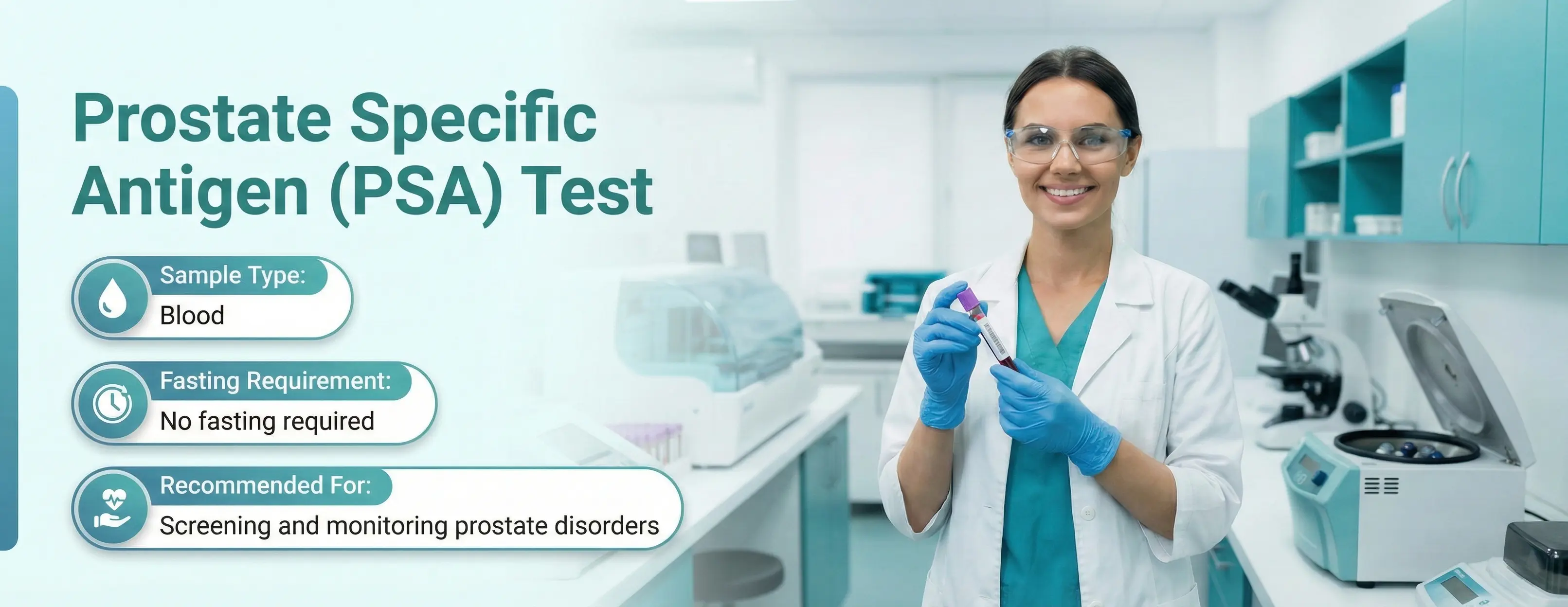
A quick info on PSA test

Overview
Prostate-specific antigen (PSA) is a protein produced by the prostate gland, a small gland located below the bladder in men that helps produce semen. The PSA test is a blood test that measures PSA levels in the blood. While low levels of PSA are normal, elevated levels may be associated with prostate cancer as well as several non-cancerous conditions, such as prostate enlargement or inflammation.
Prostate cancer is the second most common cancer among men worldwide and the third most common in India.
The PSA test is commonly used as a screening tool for prostate cancer. However, it is not specific to cancer, so additional tests may be required to confirm the diagnosis.

When and Who Should Get a PSA Test?
- Men above 50 years of age.
- Men whose close family members have had prostate cancer.
- Men who have symptoms of a prostate condition, such as painful, slow, or frequent urination, blood in the urine or semen, pelvic or back pain, or urinary incontinence (involuntary urination).
- To help monitor the progression of the disease in men diagnosed with prostate cancer.
- To help monitor the effectiveness of treatment in men undergoing treatment for prostate cancer.
.png?dim=48x48&q=75)
How Frequently Should You Take the PSA Test?
- The frequency of testing depends on age and individual risk factors, and the decision should be made in consultation with your doctor.
- Men at higher risk of prostate cancer may begin screening between 40 and 54 years of age.
- For most men, regular PSA screening is typically considered between 55 and 69 years of age, when the benefits of early detection are greatest. Annually, PSA testing or testing every 2 to 3 years may be sufficient.
- Men with elevated PSA levels or a significant increase in PSA over time may require more frequent testing and further evaluation.
- Routine screening should be discontinued in men with a life expectancy of less than 10 years or beyond the age of 75.

What Conditions Can a PSA Test Help Detect?
The PSA test is used to screen for prostate cancer. However, increased PSA levels may also be detected in other non-cancerous conditions, such as:
- An enlarged prostate (benign prostatic hyperplasia)
- Prostatitis (swelling and pain in the prostate gland)
- Urinary tract infections
- Use of certain medications
A PSA test cannot show what is causing abnormal PSA levels. So, if your level is high, you may need other tests to confirm prostate cancer or determine the cause of increased PSA levels.
Disclaimer: The above list is for educational purposes only and does not confirm a diagnosis or the presence of any condition. Always consult your doctor about your test results and diagnosis.

PSA Test Preparation
To help ensure accurate PSA results, avoid the following for 48 hours before the test:
- Sexual activity, including ejaculation.
- Vigorous exercise, particularly cycling.
What to Expect Before the Test
Fasting is not required for this test. Inform your healthcare provider if you:
- Take medications for prostate enlargement or hair loss, such as finasteride or dutasteride.
- Have recently undergone prostate surgery, a prostate biopsy, urinary catheterisation, or other urinary tract procedures.
- Have a urinary tract infection or have had one within the past three months.
- Have a liver condition that may affect test results.
What to Expect During the Sample Collection
A blood sample is required for the PSA test. The following can be expected during the sample collection:
- An elastic band is tied over the upper arm.
- A needle is inserted into a vein in the inner arm to collect the blood.
- A bandage is placed over the blood collection site to stop minor bleeding.
What to Expect After the Test
- Slight pain or a sting may be felt when the needle is inserted. Mild throbbing at the site may also be felt after the blood is drawn.
Note: If you notice anything unusual at the puncture site, such as persistent bleeding, a rash, or pain, consult your healthcare provider.

What Are the Parameters Included in the PSA Test?
The PSA test measures a single key parameter:
- Total PSA (prostate specific antigen) - measured in ng/mL (nanograms per millilitre). This is the primary value your doctor uses for initial prostate health assessment.

Normal Range of PSA Test Parameters
PSA normal values are age-dependent. The table below shows age-specific reference ranges used in clinical practice:
|
Age group |
Normal PSA range |
Clinical interpretation |
|---|---|---|
|
40 - 49 years |
0 - 2.5 ng/mL |
PSA within this range is reassuring for this age group. |
|
50 - 59 years |
0 - 3.5 ng/mL |
PSA within this range is reassuring. Above 3.5 warrants further evaluation. |
|
60 - 69 years |
0 - 4.5 ng/mL |
PSA within this range is acceptable. Above 4.5 requires urological evaluation. |
|
Above 70 years |
0 - 6.5 ng/mL |
Slightly higher PSA is expected with age. Above 6.5 warrants clinical evaluation. |
Important note: Normal PSA ranges may vary between laboratories and between Indian and Western reference populations. Studies show PSA ranges tend to be lower in Indians.

PSA Test Result Interpretation
The PSA result must be interpreted in the context of your age, symptoms, digital rectal examination findings, and the free-to-total PSA ratio. A single elevated PSA reading is not sufficient for diagnosis.
|
PSA level |
Risk category |
Potential interpretation and action |
|---|---|---|
|
Below 4 ng/mL |
Low risk |
Generally reassuring. Routine monitoring as per age-specific schedule. |
|
4 - 10 ng/mL |
Borderline/moderate risk |
Grey zone. Prostate cancer is possible, but so are BPH and prostatitis. Free PSA ratio and urological evaluation recommended. |
|
Above 10 ng/mL |
High risk |
Significantly elevated. High suspicion of prostate cancer. Urological referral and prostate biopsy are typically recommended. |
|
Rapidly rising PSA (>0.75 ng/mL/year) |
PSA velocity concern |
Even if the absolute value is below 4, a rapid annual rise warrants urgent evaluation. |
|
Low free PSA/total PSA ratio (<15%) |
Higher cancer risk |
A lower free-to-total PSA ratio suggests a higher likelihood of prostate cancer over benign conditions. |
|
Post-treatment - rising PSA |
Biochemical recurrence |
A rising PSA after prostatectomy (above 0.2 ng/mL) or after radiation suggests cancer recurrence. |
Disclaimer: This table is for educational purposes only. PSA interpretation requires the expertise of a qualified urologist. A high PSA does not confirm prostate cancer; false positives are common. Never make treatment decisions based on PSA alone.

PSA Test Risks and Limitations
Potential Risks and Complications
There is minimal risk involved with having blood taken for the PSA test. Blood vessels may vary in size from one person to another and from one side of the body to the other. Taking blood from some people may be more difficult than from others.
Other risks associated with having blood drawn are slight but may include:
- Fainting or feeling lightheaded
- Multiple punctures to locate veins
- Bleeding
- Infection (a slight risk any time the skin is broken)
Understanding Prostate Specific Antigen Test Limitations
- A PSA test cannot tell the difference between abnormal PSA levels and prostate cancer and non-cancerous conditions.
- A PSA test may lead to finding and treating prostate cancers that are slow-growing and would never have affected your health.
- Some types of prostate cancer do not cause elevated PSA levels.

PSA Test Price in Chennai
In Chennai, the usual price for a PSA test at PharmEasy is approximately INR 649. However, several factors contribute to the fluctuation in the cost of a PSA test, such as location and the diagnostic provider. For further information, you can compare PSA test prices across various major Indian cities.
|
City |
Offer Price |
|---|---|
|
649 |
|
|
649 |
|
|
649 |
|
|
649 |
|
|
649 |
|
|
649 |
|
|
649 |
|
|
649 |
|
|
649 |
|
|
649 |

Areas We Serve in Chennai
You can book the PSA Test in Chennai through PharmEasy with convenient home sample collection across several localities, including :
- Anna Nagar
- T. Nagar
- Adyar
- Velachery
- Nungambakkam
- Mylapore
- Alwarpet
- Besant Nagar
- Tambaram
- Porur
- Guindy
- Saidapet
- Kodambakkam
- Ashok Nagar
- Kilpauk
- Perambur
- Thiruvanmiyur
- Sholinganallur
- Medavakkam
- Perungudi
You can also check service availability during purchase by entering your pin code.

PSA Test Sample Collection: Home vs. Diagnostic Lab
The PSA test at PharmEasy offers convenient features as compared to traditional labs:
|
Feature |
PharmEasy home collection |
Traditional labs |
|---|---|---|
|
At-home sample collection by a phlebotomist |
✅ |
❌ |
|
No travel required |
✅ |
❌ |
|
Saves time |
✅ |
❌ |
|
Flexible appointment slots |
✅ |
❌ |
|
Comfortable testing experience |
✅ |
❌ |
|
Reduced exposure to crowds |
✅ |
❌ |
|
Easy digital report access |
✅ |
❌ |
|
Waiting in queues |
❌ |
✅ |
To get the advantage of home sample collection for the test in Chennai, visit the PharmEasy website or app. Search for the prostate specific antigen test, enter your location, and confirm the booking.
Was This Test Information Helpful?
Please rate your experience
 Yes Helpful (12)
 Not Helpful
References
People Also Ask
What is a PSA test?
Why is a PSA test done?
Does a high PSA level always mean prostate cancer?
Do I need to fast before a PSA test?
What is considered a normal PSA level?
At what age should men consider PSA screening?
Can I book a PSA test online in Chennai?
 4.6 Stars| 7+ Lakhs Ratings & Reviews

Over 10 million happy users PharmEasy Labs
- Because the digital report is available on WhatsApp, there's no need to go back to the lab. Thanks, PharmEasy!
 Sachin sharma11 Jan ‘26
 - Thanks to the coupon discount, the blood test was done at a lower price.Komal04 Jan ‘26
- The lab technician was a good and knowledgeable professional.Rakesh Pandey06 Jan ‘26
- Due to bad weather, it's difficult to reach the lab. But home collection makes things easier.Arjun08 Jan ‘26
- Thanks to the Swasth AI feature, the report is easy to understand.Priya Mehta02 Jan ‘26
- The report is available on the same day. Wow!Vikas Patel05 Jan ‘26
Have any doubts? Ask us.
Ask us anything about the Prostate Specific Antigen Test (PSA For Men) In Chennai - Price & Details to understand it better
Nearby Labs
Lab tests made easy!
- Quick Collection
- Trusted Accuracy
- Hassle-free Services
PharmEasy Labs (Covid RTPCR) - Chennai
D-37/1, MIDC, Turbhe, Opp. Sandoz,, Telangana
 grievance-officer@docon.in
 7022000900
PharmEasy Labs (Thyrocare powered) - Chennai
Kailash Heights, C.T.S No.636, Wing ‘A’, Tamil Nadu
grievance-officer@docon.in7022000900
Agilus Diagnostics Limited - Chennai
Agilus Diagnostics, No. 22/97, Kgeys Vedha Ranghaa Nivas, Near Ashok Nagar Police Station, 4Th Avenue, Dr Ambedkar Road,, Tamilnadu
grievance-officer@docon.in7022000900
Medall Healthcare pvt ltd - Chennai
191, Poonamallee High Road, near, Taylors Rd, Kilpauk,, Tamilnadu
grievance-officer@docon.in7022000900Medall Healthcare pvt ltd - Chennai
No. 58, Metro Station, Near, 6, Jawaharlal Nehru Rd,Vadapalani, Tamilnadu
grievance-officer@docon.in7022000900Medall Healthcare pvt ltd - Chennai
48, Mahatma Gandhi Rd, RBI Colony, Shastri Nagar,, Tamilnadu
grievance-officer@docon.in7022000900Medall Healthcare pvt ltd - Chennai
3/9, N Boag Rd, near AGS Theatre, T Nagar, Tamilnadu
grievance-officer@docon.in7022000900Aarthi Scans and Labs - Chennai
No.60, 100 Feet Road,Opposite to SRM University, Vadapalani, Tamilnadu
grievance-officer@docon.in7022000900Aarthi Scans and Labs - Chennai
2107, 13th Main Rd, L Block, Anna Nagar West, Anna Nagar,, Tamilnadu
grievance-officer@docon.in7022000900Aarthi Scans and Labs - Chennai
17, CV Raman Rd, Anandapuram Puram, Alwarpet,, Tamilnadu
grievance-officer@docon.in7022000900Aarthi Scans and Labs - Chennai
766, Poonamallee High Rd, Alagappa Nagar, New Bupathy Nagar, Kilpauk,, Tamilnadu
grievance-officer@docon.in7022000900Aarthi Scans and Labs - Chennai
No.3, 1st Main Rd, Vijaya Nagar, Velachery,, Tamilnadu
grievance-officer@docon.in7022000900Aarthi Scans and Labs - Chennai
116, Elumalai St, Tambaram West, Tambaram,, Tamilnadu
grievance-officer@docon.in7022000900Aarthi Scans and Labs - Chennai
Near MM Theatre, 622, Thiruvottiyur High Rd, Tondiarpet,, Tamilnadu
grievance-officer@docon.in7022000900Aarthi Scans and Labs - Chennai
50, Paper Mills Road, Jagannathan Colony, Perambur, Tamilnadu
grievance-officer@docon.in7022000900Aarthi Scans and Labs - Chennai
4, 10, Arcot Rd, Porur, Near Lakshmi Nagar Bus Stop, Tamilnadu
grievance-officer@docon.in7022000900Medall Healthcare pvt ltd - Chennai
48, Mahatma Gandhi Rd, RBI Colony, Shastri Nagar, Adyar, Tamilnadu
grievance-officer@docon.in7022000900Primex Scans and Labs - AHC - Chennai
No. 12, DHANDEESWARAM 1st MAIN ROAD, Tamilnadu
grievance-officer@docon.in7022000900Aarthi Scans and Labs - Chennai
NO.1, Rangasamy St, Kothandam Nagar, Chromepet,, Tamilnadu
grievance-officer@docon.in7022000900Aarthi Scans and Labs - Chennai
20, Medavakkam Main Rd, Bharat Nagar, Madipakkam,, Tamilnadu
grievance-officer@docon.in7022000900Aarthi Scans and Labs - Chennai
520/3, MTH Road, Ambattur OT, near SHAH Electronics, West Krishnapuram,, Tamilnadu
grievance-officer@docon.in7022000900Prashanth Hospitals - AHC - Chennai
36 & 36A, Velachery Rd, Dhandeeswaram, Velachery,, Tamilnadu
grievance-officer@docon.in7022000900Prashanth Hospitals - AHC - Chennai
No. 76 & 77, Harrington Rd, Chetpet,, Tamilnadu
grievance-officer@docon.in7022000900Prashanth Hospitals - AHC - Chennai
1B, Block No, No.1354 - 1A &, 45, 100 Feet Rd, Madhavaram,, Tamilnadu
grievance-officer@docon.in7022000900Ravina Healthcare Private Limited ( Hospital ) - Chennai
99, Poonamallee High Rd, Maduravoyal,, Tamilnadu
grievance-officer@docon.in7022000900Aarthi Scans and Labs - Chennai
No 8&9 Barani Nagar, 100 Feet Rd, near Retteri Junction, Kolathur,, Tamilnadu
grievance-officer@docon.in7022000900Neuberg Diagnostics - AHC - Chennai
46 & 48, Masilamani Rd, Balaji Nagar, Royapettah, Chennai, Tamil Nadu 600014, Tamilnadu
grievance-officer@docon.in7022000900Neuberg Diagnostics - AHC - Chennai
NO:18, 3rd Street, Nehru Nagar, Adyar, Chennai - 600020 (Near to NALLI SILKS), Tamilnadu
grievance-officer@docon.in7022000900Neuberg Diagnostics - AHC - Chennai
64, Arcot Rd, Velayutham Colony, Saligramam, Chennai, Tamil Nadu 600026, Tamilnadu
grievance-officer@docon.in7022000900Neuberg Diagnostics - AHC - Chennai
No 66, 109, Gandhi Road, Mudichur Road,, Tamilnadu
grievance-officer@docon.in7022000900Neuberg Diagnostics - AHC - Chennai
No 103 Arcot Road, Veerapa Nagar,, Tamilnadu
grievance-officer@docon.in7022000900Neuberg Diagnostics - AHC - Chennai
Shop No 5 Ground Floor, Block III , Ashwin's Amethyst Plot No 7 & 8 Ashok Brindavanam A.N.Elumalai Road, (Oil Mill Road),, Tamilnadu
grievance-officer@docon.in7022000900Arrow Diagnostics AHC - Chennai
old no:19,new no:13, 14th St, Nandanam Extension, Nandanam, Tamilnadu
grievance-officer@docon.in7022000900Ekka Biologicals Pvt Ltd - Chennai
Phase 1, First Ave, Mogappair West Main Rd, Nolambur, Tamilnadu
grievance-officer@docon.in7022000900Radolabs Private Limited - Chennai
88, Kundrathur Main Rd, MS Nagar, Porur, Tamilnadu
grievance-officer@docon.in7022000900Radolabs Private Limited - Chennai
4th St, Meenatchi Sundareswarar Koil, Sadasiva Nagar, Madipakkam, Tamilnadu
grievance-officer@docon.in7022000900Radolabs Private Limited - Chennai
9, Pazhankottai St, Nambi Nagar, Poonamallee, Tamilnadu
grievance-officer@docon.in7022000900Radolabs Private Limited - Chennai
No: 45/13, Govindan Rd, Panneerselvam Nagar, West Mambalam, Tamilnadu
grievance-officer@docon.in7022000900Radolabs Private Limited - Chennai
464A, Lakshmipuram, Mudichur Rd, West Tambaram, Tambaram, Tamilnadu
grievance-officer@docon.in7022000900Health Buddy Diagnostic Pvt Ltd - Chennai
No.12/3, Kumarswamy Nagar,Villivakkam , opp . to Sathya show room , Chennai- 600049 , Tamilnadu, Tamilnadu
grievance-officer@docon.in7022000900Sea Bird Medicare Private Limited - Chennai
1st Floor, Ram Manor, No 49/A, Trunk Rd, Nethaji Nagar, Ramakrishna Nagar, Porur,, Tamilnadu
grievance-officer@docon.in7022000900Anderson Diagnostics & Services Pvt Ltd - Chennai
No. 150, Poonamallee High Rd, opp. to Dasaprakash Hotel, Purasaiwakkam, Tamilnadu
grievance-officer@docon.in7022000900Anderson Diagnostics & Services Pvt Ltd - Chennai
Landmark-BSNL Telephone Exchange Building, No: 42, Dr Muthu Lakshmi Rd, opposite Mint Hospital, Shastri Nagar, Tamilnadu
grievance-officer@docon.in7022000900Anderson Diagnostics & Services Pvt Ltd - Chennai
Plot No.16, New No.11, 6th Cross St, New Colony, Tamilnadu
grievance-officer@docon.in7022000900Anderson Diagnostics & Services Pvt Ltd - Chennai
143, Uthamar Gandhi Rd, opp. to Park Hotel, Thousand Lights West, Tamilnadu
grievance-officer@docon.in7022000900Iswarya Hospital - AHC - Chennai
110, Rajiv Gandhi Salai, OMR, Tharamani, Tamilnadu
grievance-officer@docon.in7022000900Phlebotek Healthcare Private Limited - Chennai
3, Hastinapuram Main Rd, Nehru Nagar, Chromepet,, Tamilnadu
grievance-officer@docon.in7022000900Neuberg Diagnostics - AHC - Chennai
Skm Plaza Situated at No Ac-15 Plat No 4922 Annanagar Chennai 600 040, Tamilnadu
grievance-officer@docon.in7022000900Neuberg Diagnostics - AHC - Chennai
New No 142, Shop No 4 & 5 K.H Road Ayyanawaram Chennai 600023, Tamilnadu
grievance-officer@docon.in7022000900Neuberg Diagnostics - AHC - Chennai
No 47/68 A 7th Avenue, Ashok Nagar, Chennai 600083, Next to Hotel Mangalambika, Tamilnadu
grievance-officer@docon.in7022000900Neuberg Diagnostics - AHC - Chennai
No.102, Dr.Radhakrishnan Salai, Mylapore, Chennai - 600 004., Tamilnadu
grievance-officer@docon.in7022000900Neuberg Diagnostics - AHC - Chennai
No.17/9, 3rd Main Road, Nanganallur, Chennai - 600 061., Tamilnadu
grievance-officer@docon.in7022000900
We provide trusted, expert-curated health content to support better awareness,prevention, and care.
Backed by experienced doctors, medical experts, and strict editorial standards.