

2049+ orders placed in your location

100% NABL & ISO Certified Lab • 100% Accurate Reports
Prostate Specific Antigen Test (PSA For Men) In Pune - Price & Details
Total PSA, Complex PSA, Free PSA
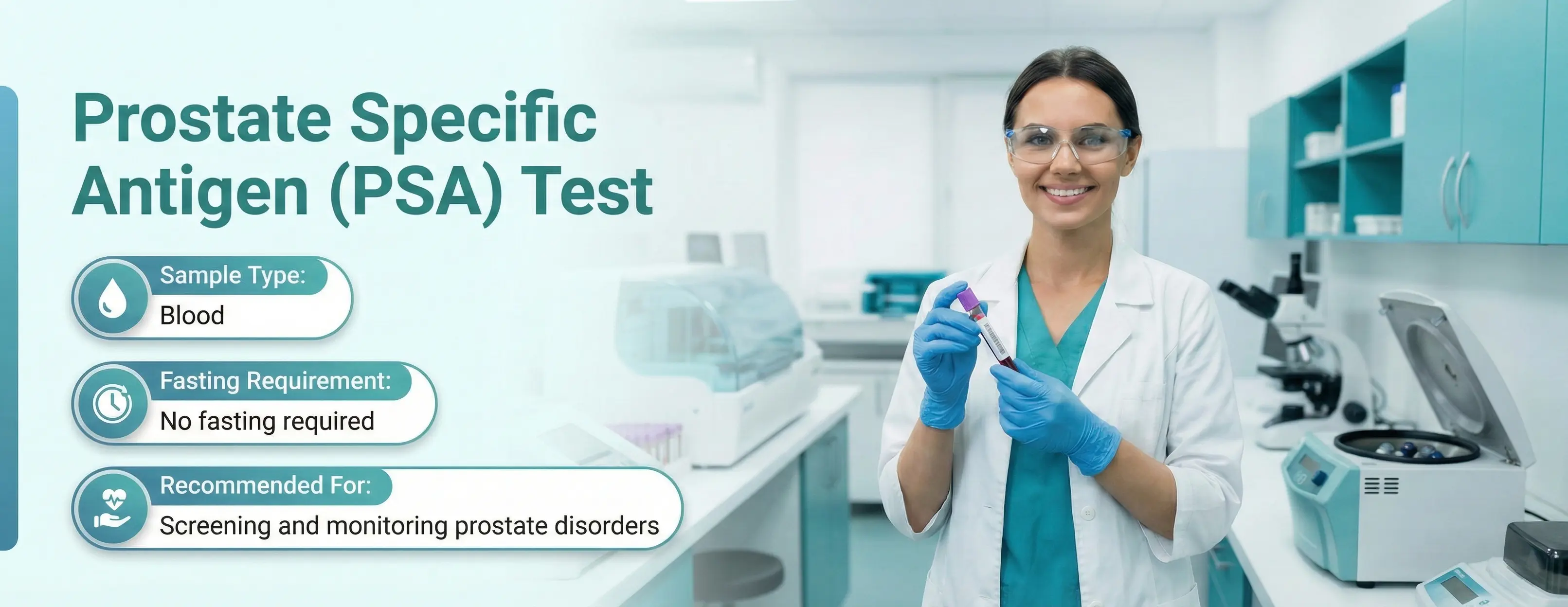
- SummaryThe Prostate-Specific Antigen (PSA) test is a blood test that measures the level of PSA in your blood. PSA is a substance produced by the prostate gland in males. The PSA levels can be elevated in benign prostatic hyperplasia, and prostate cancer. This test is done by taking a blood sample from a vein in your arm, fasting is not required for this test. Read more
- Reports WithinN/AView Sample Report

 100% NABL & ISO Certified Labs
 - SampleBlood

- Age35+ years
- GenderMales
- FastingNot Required

PharmEasy Promises



Know More About The Test


A quick info on PSA test

Overview
Prostate cancer is one of the most common cancers affecting men worldwide. It develops in the prostate gland, a small organ located below the urinary bladder that helps with semen production. Since prostate cancer often grows slowly and may not cause symptoms in its early stages, screening plays an important role in early detection.
The prostate-specific antigen (PSA) test is a commonly used screening test for prostate cancer. It measures the level of PSA, a protein produced by the prostate gland, in the blood. Elevated PSA levels may be an early indicator of prostate cancer, although they can also occur due to non-cancerous conditions such as prostate enlargement or inflammation.
Since the PSA test cannot diagnose prostate cancer on its own, it is used to identify people who may need further evaluation. It is often performed alongside other assessments, such as a digital rectal examination (DRE). Abnormal results may require additional investigations to confirm the diagnosis and guide treatment decisions.

When and Who Should Get a PSA Test?
The American Cancer Society recommends discussing the benefits, risks, and limitations ofPSA screening with a healthcare provider before deciding on testing. These discussions should begin at:
- 50 years for men at average risk.
- 45 years for men at higher risk (including African American men and those with a first-degree relative diagnosed with prostate cancer at an early age).
- 40 years for men at very high risk (such as those with more than one first-degree relative diagnosed with prostate cancer at an early age).
If prostate cancer is suspected due to symptoms such as difficulty in urinating, increased frequency or urgency of urination, pelvic discomfort, blood in semen or urine, erectile dysfunction, weakness or numbness in legs, or loss of bladder or bowel control.
.png?dim=48x48&q=75)
How Frequently Should You Take the PSA Test?
|
Frequency of testing |
Age |
|---|---|
|
A single test to establish a baseline PSA |
If you are a 40 to 45-year-old male |
|
Annual testing |
If you are a high-risk adult male aged 45 years or older |
|
Testing every 2 to 3 years |
If you are a male aged 50 years or older |
|
Routine testing is not required |
If you are a male aged 75 years old, or have less than 10 years of life expectancy |
|
The test will be repeated Follow-up testing every 6 to 12 months for monitoring |
If PSA test results are abnormal |

What Conditions Can a PSA Test Help Detect?
- The PSA test is used in screening for prostate cancer.
- PSA levels in the blood may also be elevated in cases of prostate gland enlargement or infection, urinary tract infections, use of certain medications such as finasteride, and recent procedures in the pelvic area, such as cystoscopy, catheterisation, prostate biopsy, or colonoscopy.
Elevated PSA values do not confirm prostate cancer. Further investigations will be advised for determining the cause of increased PSA levels.
Disclaimer: The above list is for educational purposes only and does not confirm a diagnosis or the presence of any condition. Always consult your doctor about your test results and diagnosis.

PSA Test Preparation
- Avoid sexual activity, including ejaculation, for 24 to 48 hours before the test.
- Avoid vigorous exercise, particularly cycling, for 24 to 48 hours before the test, as it may temporarily affect PSA levels.
What to Expect Before the Test
- The PSA test can be performed at any time of the day and does not require fasting.
- Inform your healthcare provider if you are taking medications; have recently undergone a prostate biopsy, prostate surgery, or any urinary tract procedure; have had a recent urinary tract infection (UTI); or have a liver condition such as cirrhosis or hepatitis, or a condition such as cystic fibrosis.
What to Expect During the Sample Collection
- You will be visited by our phlebotomist at your home at the scheduled time. They will clean your skin with an antiseptic solution and collect a small blood sample from a vein in your arm using a sterile needle. They will then ask you to apply pressure to the site using a cotton ball and will later apply a small bandage.
- The procedure usually takes only a few minutes and may cause mild discomfort or a slight pinching sensation.
What to Expect After the Test
- You may experience mild throbbing at the site after the blood is drawn. This is temporary and will pass in a few minutes. You may drink plenty of fluids and avoid exercising for a few hours.
- The collected sample will be taken for analysis in the laboratory, and results are usually available within a few hours on the PharmEasy platform.
Note: If you notice anything unusual at the puncture site, such as persistent bleeding, a rash, or pain, consult your healthcare provider.

What Are the parameters included in the PSA test?
The PSA test measures a single key parameter:
- Total PSA (Prostate Specific Antigen) - measured in ng/mL (nanograms per millilitre).

Normal Range of PSA Test Parameters
PSA normal values are age-dependent:
|
Age Group |
Normal PSA Range |
Clinical Interpretation |
|---|---|---|
|
40 - 49 years |
0 - 2.5 ng/mL |
PSA within this range is reassuring for this age group. |
|
50 - 59 years |
0 - 3.5 ng/mL |
PSA within this range is reassuring. Above 3.5 warrants further evaluation. |
|
60 - 69 years |
0 - 4.5 ng/mL |
PSA within this range is acceptable. Above 4.5 requires urological evaluation. |
|
Above 70 years |
0 - 6.5 ng/mL |
Slightly higher PSA is expected with age. Above 6.5 warrants clinical evaluation. |
Important Note: Normal PSA ranges may vary between laboratories and between Indian and Western reference populations. Studies show PSA ranges tend to be lower in Indians.

PSA Test Result Interpretation
The PSA result must be interpreted in the context of your age, symptoms, digital rectal examination findings, and the free/total PSA ratio. A single elevated PSA reading is not sufficient for diagnosis.
|
PSA level |
Risk category |
Potential interpretation and action |
|---|---|---|
|
Below 4 ng/mL |
Low risk |
Generally reassuring. Routine monitoring as per age-specific schedule. |
|
4 - 10 ng/mL |
Borderline/moderate risk |
Grey zone. Prostate cancer is possible, but so are BPH and prostatitis. Free PSA ratio and urological evaluation recommended. |
|
Above 10 ng/mL |
High risk |
Significantly elevated. High suspicion of prostate cancer. Urological referral and prostate biopsy are typically recommended. |
|
Rapidly rising PSA (>0.75 ng/mL/year) |
PSA velocity concern |
Even if the absolute value is below 4, a rapid annual rise warrants urgent evaluation. |
|
Low free PSA/total PSA ratio (<15%) |
Higher cancer risk |
A lower free-to-total PSA ratio suggests a higher likelihood of prostate cancer over benign conditions. |
|
Post-treatment - rising PSA |
Biochemical recurrence |
A rising PSA after prostatectomy (above 0.2 ng/mL) or after radiation suggests cancer recurrence. |
Disclaimer: This table is for educational purposes only. PSA interpretation requires the expertise of a qualified urologist. A high PSA does not confirm prostate cancer; false positives are common. Never make treatment decisions based on PSA alone.

PSA Test Risks and Limitations
Potential Risks and Complications
- The random blood sugar test is generally safe and involves minimal risk.
- Mild discomfort, slight bleeding or bruising at the blood collection site, and dizziness or light-headedness may occasionally occur.
- In rare cases, there may be difficulty locating a vein or a small risk of infection.
Understanding Prostate Specific Antigen Test Limitations
- A false-positive result may suggest prostate cancer when none is present, potentially leading to unnecessary investigations such as a prostate biopsy, which carries small risks of pain, bleeding, and infection.
- An abnormal PSA result can sometimes cause anxiety while further testing is being performed.
- A false-negative result may fail to detect an existing cancer, creating a false sense of reassurance.
- Screening may detect slow-growing prostate cancers that are unlikely to affect overall health during a person’s lifetime. In some cases, these cancers may still be treated, which can lead to side effects such as urinary problems, bowel dysfunction, and difficulties with sexual function.

PSA Test Price in Pune
In Pune, the standard cost for a PSA test at PharmEasy typically starts from INR 649. However, the pricing can fluctuate due to various factors such as location and the diagnostic provider. For additional details, you can compare PSA test prices across major cities in India.
|
City |
Offer Price |
|---|---|
|
649 |
|
|
649 |
|
|
649 |
|
|
649 |
|
|
649 |
|
|
649 |
|
|
649 |
|
|
649 |
|
|
649 |
|
|
649 |

Areas We Serve in Pune
You can book the PSA Test in Pune through PharmEasy with convenient home sample collection across several localities, including :
- Kothrud
- Shivajinagar
- Baner
- Aundh
- Pashan
- Wagholi
- Karve Nagar
- Warje
- Sinhagad Road
- Viman Nagar
- Lohegaon
- Kalyani Nagar
- Koregaon Park
- Hadapsar
- Mundhwa
- Kharadi
- Hinjewadi
- Nigdi
- Pimple Saudagar
- Dhankawadi
You can also check service availability during purchase by entering your pin code.

PSA Test Sample Collection: Home vs. Diagnostic Lab
The PSA test at PharmEasy offers convenient features as compared to traditional labs:
|
Feature |
PharmEasy home collection |
Traditional labs |
|---|---|---|
|
At-home sample collection by a phlebotomist |
✅ |
❌ |
|
No travel required |
✅ |
❌ |
|
Saves time |
✅ |
❌ |
|
Flexible appointment slots |
✅ |
❌ |
|
Comfortable testing experience |
✅ |
❌ |
|
Reduced exposure to crowds |
✅ |
❌ |
|
Easy digital report access |
✅ |
❌ |
|
Waiting in queues |
❌ |
✅ |
To get the advantage of home sample collection for the test in Pune, visit the PharmEasy website or app. Search for the prostate specific antigen test, enter your location, and confirm the booking.
Was This Test Information Helpful?
Please rate your experience
 Yes Helpful (12)
 Not Helpful
References
People Also Ask
Is the PSA test suitable for senior citizens?
Can I undergo PSA testing if I have urinary symptoms?
What is a digital rectal examination (DRE)?
Is home sample collection available in Pune?
Can younger men undergo a PSA test?
How can I prepare for the most accurate PSA result?
Is PSA testing useful even if I have no urinary symptoms?
 4.6 Stars| 7+ Lakhs Ratings & Reviews

Over 10 million happy users PharmEasy Labs
- Because the digital report is available on WhatsApp, there's no need to go back to the lab. Thanks, PharmEasy!
 Sachin sharma11 Jan ‘26
 - Thanks to the coupon discount, the blood test was done at a lower price.Komal04 Jan ‘26
- The lab technician was a good and knowledgeable professional.Rakesh Pandey06 Jan ‘26
- Due to bad weather, it's difficult to reach the lab. But home collection makes things easier.Arjun08 Jan ‘26
- Thanks to the Swasth AI feature, the report is easy to understand.Priya Mehta02 Jan ‘26
- The report is available on the same day. Wow!Vikas Patel05 Jan ‘26
Have any doubts? Ask us.
Ask us anything about the Prostate Specific Antigen Test (PSA For Men) In Pune - Price & Details to understand it better
Nearby Labs
Lab tests made easy!
- Quick Collection
- Trusted Accuracy
- Hassle-free Services
PharmEasy Labs (Thyrocare powered) - Pune
Kailash Heights, C.T.S No.636, Wing ‘A’, Maharashtra
 grievance-officer@docon.in
 7022000900
PharmEasy Labs (Covid RTPCR) - Pune
D-37/1, MIDC, Turbhe, Opp. Sandoz,, Maharashtra
grievance-officer@docon.in7022000900
Agilus Diagnostics Limited - Pune
Agilus Diagnostics, Pinnac Raj House, S.No. 155, 1St Floor, Above Union Bank Of India,, Maharashtra
grievance-officer@docon.in7022000900
Likhitha's Diagnostics & Speciality Lab - Pune
Stellar Enclave, 101, Above McDonald's, Aundh,, Maharashtra
grievance-officer@docon.in7022000900Aarthi Scans and Labs - Pune
SHOP NO 1, 2 AND OFFICE NO. 7, ON GROUND FLOOR, Audumber Haritage, 430/1, Mangalwar Peth Rd, Mangalwar Peth, Kasba Peth,, Maharashtra
grievance-officer@docon.in7022000900Vitara Healthcare - Pune
1st Floor, Tatvam Vertex, above Hotel Shivsagar, Matoshri Colony, Nandanwan Society, Vishal Nagar, Pimple Nilakh, Pune,, Maharashtra
grievance-officer@docon.in7022000900Medicover Hospitals - AHC - Pune
Medicover Hospitals KLE, Beside Union Bank of India, Sector No 1, Indrayani Nagar, Bhosari, Pimpri Chinchawad, Pune, Maharashtra
grievance-officer@docon.in7022000900Anandrishiji Medical Centre - Pune
4th Floor, Vardhaman Bldg, Shankar Sheth Rd, nr. Oswal Bandhu Samaz Bldg, Swargate,, Maharashtra
grievance-officer@docon.in7022000900KNA Healthcare - Pune
Block No.9 First Floor, 335, above Laxmi Sweet Mart, New Raviwar Peth, Rasta Peth, Maharashtra
grievance-officer@docon.in7022000900Health & Smiles Polyclinic/Multispecialty clinic - AHC - Pune
Shop no. 1 & 2, Bhuvi Sugandh Building, Balewadi High St, behind Amol Balwadkar BJP Office, Balewadi Gaon, Balewadi, Maharashtra
grievance-officer@docon.in7022000900Aarthi Scans and Labs - Pune
No .1 ground floor, FVP5+74 Ramadhawj complex, next to hp petrol pump, Vasant Baug, Vasant Baug Society, Maharshi Nagar, Maharashtra
grievance-officer@docon.in7022000900Pristine Imaging and Diagnostic Centre - Pune
Office 201, Gulmohar Apartments, 2420, East St, opposite Bombay Garage, Camp, Maharashtra
grievance-officer@docon.in7022000900Health Buddy Diagnostic Pvt Ltd - Pune
A Square, Ganga Nagar Road, Near Akurdi Railway Station, Pradhikaran, Nigdi, Pune, Maharashtra - 411044, Maharashtra
grievance-officer@docon.in7022000900Health Buddy Diagnostic Pvt Ltd - Pune
Jai Residency, Flat no. 1, Opp.Avdhoot complex, Maharana Pratap Chowk, Pune- 411046, Maharashtra
grievance-officer@docon.in7022000900Health Buddy Diagnostic Pvt Ltd - Pune
Anandghan Commercial Complex, 1st Floor, Above PNB Bank, Parihar Chowk, ITI Road, AundhPune-411007, Maharashtra
grievance-officer@docon.in7022000900Health Buddy Diagnostic Pvt Ltd - Pune
Hutatma chowk, Bhosari Alandi Road, Pune 411039, Maharashtra
grievance-officer@docon.in7022000900Diagnopein - Pune
Alka Talkies signal, Lal Bahadur Shastri Rd, Joshi Wada, Sadashiv Peth, Pune 411030, Maharashtra
grievance-officer@docon.in7022000900Diagnopein - Pune
shop 7,8 Chinmaya Co-operative Housing Soc. Opp. Zilla Parishad, Dr. Babasaheb Ambedkar Road, Camp, Pune - 411001., Maharashtra
grievance-officer@docon.in7022000900Diagnopein - Pune
1st floor b g corner, Sector Number 21, Nigdi Gaothan, Nigdi, Pimpri-Chinchwad, Maharashtra 411044, Maharashtra
grievance-officer@docon.in7022000900Diagnopein - Pune
Ground Floor, Pathare Galaxy, Below Vatsalya Hospital, Kharadi Bypass Road, Kharadi, Pune - 14, Maharashtra
grievance-officer@docon.in7022000900Diagnopein - Pune
Sitai Park, 3, DP Rd, opp. Shivsagar hotel, Harmony Society, Ward No. 8, Wireless Colony, Aundh, Pune, Maharashtra 411007, Maharashtra
grievance-officer@docon.in7022000900Diagnopein - Pune
Ground Floor, Vishal ventila, Near Noble Hospital, Magarpatta, Hadapsar, Pune 411028, Maharashtra
grievance-officer@docon.in7022000900Diagnopein - Pune
Tempo Chowk 37, NearAnjali School, Lane No. 3, Ashtavinayak Nagar, Wadgaon Sheri, Pune, 411014, Maharashtra
grievance-officer@docon.in7022000900Diagnopein - Pune
Next Laxmi Medical, Station Road, near Chaphekar Chowk, Chinchwad Gaon, Punawale, Pimpri-Chinchwad 411033, Maharashtra
grievance-officer@docon.in7022000900Diagnopein - Pune
7,8, VISHNU-VIHAR, KONDHAWA ROAD, near KUMAR PARK, Market Yard, Bibwewadi, Pune 411037, Maharashtra
grievance-officer@docon.in7022000900Diagnopein - Pune
shop no 3, 1, NEETA PARK, Airport Rd, White House Society, Yerawada, Pune 411006, Maharashtra
grievance-officer@docon.in7022000900Diagnopein - Pune
Minal Apartment, Warje Malwadi Rd, Nal Stop, Pandurang Colony, Erandwane, Pune 411004, Maharashtra
grievance-officer@docon.in7022000900Qtest Lab Dental Diagnostics - AHC - Pune
S.NO 21/4, Kharadi - Hadapsar Bypass Rd, near Manipal Hospital, Raghoba Patil Nagar, Santipur, Thite Nagar, Kharadi,, Maharashtra
grievance-officer@docon.in7022000900Texas Imaging & Labs - Pune
Lotus Court, Old Mundhwa Rd, near HDFC Bank, Chandan Nagar, Kharadi,, Maharashtra
grievance-officer@docon.in7022000900Commvault - AI Screening - Pune
Amar Sadanand Tech Park (ASTP) HQG7+5XF, Hinjawadi Road, Patil Nagar, Maharashtra
grievance-officer@docon.in7022000900Search Diagnostic Center - Pune
1st floor, Maharana Pratap Chowk, 1,Jai Residency, Trimurti Chowk, near Suvarna yug Sahakari bank, Pune, Maharashtra 411046, Maharashtra
grievance-officer@docon.in7022000900Fittr- Diagnostics - Pune
7th floor, Goodwill B’Yond, EON Free Zone, Kharadi,, Maharashtra
grievance-officer@docon.in7022000900Neuberg Diagnostics - AHC - Pune
Room No 01, Building Show, CTS No 809, Nayanatara, F.P. 147, Bhandarkar Rd, opposite TVS Showroom, Deccan Gymkhana, Pune, Maharashtra 411004, Maharashtra
grievance-officer@docon.in7022000900HealthRoute - Pune
Avishkar Campus, Nijanand Nagar, Nr. Motipura Railway Over Bridge, Himmatnagar - 383001, Maharashtra
grievance-officer@docon.in7022000900HealthRoute - Pune
NATHANI HEIGHTS' B -WING, SHOP NO. 51, GROUND FLOOR,BEFORE AXIS BANK ,BELASSIS ROAD, OPPOSITE, Maharashtra
grievance-officer@docon.in7022000900HealthRoute - Pune
1761, Navarang Circle, Dr Rajkumar Rd, opp. to Navrang Theater, 2nd Stage, Rajajinagar,, Maharashtra
grievance-officer@docon.in7022000900Medicos Clinics - Pune
DAV School Lane.Bisra Road, Bisra Road, Maharashtra
grievance-officer@docon.in7022000900Dr Danej Heart Clinics and Diagnostics - Pune
Savata Lodge Basement, Kothi Road , Savta Lodge, Maharashtra
grievance-officer@docon.in7022000900HealthRoute - Pune
51/21, Shipra Path, opp. indus hospital, Ward 27, Mansarovar Sector 5, Mansarovar,, Maharashtra
grievance-officer@docon.in7022000900ScanLab Diagnostics - Pune
b56, Block B, Sector 22, B-Block Noida Opposite Income Tax Office Gautam Budh Nagar, Maharashtra
grievance-officer@docon.in7022000900Tenet Diagnostics - Pune
Ground Floor, SK 112, Sector 116,, Maharashtra
grievance-officer@docon.in7022000900CureBay Clinics - AHC - Pune
Plot-659, Tankapani Rd, BJB Nagar,, Maharashtra
grievance-officer@docon.in7022000900Explore More at PharmEasy
Top-Selling Healthcare Products

We provide trusted, expert-curated health content to support better awareness,prevention, and care.
Backed by experienced doctors, medical experts, and strict editorial standards.