

2049+ orders placed in your location

100% NABL & ISO Certified Lab • 100% Accurate Reports
Prostate Specific Antigen Test (PSA For Men) In Hyderabad - Price & Details
Total PSA, Complex PSA, Free PSA
- SummaryThe Prostate-Specific Antigen (PSA) test is a blood test that measures the level of PSA in your blood. PSA is a substance produced by the prostate gland in males. The PSA levels can be elevated in benign prostatic hyperplasia, and prostate cancer. This test is done by taking a blood sample from a vein in your arm, fasting is not required for this test. Read more
- Reports Within4 HrsView Sample Report

 100% NABL & ISO Certified Labs
 - SampleBlood

- Age35+ years
- GenderMales
- FastingNot Required

PharmEasy Promises



Know More About The Test


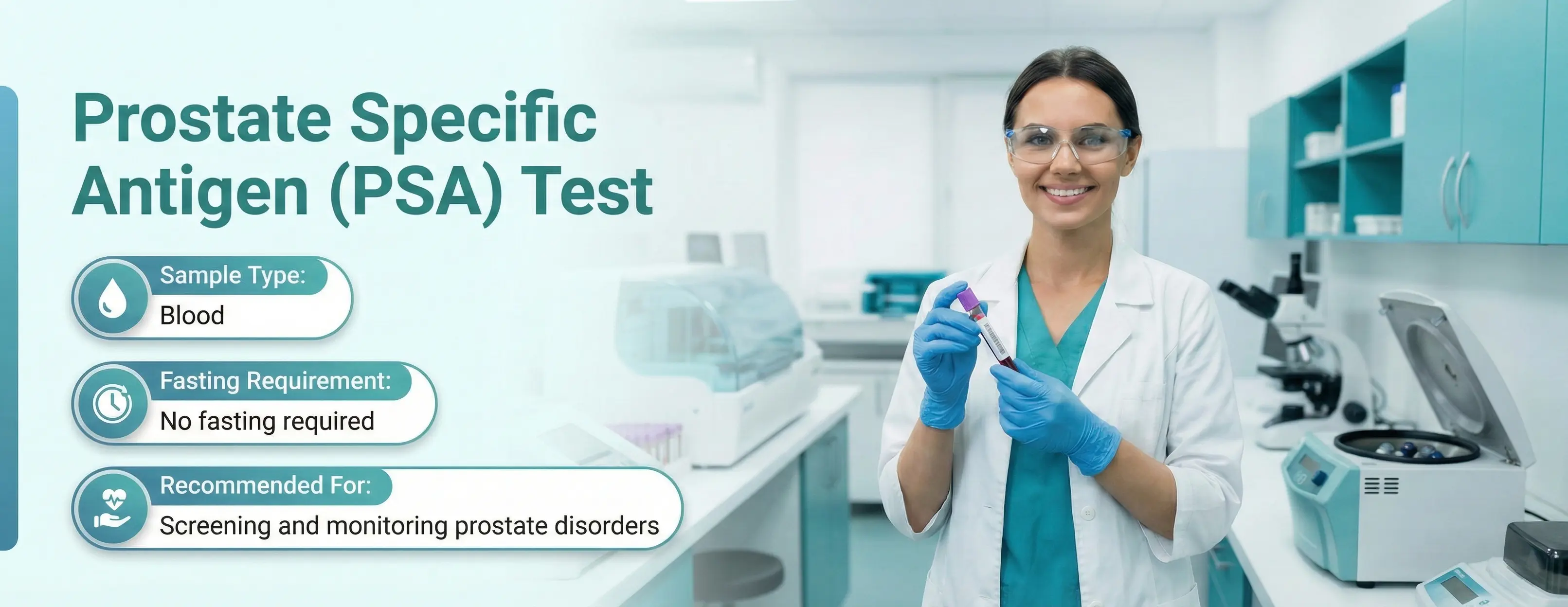
A quick info on PSA test

Overview
The prostate specific antigen (PSA) test is a simple blood test that measures the amount of PSA in the blood. PSA is a protein produced by both normal and cancerous cells in the prostate gland in men. It is released into the seminal fluid to help liquefy semen, but small amounts can naturally leak into the bloodstream.
The PSA test is primarily used to screen for prostate cancer and monitor men who have already been diagnosed with the disease. It may also be used for evaluating urinary issues in men, such as frequent or painful urination and pelvic pain.
While a high PSA level can be a warning sign for prostate cancer, an elevated result does not always mean cancer. Several non-cancerous conditions of the urinary or pelvic area are much more common causes of a spike in PSA.
If PSA levels are elevated, your doctor may advise a repeat PSA test, digital rectal exam, prostate MRI, or biopsy to aid in the diagnosis. For personalised guidance on whether you should be screened, you may consult your primary care physician or urologist.

When and Who Should Get a PSA Test Done?
- If you are an adult male above 50 years of age or have a close family member (father, brother, or son) with prostate cancer.
- If you experience frequent urination, difficulty in urinating, blood in the urine or semen, pelvic or back pain, or urinary incontinence.
- Your doctor may also recommend this test to monitor disease progression, treatment response, or recurrence if you have already been diagnosed with prostate cancer.
.png?dim=48x48&q=75)
How Frequently Should You Take the PSA Test?
The frequency of undergoing the PSA test depends on the individual's age and risk factors and must be decided after discussion with your doctor.
- Age 40-45 years: A single PSA test to establish a baseline PSA level.
- High-risk men aged 45 years and older: Annual PSA testing.
- Men aged 50 years and older: PSA testing every 2-3 years, depending on individual risk factors and previous results.
- Men aged 75 years and older or those with a life expectancy of less than 10 years: Routine PSA screening is generally not recommended.
- Abnormal PSA results: Repeat testing and follow-up monitoring, typically every 6-12 months, may be advised.

What Conditions Can a PSA Test Help Detect?
- Prostate cancer screening in asymptomatic patients
- Initial test for the diagnosis of prostate cancer in those with urinary symptoms
- Monitoring treatment response and recurrence in patients who have prostate cancer or are in remission.
- PSA levels can also be abnormal in benign prostatic hyperplasia, urinary tract infections, inflammation, and infection of the prostate, and if you take certain medications.
Elevated PSA values do not confirm prostate cancer. Further investigations will be advised for determining the cause of increased PSA levels.
Disclaimer: The above list is for educational purposes only and does not confirm a diagnosis or the presence of any condition. Always consult your doctor about your test results and diagnosis.
.png?dim=48x48&q=75)
PSA Test Preparation
To help ensure accurate PSA test results, avoid activities that may temporarily increase PSA levels for at least 48 hours before the blood sample is collected:
- Avoid sexual activity, including ejaculation.
- Refrain from vigorous physical activity, particularly cycling or motorcycle riding, which can place pressure on the prostate gland.
- Avoid prostate manipulation, such as prostate massage or a digital rectal examination (DRE), immediately before the test.
What to Expect Before the Test
- The PSA test can be performed at any time of the day and does not require fasting.
- Inform your healthcare provider if you are taking medications for prostate enlargement or hair loss, such as finasteride or dutasteride.
- You should also mention any recent urinary tract procedures, including catheterisation, cystoscopy, or a prostate biopsy, within the previous six weeks.
- If you currently have, or have recently recovered from, a urinary tract infection, your healthcare provider may recommend postponing the test.
What to Expect During the Sample Collection
A trained phlebotomist will arrive at your home at the scheduled time.
- An elastic band will be tied over the upper arm, and you may be asked to make a tight fist.
- A sterile needle will be inserted into a vein in your inner arm to collect the blood sample.
- After the needle is removed, you may be asked to apply pressure to the site with a cotton gauze, and then a bandage may be placed.
What to Expect After the Test
- A slight pain or a sting may be felt when the needle is inserted. Mild throbbing at the site may also be felt after the blood is drawn, which will pass in about a minute.
- Once the sample is analysed in the laboratory, the report will be uploaded to the PharmEasy platform for easy access. The healthcare provider will interpret the results and advise further evaluation or treatment if required.
Note: If you notice anything unusual at the puncture site, such as persistent bleeding, a rash, or pain, consult your healthcare provider.

What are the Parameters Included in a PSA Test?
The PSA test measures a single key parameter:
- Total PSA (prostate specific antigen) - measured in ng/mL (nanograms per millilitre).

Normal Range of PSA Test Parameters
PSA normal values are age-dependent:
|
Age group |
Normal PSA range |
Clinical interpretation |
|---|---|---|
|
40 - 49 years |
0 - 2.5 ng/mL |
PSA within this range is reassuring for this age group. |
|
50 - 59 years |
0 - 3.5 ng/mL |
PSA within this range is reassuring. Above 3.5 warrants further evaluation. |
|
60 - 69 years |
0 - 4.5 ng/mL |
PSA within this range is acceptable. Above 4.5 requires urological evaluation. |
|
Above 70 years |
0 - 6.5 ng/mL |
Slightly higher PSA is expected with age. Above 6.5 warrants clinical evaluation. |
Important note: Normal PSA ranges may vary between laboratories and between Indian and Western reference populations. Studies show PSA ranges tend to be lower in Indians.
.png?dim=48x48&q=75)
PSA Test Result Interpretation
The PSA result must be interpreted in the context of your age, symptoms, digital rectal examination findings, and the free/total PSA ratio. A single elevated PSA reading is not sufficient for diagnosis.
|
PSA level |
Risk category |
Potential interpretation and action |
|---|---|---|
|
Below 4 ng/mL |
Low risk |
Generally reassuring. Routine monitoring as per age-specific schedule. |
|
4 - 10 ng/mL |
Borderline/moderate risk |
Grey zone. Prostate cancer is possible, but so are BPH and prostatitis. Free PSA ratio and urological evaluation recommended. |
|
Above 10 ng/mL |
High risk |
Significantly elevated. High suspicion of prostate cancer. Urological referral and prostate biopsy are typically recommended. |
|
Rapidly rising PSA (>0.75 ng/mL/year) |
PSA velocity concern |
Even if the absolute value is below 4, a rapid annual rise warrants urgent evaluation. |
|
Low free PSA/total PSA ratio (<15%) |
Higher cancer risk |
A lower free-to-total PSA ratio suggests a higher likelihood of prostate cancer over benign conditions. |
|
Post-treatment - rising PSA |
Biochemical recurrence |
A rising PSA after prostatectomy (above 0.2 ng/mL) or after radiation suggests cancer recurrence. |
Disclaimer: This table is for educational purposes only. PSA interpretation requires the expertise of a qualified urologist. A high PSA does not confirm prostate cancer - false positives are common. Never make treatment decisions based on PSA alone.

PSA Test Risks and Limitations
Occasionally, side effects related to blood sample collection, such as slight bleeding, bruising, dizziness, fainting, difficulty locating veins, or a small risk of infection, may occur. Try not to exert the arm too much to reduce the risk of bruising.
Understanding Prostate Specific Antigen Test Limitations
- Elevated PSA levels do not always indicate prostate cancer and may lead to additional investigations, such as prostate biopsies, which carry risks of discomfort, bleeding, and infection.
- A normal PSA result does not completely rule out prostate cancer, as some cancers may not cause a significant rise in PSA levels.
- PSA screening may identify slow-growing prostate cancers that are unlikely to cause symptoms or affect life expectancy, potentially resulting in unnecessary treatment and associated side effects.
- Non-cancerous conditions, including benign prostatic hyperplasia (BPH), prostatitis, and urinary tract infections, can also increase PSA levels, making interpretation more challenging.

PSA Test Price in Hyderabad
In Hyderabad, the average cost of a PSA test at PharmEasy typically starts from INR 649. However, various factors can influence the cost fluctuations of a PSA test, such as location and the diagnostic provider. For more insights, you can compare PSA test prices across major Indian cities.
|
City |
Offer Price |
|---|---|
|
649 |
|
|
649 |
|
|
649 |
|
|
649 |
|
|
649 |
|
|
649 |
|
|
649 |
|
|
649 |
|
|
649 |
|
|
649 |

Areas We Serve in Hyderabad
You can book Prostate Specific Antigen Test (PSA For Men) in Hyderabad through PharmEasy with convenient home sample collection across several localities, including :
- Gachibowli
- Somajiguda
- Madhapur
- Kondapur
- Kukatpally
- Miyapur
- Jubilee Hills
- Banjara Hills
- Ameerpet
- Begumpet
- Secunderabad
- Manikonda
- Nallagandla
- Chanda Nagar
- Himayatnagar
- Mehdipatnam
- Tolichowki
- Attapur
- Uppal
- LB Nagar
You can also check service availability during purchase by entering your pin code.

PSA Test Sample Collection: Home vs. Diagnostic Lab
The PSA test at PharmEasy offers convenient features as compared to traditional labs.
|
Feature |
PharmEasy home collection |
Traditional labs |
|---|---|---|
|
At-home sample collection |
✅ |
❌ |
|
No travel required |
✅ |
❌ |
|
Saves time |
✅ |
❌ |
|
Flexible appointment slots |
✅ |
❌ |
|
Comfortable testing experience |
✅ |
❌ |
|
Reduced exposure to crowds |
✅ |
❌ |
|
Professional home visit by a phlebotomist |
✅ |
❌ |
|
Easy digital report access |
✅ |
❌ |
|
Waiting in queues |
❌ |
✅ |
Pro tip: To get the advantage of home sample collection for the test in Ahmedabad, visit the PharmEasy website or app. Search for the prostate specific antigen test, enter your location, and confirm the booking.
Was This Test Information Helpful?
Please rate your experience
 Yes Helpful (12)
 Not Helpful
References
People Also Ask
Can PSA levels fluctuate naturally?
Can PSA testing be used after prostate cancer treatment?
Does an elevated PSA level always require a biopsy?
What is PSA velocity?
Are reports of the PSA test done through PharmEasy available digitally?
Are home sample collection services available for senior citizens in Hyderabad?
How long does the sample collection take for the PSA test?
 4.6 Stars| 7+ Lakhs Ratings & Reviews

Over 10 million happy users PharmEasy Labs
- Because the digital report is available on WhatsApp, there's no need to go back to the lab. Thanks, PharmEasy!
 Sachin sharma11 Jan ‘26
 - Thanks to the coupon discount, the blood test was done at a lower price.Komal04 Jan ‘26
- The lab technician was a good and knowledgeable professional.Rakesh Pandey06 Jan ‘26
- Due to bad weather, it's difficult to reach the lab. But home collection makes things easier.Arjun08 Jan ‘26
- Thanks to the Swasth AI feature, the report is easy to understand.Priya Mehta02 Jan ‘26
- The report is available on the same day. Wow!Vikas Patel05 Jan ‘26
Have any doubts? Ask us.
Ask us anything about the Prostate Specific Antigen Test (PSA For Men) In Hyderabad - Price & Details to understand it better
Nearby Labs
Lab tests made easy!
- Quick Collection
- Trusted Accuracy
- Hassle-free Services
PharmEasy Labs (Covid RTPCR) - Hyderabad
D-37/1, MIDC, Pune, Opp. Sandoz,, Tamil Nadu
 grievance-officer@docon.in
 7022000900
PharmEasy Labs (Thyrocare powered) - Hyderabad
Kailash Heights, C.T.S No.636, Wing ‘A’, Telangana
grievance-officer@docon.in7022000900
Medquest Diagnostics - Hyderabad
5th Floor, Diamond Tower, Khairtabad, 500003, Telangana
grievance-officer@docon.in7022000900
Vijaya Diagnostics Center - AHC - Hyderabad
31, 9-1, 77 (new), IVth Floor, Sarojini Devi Rd, opp. Kotak Mahindra bank, Regimental Bazaar, Shivaji Nagar, 500003, Telangana
grievance-officer@docon.in7022000900Vijaya Diagnostics Center - AHC - Hyderabad
1-7-79/A & B, Legend Crystal, P.G. Road, HDFC Bank Lane, behind Sunshine Hospital, Paradise, 500003, Telangana
grievance-officer@docon.in7022000900Vijaya Diagnostics Center - AHC - Hyderabad
Ground Floor, Plot No. 22, opp. G Pulla Reddy Sweets, Janakapuri, Asbestos Staff Colony, Karkhana,, Telangana
grievance-officer@docon.in7022000900Vijaya Diagnostics Center - AHC - Hyderabad
Ground Floor, Narayana Ganga Enclave, D No. 11-2-469 & 470, behind Venkateswara Swamy Temple Namalagundu, Seethaphalmandi, 500061, Telangana
grievance-officer@docon.in7022000900Vijaya Diagnostics Center - AHC - Hyderabad
6-39/27, Rd Number 3, opposite Medplus Pharmacy, Mallikarjuna Nagar, Old Bowenpally,500011, Telangana
grievance-officer@docon.in7022000900Agilus Diagnostics - Hyderabad
D.No: 6-3-455, Ground Ans 1st floor, Titus sharma complex, sai baba temple road, Telangana
grievance-officer@docon.in7022000900Lucid Diagnostics - Hyderabad
Plot No. 5 & 6, opp. MORE Megastore, Sri Sai Nagar Colony, Kukatpally,, Telangana
grievance-officer@docon.in7022000900Lucid Diagnostics - Hyderabad
No. 1-6-5/5, Ganapathi Arcade Radhika X Road, behind Asian Radhika Multiplex, Kapra,, Telangana
grievance-officer@docon.in7022000900Lucid Diagnostics - Hyderabad
203, Vasavi Nagar, Karkhana,, Telangana
grievance-officer@docon.in7022000900Agilus Diagnostics Limited - Hyderabad
Agilus Diagnostics, D.No: 6-3-455, Ground And 1St Floor, Titu'S Sharma Complex, Sai Baba Temple Road, Panjagutta,, Telangana
grievance-officer@docon.in7022000900Tesla Diagnostics - Hyderabad
2ND FLOOR, SY.NO.37, Gachibowli - Miyapur Rd, above RATNADEEP SUPERMARKET,, Telangana
grievance-officer@docon.in7022000900Tenet Diagnostics - Hyderabad
Survey No.136, Ground Floor, Sreshta Marvel, Gachibowli - Miyapur Rd, P Janardhan Reddy Nagar, Gachibowli, Telangana
grievance-officer@docon.in7022000900Tenet Diagnostics - Hyderabad
Pooja Plaza, plot no.C2/C2A, Vikrampuri Colony, above Vac's Patisserie, Vikrampuri Colony, Karkhana, Hyderabad,, Telangana
grievance-officer@docon.in7022000900Tenet Diagnostics - Hyderabad
Plot no 101,Survey No. 459,460 & 461 Atomic Energy Employees Co-Operative Housing Society Colony Anupuram, Kapra,, Telangana
grievance-officer@docon.in7022000900Lucid Diagnostics - Hyderabad
D.No: 16-11-770, Moosarambagh signal, SBI Bank lane service road Moosarambagh x, road, Dilsukhnagar,, Telangana
grievance-officer@docon.in7022000900Aarthi Scans and Labs - Hyderabad
MIG-148, Rd Number 1, near Padmaja hospital, KPHB Phase 2, Kukatpally,, Telangana
grievance-officer@docon.in7022000900Aarthi Scans and Labs - Hyderabad
6-3-347/12/A/10/1/7, Saibaba Temple Rd, near Model House, Dwarakapuri, Punjagutta, Telangana
grievance-officer@docon.in7022000900Likhitha's Diagnostics & Speciality Lab - Hyderabad
Opposite Pillar no : 1555, 13-3-12/A Hanuman nagar, Opp Laxmi chindrens hospital, pochemma temple lane, Chaithanya puri ,Dilshuknagar500060, Telangana
grievance-officer@docon.in7022000900Likhitha's Diagnostics & Speciality Lab - Hyderabad
MIG 252, Road No. 4, opposite J.K. Hospital, K P H B Phase 1, Kukatpally,, Telangana
grievance-officer@docon.in7022000900Likhitha's Diagnostics & Speciality Lab - Hyderabad
Trimulgherry - ECIL Rd, opp. to Srikara Hospital, above Union bank, North Kamala Nagar, Kushaiguda,, Telangana
grievance-officer@docon.in7022000900Aarthi Scans and Labs - Hyderabad
Maruti Complex, 16-11-740/S, Gaddiannaram Rd, opp. Revenue board colony, Dilsukhnagar,, Telangana
grievance-officer@docon.in7022000900Medicover Hospitals - AHC - Hyderabad
Behind Cyber Towers, In the Lane of IBIS Hotels, HUDA Techno Enclave, HITEC City, Hyderabad, Telangana 500081, Telangana
grievance-officer@docon.in7022000900Medicover Hospitals - AHC - Hyderabad
Door No 22, Opposite Gandemma Temple, Near BHEL Circle Ramachandrapuram, Road, Hyderabad, Telangana 502032, Telangana
grievance-officer@docon.in7022000900Sprint Diagnostics - Hyderabad
D NO:16-2-183/2/1,SY.NO.145/PART,M.C.K,BLOCK NO.2,SAI NAGAR,HYDER NAGAR VILLAGE,, Telangana
grievance-officer@docon.in7022000900Sprint Diagnostics - Hyderabad
Plot No: 25, 89, Prof CR Road, Sri Shyam Nagar, Telecom Nagar,, Telangana
grievance-officer@docon.in7022000900Sprint Diagnostics - Hyderabad
Plot No. 1,2,3,4, 5/A & 5/B, Bahadurguda Village, LB Nagar - Uppal Rd,, Telangana
grievance-officer@docon.in7022000900Sprint Diagnostics - Hyderabad
Anupuram, Kapra Panchayat and Municipality,, Telangana
grievance-officer@docon.in7022000900Aarthi Scans and Labs - Hyderabad
Plot-40, Opp: Narayana Medical Academy, Old Vasavi Nagar, New Vasavi Nagar, Karkhana,, Telangana
grievance-officer@docon.in7022000900Apoorva Healthcare - Hyderabad
Plot.No, 97, Ayyappa Society Main Rd, near CGR School, Ayyappa Society, Sri Sai Nagar, Madhapur,, Telangana
grievance-officer@docon.in7022000900Lucid Diagnostics - Hyderabad
3-6-630, Himayatnagar, Opp Bharat Petroleum, Telangana
grievance-officer@docon.in7022000900Lucid Diagnostics - Hyderabad
Shop No. 103, K1 PRIMO, Junction, above Ratnadeep Super Market,, Telangana
grievance-officer@docon.in7022000900Aarthi Scans and Labs - Hyderabad
Plot no. 8, 1-363/30, opp. Galaxy theatre, Aditya Nagar Colony, Surya Nagar, Toli Chowki,, Telangana
grievance-officer@docon.in7022000900Aarthi Scans and Labs - Hyderabad
Imtiyaz plaza, 20-4-209/1/42, Shah Ali Banda New Rd, opp. Gowtham model school Hyderabad, Khilwat, Telangana
grievance-officer@docon.in7022000900ZORG Diagnostics - Hyderabad
Vineela Vertex, First floor, SY NO 27/1 Wellington Road, W Marredpally Rd, Cantonment,, Telangana
grievance-officer@docon.in7022000900Zoi Hospitals - AHC - Hyderabad
Plot No. 6-3, 1106/1/A, Raj Bhavan Rd, adj. HSBC bank, Nishat Bagh Colony, Somajiguda,, Telangana
grievance-officer@docon.in7022000900Zoi Hospitals - AHC - Hyderabad
Pillar Number 145, Rambagh Colony,, Telangana
grievance-officer@docon.in7022000900Tesla Diagnostics - Hyderabad
Sri Bramaramba Mallikarjuna Residency, Beside Vijetha Super Market Beeramguda, Ameenpur, Sangareddy, Dist,, Telangana
grievance-officer@docon.in7022000900Tesla Diagnostics - Hyderabad
A, 4, 8-1 305 2 Shaikpet Road, next to Karachi Bakery, Shaikpet,, Telangana
grievance-officer@docon.in7022000900Tesla Diagnostics - Hyderabad
opp. Narayana Hrudayalaya Hospitals, Venkatarama Colony, Suraram,, Telangana
grievance-officer@docon.in7022000900Tesla Diagnostics - Hyderabad
H.NO: 1-10-316, Above Ratnadeep Super Market, Bapuji Nagar Rd, Bowenpally,, Telangana
grievance-officer@docon.in7022000900Tesla Diagnostics - Hyderabad
D. No: 1, 10-218/6, Sri Chakri Puram Colony, Kushaiguda,, Telangana
grievance-officer@docon.in7022000900Aarthi Scans and Labs - Hyderabad
Survey No55/E, Solitaire Plaza, Hanuman Nagar, Shilpa Hills, Kondapur, Telangana
grievance-officer@docon.in7022000900Elbit Medical Diagnostics - Hyderabad
23-1-709/1,2&3, Makkah complex, Moghalpura, Charminar, Telangana
grievance-officer@docon.in7022000900Neuberg Diagnostics - AHC - Hyderabad
1-18-3 (MIG, Sainikpuri 1st Main Rd, opposite KFC, Vayupuri, A. S. Rao Nagar, Telangana
grievance-officer@docon.in7022000900Neuberg Diagnostics - AHC - Hyderabad
1, 6-3-903/a, 1, Raj Bhavan Rd, Opp. Yashoda Hospital, Somajiguda, Telangana
grievance-officer@docon.in7022000900Health First Hospitals & Clinics And Diagnostics - Hyderabad
7-1-396/2/10/3,HOUSE NO : A-19/MIG,STREET BK GUDA, Telangana
grievance-officer@docon.in7022000900Lucid Diagnostics - Hyderabad
Ground Floor , Lahari Estates, near More Super Market, Pragathi Nagar, Telangana
grievance-officer@docon.in7022000900Lucid Diagnostics - Hyderabad
Plot No 411, Mallampet Rd, opp. Indian Oil Petrol Bunk, Bachupally, Telangana
grievance-officer@docon.in7022000900Lucid Diagnostics - Hyderabad
7-13/98/IIA, Road, No 1, Neknampur Rd, Alkapuri, Manikonda, Telangana
grievance-officer@docon.in7022000900Konnect Diagnostic Center - Hyderabad
Pillar Number 137, H.No. : 3-4-174/5/1/SF, above Zudio showroom,, Telangana
grievance-officer@docon.in7022000900Neuberg Diagnostics - AHC - Hyderabad
1, 6-3-903/a, 1, Raj Bhavan Rd, Opp. Yashoda Hospital, Somajiguda, Telangana
grievance-officer@docon.in7022000900Aira Diagnostics - Hyderabad
H.NO.-2-2-118/1/12&13, Shivam Rd, Prashanti Nagar, New Nallakunta,, Telangana
grievance-officer@docon.in7022000900Tricorder Diagnostics - AHC - Hyderabad
Flat # 201 & 202 2nd Floor, Siri Sampada Arcade III, behind Union Bank of India,, Telangana
grievance-officer@docon.in7022000900Commvault - AI Screening - Hyderabad
Atria block 10th Floor, (Level-12), Atria, The V Park, Plot no.17, Hitech City Rd, Software Units Layout, Telangana
grievance-officer@docon.in7022000900Aarvi Diagnostics - Hyderabad
1-1-29/214, opposite to union Bank of India, Jammigadda, Jai Jawan Colony, Telangana
grievance-officer@docon.in7022000900Mohans Health Care - Hyderabad
12-2-417/B/32, Gudi Malkapur Rd, opp. yadav bhavan hotel, beside city union bank, SBI Colony, Gudi Malkapur, Mehdipatnam,, Telangana
grievance-officer@docon.in7022000900Konnect Diagnostic Center - Hyderabad
H NO: 2-22-298/8/2/A,Beside Kalamandhir,Kukkapally,Housing Board colony,KPHP colony,, Telangana
grievance-officer@docon.in7022000900Lotus Hospitals - AHC - Hyderabad
ITPL Main Rd, Rajapalya, Hoodi, Telangana
grievance-officer@docon.in7022000900Medicover Hospitals - AHC - Hyderabad
VQMP+J3C, Arambag, Telangana
grievance-officer@docon.in7022000900Focus Diagnostics - Hyderabad
Dashrathpuri Metro, Plot No.71, Dabri - Palam Rd, near Gate No.2, Ch Harphool Singh Market, Naveen Kunj Society, Telangana
grievance-officer@docon.in7022000900Focus Diagnostics - Hyderabad
Dashrathpuri Metro, Plot No.71, Dabri - Palam Rd, near Gate No.2, Ch Harphool Singh Market, Naveen Kunj Society, Telangana
grievance-officer@docon.in7022000900Focus Diagnostics - Hyderabad
Jaya Enclave, 6-3-347/12/A/10/1/8, Sai Baba Temple Rd, Dwarakapuri, Telangana
grievance-officer@docon.in7022000900Medicover Hospitals - AHC - Hyderabad
Shahastradhara Road , Near PNB Bank,, Telangana
grievance-officer@docon.in7022000900AJ Test enterprise - Hyderabad
41/7, First Floor, Adarsh Nagar, Road, Market Yard,, Telangana
grievance-officer@docon.in7022000900Lucid Diagnostics - Hyderabad
Beside BOI bank, Gayathri etstaes, Telangana
grievance-officer@docon.in7022000900
We provide trusted, expert-curated health content to support better awareness,prevention, and care.
Backed by experienced doctors, medical experts, and strict editorial standards.