

1692+ orders placed in your location

100% NABL & ISO Certified Lab • 100% Accurate Reports
Prostate Specific Antigen (PSA For Men) In Rajkot - Price & Details
Total PSA, Complex PSA, Free PSA
- SummaryThe Prostate Specific Antigen (PSA) Test is performed to measure PSA levels in the blood and assess prostate health. It is commonly used to detect prostate disorders including prostatitis, benign prostatic hyperplasia, or prostate cancer, and to monitor response to treatment. This blood test does not require fasting and is recommended for adult males, particularly those with urinary symptoms or increased risk factors.Read more
- Reports Within13 HrsView Sample Report

- SampleBlood

- Age35+ years
- GenderMales
- FastingNot Required

PharmEasy Promises



Know More About The Test


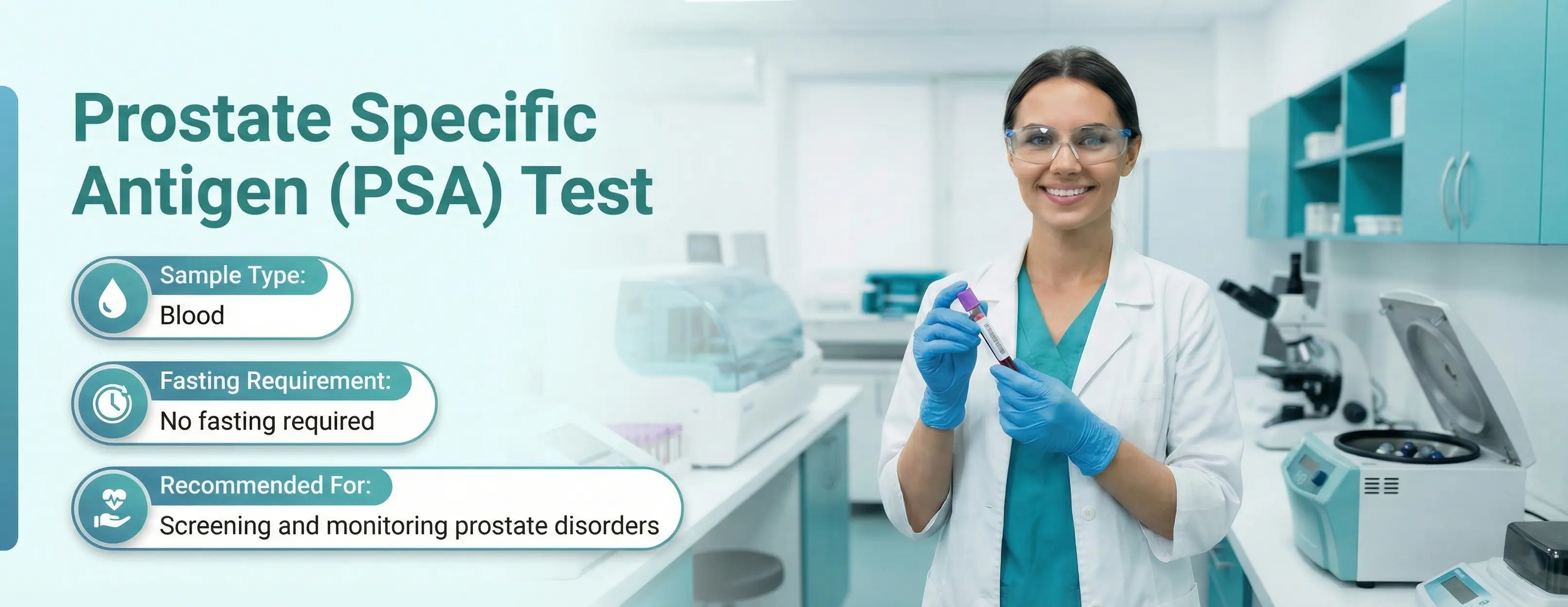
A quick info on PSA test

Overview
The prostate-specific antigen (PSA) test measures PSA levels in the bloodstream and screens for prostate cancer in men. It is also used to monitor those already diagnosed with prostate cancer and to check whether the cancer has returned after treatment. The prostate is a small, walnut-sized gland present below the bladder in men that produces a portion of the semen. The prostate cells produce PSA, an enzyme that liquefies the semen and helps sperm move freely. Small amounts of PSA normally enter the blood, so healthy men usually have low PSA levels. In prostate cancer, large amounts of PSA are detected in the blood because of a significant increase in the number of cancerous cells. The PSA test is used to detect this increase. With increasing age, the prostate gland enlarges in some men (benign prostatic hyperplasia) and can also cause an increase in blood PSA levels. This condition is non-cancerous. Inflammation or irritation of the prostate, urinary tract infections, and recent ejaculation can also increase PSA levels. Hence, a high PSA level does not always point towards prostate cancer. If your doctor suspects cancer, a digital rectal exam, imaging or a biopsy may be advised. Prostate cancer is one of the most common cancers among Indian men. While men above 50 years of age are at a higher risk, it can also occur in younger men sometimes. Hence, it is important to report any unusual urinary symptoms to your doctor promptly and discuss whether PSA testing is necessary. PharmEasy Labs usually provides PSA test results in about a few hours to a day, depending on your location in Rajkot.

When and Who Should Get a PSA Test Done?
- Men above 50 years of age and those with a family history of prostate cancer. Discuss the potential benefits, risks, and limitations of testing with your doctor before deciding whether to undergo PSA screening.
- Men experiencing symptoms suggestive of a prostate condition, such as difficulty urinating, frequent urination, blood in the urine or semen, pelvic or back pain, or urinary incontinence.
- To monitor disease progression, treatment response, or recurrence in men diagnosed with prostate cancer.
- When the doctor feels a lump, hardness, or enlargement of the prostate during a digital rectal examination (DRE).

How Frequently Should You Take the PSA Test?
The frequency of PSA testing depends on individual age and risk factors and should be decided after discussion with your doctor.
|
Frequency of testing |
Age |
|---|---|
|
A single test to establish baseline PSA |
If you are a 40 to 45-year-old male |
|
Annual testing |
If you are a high-risk male, 45 years or older |
|
Testing every 2 to 3 years |
If you are a male, 50 years or older |
|
Routine testing not required |
If you are a male, 75 years or older or have less than 10 years of life expectancy |
|
Test will be repeated Follow-up testing every 6 to 12 months for monitoring |
If PSA test results were abnormal |

What Conditions Can a PSA Test Help Detect?
Elevated PSA values may occur in the following conditions. Further investigations will be advised to determine the cause of elevated PSA levels.
- Screening for prostate cancer.
- Monitoring treatment response in those undergoing treatment for prostate cancer.
- Checking for recurrence in patients who had prostate cancer and are in remission.
- Benign prostatic hyperplasia (BPH), a non-cancerous enlargement of the prostate gland, common in older men.
- Prostatitis, inflammation or infection of the prostate gland.
Disclaimer: The above list is for educational purposes only and does not confirm diagnosis or the presence of any condition. Always consult your doctor for your test results and diagnosis.

PSA Test Preparation
What to Expect Before the Test
- Fasting is not required for this test. You can eat and drink normally before the test unless your doctor has ordered other blood work that requires fasting.
Before scheduling the test, let your doctor know about the following, as these may affect PSA levels:
- Recent illnesses.
- Medicines and supplements (especially those for enlarged prostate or hair loss like finasteride or dutasteride and testosterone supplements).
- Recent procedures like urinary catheter insertion, cystoscopy, or prostate biopsy within the last 6 weeks.
- Current or recent urinary tract infections.
You may be asked to stop certain medicines for a short duration before the test. Do not stop any on your own without speaking to your doctor first.
You may need to follow certain instructions before undergoing the test:
- Avoid intercourse, masturbation or ejaculation for 48 hours before the test.
- Do not partake in physical activities that can cause pressure on the prostate such as cycling, riding a motorcycle or horseback riding, for 48 hours before the test.
- Avoid intense workouts, contact sports and heavy lifting for 48 hours before the test.
- Do not undergo a prostate massage or rectal exam just before the test.
What to Expect During the Sample Collection?
- The PharmEasy phlebotomist will arrive at the scheduled time, verify your identity, and confirm the ordered test.
- They will then wrap an elastic band (tourniquet) around your upper arm. This makes your veins fill with blood. They will feel for a suitable vein, usually at the crook of your elbow.
- They will then sanitise the injection area with an alcohol wipe and let it air-dry completely.
- They will insert a small needle into the vein and attach an airtight collection tube to draw the required amount of blood.
- They will then release the tourniquet, slide the needle out, and press a sterile gauze pad over the puncture site.
- They will apply a small bandage or tape to the arm and safely dispose of the needle.
What to Expect After the Test?
- Keep the small bandage on the puncture site for a few hours.
- You may notice light bruising, tenderness, or a small bump at the injection site; this usually fades in a day or two. Apply a cool compress if it feels sore.
- You do not need to rest or restrict your usual diet.

What are the Parameters Included in a PSA Test?
The PSA test measures total prostate-specific antigen (PSA) levels in your blood.

Normal Range of PSA Test Parameters
|
PSA level |
Classification |
|---|---|
|
Less than 4.00 ng/mL |
Normal |
|
4.01 to 10.00 ng/mL |
Borderline |
|
Above 10.00 ng/mL |
High |
Important Note: Normal PSA ranges may vary between laboratories and between Indian and Western reference populations.

PSA Test Result Interpretation
The PSA result must be interpreted in the context of your age, symptoms, and digital rectal examination findings. A single elevated PSA reading is not sufficient for diagnosis.
|
PSA level |
Risk category |
Potential interpretation and action |
|---|---|---|
|
Below 4 ng/mL |
Low risk |
Generally reassuring. Routine monitoring as per age-specific schedule. |
|
4 - 10 ng/mL |
Borderline/moderate risk |
Grey zone. Prostate cancer is possible, but so are BPH and prostatitis. |
|
Above 10 ng/mL |
High risk |
Significantly elevated. High suspicion of prostate cancer. |
|
Rapidly rising PSA (>0.75 ng/mL/year) |
PSA velocity concern |
Even if the absolute value is below 4, a rapid annual rise warrants urgent evaluation. |
|
Post-treatment - rising PSA |
Recurrence |
Any rising PSA after prostatectomy (above 0.2 ng/mL) or after radiation suggests cancer recurrence. |
Disclaimer: This table is for educational purposes only. PSA interpretation requires a qualified urologist.

PSA Test Risks and Limitations
Potential Risks and Complications
The PSA blood test is safe, and most side effects are mild, temporary, and resolved without specific treatment:
- Blood leaking from the vein into surrounding tissue causes a black-and-blue mark or a swollen lump.
- Mild tenderness, aching, or discomfort at the puncture site.
- Seeing blood, pain, or anxiety can lower heart rate and blood pressure, causing light-headedness, sweating, or fainting.
- Bleeding at the puncture site can last longer if you are on blood thinners or have a bleeding disorder.
- Rarely, improper procedure or movement can affect a nearby nerve, causing a sharp, shooting pain, tingling, or numbness.
- Bacteria on the skin can enter the puncture site and cause infection.
Understanding Prostate-Specific Antigen Test Limitations
- The PSA test is specific to the prostate gland but is not specific for prostate cancer, as it can also increase in other conditions of the prostate such as enlarged prostate, prostate infection, or urinary tract infection.
- In some cases of prostate cancer, PSA levels can be within the normal range.
- The test cannot distinguish between slow-growing cancers that may never cause harm and aggressive cancers that need treatment, which may lead to unnecessary tests and treatment.
- Factors such as recent ejaculation, cycling, a rectal examination, urinary catheter use, or a prostate procedure can temporarily raise PSA levels.
- Certain medicines can significantly lower PSA levels, which may hide a problem.
- PSA levels naturally increase with age, making results harder to interpret.
- The test cannot confirm cancer on its own, and further tests such as an MRI scan or biopsy are needed for diagnosis.


Areas we serve in Rajkot
You can book PSA Test in Rajkot through PharmEasy with convenient home sample collection across several localities, including :
- Kalawad Road
- University Road
- Raiya Road
- Yagnik Road
- Amin Marg
- Race Course Road
- Kotecha Nagar
- Nana Mava
- Mota Mava
- Bhakti Nagar
- Dhebar Road
- Shastri Nagar
- Junction Plot
- Morbi Road
- Mavdi
- Aji Industrial Area
- Kuvadva Road
- Gandhigram
- Bajrangwadi
- Mavdi Plot
You can also check service availability during purchase by entering your pincode.

PSA Test Sample Collection: Home vs. Diagnostic Lab
The PSA test at PharmEasy offers convenient features compared with traditional labs:
|
Feature |
PharmEasy home collection |
Traditional labs |
|---|---|---|
|
At-home sample collection by a phlebotomist |
✅ |
❌ |
|
No travel required |
✅ |
❌ |
|
Saves time |
✅ |
❌ |
|
Flexible appointment slots |
✅ |
❌ |
|
Comfortable testing experience |
✅ |
❌ |
|
Reduced exposure to crowds |
✅ |
❌ |
|
Easy digital report access |
✅ |
❌ |
|
Waiting in queues |
❌ |
✅ |
To get the advantage of home sample collection for the test in Rajkot, visit the PharmEasy website or app. Search for the prostate-specific antigen test, enter your location, and confirm the booking.
Was This Test Information Helpful?
Please rate your experience
 Yes Helpful (16)
 Not Helpful
References
People Also Ask
Do I need to visit a PharmEasy collection centre for the PSA test in Rajkot?
Where is my PSA test sample processed after home collection in Rajkot?
How will I receive my PSA test report in Rajkot through PharmEasy?
Can herbal supplements for prostate health affect PSA?
What are the benefits of PSA screening?
What are the possible harms of PSA screening?
What happens if I choose not to be screened?
 4.6 Stars| 7+ Lakhs Ratings & Reviews


Over 10 million happy users PharmEasy Labs
- Because the digital report is available on WhatsApp, there's no need to go back to the lab. Thanks, PharmEasy!
 Sachin sharma11 Jan ‘26
- Thanks to the coupon discount, the blood test was done at a lower price.Komal04 Jan ‘26
- The lab technician was a good and knowledgeable professional.Rakesh Pandey06 Jan ‘26
- Due to bad weather, it's difficult to reach the lab. But home collection makes things easier.Arjun08 Jan ‘26
- Thanks to the Swasth AI feature, the report is easy to understand.Priya Mehta02 Jan ‘26
- The report is available on the same day. Wow!Vikas Patel05 Jan ‘26
Have any doubts? Ask us.
Ask us anything about the Prostate Specific Antigen (PSA For Men) In Rajkot - Price & Details to understand it better
Nearby Labs
Lab tests made easy!
- Quick Collection
- Trusted Accuracy
- Hassle-free Services
Excel Diagnostic Centre - Rajkot
Kim Plaza Hanuman Madhi Near Devpushp Medical Store Raiya Road, Gujarat
 grievance-officer@docon.in
 7022000900


We provide trusted, expert-curated health content to support better awareness,prevention, and care.
Backed by experienced doctors, medical experts, and strict editorial standards.