

2114+ orders placed in your location

100% NABL & ISO Certified Lab • 100% Accurate Reports
Prostate Specific Antigen (PSA) Test
Total PSA, Complex PSA, Free PSA
- SummaryThe Prostate-Specific Antigen (PSA) test is a blood test that measures the level of PSA in your blood. PSA is a substance produced by the prostate gland in males. The PSA levels can be elevated in benign prostatic hyperplasia, and prostate cancer. This test is done by taking a blood sample from a vein in your arm, fasting is not required for this test. Read more
- Reports Within7 HrsView Sample Report

 100% NABL & ISO Certified Labs
 - SampleBlood

- Age35+ years
- GenderMales
- FastingNot Required

PharmEasy Promises



Know More About The Test


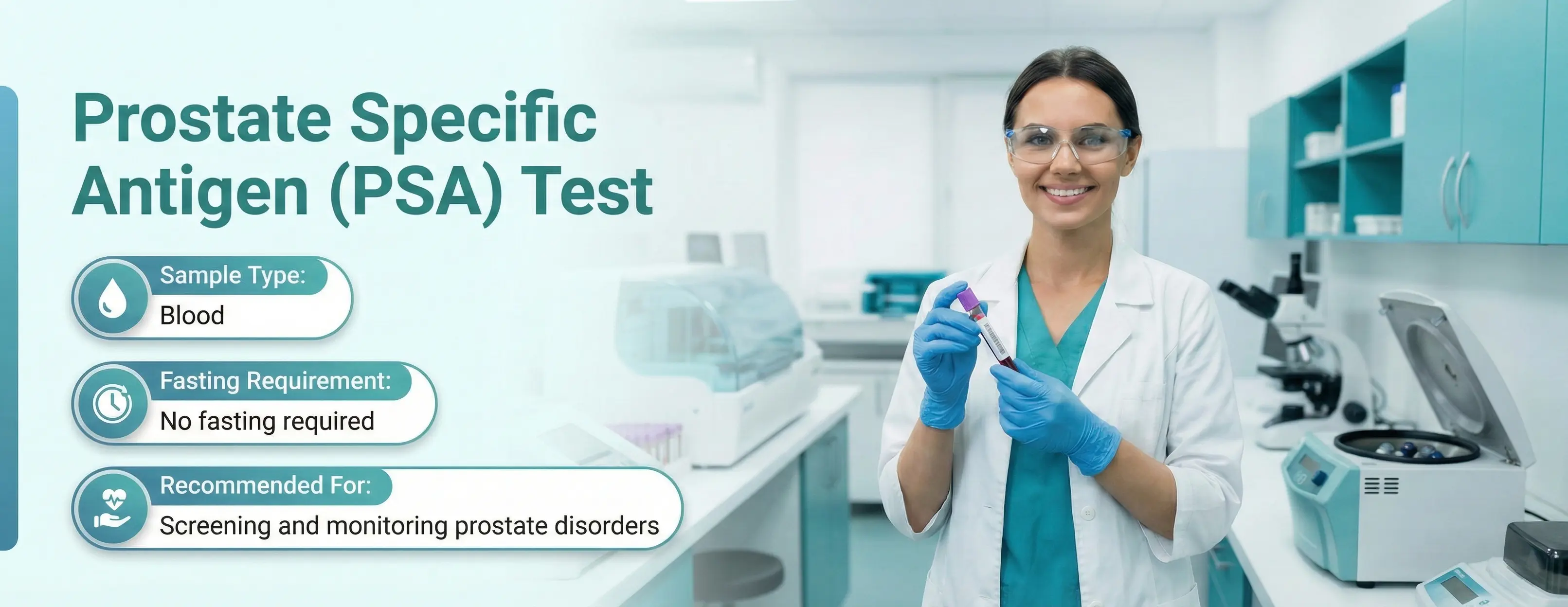
A quick info on PSA test

Overview
The PSA test, also called the Prostate Specific Antigen test, is a simple blood test that measures PSA levels in your blood. PSA is a protein produced by both normal and abnormal cells of the prostate gland - a walnut-sized gland located below the bladder in men. Under normal conditions, only small amounts of PSA circulate in the blood. Elevated PSA levels can signal prostate cancer, prostate infection (prostatitis), or benign prostatic hyperplasia (BPH - non-cancerous prostate enlargement).
Doctors order a PSA test as the primary blood test for prostate cancer screening. While PSA is not exclusive to cancer, several benign conditions also raise it. A significantly elevated or rapidly rising PSA level prompts further investigation. When used alongside a digital rectal examination (DRE) and free PSA ratio, the PSA test helps urologists make informed decisions about whether a prostate biopsy is needed.
The PSA test monitors prostate gland health and is used for prostate cancer screening, diagnosis, and treatment monitoring. No fasting is required. The test is recommended exclusively for adult males, and the results are available within 15 hours.

When and Who Should Get a PSA Test Done?
A PSA test is performed as a prostate cancer screening test or when prostate-related symptoms are present. It is recommended exclusively for adult men.
This test is usually recommended for:
- Men with difficulty urinating - weak stream, frequent urination especially at night, incomplete bladder emptying, or pain during urination.
- Men with blood in the urine or semen, pain in the lower back, hips, or pelvis, or unexplained erectile dysfunction.
- Men above 50 years - for routine prostate cancer screening, or above 40 years with a family history of prostate cancer.
- Men with a first-degree relative (father or brother) diagnosed with prostate cancer - who are at significantly higher genetic risk.
- Men diagnosed with Benign Prostatic Hyperplasia (BPH) or prostatitis - for ongoing monitoring.
- Men already on treatment for confirmed prostate cancer - to monitor treatment effectiveness and detect recurrence.
- Men on medications that affect the prostate - such as finasteride or dutasteride - for regular PSA monitoring.
.png?dim=48x48&q=75)
How Frequently Should You Take the PSA Test?
PSA testing frequency depends on your age, baseline PSA level, risk factors, and whether you are on treatment. The decision to screen is best made after discussing benefits and limitations with your doctor.
|
Health Scenario |
Context |
Recommended Frequency |
|---|---|---|
|
Routine Prostate Cancer Screening |
Men above 50 years with no symptoms or known prostate disease. |
Yearly once and every 2 to 4 years if PSA is below 1 ng/mL; every 1 to 2 years if PSA is between 1 and 3 ng/mL. |
|
High-Risk Screening |
Men above 40 years with a family history of prostate cancer. |
Once every 6 months, annually, or every 2 years, as advised by the urologist. |
|
Elevated PSA Monitoring |
PSA is elevated, but biopsy has not confirmed cancer - in active surveillance. |
Every 3 to 6 months to track whether levels are rising or stable. |
|
Post-Prostate Cancer Treatment |
After surgery, radiation, or hormone therapy for confirmed prostate cancer. |
Every 3 to 6 months for 2 years, then annually if stable. |
|
Monitoring Prostatitis or BPH |
Patients with confirmed prostate infection or benign enlargement on treatment. |
As advised by the urologist - typically every 6 to 12 months. |
|
Monitoring Medication Effect |
Patients on finasteride or dutasteride, which lower PSA by approximately 50%. |
Every 6 months - adjusted interpretation required. |

What Conditions Can a PSA Test Help Detect?
The PSA test is the primary blood test for prostate health evaluation. Key conditions it can help detect:
- Prostate Cancer (Adenocarcinoma of the Prostate) - the most common cancer in men globally. PSA is elevated in the majority of prostate cancer cases, often before symptoms develop.
- Benign Prostatic Hyperplasia (BPH) - non-cancerous enlargement of the prostate, very common in men above 50 years. Causes urinary symptoms and can moderately elevate PSA.
- Prostatitis (Prostate Infection) - bacterial or inflammatory infection of the prostate. It can cause a sharp, dramatic rise in PSA that returns to normal once the infection is treated.
- Biochemical Recurrence of Prostate Cancer - after successful treatment, a rising PSA is the earliest and most sensitive indicator that cancer has returned.
- High-Grade Prostatic Intraepithelial Neoplasia (HGPIN) - precancerous changes in the prostate that elevate PSA and are detected through biopsy.
Important Note: A high PSA does not confirm prostate cancer. Every 3 in 4 men with an elevated PSA do not have prostate cancer. Always share your results with a urologist for proper clinical evaluation.
.png?dim=48x48&q=75)
PSA Test Preparation
What to Expect Before the PSA Test
No fasting is required. You can eat and drink normally. However, to ensure the most accurate result, inform your doctor about: ejaculation in the past 24 to 48 hours (which can temporarily raise PSA - abstain if possible before the test); vigorous exercise, cycling, or a digital rectal examination (DRE) within 48 hours; current medications including finasteride, dutasteride, or NSAIDs; and any recent urological procedures such as cystoscopy or prostate biopsy.
What to Expect During the Blood Collection
A phlebotomist cleans the skin with an antiseptic, then places an elastic band around your upper arm to make the veins easier to access. A small needle is inserted into the vein - you may feel a brief pinch. Blood is collected into a labelled tube in under a minute.
What to Expect After the PSA Test
A small cotton swab and bandage are placed over the site to stop any minor bleeding. You can return to normal activities immediately. Minor bruising is normal and disappears quickly. Your digital report will be available within 15 hours.

What are the Parameters Included in a PSA Test?
The PSA test measures a single key parameter:
- Total PSA (Prostate Specific Antigen) - Measured in ng/mL (nanograms per millilitre). PSA is a protein produced by prostate cells. The total PSA includes both bound PSA (attached to blood proteins) and free PSA (circulating unbound). This is the primary value your doctor uses for initial prostate health assessment.
When total PSA is elevated, many laboratories also measure the free PSA and calculate the free/total PSA ratio. A lower ratio (below 15%) increases suspicion for prostate cancer over benign conditions. Studies also show that PSA normal ranges are lower in Indians compared to Western populations, making interpretation in an Indian clinical context important.

Normal Range of PSA Test Parameters
PSA normal values are age-dependent. The table below shows age-specific reference ranges used in clinical practice.
|
Age Group |
Normal PSA Range |
Clinical Interpretation |
|---|---|---|
|
40 - 49 years |
0 - 2.5 ng/mL |
PSA within this range is reassuring for this age group. |
|
50 - 59 years |
0 - 3.5 ng/mL |
PSA within this range is reassuring. Above 3.5 warrants further evaluation. |
|
60 - 69 years |
0 - 4.5 ng/mL |
PSA within this range is acceptable. Above 4.5 requires urological evaluation. |
|
Above 70 years |
0 - 6.5 ng/mL |
Slightly higher PSA is expected with age. Above 6.5 warrants clinical evaluation. |
Important Note: Normal PSA ranges may vary between laboratories and between Indian and Western reference populations. Studies show PSA ranges tend to be lower in Indians.
.png?dim=48x48&q=75)
PSA Test Result Interpretation
The PSA result must be interpreted in the context of your age, symptoms, digital rectal examination findings, and the free/total PSA ratio. A single elevated PSA reading is not sufficient for diagnosis.
|
PSA Level |
Risk Category |
Potential Interpretation and Action |
|---|---|---|
|
Below 4 ng/mL |
Low Risk |
Generally reassuring. Routine monitoring as per age-specific schedule. |
|
4 - 10 ng/mL |
Borderline / Moderate Risk |
Grey zone. Prostate cancer is possible, but so are BPH and prostatitis. Free PSA ratio and urological evaluation recommended. |
|
Above 10 ng/mL |
High Risk |
Significantly elevated. High suspicion of prostate cancer. Urological referral and prostate biopsy are typically recommended. |
|
Rapidly Rising PSA (>0.75 ng/mL/year) |
PSA Velocity Concern |
Even if the absolute value is below 4, a rapid annual rise warrants urgent evaluation. |
|
Low Free PSA/Total PSA Ratio (<15%) |
Higher Cancer Risk |
A lower free-to-total PSA ratio suggests a higher likelihood of prostate cancer over benign conditions. |
|
Post-Treatment - Rising PSA |
Biochemical Recurrence |
Any rising PSA after prostatectomy (above 0.2 ng/mL) or after radiation suggests cancer recurrence. |
Disclaimer: This table is for educational purposes only. PSA interpretation requires the expertise of a qualified urologist. A high PSA does not confirm prostate cancer - false positives are common. Never make treatment decisions based on PSA alone.

PSA Test Risks and Limitations
Potential Risks and Complications
The PSA test involves a simple blood draw and is very safe. Most people feel only a brief pinch. Consult a doctor if:
- The puncture site does not stop bleeding after gentle pressure
- You notice unusual redness, swelling, warmth, or lasting pain at the needle site
- You feel persistently lightheaded after the blood draw.
Understanding PSA Test Limitations
The PSA test is not specific to cancer; BPH, prostatitis, ejaculation, cycling, and DRE can all elevate PSA without cancer being present, causing false-positive results. Approximately 15% of prostate cancers can occur with a normal PSA (below 4 ng/mL), causing false negatives. The test also cannot distinguish between slow-growing and fast-growing aggressive cancers. Medications such as finasteride and dutasteride lower PSA by approximately 50%, requiring adjusted interpretation.

Related and Follow-up Tests
An elevated PSA marks the beginning of a prostate health investigation. Your doctor will recommend additional tests to clarify the cause and guide further management.
|
PSA Finding |
Suggested Follow-up Test |
Why It Is Ordered |
|---|---|---|
|
Elevated PSA (any level) |
A low free PSA ratio (below 15%) increases suspicion for prostate cancer over benign conditions. |
|
|
Elevated PSA + Urinary Symptoms |
To rule out prostatitis (prostate infection) or UTI as the cause of elevated PSA. |
|
|
Elevated PSA + Suspected Cancer |
Prostate Biopsy (TRUS-guided) |
Gold standard for confirming or ruling out prostate cancer. Guided by transrectal ultrasound. |
|
Elevated PSA + Prostate Symptoms |
Transrectal Ultrasound (TRUS) |
Images the prostate gland to detect enlargement, irregular texture, or suspicious nodules. |
|
Confirmed Prostate Cancer |
MRI Prostate (mpMRI) |
Advanced imaging to assess tumour location, size, and whether cancer has spread beyond the prostate. |
|
High PSA + Suspected Metastasis |
Bone Scan |
Prostate cancer commonly spreads to the bone. A bone scan detects skeletal metastases. |
|
Monitoring After Treatment |
Serial PSA (Repeat every 3-6 months) |
Post-treatment PSA trend is the most sensitive marker for detecting cancer recurrence. |
Note: A confirmed diagnosis of prostate cancer requires a prostate biopsy. Treatment options - including active surveillance, surgery, radiation, or hormone therapy - are guided by the cancer stage, grade, and the patient's overall health.

PSA Test Sample Collection: Home vs. Diagnostic Lab
|
Feature |
Home Collection (PharmEasy) |
Traditional Diagnostic Lab |
|---|---|---|
|
Convenience |
High - sample taken from your home or office. |
Low - requires travelling and waiting in queues. |
|
Time Saving |
Maximum - no travel time. You pick the time slot. |
Minimum - depends on traffic and lab rush. |
|
Safety & Comfort |
Safe - avoids exposure to other sick patients. |
Moderate - exposure to crowded waiting areas. |
|
Process |
A professional phlebotomist visits you. |
You must visit the facility during its hours. |
|
Report Access |
Digital - sent directly to your app or email. |
Often requires a second visit for physical copies. |
Pro Tip: Book your PSA test on PharmEasy - no fasting required, a certified phlebotomist at your doorstep, and your digital report delivered within 15 hours. Convenient, private, and affordable.

PSA Test Price/Cost
A PSA test is typically available at a starting price of around INR 649. However, the final cost may vary depending on the city and the laboratory you choose. For better clarity, you can compare PSA test prices across major cities in India.
|
City |
Offer Price |
|---|---|
|
649 |
|
|
649 |
|
|
649 |
|
|
649 |
|
|
649 |
|
|
649 |
|
|
649 |
|
|
649 |
|
|
649 |
|
|
649 |
Was This Test Information Helpful?
Please rate your experience
 Yes Helpful (12)
 Not Helpful
References
People Also Ask
Does a high PSA always mean I have prostate cancer?
What PSA level is considered high?
Can the PSA test detect prostate cancer early?
Do I need to avoid ejaculation before a PSA test?
Can medications affect my PSA result?
What is the free PSA test and when is it ordered?
How is prostate cancer confirmed after a high PSA?
 4.6 Stars| 7+ Lakhs Ratings & Reviews

Over 10 million happy users PharmEasy Labs
- Because the digital report is available on WhatsApp, there's no need to go back to the lab. Thanks, PharmEasy!
 Sachin sharma11 Jan ‘26
 - Thanks to the coupon discount, the blood test was done at a lower price.Komal04 Jan ‘26
- The lab technician was a good and knowledgeable professional.Rakesh Pandey06 Jan ‘26
- Due to bad weather, it's difficult to reach the lab. But home collection makes things easier.Arjun08 Jan ‘26
- Thanks to the Swasth AI feature, the report is easy to understand.Priya Mehta02 Jan ‘26
- The report is available on the same day. Wow!Vikas Patel05 Jan ‘26
Have any doubts? Ask us.
Ask us anything about the Prostate Specific Antigen (PSA) Test to understand it better

We provide trusted, expert-curated health content to support better awareness,prevention, and care.
Backed by experienced doctors, medical experts, and strict editorial standards.