

37+ orders placed in your location

100% NABL & ISO Certified Lab • 100% Accurate Reports
HDL Cholesterol Test
High-Density Lipoprotein Test, High-Density Lipoprotein Cholesterol Test, Good cholesterol test, HDL
- SummaryThe HDL (High-Density Lipoprotein) Cholesterol test measures the level of “good” cholesterol in the blood, which helps remove excess cholesterol from arteries and may reduce the risk of some heart diseases. It is part of a lipid profile test. The test is performed using a blood sample, and fasting for 9–12 hours is usually recommended for accurate results. Read more
- Reports Within14 HrsView Sample Report

 100% NABL & ISO Certified Labs
 - SampleBlood

- AgeAll Age Group
- GenderMale and Female
- Fasting10-12 Hrs

PharmEasy Promises



Know More About The Test


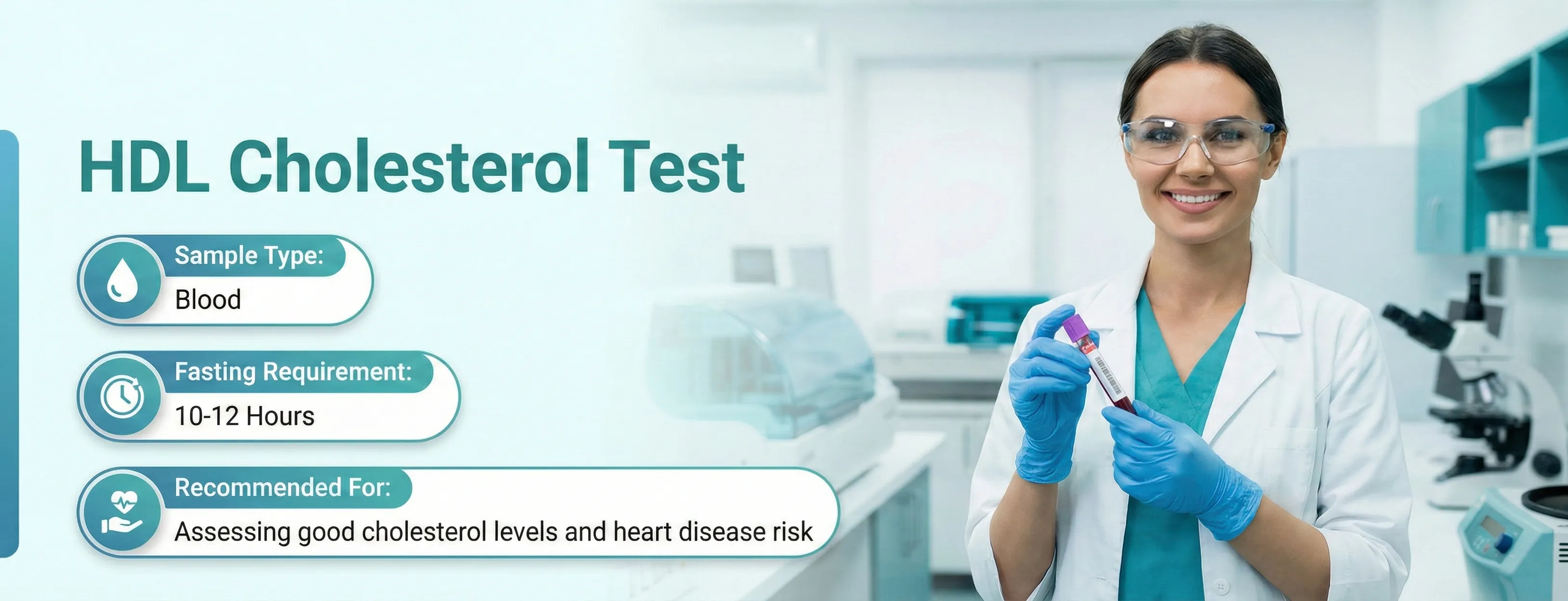
A quick info on HDL Cholestrol Test

Overview
The HDL cholesterol test measures the level of high-density lipoprotein (HDL) cholesterol in your blood, widely known as the good cholesterol. Cholesterol is a soft, waxy, fat-like substance your body needs to work properly, and it travels through the blood packaged inside lipoproteins. The main types are HDL, LDL, VLDL, and triglycerides, and each behaves differently. HDL is considered protective, while LDL and VLDL are the harmful, artery-clogging forms.
HDL earns its good reputation because of its role in transporting cholesterol: it picks up excess cholesterol from the blood and artery walls and carries it back to the liver, where it is processed and removed from the body. By clearing away cholesterol that would otherwise build up as fatty plaque, HDL helps keep the arteries open and lowers the risk of heart disease and stroke. In general, a higher HDL level is better for heart health.
The HDL cholesterol test is part of the standard lipid profile, but it can also be done on its own to assess and monitor cardiovascular risk over time.
When and Who Should Get a HDL Cholesterol Test Done?
Your doctor may recommend an HDL cholesterol test as part of a routine lipid check or when you have risk factors for heart disease.
- People with a family history of heart disease.
- Older adults, in whom cardiovascular risk naturally rises.
- People with high blood pressure (hypertension).
- Those who are overweight or have an inactive, sedentary lifestyle.
- People with diabetes.
- Smokers and those who consume alcohol regularly.
.png?dim=48x48&q=75)
How Frequently Should You Take the HDL Cholesterol Test?
How often you need the test depends on your HDL level and your overall cardiovascular risk. People with previously low HDL, or with risk factors such as diabetes and high blood pressure, are usually tested more often than those with normal results and no risk factors.
Your doctor will advise the next steps and the right follow-up interval, particularly if you are making lifestyle changes or starting treatment to improve your cholesterol balance.

What Conditions Can a HDL Cholesterol Test Help Detect?
HDL is a key marker of cardiovascular health. A low HDL level signals an increased risk of conditions driven by atherosclerosis: the build-up of cholesterol plaque in the arteries. The test contributes to the assessment of the risk of:
- Coronary artery disease (CAD): narrowing of the arteries that supply the heart.
- Heart attack (myocardial infarction): caused by blocked blood flow to the heart muscle.
- Stroke: reduced or blocked blood flow to the brain.
- Peripheral artery disease: reduced circulation in the limbs.
.png?dim=48x48&q=75)
HDL Cholesterol Test Preparation
Correct preparation matters for the HDL test, as fasting helps ensure an accurate result, especially when it is done as part of a lipid profile.
What to Expect Before the Test
- Fast for 10 to 12 hours before the test (a minimum of 8 hours) for accurate results. Plain water is allowed.
- Do not smoke or drink alcohol for about 24 hours before the test.
- Avoid strenuous exercise before the test, as it can temporarily affect the reading.
- Closely follow your doctor's instructions about any medicines or herbal supplements to pause or continue.
What to Expect During the Blood Collection
A phlebotomist cleans the skin with an antiseptic, then places an elastic band around your upper arm to make the veins easier to access. A small needle is inserted into the vein; you may feel a brief pinch. Blood is collected into a labelled tube in under a minute.
What to Expect After the Test
A small cotton swab and bandage are placed over the site to stop any minor bleeding. You can eat and drink immediately after the test. It is a good idea to have a light meal after your fast. There may be slight soreness at the needle site or mild light-headedness. If you feel dizzy, sit and rest for a few minutes.

What are the Parameters Included in a HDL Cholesterol Test?
The HDL cholesterol test measures a single parameter: the level of high-density lipoprotein (good) cholesterol in your blood, reported in mg/dL. The result is a number rather than a positive or negative.
- HDL cholesterol: the protective, cholesterol-clearing lipoprotein. Unlike most markers, with HDL a higher value is better; a low value indicates poorer heart protection and a higher risk of heart disease.
Because HDL is only one piece of your cholesterol profile, your doctor will usually interpret it alongside total cholesterol, LDL, and triglycerides to assess your overall cardiovascular risk.

Normal Range of HDL Cholesterol Test Parameters
The table below shows the standard interpretation for HDL cholesterol. With HDL, higher is healthier.
|
HDL level (mg/dL) |
Interpretation |
|---|---|
|
Less than 40 mg/dL |
Low: associated with an increased risk of heart disease. |
|
40 - 59 mg/dL |
Borderline: acceptable, but higher is better. |
|
60 mg/dL or above |
High: protective against heart disease. |
Important Note: Reference ranges may vary slightly between laboratories, and HDL targets can differ by sex and individual risk. Always refer to the range printed on your own report and consult your doctor for interpretation.
.png?dim=48x48&q=75)
HDL Cholesterol Test Result Interpretation
HDL is the cholesterol where a higher number works in your favour. Here is what your result generally means:
|
Result |
Possible interpretation |
|---|---|
|
Above 60 mg/dL |
A protective level that lowers your susceptibility to heart disease. |
|
40 - 59 mg/dL |
An acceptable but improvable level; lifestyle changes can help raise it. |
|
Less than 40 mg/dL |
Linked to an increased risk of heart problems, including heart attack and stroke, especially alongside high blood pressure or diabetes. |
Some factors can falsely change the reading: strenuous activity before the test, alcohol, certain medicines, and thyroid disorders may falsely raise HDL, while some inherited conditions, infections, inflammation, and medicines may falsely lower it. Where HDL is low, lifestyle changes, such as regular exercise, a healthy diet, avoiding smoking and alcohol, controlling blood pressure, and reducing weight, can help improve it.
Disclaimer: This information is for educational purposes and provides a risk assessment only. It does not confirm a diagnosis. Always consult your doctor to understand how your HDL result relates to your overall health.

HDL Cholesterol Test Risks and Limitations
The HDL test is a routine blood draw that is generally very safe, with minor procedural risks and a few limitations.
Potential Risks and Complications
Most people feel only a brief pinch. Consult your doctor if you notice:
- Persistent bleeding at the puncture site that does not stop with gentle pressure.
- Redness, swelling, or pain at the needle insertion site.
- Light-headedness that continues after the blood draw. Sit and rest before leaving.
Understanding HDL Cholesterol Test Limitations
- Strenuous activity, alcohol, thyroid disorders, and some medicines can falsely raise or lower the result.
- A single value is a snapshot; HDL is best understood alongside the rest of your lipid profile.
- Not fasting properly can affect the reading, particularly when done within a lipid panel.
- Reference ranges differ between labs, so results may not be directly comparable.

Related and Follow-up Tests
HDL is rarely assessed in isolation. Your doctor may recommend additional tests to complete your cardiovascular risk assessment.
|
Your finding |
Suggested follow-up test |
Why it is ordered |
|---|---|---|
|
Low HDL |
Provides total cholesterol, LDL, and triglycerides for a full picture. |
|
|
Low HDL with risk factors |
Diabetes lowers HDL and raises heart risk; often checked together. |
|
|
Abnormal lipids |
Thyroid problems can affect cholesterol levels. |
|
|
High overall risk |
ECG and 2D echocardiogram |
Assesses the heart directly when cardiovascular disease is suspected. |
|
Family history of early heart disease |
Lipoprotein(a) and ApoB |
Adds inherited and particle-based risk markers. |
HDL Cholesterol Test Sample Collection: Home vs. Diagnostic Lab
|
Feature |
Home collection (PharmEasy) |
Traditional diagnostic lab |
|---|---|---|
|
Convenience |
High: sample is taken from your home or office. |
Low: requires travelling and waiting in queues. |
|
Time saving |
Maximum: no travel time. You pick the time slot. |
Minimum: depends on traffic and lab rush. |
|
Safety and comfort |
Safe: avoids exposure to other sick patients. |
Moderate: exposure to crowded waiting areas. |
|
Process |
A professional phlebotomist visits you. |
You must visit the facility during its hours. |
|
Report access |
Digital: sent directly to your app or email. |
Often requires a second visit for physical copies. |
Pro Tip: For a stress-free experience, book your HDL cholesterol test on PharmEasy. Fast overnight, get your sample collected at home in the morning, and receive your digital report the same day - without stepping out.
Was This Test Information Helpful?
Please rate your experience
 Yes Helpful
  Not Helpful
References
Health packages containing 'HDL Cholesterol Test'
 For full-body wellness, go for a comprehensive checkup
People Also Ask
What is HDL cholesterol and why is it called good cholesterol?
What is a normal HDL level?
Do I need to fast before the test?
How can I increase my HDL cholesterol?
Is a high HDL always good?
What does a low HDL mean?
 4.6 Stars| 7+ Lakhs Ratings & Reviews

Over 10 million happy users PharmEasy Labs
- Because the digital report is available on WhatsApp, there's no need to go back to the lab. Thanks, PharmEasy!
 Sachin sharma11 Jan ‘26
 - Thanks to the coupon discount, the blood test was done at a lower price.Komal04 Jan ‘26
- The lab technician was a good and knowledgeable professional.Rakesh Pandey06 Jan ‘26
- Due to bad weather, it's difficult to reach the lab. But home collection makes things easier.Arjun08 Jan ‘26
- Thanks to the Swasth AI feature, the report is easy to understand.Priya Mehta02 Jan ‘26
- The report is available on the same day. Wow!Vikas Patel05 Jan ‘26
Have any doubts? Ask us.
Ask us anything about the HDL Cholesterol Test to understand it better

We provide trusted, expert-curated health content to support better awareness,prevention, and care.
Backed by experienced doctors, medical experts, and strict editorial standards.