

1411+ orders placed in your location

100% NABL & ISO Certified Lab • 100% Accurate Reports
SGPT / ALT Test (Alanine Transaminase) in Gurgaon - Price and details
Serum Glutamic-Pyruvic Test (SGPT), Alanine Aminotransferase Test (ALT), Glutamic-Pyruvic Test (GPT)
- SummaryThe SGPT (Alanine Aminotransferase) test measures SGPT enzyme levels in the blood to assess liver health. Increased levels can indicate liver damage or inflammation. This test may be advised if symptoms like fatigue, yellowing of the skin, stomach pain, or appetite loss are noticed, or for monitoring liver conditions. Fasting is usually not required unless recommended, and it can be done for all ages and genders.Read more
- Reports Within6 HrsView Sample Report

 100% NABL & ISO Certified Labs
 - SampleBlood

- AgeAll Age Group
- GenderMale and Female
- FastingNot Required

PharmEasy Promises



Know More About The Test


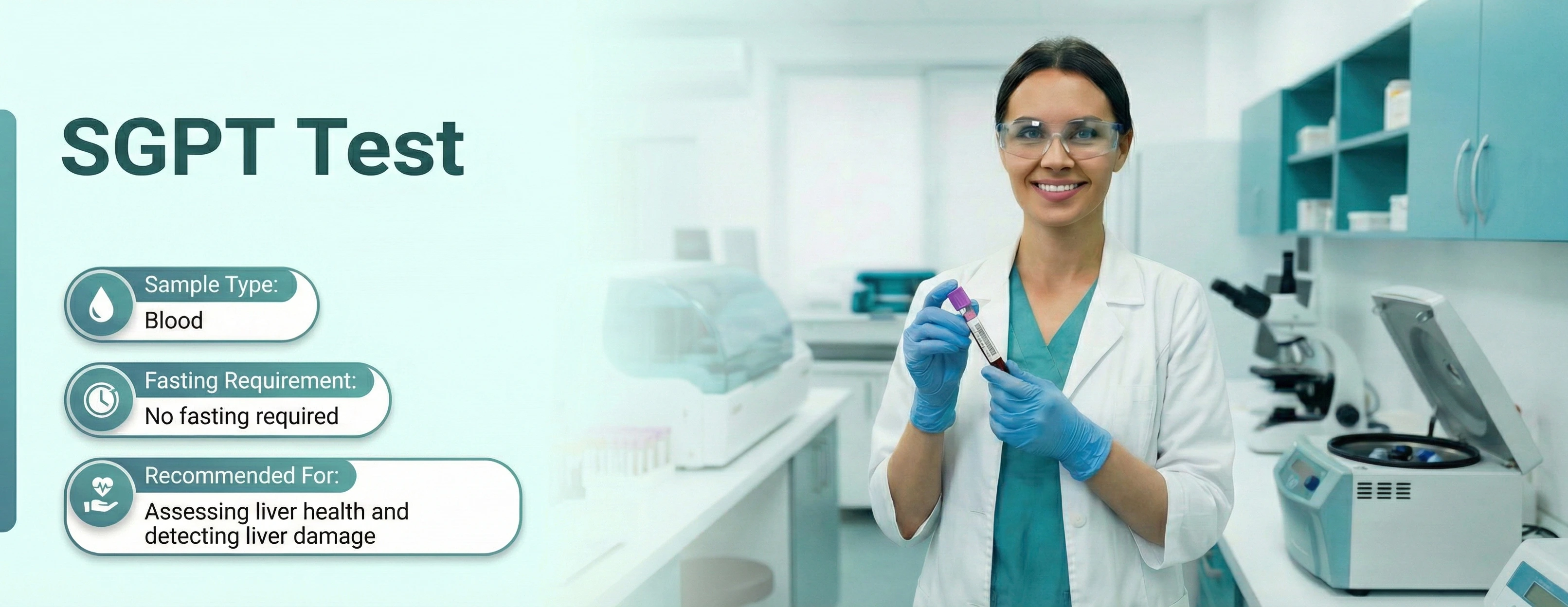
A SGPT / ALT Test Reference Ranges

Overview
Alanine aminotransferase (ALT), also known as SGPT, is an enzyme found mainly in the liver and in smaller amounts in other tissues, such as the kidneys, heart, and muscles. During liver cell damage, ALT levels may increase in the blood. An SGPT/ALT blood test is used to assess liver health and detect possible liver injury.
The liver plays a vital role in digestion, metabolism, detoxification, and the removal of waste substances from the body. It processes, stores, and transforms nutrients obtained from food. The liver also helps regulate blood sugar levels. In addition, the liver is responsible for processing substances such as medications and toxins and also contributes to hormone production. Because the liver has a strong reserve capacity, it can continue functioning normally even when some damage is present. As a result, liver disease may sometimes remain undetected until specific tests are performed to identify signs of injury. The enzyme ALT is normally present in the blood in small amounts. However, when liver cells become damaged or inflamed, larger amounts of ALT are released into the bloodstream, which can be detected through an SGPT/ALT test. Although elevated ALT levels are sensitive indicators of liver cell injury, they do not identify the exact cause of liver damage. Common reasons for increased ALT levels include alcohol-related liver injury, fatty liver disease, hepatitis, and liver injury caused by medications or herbal supplements.

When and Who Should Get a SGPT/ALT Test Done?
- As part of preventive health screening: An SGPT/ALT test may be included in a routine health check-up as a precautionary measure, even when no symptoms are present.
- When liver disease risk factors are identified: Your doctor may recommend this test if you have risk factors for liver disease, including habitual or heavy alcohol use, a family history of liver disorders, excess body weight, type 2 diabetes, or extended use of medications that may place stress on the liver.
- When symptoms suggest possible liver involvement: If you are experiencing persistent nausea, vomiting, discomfort in the abdominal region, unexplained tiredness, decreased appetite, itching of the skin, jaundice (a yellowing of the skin or the whites of the eyes), unusually dark urine, or pale-coloured stools, your doctor may order this test to explore whether a liver-related condition may be responsible.
- Following potential exposure to hepatitis: Testing may be recommended if you have been in situations that carry a risk of hepatitis infection, such as exposure to infected blood, shared use of needles, unprotected sexual contact, or other high-risk circumstances.
- To monitor a pre-existing liver condition: In individuals already living with a diagnosed liver disorder, periodic SGPT/ALT testing serves as a useful tool to track how the condition is responding to treatment and whether liver health is improving, holding steady, or declining over time.
.png?dim=48x48&q=75)
How Frequently Should You Take the SGPT/ALT Test?
Depending on individual circumstances, the recommended frequency for an SGPT/ALT test can vary:
|
Health Scenario |
Recommended SGPT/ALT Test Frequency |
|---|---|
|
Routine annual health check-up |
Once a year to monitor overall health and liver function. |
|
Medication monitoring |
Every 1 to 3 months for individuals taking medicines such as cholesterol-lowering medications, long-term painkillers, or anti-seizure medicines. |
|
Existing liver conditions |
Once a month or as advised by your doctor for active liver conditions such as hepatitis or cirrhosis. |
|
Regular or heavy alcohol consumption |
Every 3 to 6 months to monitor liver enzyme levels. |
|
Treatment monitoring |
Follow-up testing within 4 to 6 weeks to assess recovery and evaluate response to treatment. |
|
Before a surgical procedure |
Usually once within 48 to 72 hours before surgery to assess liver function and overall liver health. |

What Conditions Can a SGPT/ALT Test Help Detect?
The SGPT/ALT test may help with diagnosing:
- Alcohol-induced liver injury.
- Inflammation or swelling of the liver.
- Scarring of the liver, called cirrhosis.
- Hepatitis A, B, or C.
- Infectious mononucleosis.
- Metabolic dysfunction-associated steatotic liver disease (MASLD), formerly called nonalcoholic fatty liver disease (NAFLD).
- Metabolic dysfunction-associated steatohepatitis (MASH), formerly called nonalcoholic steatohepatitis (NASH).
- As part of a complete work-up if liver cancer is suspected.
- Liver ischemia (not enough blood flow to your liver which may lead to death of liver tissue
- Hemochromatosis (too much iron in the blood)
Disclaimer: The above list is for educational purposes only and does not confirm diagnosis or the presence of any condition. Always consult your doctor for your test results and diagnosis.

SGPT/ALT Test Preparation
- Inform your healthcare provider of any prescription drugs, over-the-counter medicines, or nutritional supplements you are currently using. Do not stop or modify any medication without first seeking medical advice.
- Avoid consuming large portions, fatty or greasy foods, sweetened beverages, and drinks containing caffeine prior to the test, as these can bring about short-term fluctuations in results.
- Even moderate alcohol intake can temporarily push ALT levels higher, which may affect how your results are interpreted. It is best to refrain from alcohol the day before your test.
- High-intensity exercise and demanding workout sessions can cause a temporary spike in ALT levels. Sharing details of your fitness routine with your doctor will help ensure your results are evaluated in the right context.
What to Expect Before the Test
- The SGPT/ALT test does not require fasting. However, if it is being done along with other investigations or as part of a health check-up package, your doctor may ask you to avoid food and beverages for a specified period before the test.
What to Expect During the Sample Collection
- A trained phlebotomist will arrive at your home at the scheduled time.
- A small blood sample will be collected from a vein in your arm using a sterile needle after the skin is cleaned with antiseptic. You may feel a slight pricking sensation.
- The procedure usually takes only a few minutes.
What to Expect After the Test
- Mild throbbing may be felt at the blood draw site for a few minutes after the blood is drawn. Occasionally, you may feel dizzy, in which case you may lie down for a while until the feeling passes.
- The blood sample is sent to the laboratory for analysis, and results are usually made available within a few hours that can be downloaded from the PharmEasy platform. Depending on the findings, repeat testing or additional investigations may sometimes be recommended for further evaluation.
Note: If you notice anything unusual at the puncture site, such as persistent bleeding, a rash, or pain, consult your healthcare provider.

What are the Parameters Included in a SGPT/ALT Test?
The SGPT/ALT test measures a single key parameter:
- SGPT/ALT (alanine aminotransferase), reported in units per litre (U/L).

Normal Range of SGPT/ALT Test Parameters
The table below shows standard reference ranges of SGPT/ALT levels.
|
Parameter |
Normal range |
|---|---|
|
SGPT/ALT (alanine aminotransferase) |
Less than 45 U/L (units per litre) |
Important note: SGPT values can be slightly higher in men than women, and in individuals with higher muscle mass. Levels are also marginally higher in children, especially infants. Normal ranges may vary slightly between laboratories. Always refer to the reference range printed on your specific lab report and consult your doctor for interpretation.

SGPT/ALT Test Result Interpretation
SGPT results must always be interpreted in the context of your gender, symptoms, alcohol use, medications, and the degree of elevation.
|
SGPT level |
Category |
Potential interpretation |
|---|---|---|
|
Below 45 U/L |
Normal |
Liver cells are not significantly damaged. No evidence of active liver injury at this time. |
|
45 - 120 U/L |
Mildly elevated |
May indicate early fatty liver, mild hepatitis, medication side effects, or moderate alcohol use. |
|
120 - 400 U/L |
Moderately elevated |
Suggests significant liver inflammation or injury. Commonly seen in active viral hepatitis, alcoholic hepatitis, or moderate fatty liver. |
|
Above 400 U/L |
Severely elevated |
Indicates serious liver cell damage. Seen in acute viral hepatitis, paracetamol toxicity, ischaemic hepatitis, or severe autoimmune hepatitis. |
|
Above 1000 U/L |
Very severely elevated |
Suggests massive liver cell destruction, such as acute liver failure, severe drug toxicity, or toxic shock. This is a medical emergency. |
Disclaimer: This table is for educational purposes only. SGPT/ALT interpretation requires the expertise of a healthcare professional.

SGPT/ALT Test Risks and Limitations
Potential Risks and Complications
- The SGPT/ALT test is a routine blood test and is considered safe with minimal risk. Some individuals may experience mild discomfort, minor bruising, or slight bleeding at the site where blood is drawn. Occasional dizziness or light-headedness may also occur in some cases.
- In rare instances, there may be difficulty in locating a suitable vein, or a very small possibility of infection at the puncture site.
Understanding SGPT/ALT Test Limitations
- Slightly increased SGPT/ALT levels may not always indicate liver disease. Factors such as heavy meals, intense exercise, alcohol consumption, or prolonged medication use can temporarily elevate ALT levels.
- This test only identifies increased ALT enzyme levels in the blood. Additional tests and clinical evaluation may be needed for identifying the cause of elevated levels.
- In advanced liver scarring (cirrhosis), SGPT/ALT levels may only be slightly elevated despite significant liver cell damage. Further assessments such as a FibroScan or liver biopsy may be advised.
- A normal result does not entirely rule out liver disease, especially if symptoms are present.
- Since minimal amounts of ALT is also found in organs other than the liver, occasionally increased ALT levels may occur due to damage to these organs. Hence, this test may not be specific to the liver alone.

SGPT/ALT Test Price in Gurgaon
In Gurgaon, an SGPT test via PharmEasy is typically available at around INR 225, with minor variations depending on the diagnostic provider, locality, and any ongoing offers. To get a clearer idea, you can compare SGPT test prices across major cities in India.
|
City |
Offer Price |
|---|---|
|
225 |
|
|
225 |
|
|
225 |
|
|
225 |
|
|
225 |
|
|
225 |
|
|
225 |
|
|
225 |
|
|
225 |
|
|
225 |

Areas we serve in Gurgaon
The SGPT/ALT test at PharmEasy is available across various residential and commercial areas in Gurgaon, including:
- DLF Phase 1
- DLF Phase 2
- DLF Phase 3
- DLF Phase 4
- DLF Phase 5
- Udyog Vihar
- Sector 23
- Sector 44
- Sector 67
- Sector 70
- Sushant Lok
- Sector 5
- Palam Vihar
- Nirvana Country
- Sector 14
- Sector 31
- Sector 46
- Sector 49
- Sector 56
- Sector 57
You can also check service availability during purchase by entering your PIN code.

SGPT/ALT Test Sample Collection: Home vs. Diagnostic Lab
The SGPT/ALT test at PharmEasy offers convenient features as compared with traditional labs:
|
Feature |
PharmEasy home collection |
Traditional labs |
|---|---|---|
|
At-home sample collection by phlebotomist |
✅ |
❌ |
|
No travel required |
✅ |
❌ |
|
Saves time |
✅ |
❌ |
|
Flexible appointment slots |
✅ |
❌ |
|
Comfortable testing experience |
✅ |
❌ |
|
Reduced exposure to crowds |
✅ |
❌ |
|
Easy digital report access |
✅ |
❌ |
|
Waiting in queues |
❌ |
✅ |
To get the advantage of home sample collection for the test in Gurgaon, visit the PharmEasy website or app. Search for the SGPT/ALT test, enter your location and confirm the booking.
Was This Test Information Helpful?
Please rate your experience
 Yes Helpful (38)
 Not Helpful
References
Health packages containing 'SGPT / ALT (Alanine Transaminase) Test'
 For full-body wellness, go for a comprehensive checkup
People Also Ask
Can I drink water before an SGPT/ALT test?
How long before an SGPT/ALT test should I avoid alcohol?
Can exercise affect SGPT/ALT test results?
Can medications affect SGPT/ALT levels?
Can I book an SGPT/ALT test online in Gurgaon?
Is home sample collection available for an SGPT/ALT test at PharmEasy Labs in Gurgaon?
How long does it take to receive SGPT/ALT test results in Gurgaon?
 4.6 Stars| 7+ Lakhs Ratings & Reviews

Over 10 million happy users PharmEasy Labs
- Because the digital report is available on WhatsApp, there's no need to go back to the lab. Thanks, PharmEasy!
 Sachin sharma11 Jan ‘26
 - Thanks to the coupon discount, the blood test was done at a lower price.Komal04 Jan ‘26
- The lab technician was a good and knowledgeable professional.Rakesh Pandey06 Jan ‘26
- Due to bad weather, it's difficult to reach the lab. But home collection makes things easier.Arjun08 Jan ‘26
- Thanks to the Swasth AI feature, the report is easy to understand.Priya Mehta02 Jan ‘26
- The report is available on the same day. Wow!Vikas Patel05 Jan ‘26
Have any doubts? Ask us.
Ask us anything about the SGPT / ALT Test (Alanine Transaminase) in Gurgaon - Price and details to understand it better
Nearby Labs
Lab tests made easy!
- Quick Collection
- Trusted Accuracy
- Hassle-free Services
PharmEasy Labs (Covid RTPCR) - Gurgaon
D-37/1, MIDC, Turbhe, Opp. Sandoz,, Maharashtra
 grievance-officer@docon.in
 7022000900
Agilus Diagnostics Limited - Gurgaon
Agilus Diagnostics, Unit No-Cg: 014, First Floor, The Palm Springs Plaza, Golf Course Road, Sector - 53-54, Near Rapid Metro,, Haryana
grievance-officer@docon.in7022000900
Aarthi Scans and Labs - Gurgaon
Plot 141, near Huda Market, Sector 15 Part 2, Sector 15,, Haryana
grievance-officer@docon.in7022000900Pixel Diagnostics - Gurgaon
House no 24, near Gate no 5, DLF Colony, Sector 14,, Haryana
grievance-officer@docon.in7022000900Plasma Medicare Diagnostics - Gurgaon
2546/16, Basement, Opp. Haldiram, Sector-16, HUDA Market, Faridabad, Haryana
grievance-officer@docon.in7022000900Plasma Medicare Diagnostics - Gurgaon
SCO-210, Block-B, Veer Complex, JMD Market, Green Field, Sector-42, Faridabad, Haryana
grievance-officer@docon.in7022000900HealthRoute - Gurgaon
2546/16, BASEMENT, OPPO. HALDIRAM, SECTOR-16, HUDA MARKET, Haryana
grievance-officer@docon.in7022000900HealthRoute - Gurgaon
SCO-210, BLOCK-B, VEER COMPLEX, JMD MARKET, GREEN FIELD, SECTOR-42, Haryana
grievance-officer@docon.in7022000900Health Buddy Diagnostic Pvt Ltd - Gurgaon
Ed - 17A, Outer Ring Rd, Opp. Rohini Court Complex, Nr. Madhuban Chowk, Block Ed, Dakshini Pitampura, Pitampura, New Delhi, Delhi, 110034, Haryana
grievance-officer@docon.in7022000900
We provide trusted, expert-curated health content to support better awareness,prevention, and care.
Backed by experienced doctors, medical experts, and strict editorial standards.