

10193+ orders placed in your location

100% NABL & ISO Certified Lab • 100% Accurate Reports
Fasting Blood Sugar (FBS) Test
Fasting blood glucose, Fasting Glucose Test, Blood Sugar Fasting, BS (F)
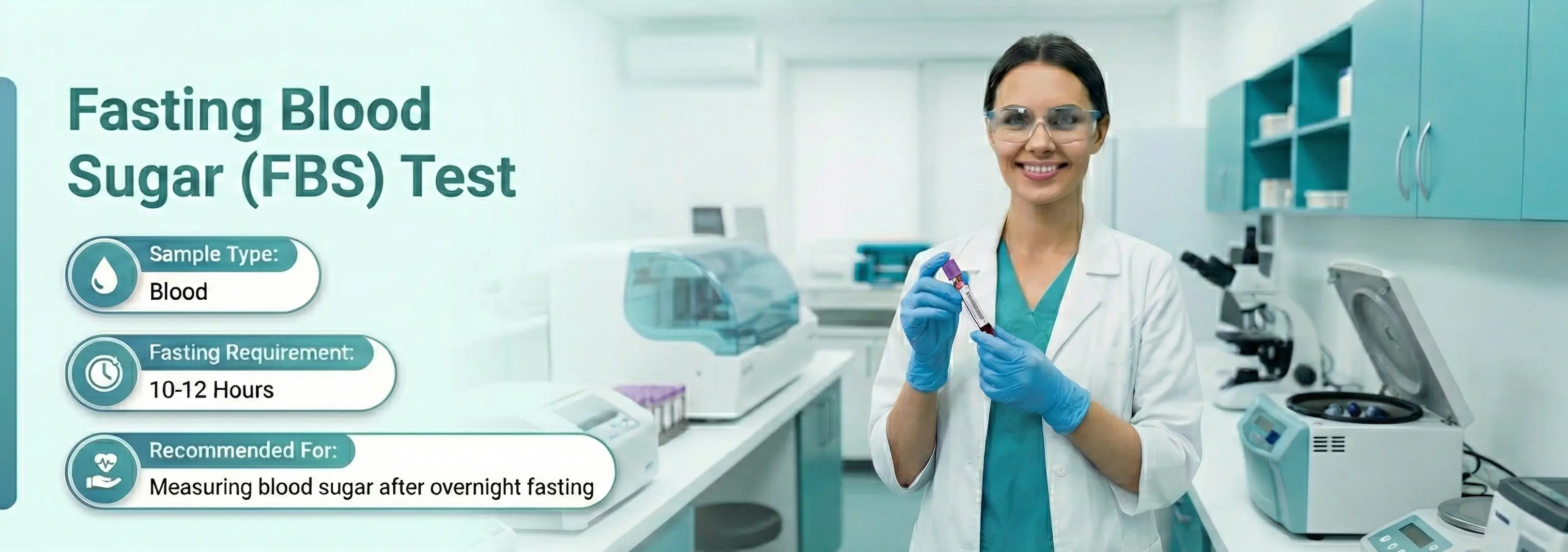
- SummaryThe Fasting Blood Sugar (FBS) Test measures glucose levels in your blood after 10–12 hours of fasting. It helps detect diabetes or prediabetes and is useful for routine monitoring in those already diagnosed. This test uses a blood sample, requires fasting, and is suitable for all age groups.Read more
- Reports Within7 HrsView Sample Report

 100% NABL & ISO Certified Labs
 - SampleBlood

- AgeAll Age Group
- GenderMale and Female
- Fasting10-12 Hrs

PharmEasy Promises



Know More About The Test


A quick info on FBS test

Overview
Glucose is a type of sugar generated from the carbohydrates you eat (like bread and rice) and is the main source of energy for your body. After eating, glucose enters your bloodstream to provide energy. If blood sugar levels are too high, it may indicate conditions like prediabetes or diabetes. These health problems often do not show clear symptoms early on, which is why regular testing is important, especially if you are at high risk for diabetes.
The FBS test, or Fasting Blood Sugar test, measures the amount of glucose in your blood after you have not eaten for 8 hours. Doctors usually recommend this test during routine check-ups or if diabetes is suspected. This is because early testing helps detect changes in blood sugar levels and allows timely management to avoid any future complications.
When and Who Should Get a FBS Test Done?
Your doctor may recommend an FBS test in the following situations:
- You may be at higher risk of type 2 diabetes if you:
- Are 35 years or older
- Belong to higher-risk groups (which includes the Asian population)
- Have prediabetes
- Have a family history of diabetes
- Have high blood pressure or heart disease
- Had diabetes during pregnancy (gestational diabetes) or delivered a baby weighing over 9 pounds
- Are overweight or obese
- Exercise less than three times a week
- Have non-alcoholic fatty liver disease (NAFLD)
- If you have symptoms of high blood sugar, such as:
- Fatigue
- Increased thirst
- Frequent urination
- Slow-healing wounds
- Numbness or tingling in the hands or feet
- Unexplained weight loss
- Blurred vision
- If you have symptoms of low blood sugar, such as:
- Headache
- Hunger
- Shakiness or feeling jittery
- Dizziness or confusion
- Difficulty speaking or seeing clearly
- Fast or irregular heartbeat
- Fainting or seizures
- If you already have prediabetes or diabetes
- If you are pregnant, testing is usually done to check for gestational diabetes
- If you are taking certain long-term medications (such as steroids), they can affect blood sugar levels.
.png?dim=48x48&q=75)
How Frequently Should You Take the FBS Test?
The recommended frequency of blood sugar testing (such as an FBS test) varies depending on an individual’s health status, risk factors, and existing medical conditions. The table below outlines general guidelines for how often testing should be performed in different scenarios.
|
Health Scenario |
Context |
Recommended Frequency |
|---|---|---|
|
Healthy adults (≥35 years) |
No symptoms (routine screening) |
Every 3 years |
|
Prediabetes |
Slightly elevated blood sugar levels |
Every 1 to 2 years |
|
High risk for diabetes |
Overweight, family history, etc. |
Every 3 years |
|
Pregnancy |
Screening for gestational diabetes |
Once between 24 and 28 weeks (earlier if high risk) |
|
Diagnosed diabetes |
To monitor blood sugar control |
As advised by the doctor (often daily self-monitoring with a self-monitoring device + blood tests every 3 to 6 months) |
|
Taking medications that affect blood glucose levels |
Taking steroids, antipsychotics, etc. |
As advised by the doctor |
|
Have symptoms of abnormal glucose levels |
Symptoms of high or low blood sugar |
Immediately (as recommended by the doctor) |

What Conditions Can a FBS Test Help Detect?
An FBS test is mainly used to detect and monitor conditions related to abnormal blood sugar levels. These include:
- Prediabetes and Diabetes: Prediabetes means blood sugar levels are higher than normal but not high enough to be diabetes, while diabetes is a condition where the body cannot properly control blood sugar levels.
- Monitoring Existing Conditions: This test is also used to monitor blood sugar control in people already diagnosed (with prediabetes or diabetes).
- Thyroid Disorders: Hyperthyroidism (overactive thyroid) may lead to increased blood sugar levels, while hypothyroidism (underactive thyroid) may sometimes be linked to low sugar levels.
- Pancreatic Conditions: Problems with the pancreas (such as pancreatitis) may affect glucose control.
- Adrenal Gland Disorders: Some adrenal gland conditions, like Cushing’s syndrome and pheochromocytoma (overactivity of adrenal glands), can cause high blood sugar, while Addison’s disease (underactive adrenal glands) may lead to low blood sugar.
- Liver and Kidney Disease: These organs help regulate glucose, so diseases affecting them can lead to abnormal glucose levels.
- Pituitary Disorders: Certain hormonal imbalances linked to the pituitary gland can affect the regulation of blood glucose levels.
- Medication Effects: Some medicines (e.g., steroids, certain diabetes drugs) can increase or decrease blood glucose levels.
- Nutritional and Lifestyle Factors: Malnutrition, alcohol use disorder, or not eating enough (especially in people taking diabetes medicines) can cause low blood sugar. Increased physical activity can also lower glucose levels.
- Stress-Related Conditions: Severe illness, surgery, or trauma can temporarily increase blood glucose levels.
Note: An FBS test alone is not enough to diagnose the exact cause of abnormal glucose levels. It is a screening tool that indicates whether blood sugar is high or low. To confirm a diagnosis, doctors usually recommend additional tests based on the suspected condition.
.png?dim=48x48&q=75)
FBS Test Preparation
What to Expect Before the FBS Test
You must fast for 10 to 12 hours before the test. During the fasting period, drink plain water freely. Avoid all food, milk, tea, coffee, juices, and beverages other than water. Avoid smoking and alcohol for at least 24 hours, as both can falsely elevate triglyceride levels. Avoid strenuous exercise in the 24 hours before the test. Continue your regular medications unless your doctor advises otherwise. Morning appointments are strongly recommended.
What to Expect During the Blood Collection
A phlebotomist cleans the skin with an antiseptic, then places an elastic band around your upper arm to make the veins easier to access. A small needle is inserted into the vein; you may feel a brief pinch. Blood is collected into a labelled tube in under a minute.
What to Expect After the FBS Test
A small cotton swab and bandage are placed over the site to stop any minor bleeding. You can eat and drink immediately after the test - have a light meal as soon as possible after the fast. If dizzy, sit and relax for a few minutes.

What are the Parameters Included in a FBS Test?
In an FBS test, the primary parameter measured is
- Fasting Blood Glucose Level
Glucose is the body’s main source of energy and is regulated by insulin (a hormone), which helps move it from the blood into cells. When this balance is disrupted, glucose can either build up in the blood or fall too low. If not identified and controlled, this can lead to long-term complications such as heart disease and nerve damage.
Therefore, tests like FBS are important for the early detection and monitoring of blood glucose imbalances. It reflects the amount of glucose present in your blood after a fasting period (of at least 8 hours), helping assess baseline blood sugar levels without the influence of recent food intake.

Normal Range of FBS Test Parameters
The FBS test normal range is indicated in the table below.
|
Test Parameter |
Normal Range |
|---|---|
|
Fasting Blood Sugar (Glucose) |
70 to 100 mg/dL |
Note:
- The normal range may vary slightly depending on the laboratory and individual health conditions.
- The test requires fasting for at least 8 hours (no food or drinks except water) for accurate results.
.png?dim=48x48&q=75)
FBS Test Result Interpretation
The table below provides a general interpretation of FBS test results based on whether levels are low or high.
|
Fasting Blood Glucose (mg/dL) |
What It May Indicate |
|---|---|
|
Low (<70) |
Taking medications that affect blood glucose levels, not eating enough, liver/kidney issues |
|
Normal (70 to 100) |
Healthy blood sugar control |
|
Prediabetes (100 to 125) |
Higher than normal levels. Indicates increased risk of diabetes |
|
High (≥126) |
Likely diabetes. Needs confirmation with repeat testing |
Note:
- Certain medical conditions can also affect FBS results, including thyroid disorders (such as hyperthyroidism and hypothyroidism), pancreatic conditions (such as pancreatitis), adrenal gland disorders (such as Cushing’s syndrome, Addison’s disease, and pheochromocytoma), liver or kidney disease, and pituitary disorders. Other factors like acute illness, stress, malnutrition, alcohol use, and certain medications may also influence results.
- A single high value is not enough for diagnosis. Repeat testing or additional tests are usually required.
- Results should always be interpreted by a doctor along with clinical symptoms and, if needed, additional tests.

FBS Test Risks and Limitations
Like any other medical test, this test also has some risks and limitations.
Risks:
The FBS blood test is generally safe and involves minimal risk. You may feel slight pain or a sting when the needle is inserted. Some people may experience mild bruising or lightheadedness. However, risks from the Fasting Blood Sugar test procedure are rare, and if any of these occur, they quickly resolve on their own.
Limitations:
- An FBS test provides only a single point measurement, so it may not be enough to confirm a diagnosis on its own.
- Results can be affected if proper fasting is not followed.
- Test results may sometimes be affected by sample-related factors such as haemolysis (breakdown of red blood cells), lipaemia (excess fat in the blood sample), icterus (high bilirubin levels causing yellow discoloration), or the presence of certain antibodies, which can lead to inaccurate values.

Related and Follow-up Tests
Depending on your symptoms and results, your doctor may recommend additional tests to better understand your condition:
- Glycated haemoglobin (HbA1c)
- Oral glucose tolerance test (OGTT)
- Random blood sugar (RBS)
- Postprandial blood sugar (PPBS)
- Glucose challenge tests
- Continuous glucose monitoring (CGM)

FBS Test Sample Collection: Home vs. Diagnostic Lab
|
Feature |
Home Collection (PharmEasy) |
Traditional Diagnostic Lab |
|---|---|---|
|
Convenience |
High - sample taken from your home or office. |
Low - requires travelling and waiting in queues. |
|
Time Saving |
Maximum - no travel time. You pick the time slot. |
Minimum - depends on traffic and lab rush. |
|
Safety & Comfort |
Safe - avoids exposure to other sick patients. |
Moderate - exposure to crowded waiting areas. |
|
Process |
A professional phlebotomist visits you. |
You must visit the facility during its hours. |
|
Report Access |
Digital - sent directly to your app or email. |
Often requires a second visit for physical copies. |
Pro Tip: For the most stress-free experience, book a FBS test on PharmEasy. Enjoy professional service and accurate results without stepping out of your house.

FBS Test Price/Cost
An FBS (Fasting Blood Sugar) test is typically priced around INR 119. The cost may vary depending on the city and the laboratory selected. To get a clearer idea, you can compare FBS test prices across major cities in India.
|
City |
Offer Price |
|---|---|
|
Bengaluru |
119 |
|
Chennai |
119 |
|
Delhi |
119 |
|
Hyderabad |
119 |
|
Kolkata |
119 |
|
Lucknow |
119 |
|
Mumbai |
119 |
|
Nagpur |
119 |
|
Patna |
119 |
|
Pune |
119 |
Was This Test Information Helpful?
Please rate your experience
 Yes Helpful (6)
 Not Helpful
References
Health packages containing 'Fasting Blood Sugar (FBS) Test'
 For full-body wellness, go for a comprehensive checkup
People Also Ask
What level of blood sugar is dangerous?
What is a normal blood sugar level after eating?
Can diabetes be cured completely?
How can I help manage my blood sugar levels?
What is FBS and the PPBS test?
Which nuts should individuals with diabetes avoid?
Does FBS increase with age?
Can dehydration increase FBS?
What is a normal blood sugar for a 70-year-old?
What complications can diabetes cause, and how can I stay healthy?
 4.6 Stars| 7+ Lakhs Ratings & Reviews

Over 10 million happy users PharmEasy Labs
- Because the digital report is available on WhatsApp, there's no need to go back to the lab. Thanks, PharmEasy!
 Sachin sharma11 Jan ‘26
 - Thanks to the coupon discount, the blood test was done at a lower price.Komal04 Jan ‘26
- The lab technician was a good and knowledgeable professional.Rakesh Pandey06 Jan ‘26
- Due to bad weather, it's difficult to reach the lab. But home collection makes things easier.Arjun08 Jan ‘26
- Thanks to the Swasth AI feature, the report is easy to understand.Priya Mehta02 Jan ‘26
- The report is available on the same day. Wow!Vikas Patel05 Jan ‘26
Have any doubts? Ask us.
Ask us anything about the Fasting Blood Sugar (FBS) Test to understand it better

We provide trusted, expert-curated health content to support better awareness,prevention, and care.
Backed by experienced doctors, medical experts, and strict editorial standards.