

230+ orders placed in your location

100% NABL & ISO Certified Lab • 100% Accurate Reports
Double Marker First Trimester 8-13 Week (FMF Certified)
- SummaryDouble Marker Test is a prenatal screening test that involves a simple blood test, usually advised between 8-13 weeks of pregnancy. Deregulated levels of these markers often indicate the risk of chromosomal abnormalities like Down syndrome, Edwards syndrome, and Patau syndrome in the developing baby.Read more
- TestsIncludes 3 tests
- Reports Within26 HrsView Sample Report

 100% NABL & ISO Certified Labs
 - SampleBlood

- FastingNot Required

PharmEasy Promises



Know More About The Package


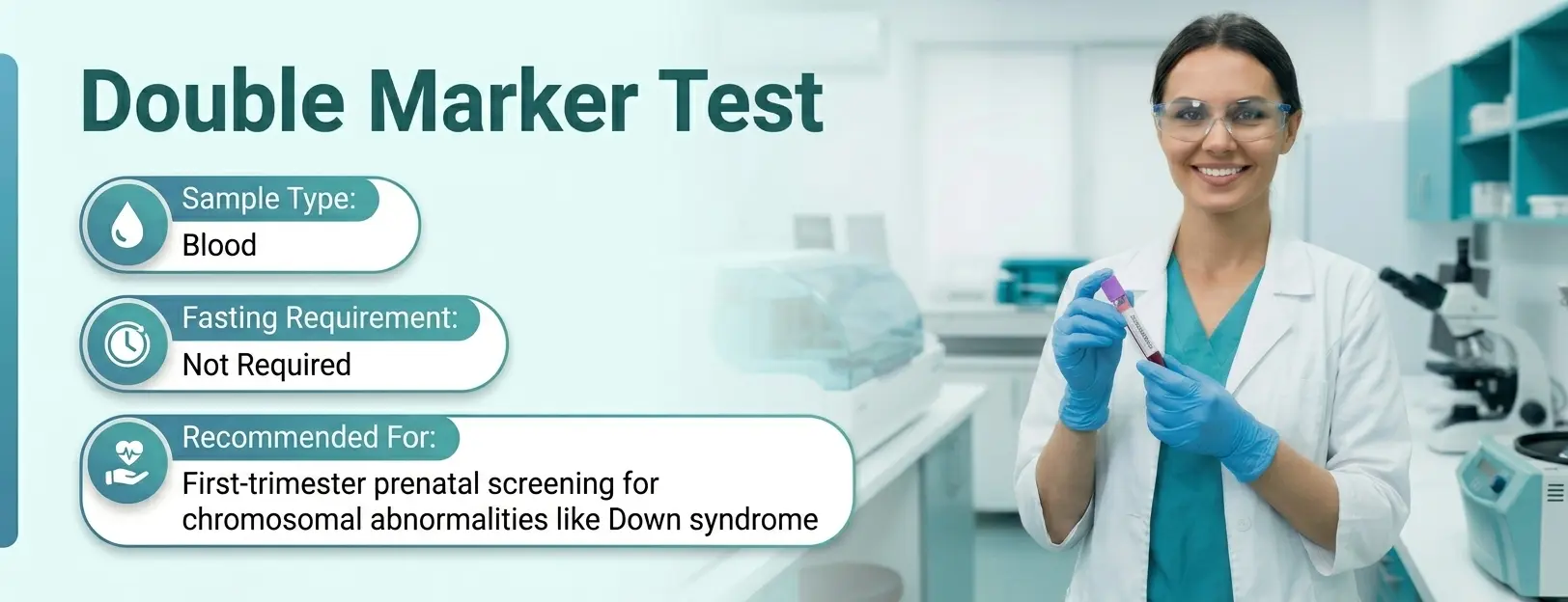
A quick info on Double Marker Test

Overview
The double marker test (also known as the dual marker test) is a pregnancy screening test typically conducted between 8 and 13 weeks of pregnancy. It helps to assess the risk of certain genetic conditions in the baby, such as Down syndrome (Trisomy 21), Edwards syndrome (Trisomy 18), and Patau syndrome (Trisomy 13), by measuring two substances in the mother’s blood:
- Free beta-human chorionic gonadotropin (β-hCG)
- Pregnancy-associated plasma protein-A (PAPP-A)
This test is safe and does not harm the baby. It only assesses the risk of certain conditions and does not provide a confirmed diagnosis. A hard copy of an ultrasound (nuchal translucency or NT scan) report is required before booking the double marker test, as the test results are interpreted together with the ultrasound findings.

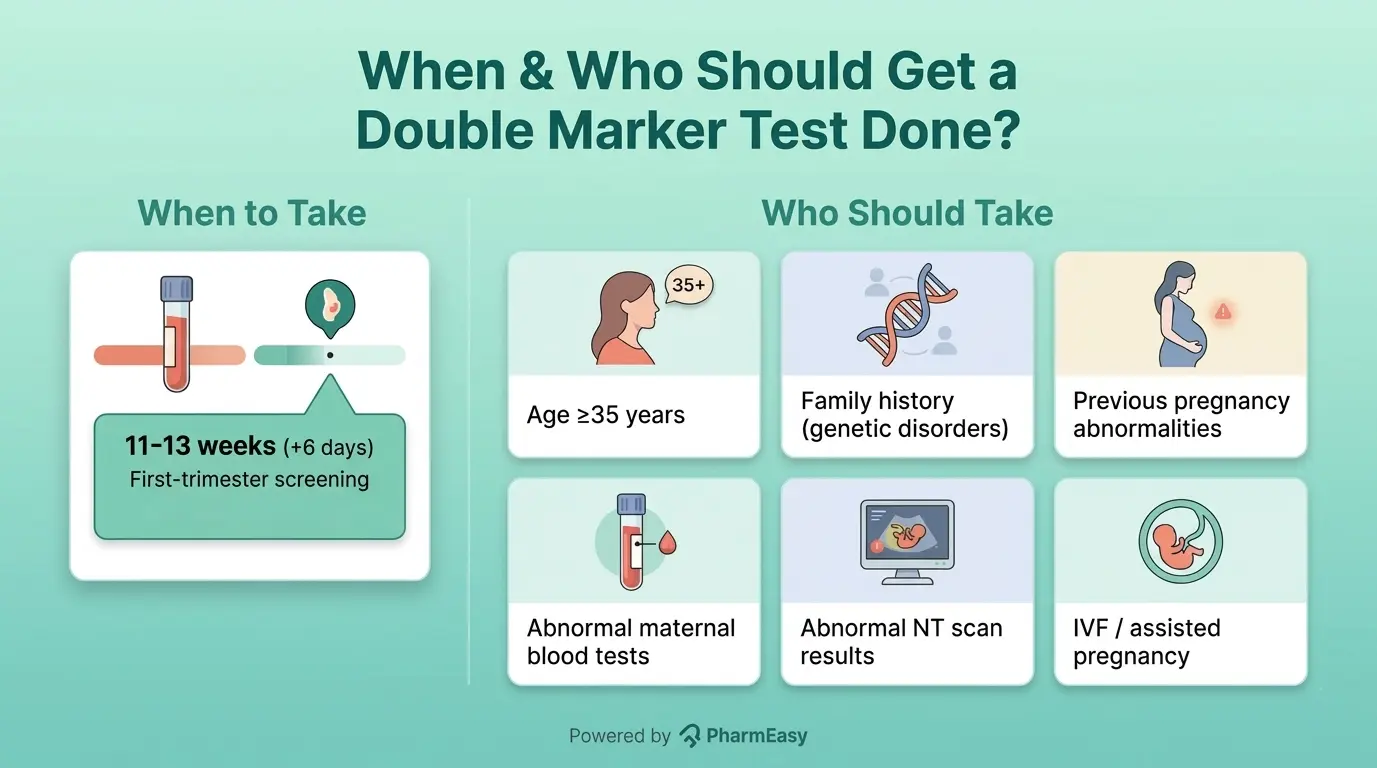
When and Who Should Get a Double Marker Test Done?
A double marker test in pregnancy is performed as a routine screening test in early pregnancy to assess the risk of genetic problems in the baby. This helps doctors make timely decisions about further diagnostic tests if needed.
This test is usually recommended for:
- Women aged 35 years and above.
- Individuals with a family history of genetic disorders.
- Women who have had a previous pregnancy with abnormalities.
- Women with abnormal results on other maternal blood tests.
- Women with abnormal results on early ultrasound findings (NT scan).
- Women who conceived through in vitro fertilization (IVF) or other assisted methods.
.png?dim=48x48&q=75)
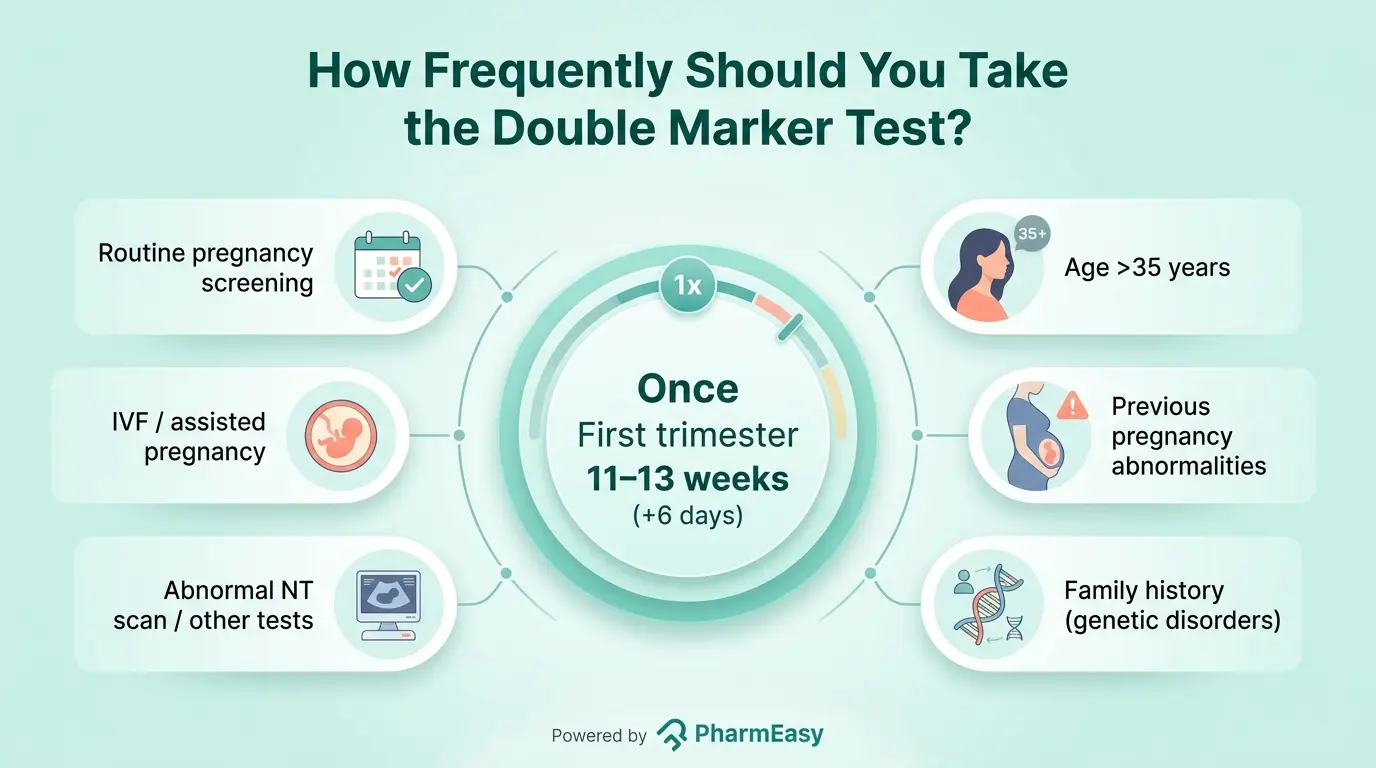
How Frequently Should You Take the Double Marker Test?
The double marker test is usually performed once during early pregnancy, within a specific time window:
|
Health Scenario |
Context |
Recommended Frequency |
|---|---|---|
|
Routine pregnancy screening |
Part of the first-trimester screening to assess genetic risk |
Once between 8 and 13 weeks |
|
Advanced maternal age (>35 years) |
Higher risk of chromosomal (certain genetic) abnormalities |
Once in the first trimester |
|
Previous pregnancy with abnormalities |
Risk of recurrence |
Once in the first trimester |
|
Family history of genetic disorders |
Increased genetic risk |
Once in the first trimester |
|
Abnormal NT scan or other tests |
Requires further risk assessment |
Once in the first trimester |
|
IVF or assisted pregnancy |
Needs closer monitoring |
Once in the first trimester |

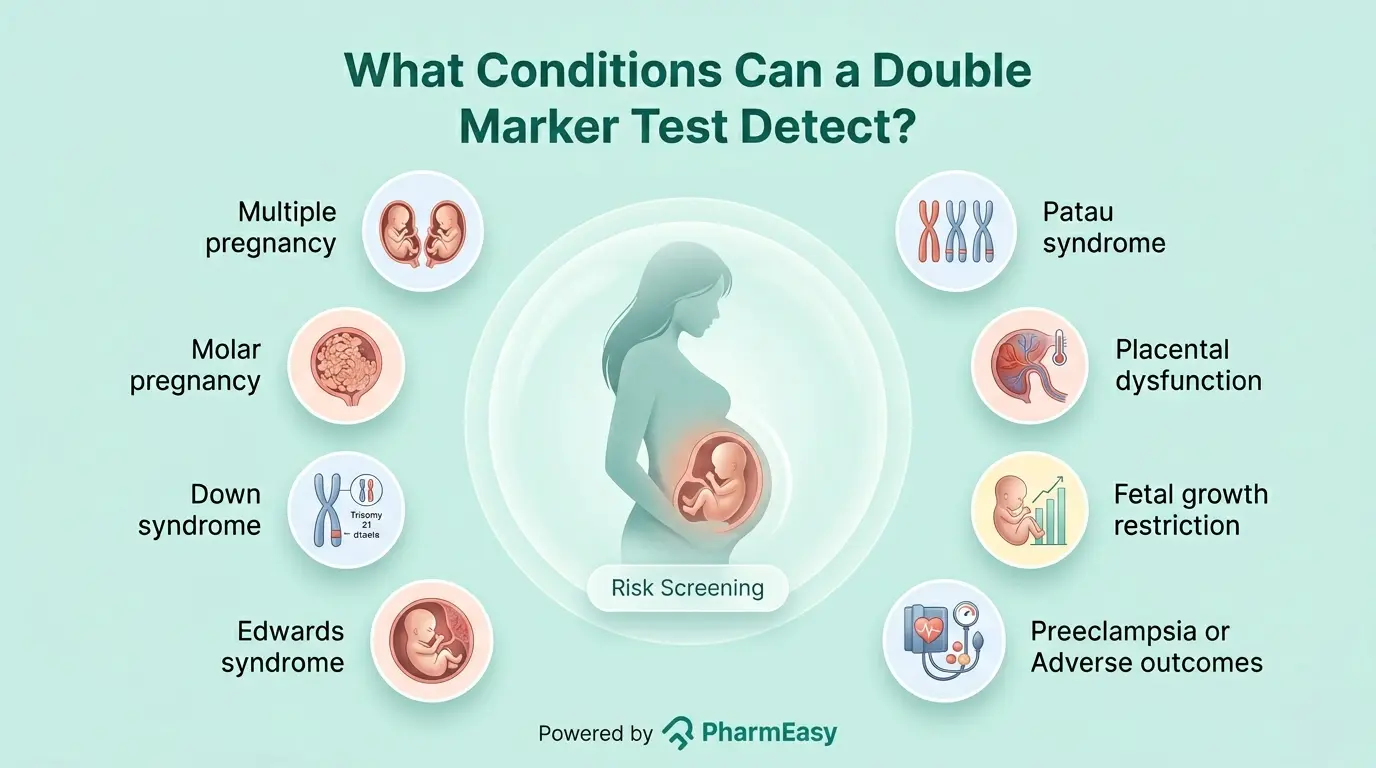
What Conditions Can a Double Marker Test Help Detect?
The double marker test results help assess the risk of conditions, such as:
- Down syndrome (Trisomy 21): A genetic condition where babies may have delayed development and features such as eyes slightly slanted upwards, flat facial features, shorter height, and low birth weight.
- Edwards syndrome (Trisomy 18): A genetic condition associated with developmental issues and features such as cleft lip/palate (a gap in the upper lip or roof of the mouth), abnormal hands/feet, kidney issues, and heart defects in babies.
- Patau syndrome (Trisomy 13): A genetic condition where babies may have serious health issues and features such as cleft lip/palate, extra fingers/toes, brain abnormalities, and heart defects.
Note: This is a screening test that only assesses the risk of certain conditions. More tests are needed to understand the results clearly.
.png?dim=48x48&q=75)
Double Marker Test Preparation
What to Expect Before the Double Marker Test
No fasting is required for a standalone Double Marker Test. You can eat and drink normally. However, if it is part of a broader package that includes fasting tests, your doctor may advise an 8 to 12 hour fast.
What to Expect During the Blood Collection
A phlebotomist cleans the skin with an antiseptic, then places an elastic band around your upper arm to make the veins easier to access. A small needle is inserted into the vein - you may feel a brief pinch. Blood is collected into a labelled tube in under a minute.
What to Expect After the Double Marker Test
A small cotton swab and bandage are placed over the site to stop any minor bleeding. You can return to normal activities immediately. Minor bruising is normal and disappears quickly. If dizzy, sit and rest for a few minutes.

What are the Parameters Included in a Double Marker Test?
The double marker test checks for two parameters:
- Free Beta-hCG: A hormone made during pregnancy that helps support the pregnancy.
- PAPP-A: A protein that helps the baby grow and supports the placenta (the organ that nourishes the baby in the womb).
Note: Before booking this test, you may need to present a hard copy of your most recent USG report (not an older one) along with the test requisition form (TRF) form filled with complete details. The result will show a risk ratio based on free β-hCG, PAPP-A, and other maternal factors (such as age, etc.).

Normal Range of Double Marker Test Parameters
The table below shows the double marker test values.
|
Double Marker |
Positive |
Negative |
|---|---|---|
|
Trisomy 13 and 18 |
>1:100 |
<1:100000 |
|
Trisomy 21 |
> 1:250 |
<1:10000 |
Important Note
- Results should always be interpreted by a qualified doctor.
- Values in test results may vary based on laboratory standards, pregnancy dates, and maternal factors (e.g., weight).
- This is a screening test that does not provide a diagnosis; it only provides risk assessment.
- For the double marker test price, please contact your local diagnostic center or refer to online healthcare platforms.
.png?dim=48x48&q=75)
Double Marker Test Result Interpretation
The table below shows what high or low levels in a double marker test report may indicate:
|
Condition |
Result Range |
Interpretation |
|---|---|---|
|
Trisomy 13 & 18 |
>1:100 |
High risk (screen positive); further evaluation may be needed |
|
Trisomy 13 & 18 |
<1:100000 |
Low risk (screen negative) |
|
Trisomy 21 (Down syndrome) |
>1:250 |
High risk (screen positive); further testing recommended |
|
Trisomy 21 (Down syndrome) |
<1:10000 |
Low risk (screen negative) |
Note: A higher ratio (e.g., ≥1:10000) is considered low risk (screen negative) and indicates a lower chance of chromosomal abnormalities, though it does not completely rule them out. Likewise, a lower ratio (e.g., ≤1:250) is considered high risk (screen positive) and suggests an increased likelihood of abnormalities, for which further confirmatory tests may be recommended.
The double marker test results are always interpreted together with the NT scan report to better evaluate the risk of chromosomal abnormalities.

Double Marker Test Risks and Limitations
This test is generally considered safe; however, some possible risks and limitations are as follows:
Potential Risks and Complications (Rare)
- Mild pain at the blood draw site.
- Slight bleeding or bruising.
- Light-headedness or dizziness.
Note: If any of these do occur, they usually resolve on their own shortly.
Understanding Double Marker Test Limitations
- This is a screening test that provides a risk estimate and is not a diagnostic test.
- There is a possibility of false positive and false negative results.
- The test is more accurate when the double marker test weeks (pregnancy weeks) are calculated correctly.
- Results are more reliable when combined with NT scan findings.

Related and Follow-up Tests
If the double marker test shows a possible risk, doctors will compare it with the NT scan and may suggest further tests, such as:
- Non-Invasive Prenatal Testing (NIPT)
- Chorionic Villus Sampling (CVS)
- Amniocentesis

Double Marker Test Sample Collection: Home vs. Diagnostic Lab
|
Feature |
Home Collection (PharmEasy) |
Traditional Diagnostic Lab |
|---|---|---|
|
Convenience |
High - sample taken from your home or office. |
Low - requires traveling and waiting in queues. |
|
Time Saving |
Maximum - no travel time. You pick the time slot. |
Minimum - depends on traffic and lab rush. |
|
Safety & Comfort |
Safe - avoids exposure to other sick patients. |
Moderate - exposure to crowded waiting areas. |
|
Process |
A professional phlebotomist visits you. |
You must visit the facility during their hours. |
|
Report Access |
Digital - sent directly to your app or email. |
Often requires a second visit for physical copies. |
Pro Tip: For the most stress-free experience, book your test on PharmEasy. Enjoy professional service and accurate results without stepping out of your house.
Was This Test Information Helpful?
Please rate your experience
 Yes Helpful (1)
 Not Helpful
References
People Also Ask
What is the difference between the Double Marker and Triple Marker tests?
What is the difference between an NT scan and a Double Marker test?
Is the Double Marker test compulsory?
Can a Double Marker test be done after 14 weeks?
What is the age-related risk in women undergoing a Double Marker test?
Which trimester is the best for getting a Double Marker test done?
What is the biggest indicator of Down syndrome?
How to avoid Down syndrome during pregnancy?
Is the Double Marker test safe for the baby?
 4.6 Stars| 7+ Lakhs Ratings & Reviews

Over 10 million happy users PharmEasy Labs
- Because the digital report is available on WhatsApp, there's no need to go back to the lab. Thanks, PharmEasy!
 Sachin sharma11 Jan ‘26
 - Thanks to the coupon discount, the blood test was done at a lower price.Komal04 Jan ‘26
- The lab technician was a good and knowledgeable professional.Rakesh Pandey06 Jan ‘26
- Due to bad weather, it's difficult to reach the lab. But home collection makes things easier.Arjun08 Jan ‘26
- Thanks to the Swasth AI feature, the report is easy to understand.Priya Mehta02 Jan ‘26
- The report is available on the same day. Wow!Vikas Patel05 Jan ‘26
Have any doubts? Ask us.
Ask us anything about the Double Marker First Trimester 8-13 Week (FMF Certified) to understand it better

We provide trusted, expert-curated health content to support better awareness,prevention, and care.
Backed by experienced doctors, medical experts, and strict editorial standards.