

11081+ orders placed in your location

100% NABL & ISO Certified Lab • 100% Accurate Reports
Erythrocyte Sedimentation Rate (ESR) Test
Erythrocyte sedimentation rate, Westergren sedimentation rate, Sed rate, Sed rate by modified Westergren, Sedimentation rate
- SummaryErythrocyte Sedimentation Rate is a blood test that indicates inflammatory activity in the body. It may help your doctor in monitoring of inflammatory conditions. The ESR levels can be raised during fever, arthritis, vasculitis, acute and chronic infections, cancers and autoimmune disorders. The ESR test is done by taking a blood sample from a vein in your arm; fasting is not required for this test, and it can be performed at any time of the day.Read more
- Reports Within8 HrsView Sample Report

 100% NABL & ISO Certified Labs
 - SampleBlood

- AgeAll Age Group
- GenderMale and Female
- FastingNot Required

PharmEasy Promises



Know More About The Test


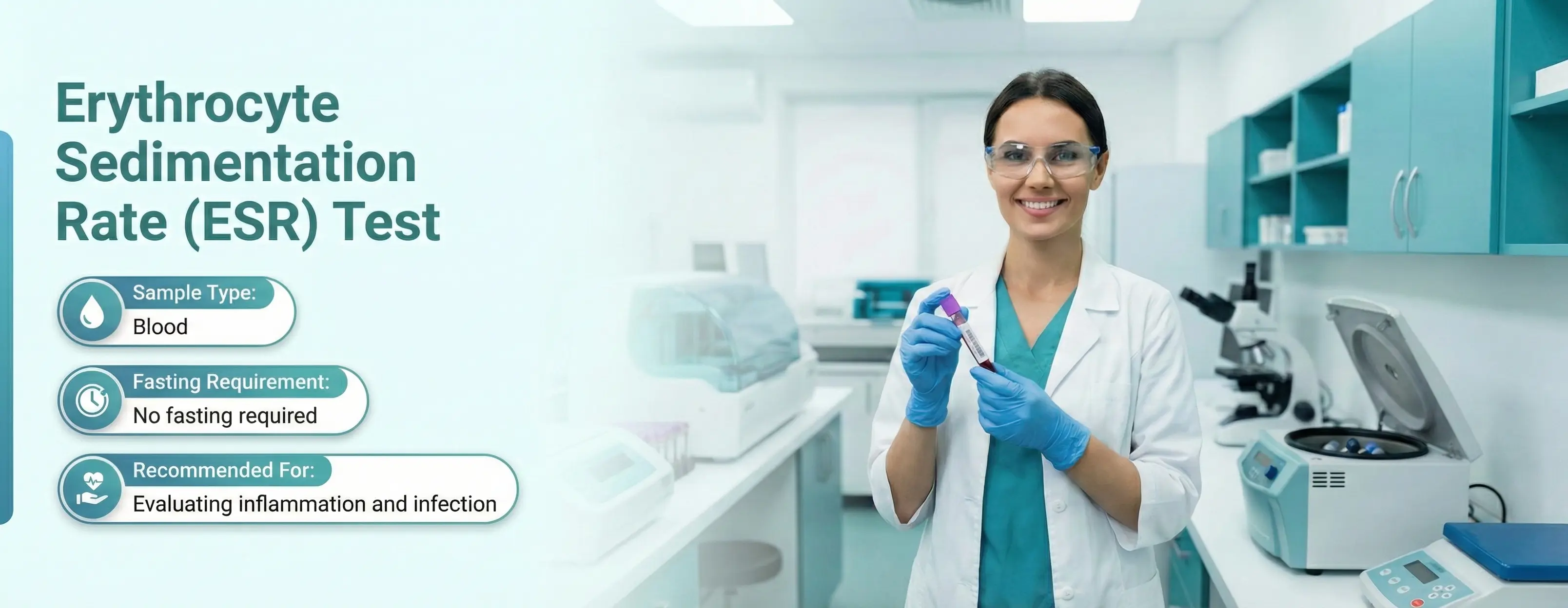
A quick info on ESR test

Overview
The Erythrocyte Sedimentation Rate (ESR) test measures how quickly your red blood cells (erythrocytes) settle to the bottom of a test tube over one hour. Doctors order an ESR test when inflammation, infection, or a chronic disease is suspected. When inflammation is present, proteins like fibrinogen cause red blood cells to clump together, making them settle faster and producing a high ESR reading. The ESR does not identify the specific cause of inflammation; instead, it serves as a sensitive early-warning signal prompting further investigation.
The ESR test is a simple, low-cost screening tool that signals whether inflammation is present in the body. The test does not identify the cause or location of inflammation and cannot diagnose any specific disease on its own. Doctors use it alongside other tests (such as CRP) to investigate symptoms or monitor known conditions.

When and Who Should Get a ESR Test Done?
An ESR test is performed to detect inflammation in your body and assess its severity. This helps doctors investigate active symptoms or monitor chronic and long-term conditions.
This test is usually recommended for:
- Anyone with persistent or unexplained fever (lasting more than a few days).
- Individuals with chronic joint pain, stiffness, or swelling.
- People with unexplained fatigue, prolonged weakness, or a general feeling of being unwell.
- Patients diagnosed with rheumatoid arthritis, lupus, or IBD - to track disease activity.
- Patients where tuberculosis is suspected - particularly with chronic cough, night sweats, and weight loss.
- Patients being evaluated for polymyalgia rheumatica or giant cell arteritis, where ESR is a key diagnostic marker.
- As part of a routine preventive health check-up, especially if you are above 50 years of age.
.png?dim=48x48&q=75)
How Frequently Should You Take the ESR Test?
The frequency of an ESR test depends entirely on your health condition and your doctor's guidance.
Unlike CRP, which rises and falls rapidly, ESR changes more slowly, making it better suited for tracking long-term trends in inflammation rather than acute changes.
|
Health Scenario |
Context |
Recommended Frequency |
|---|---|---|
|
Routine Health Check |
Healthy individuals above 40, or those with risk factors for chronic disease. |
Usually, once a year as part of a preventive check-up. |
|
Chronic Inflammatory Disease |
Managing conditions like rheumatoid arthritis, lupus, or IBD. |
Every 1 to 3 months, based on disease stability and treatment plan. |
|
Tuberculosis Monitoring |
Patients undergoing treatment for TB. |
Every 1 to 2 months to track treatment response. |
|
Multiple Myeloma / Blood Disorders |
Monitoring disease progression or treatment response. |
As directed by the specialist, typically every 1 to 3 months. |
|
Polymyalgia Rheumatica / GCA |
Confirming diagnosis and monitoring steroid therapy response. |
Every 4 to 6 weeks during active treatment. |
|
Post-Illness Follow-up |
To confirm recovery and return of ESR to normal after an acute illness. |
Once, 4 to 6 weeks after completing treatment. |

What Conditions Can a ESR Test Help Detect?
The ESR test is a powerful screening and monitoring tool, but it does not confirm any specific disease on its own. Think of it as a broad health radar: it detects the presence of inflammation by measuring an indirect effect rather than the cause directly. Elevated ESR may provide early warnings for:
- Chronic inflammatory conditions - such as rheumatoid arthritis and systemic lupus erythematosus (SLE).
- Bacterial and fungal infections - ESR rises in response to active infections that trigger an immune response.
- Tuberculosis (TB) - It is a well-established marker for both diagnosis and monitoring of TB treatment.
- Inflammatory bowel diseases - such as Crohn's disease and ulcerative colitis.
- Polymyalgia rheumatica and giant cell arteritis - where ESR is a key diagnostic marker.
- Anaemia and certain blood disorders - including sickle cell disease and other red blood cell conditions.
- Kidney disease and nephrotic syndrome - both of which cause significant protein changes that raise ESR.
- Certain cancers - including multiple myeloma, lymphoma, and metastatic cancers, where ESR can be dramatically elevated.
Important Note: Always share your results with a medical professional for a proper diagnosis. The ESR test does not confirm any of the above conditions on its own.
.png?dim=48x48&q=75)
ESR Test Preparation
When your ESR is elevated above the normal range, it signals that inflammation or another underlying condition may be present. The degree of elevation often provides a clue about the likely cause.
|
ESR Level |
Result |
Potential Interpretation (May be associated with) |
|---|---|---|
|
0 - 20 mm/hr |
Normal |
No significant inflammation detected. A normal ESR is reassuring but does not completely rule out all diseases. Some conditions, particularly early-stage diseases or certain viral infections, may not raise ESR significantly. |
|
20 - 40 mm/hr |
Mildly High |
Pregnancy (physiologically normal), anaemia, older age, mild infections or viral illnesses, obesity, thyroid disease, early or well-controlled autoimmune conditions. |
|
40 - 70 mm/hr |
Moderately High |
Rheumatoid arthritis or other inflammatory arthritis, inflammatory bowel disease (Crohn's, ulcerative colitis), kidney disease or nephrotic syndrome, active or chronic bacterial infection, Lupus (SLE) with moderate disease activity. |
|
70 - 100 mm/hr |
High |
Active tuberculosis (TB), osteomyelitis (bone infection), systemic vasculitis, severe autoimmune disease flare-up, polymyalgia rheumatica or giant cell arteritis, lymphoma. |
|
Above 100 mm/hr |
Very High |
Multiple myeloma or other plasma cell disorders, severe or disseminated infections, metastatic cancer, severe connective tissue disease, or subacute bacterial endocarditis. An ESR above 100 mm/hr almost always indicates a serious underlying disease requiring urgent investigation. |
Disclaimer: This table is for educational purposes and provides a risk assessment only. These findings do not confirm a diagnosis. Many factors, including age, gender, pregnancy, anaemia, and certain medications, can affect ESR levels. Always consult your doctor to understand how these results relate to your symptoms and overall health.

What are the Parameters Included in a ESR Test?
The ESR test measures a single key parameter: the rate at which your red blood cells settle in a standardised tube over one hour. Your report will typically include:
- ESR value (mm/hr) - The distance in millimetres that red blood cells have settled in one hour. This is the primary result of the test.
- Method used - Most laboratories use either the Westergren method (the international gold standard) or the Wintrobe method. The Westergren method is more sensitive and widely accepted globally.
Because ESR changes slowly, a single elevated result is most meaningful when considered alongside your clinical symptoms and other blood test results. A trend of consistently high ESR over time is often more informative than a single isolated reading.

Normal Range of ESR Test Parameters
The table below shows the typical normal ESR ranges by age and gender (Westergren method).
|
Category |
Normal ESR Range (mm/hr) |
|---|---|
|
Adult Men (under 50 years) |
0 - 15 mm/hr |
|
Adult Men (above 50 years) |
0 - 20 mm/hr |
|
Adult Women (under 50 years) |
0 - 20 mm/hr |
|
Adult Women (above 50 years) |
0 - 30 mm/hr |
|
Children |
0 - 10 mm/hr |
|
Newborns |
0 - 2 mm/hr |
Important Note: The normal values and reference ranges may vary slightly between laboratories and between the Westergren and Wintrobe methods. Please refer to the ranges printed on your specific report and consult your doctor to understand what your number means for your health.
.png?dim=48x48&q=75)
ESR Test Result Interpretation
When your ESR is elevated above the normal range, it signals that inflammation or another underlying condition may be present. The degree of elevation often provides a clue about the likely cause.
|
ESR Level |
Result |
Potential Interpretation (May be associated with) |
|---|---|---|
|
0 - 20 mm/hr |
Normal |
No significant inflammation detected. A normal ESR is reassuring but does not completely rule out all diseases. Some conditions, particularly early-stage diseases or certain viral infections, may not raise ESR significantly. |
|
20 - 40 mm/hr |
Mildly High |
Pregnancy (physiologically normal), anaemia, older age, mild infections or viral illnesses, obesity, thyroid disease, early or well-controlled autoimmune conditions. |
|
40 - 70 mm/hr |
Moderately High |
Rheumatoid arthritis or other inflammatory arthritis, inflammatory bowel disease (Crohn's, ulcerative colitis), kidney disease or nephrotic syndrome, active or chronic bacterial infection, Lupus (SLE) with moderate disease activity. |
|
70 - 100 mm/hr |
High |
Active tuberculosis (TB), osteomyelitis (bone infection), systemic vasculitis, severe autoimmune disease flare-up, polymyalgia rheumatica or giant cell arteritis, lymphoma. |
|
Above 100 mm/hr |
Very High |
Multiple myeloma or other plasma cell disorders, severe or disseminated infections, metastatic cancer, severe connective tissue disease, or subacute bacterial endocarditis. An ESR above 100 mm/hr almost always indicates a serious underlying disease requiring urgent investigation. |
Disclaimer: This table is for educational purposes and provides a risk assessment only. These findings do not confirm a diagnosis. Many factors, including age, gender, pregnancy, anaemia, and certain medications, can affect ESR levels. Always consult your doctor to understand how these results relate to your symptoms and overall health.

ESR Test Risks and Limitations
Potential Risks and Complications
The ESR test is a very safe, routine blood draw. Complications are extremely rare, and most people only feel a brief pinch. Consult a doctor if:
- The puncture site does not stop bleeding after gentle pressure
- You notice unusual redness, warmth, or lasting pain at the needle site
- You feel persistently lightheaded after the blood draw; sit and rest for a few minutes before standing up.
Understanding ESR Test Limitations
ESR is a nonspecific marker that indicates inflammation is present, but cannot pinpoint its location or cause. ESR is affected by many factors that can cause a false reading. Age, gender, pregnancy, anaemia, and red blood cell shape all affect results. Medications, including oral contraceptives, aspirin, and corticosteroids, can also interfere with ESR levels. A normal ESR does not rule out all diseases, and ESR must always be interpreted alongside symptoms and other test results.

Related and Follow-up Tests
If your ESR test results are elevated, your doctor may suggest follow-up tests to identify the specific source and cause of inflammation.
|
ESR Finding |
Suggested Follow-up Test |
Why It Is Ordered |
|---|---|---|
|
Elevated ESR (any level) |
A faster-responding inflammation marker. When both ESR and CRP are elevated, the likelihood of significant inflammation or infection is much higher. |
|
|
Elevated ESR (any level) |
Assesses red blood cell, white blood cell, and platelet counts that may help explain the cause of elevated ESR. |
|
|
Elevated ESR + Joint Pain |
Ordered when elevated ESR is associated with joint pain or stiffness, to assess for rheumatoid arthritis. |
|
|
Elevated ESR + Suspected Lupus |
Suggested if autoimmune conditions like lupus (SLE) or Sjogren's syndrome are suspected. |
|
|
Very High ESR (above 100 mm/hr) |
Ordered to check for multiple myeloma or other plasma cell disorders. |
|
|
Elevated ESR + Cough, Night Sweats |
Mantoux Test (TST) or IGRA Test |
Recommended if tuberculosis is suspected based on clinical symptoms and elevated ESR. |
|
Very High ESR + Headache and Jaw Pain |
Temporal Artery Biopsy |
In cases of suspected giant cell arteritis, where ESR is often dramatically elevated. |
Note: These follow-up tests help convert a non-specific ESR warning signal into a clear and actionable diagnosis. Always consult your doctor to decide which additional tests are right for you.

ESR Test Sample Collection: Home vs. Diagnostic Lab
|
Feature |
Home Collection (PharmEasy) |
Traditional Diagnostic Lab |
|---|---|---|
|
Convenience |
High - sample taken from your home or office. |
Low - requires travelling and waiting in queues. |
|
Time Saving |
Maximum - no travel time. You pick the time slot. |
Minimum - depends on traffic and lab rush. |
|
Safety & Comfort |
Safe - avoids exposure to other sick patients. |
Moderate - exposure to crowded waiting areas. |
|
Process |
A professional phlebotomist visits you. |
You must visit the facility during its hours. |
|
Report Access |
Digital - sent directly to your app or email. |
Often requires a second visit for physical copies. |
Pro Tip: For the most stress-free experience, book a ESR test on PharmEasy. Enjoy professional service and accurate results without stepping out of your house.
Was This Test Information Helpful?
Please rate your experience
 Yes Helpful (31)
 Not Helpful
References
People Also Ask
What is the difference between ESR and CRP? Which one is better?
My ESR is slightly elevated, but I feel fine. Should I be worried?
Do I need to fast before an ESR test?
Why is my ESR high, but my CRP is normal?
Does anaemia affect ESR results?
Can ESR be elevated in pregnancy?
What does a very high ESR (above 100 mm/hr) mean?
 4.6 Stars| 7+ Lakhs Ratings & Reviews

Over 10 million happy users PharmEasy Labs
- Because the digital report is available on WhatsApp, there's no need to go back to the lab. Thanks, PharmEasy!
 Sachin sharma11 Jan ‘26
 - Thanks to the coupon discount, the blood test was done at a lower price.Komal04 Jan ‘26
- The lab technician was a good and knowledgeable professional.Rakesh Pandey06 Jan ‘26
- Due to bad weather, it's difficult to reach the lab. But home collection makes things easier.Arjun08 Jan ‘26
- Thanks to the Swasth AI feature, the report is easy to understand.Priya Mehta02 Jan ‘26
- The report is available on the same day. Wow!Vikas Patel05 Jan ‘26
Have any doubts? Ask us.
Ask us anything about the Erythrocyte Sedimentation Rate (ESR) Test to understand it better

We provide trusted, expert-curated health content to support better awareness,prevention, and care.
Backed by experienced doctors, medical experts, and strict editorial standards.