

2898+ orders placed in your location

100% NABL & ISO Certified Lab • 100% Accurate Reports
Serum Phosphorus (Ph) Test
Phosphorus Test, P, PO4, Phosphorus-Serum
- SummaryThe Serum Phosphorus test measures the level of phosphorus in the blood, which is essential for healthy bones, teeth, and cell function. It helps assess kidney function, bone disorders, or some hormonal imbalances. The test is done using a blood sample, and fasting for 8–12 hours may be recommended for accurate results.Read more
- Reports Within10 HrsView Sample Report

 100% NABL & ISO Certified Labs
 - SampleBlood

- AgeAll Age Group
- GenderMale and Female
- FastingNot Required

PharmEasy Promises



Know More About The Test


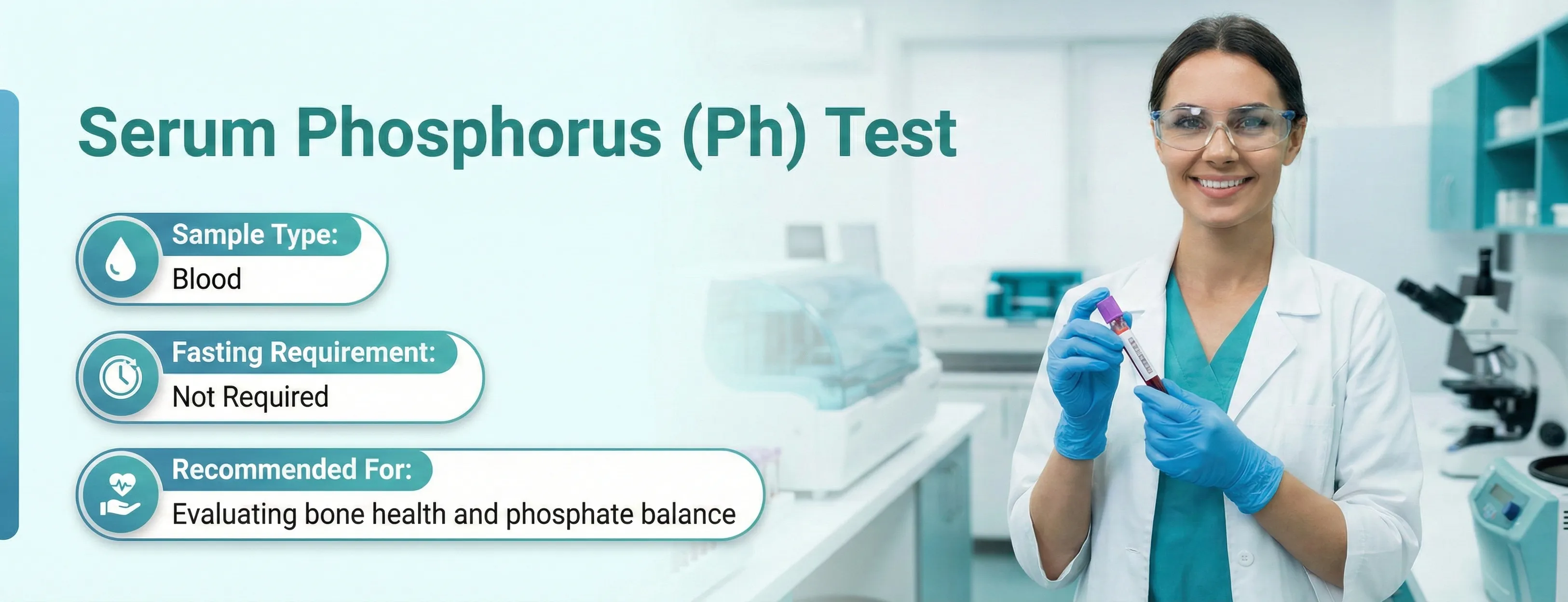
A quick info on Serum Phosphorus (Ph) Test

Overview
The Phosphorus test, also known as the serum phosphorus test, phosphate test, or inorganic phosphorus test, measures the levels of phosphorus in the blood.
Phosphorus is an essential mineral that supports healthy teeth and bones, helps nerves and muscles function properly, and plays an important role in energy production. It is obtained from food such as dairy products, nuts and seeds, legumes, eggs, meat, poultry, and seafood.
Most phosphorus is found in the teeth and bones, while some amount is also present in the blood. An excess amount of phosphorus is filtered out by the kidneys. Hence, high phosphorus levels in the blood may point towards a kidney disorder.
Abnormal phosphorus levels in blood can cause fatigue, irritability, muscle cramps, or bone pain, indicating underlying conditions such as bone disorders, kidney dysfunction, or malnutrition. Therefore, monitoring of blood phosphate level is important in kidney, endocrine, and gastrointestinal disorders.
Phosphorus levels in the body are influenced by calcium, vitamin D, and parathyroid hormone. Hence, if you have a deficiency in the above nutrients or are taking these supplements, your doctor may recommend a Phosphorus test.

When and Who Should Get a Serum Phosphorus (Ph)Test Done?
The Phosphorus test is a diagnostic test performed alone or along with tests that detect bone disorders, kidney problems, or it can be included with tests that measure calcium, vitamin D, or parathyroid hormone levels to get a complete picture of mineral and hormonal imbalances in the body.
If you experience the following symptoms, your doctor may recommend a Phosphorus test:
- Fatigue or weakness
- Bone or joint pain
- Muscle cramps
- Brittle nails
- Irritability or confusion
- Seizures
A doctor may also recommend this test to monitor the following conditions:
- Diabetes, especially if you have uncontrolled blood sugar
- Parathyroid disorders
- Chronic kidney disease
- Bone disorders
- Effect of calcium or vitamin D supplements
- Long-term usage of medications such as antacids or diuretics
.png?dim=48x48&q=75)
How Frequently Should You Take the Serum Phosphorus (Ph) Test?
There is no fixed or regular interval for taking the Phosphorus test. Your doctor orders this test if you have symptoms such as bone pain, muscle cramps, mental confusion, abnormal calcium levels, or to monitor certain conditions such as diabetes or parathyroid disorders.

What Conditions Can a Serum Phosphorus (Ph) Test Help Detect?
Phosphorus levels help in the detection of the following conditions:
- Kidney disease - High phosphorus levels may suggest chronic kidney disease.
- Bone disorders - Low phosphorus levels cause fragile bones accompanied by pain, leading to bone disorders.
- Parathyroid disorders - Parathyroid hormone regulates the levels of phosphorus in the blood. Hyperparathyroidism causes low phosphorus, and hypoparathyroidism leads to high phosphorus in the blood.
- Mineral or hormonal imbalances - Calcium and vitamin D impact the levels of phosphorus in the blood. Hypercalcemia and vitamin D toxicity cause low phosphorus [hypophosphataemia]
- Malnutrition - As phosphorus is obtained from the diet, low levels of phosphorus may indicate malnutrition.
- Gastrointestinal disorders - Such as malabsorption or long-term use of antacids
.png?dim=48x48&q=75)
Serum Phosphorus (Ph) Test Preparation
What to Expect Before the Phosphorus Test
Generally, no special preparation is needed before this test. However, if it is included with other tests, overnight fasting or avoiding certain foods or medications may be needed.
Note: Always consult your doctor before the test for any special instructions and inform them about all supplements and medications you take.
What to Expect During the Blood Collection
A small blood sample is needed for the Phosphorus test. Here is what you can expect during sample collection:
- An elastic band is tied around your arm to pop up the veins.
- A needle is inserted into a vein in the inner arm. You may experience a slight pinch during this process.
- A small amount of blood is collected in a labelled test tube for lab testing.
What to Expect After the Phosphorus Test
- This blood sample collection procedure is generally safe with little to no risks.
- Feeling dizzy for a few seconds is common and improves with a little rest.
- Any minor bleeding is usually controlled with a bandage.
- However, if you notice anything unusual, such as bleeding, pain, or a rash at the puncture site, contact your healthcare provider.

What are the Parameters Included in a Serum Phosphorus (Ph) Test?
This test measures a single parameter:
Phosphorus: The Phosphorus test measures the levels of phosphorus, also known as inorganic phosphate, in the blood. Abnormal levels of phosphorus in the blood help in the detection of certain conditions.

Normal Range of Serum Phosphorus (Ph) Test Parameters
Phosphorus levels are reported in milligrams per decilitre [mg/dL]. Check the table below to know about the normal range of phosphorus in adults and children:
|
Category |
Normal range |
|---|---|
|
Adults |
2.4 to 5.1 mg/dL |
|
Children |
4.0 to 7.0 mg/dL |
The range of phosphorus levels that is considered moderate or critical is mentioned below:
|
Interpretation |
Range |
|---|---|
|
Moderate |
1.5-2.4 mg/dL |
|
Critical |
<1 mg/dL and >8.9mg/dL |
Note: Normal values and reference ranges of the test may vary from lab to lab. Please refer to the ranges mentioned in the report and consult a doctor to understand the interpretation of lab reports.
.png?dim=48x48&q=75)
Serum Phosphorus (Ph) Test Result Interpretation
A mild rise or fall in phosphorus levels may not cause noticeable symptoms. A major change in levels can affect the normal functioning of the body and may be associated with the following conditions:
|
Level |
Potential interpretation (may be associated with) |
|
Low [hypophosphataemia] |
|
|
High [hyperphosphataemi] |
|
Disclaimer: This test helps your doctor evaluate the above conditions, but one should not reach any conclusion or diagnosis without a doctor’s guidance.

Serum Phosphorus (Ph) Test Risks and Limitations
Potential Risks and Complications
- The Phosphorus test is performed using a routine blood sample collection procedure with little to no risk. Consult your doctor if you notice anything unusual, such as bleeding, pain, or a rash at the puncture site.
Understanding Phosphorus Test Limitations
The following factors can affect the test results:
- Certain medications or supplements
- Misinterpretation of results
- Inaccurate procedure or equipment

Related and Follow-up Tests
These are key related and follow-up tests often ordered with the Phosphorus test:
- Calcium - measures levels of calcium in the blood
- Vitamin D - tells about vitamin D levels in the blood
- Parathyroid hormone - PTH levels in the blood are assessed
- Kidney function test - assess the kidney function
- Urinary phosphorus test - measures phosphorus levels present in urine
- Magnesium - magnesium is important to check for electrolyte levels in the body

Serum Phosphorus (Ph) Test Sample Collection: Home vs. Diagnostic Lab
|
Feature |
Home Collection (PharmEasy) |
Traditional Diagnostic Lab |
|---|---|---|
|
Convenience |
High - sample taken from your home or office. |
Low - requires travelling and waiting in queues. |
|
Time Saving |
Maximum - no travel time. You pick the time slot. |
Minimum - depends on traffic and lab rush. |
|
Safety & Comfort |
Safe - avoids exposure to other sick patients. |
Moderate - exposure to crowded waiting areas. |
|
Process |
A professional phlebotomist visits you. |
You must visit the facility during its hours. |
|
Report Access |
Digital - sent directly to your app or email. |
Often requires a second visit for physical copies. |
Pro Tip: For the most stress-free experience, book a Serum Phosphorus (Ph) test on PharmEasy. Enjoy professional service and accurate results without stepping out of your house.
Was This Test Information Helpful?
Please rate your experience
 Yes Helpful (1)
 Not Helpful
References
People Also Ask
Why is the Phosphorus test ordered?
How is the Phosphorus test done?
What are the symptoms of low phosphorus?
Which foods contain phosphorus?
Do I need to fast before a Phosphorus test?
When to worry about phosphorus levels?
 4.6 Stars| 7+ Lakhs Ratings & Reviews

Over 10 million happy users PharmEasy Labs
- Because the digital report is available on WhatsApp, there's no need to go back to the lab. Thanks, PharmEasy!
 Sachin sharma11 Jan ‘26
 - Thanks to the coupon discount, the blood test was done at a lower price.Komal04 Jan ‘26
- The lab technician was a good and knowledgeable professional.Rakesh Pandey06 Jan ‘26
- Due to bad weather, it's difficult to reach the lab. But home collection makes things easier.Arjun08 Jan ‘26
- Thanks to the Swasth AI feature, the report is easy to understand.Priya Mehta02 Jan ‘26
- The report is available on the same day. Wow!Vikas Patel05 Jan ‘26
Have any doubts? Ask us.
Ask us anything about the Serum Phosphorus (Ph) Test to understand it better
Explore More at PharmEasy
Top-Selling Healthcare Products

We provide trusted, expert-curated health content to support better awareness,prevention, and care.
Backed by experienced doctors, medical experts, and strict editorial standards.