

69+ orders placed in your location

100% NABL & ISO Certified Lab • 100% Accurate Reports
D-DIMER Test
Fibrin degradation fragment, fragment D-dimer
- SummaryD-DIMER Test is a simple test taken using a random blood sample to determine the presence and levels of D-Dimer in the blood. This test helps to assess the possibility of thrombotic episodes and helps diagnose other conditions related to thrombosis(clotting). This test is done by taking a blood sample from a vein in your arm, fasting is not required for this test. Read more
- Reports Within10 HrsView Sample Report

 100% NABL & ISO Certified Labs
 - SampleBlood

- AgeAll Age Group
- GenderMale and Female
- FastingNot Required

PharmEasy Promises



Know More About The Test


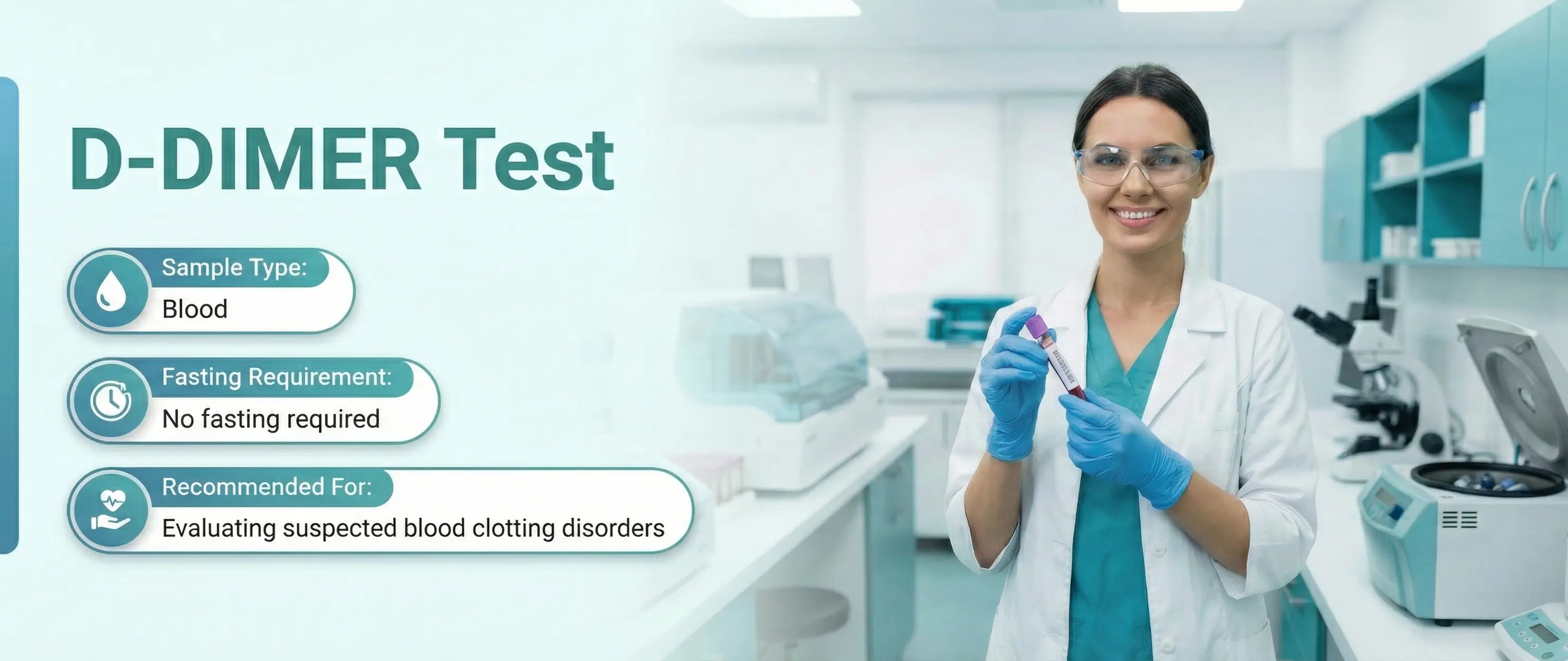
A quick info on D-Dimer test

Overview
The D-Dimer test is a blood test that measures the level of D-dimer, a small protein fragment produced when a blood clot (thrombus) dissolves in the body. Blood clotting is a normal and essential process that prevents excessive bleeding after injury. When a clot forms, the body simultaneously activates a process to break it down, releasing D-dimer into the bloodstream. A high D-dimer level indicates that significant clot formation and dissolution are occurring in the body.
Doctors order a D-Dimer test primarily to rule out deep vein thrombosis (DVT) and pulmonary embolism (PE), two serious and potentially life-threatening blood clot conditions. The test is most useful as a rule-out tool. A negative D-dimer in a patient with low clinical probability effectively excludes these conditions without requiring expensive imaging. However, a positive D-dimer is non-specific; many conditions can raise it, and further imaging is always required to confirm a clot.
The D-Dimer test monitors the body's clotting and fibrinolysis (clot-dissolving) system. It is used in the emergency evaluation of suspected DVT and PE, the management of DIC (disseminated intravascular coagulation), the monitoring of severe COVID-19 and sepsis, and the assessment of hypercoagulable states. Fasting is not required for this test.
Important Note: A positive D-dimer does not confirm a blood clot; it only suggests that clot activity may be present. Imaging is always required to confirm a diagnosis. Always consult a doctor for urgent clinical evaluation.

When and Who Should Get a D-Dimer Test Done?
A D-Dimer test is performed in emergency and clinical settings when abnormal blood clotting is suspected. It is not a routine screening test for healthy individuals.
This test is usually recommended for:
- Anyone with sudden swelling, pain, warmth, or redness in one leg - classic symptoms of Deep Vein Thrombosis (DVT).
- Anyone with sudden chest pain, shortness of breath, rapid heartbeat, or coughing up blood - warning signs of pulmonary embolism (PE).
- Hospitalised patients with high DVT or PE risk - including post-surgical patients, those on prolonged bed rest, or those with cancer.
- Patients with suspected disseminated intravascular coagulation (DIC) - a severe bleeding and clotting disorder in critically ill patients.
- COVID-19 patients and those with severe sepsis - where elevated D-dimer guides anticoagulant therapy decisions.
- Pregnant women with suspected DVT - pregnancy significantly increases the risk of blood clots.
- Patients on anticoagulant therapy - to monitor treatment effectiveness and assess residual clot activity.
Important Note: The D-Dimer test is most useful when the clinical probability of DVT or PE is low to moderate. A negative result in this context effectively rules out a clot. Always consult a doctor for clinical evaluation and decision-making.
.png?dim=48x48&q=75)
How Frequently Should You Take the D-Dimer Profile Test?
The D-Dimer test is not a routine periodic test. It is ordered based on specific clinical situations, primarily emergencies where blood clot conditions are suspected or being monitored.
|
Health Scenario |
Context |
Recommended Frequency |
|---|---|---|
|
Suspected DVT or PE (Emergency) |
Patient with leg swelling, chest pain, or breathlessness where a blood clot is suspected. |
Once at presentation. If negative, the clinical probability score is used to decide further imaging. |
|
Monitoring DIC |
Patients with disseminated intravascular coagulation in an ICU setting. |
Every 6 to 12 hours during active treatment, as directed by the intensivist. |
|
COVID-19 / Severe Infection |
Elevated D-dimer in hospitalised COVID-19 or severe sepsis patients. |
Every 48 to 72 hours to track clotting risk and guide anticoagulant therapy. |
|
Post-Anticoagulant Treatment |
After completing a course of anticoagulants for DVT or PE. |
Once, 3 to 6 months after stopping therapy, to assess recurrence risk. |
|
Pregnancy with Clot Concern |
Pregnant women with symptoms suggesting DVT - leg swelling, warmth, redness. |
Once, as part of the initial evaluation (with adjusted age-corrected thresholds). |
Important Note: D-dimer testing frequency is determined entirely by the clinical situation and the treating doctor. Never order or interpret D-dimer results without medical guidance.

What Conditions Can a D-Dimer Test Help Detect?
The D-Dimer test is primarily used to evaluate the following conditions involving abnormal blood clot formation:
- Deep Vein Thrombosis (DVT) - a blood clot in the deep veins, usually in the legs. A negative D-dimer in a low-probability patient rules out DVT effectively.
- Pulmonary Embolism (PE) - a blood clot that has travelled to the lungs. One of the most dangerous and potentially fatal conditions the test helps rule out or trigger further investigation for.
- Disseminated Intravascular Coagulation (DIC) - a life-threatening condition where widespread clotting throughout the body depletes clotting factors, causing simultaneous bleeding. Very high D-dimer is a hallmark.
- Cerebral Venous Sinus Thrombosis (CVST) - a rare blood clot in the brain's venous drainage system. Elevated D-dimer alongside neurological symptoms prompts brain imaging.
- Hypercoagulable States - conditions causing abnormally high clotting tendency, including antiphospholipid syndrome, Factor V Leiden mutation, and cancer-related thrombosis.
- Severe COVID-19 - dramatically elevated D-dimer is associated with micro-clotting and poor outcomes in severe SARS-CoV-2 infection.
- Sepsis and Multi-Organ Failure - elevated D-dimer in ICU patients reflects systemic inflammation and coagulation activation.
Important Note: A positive D-dimer does not confirm any of these conditions. All require confirmatory imaging or clinical assessment. Always consult a doctor.
.png?dim=48x48&q=75)
D-Dimer Profile Test Preparation
What to Expect Before the D-Dimer Test
No fasting is required. You can eat, drink, and take regular medications before the test. Inform your doctor about:
- All anticoagulant medications (heparin, warfarin, rivaroxaban, apixaban), as these directly affect clotting and D-dimer levels.
- Recent surgery, trauma, or hospitalisation, which can elevate D-dimer without a thrombotic event.
- Pregnancy status, as D-dimer naturally rises progressively throughout pregnancy.
- Any recent infections, cancer diagnosis, or autoimmune conditions.
What to Expect During the Blood Collection
A phlebotomist cleans the skin with an antiseptic, then places an elastic band around your upper arm to make the veins easier to access. A small needle is inserted into the vein; you may feel a brief pinch. Blood is collected into a labelled tube in under a minute.
What to Expect After the D-Dimer Test
A small cotton swab and bandage are placed over the site to stop any minor bleeding. You can return to normal activities if this is a planned test. If you have active symptoms of DVT or PE (leg swelling, chest pain, breathlessness), do not leave the clinical setting until your doctor has reviewed the result and given clearance.
Important Note: If you have symptoms of DVT or PE, seek emergency care immediately. Do not attempt to book a D-Dimer test online in a suspected cardiac or pulmonary emergency.

What are the Parameters Included in a D-Dimer Test?
The D-Dimer test measures a single key parameter:
- D-Dimer Level - Measured in μg/mL FEU or ng/mL (nanograms per millilitre). D-dimer is a fibrin degradation product released when the body's clot-dissolving system (fibrinolysis) breaks down a blood clot. Its presence at elevated levels indicates that clot formation and breakdown are occurring. The test reports only the D-dimer value; it cannot identify where in the body the clot is located or how large it is.
The D-Dimer test is particularly powerful as a negative predictor: a normal D-dimer in a patient with low clinical probability of DVT or PE effectively rules out these conditions and avoids the need for expensive imaging. An elevated D-dimer is non-specific; many conditions, including age, pregnancy, infection, surgery, and cancer, can raise it without a thrombotic event.

Normal Range of D-Dimer Test Parameters
The D-Dimer test measures a single key parameter:
- D-Dimer Level - Measured in μg/mL FEU or ng/mL (nanograms per millilitre). D-dimer is a fibrin degradation product released when the body's clot-dissolving system (fibrinolysis) breaks down a blood clot. Its presence at elevated levels indicates that clot formation and breakdown are occurring. The test reports only the D-dimer value; it cannot identify where in the body the clot is located or how large it is.
The D-Dimer test is particularly powerful as a negative predictor: a normal D-dimer in a patient with low clinical probability of DVT or PE effectively rules out these conditions and avoids the need for expensive imaging. An elevated D-dimer is non-specific; many conditions, including age, pregnancy, infection, surgery, and cancer, can raise it without a thrombotic event.

D-Dimer Test Risks and Limitations
Potential Risks and Complications
The D-Dimer test involves a simple blood draw and is very safe. Most people feel only a brief pinch. Consult a doctor if:
- The puncture site does not stop bleeding after gentle pressure
- You notice unusual redness, swelling, warmth, or lasting pain at the needle site
- You feel persistently lightheaded after the blood draw; sit and rest for a few minutes.
Understanding D-Dimer Test Limitations
The D-Dimer test is highly sensitive but not specific. It can be elevated by many conditions other than blood clots, including age, pregnancy, surgery, infection, cancer, trauma, and inflammatory conditions, making false-positive results very common. A positive D-dimer alone is insufficient to diagnose DVT or PE; imaging is always required. A normal D-dimer is most reliable when clinical probability is low; in high-probability patients, imaging should proceed regardless. D-dimer also cannot identify the location or size of a clot.
Note: Always consult a doctor before ordering or interpreting a D-Dimer test. Never make treatment decisions based on D-dimer alone.

Related and Follow-up Tests
The D-Dimer test is most valuable as a rule-out tool. An elevated result always requires further imaging or clinical investigation to confirm or exclude thrombosis.
|
D-Dimer Finding |
Suggested Follow-up Test |
Why It Is Ordered |
|---|---|---|
|
Elevated D-Dimer + Leg Swelling |
Doppler Ultrasound (Leg Veins) |
Gold standard for confirming deep vein thrombosis (DVT) in the lower limb veins. |
|
Elevated D-Dimer + Chest Symptoms |
CT Pulmonary Angiography (CT-PA) |
Gold standard for diagnosing pulmonary embolism (PE) - detects clots in the pulmonary arteries. |
|
Very High D-Dimer + Active Bleeding |
Coagulation Panel (PT, APTT, Fibrinogen) |
Assesses the entire clotting cascade - essential for diagnosing and managing DIC. |
|
Elevated D-Dimer + Suspected Cancer |
Tumour Markers and Imaging |
Cancer is a major cause of hypercoagulability and chronically elevated D-dimer. |
|
Elevated D-Dimer + Pregnancy |
Obstetric Doppler Ultrasound |
DVT in pregnancy requires urgent imaging as anticoagulation management differs during pregnancy. |
|
Elevated D-Dimer + Stroke Symptoms |
MRI or CT Brain |
To detect cerebral venous sinus thrombosis - blood clots in the brain's venous system. |
|
Post-DVT/PE Treatment |
Repeat D-Dimer + Clinical Review |
After completing anticoagulation therapy - to assess residual clot activity and recurrence risk. |
Note: The investigation of suspected DVT or PE is time-sensitive. An elevated D-dimer in a symptomatic patient should prompt urgent imaging. Always follow your doctor's guidance.

D-Dimer Test Sample Collection: Home vs. Diagnostic Lab
|
Feature |
Home Collection (PharmEasy) |
Traditional Diagnostic Lab |
|---|---|---|
|
Convenience |
High - sample taken from your home or office. |
Low - requires travelling and waiting in queues. |
|
Time Saving |
Maximum - no travel time. You pick the time slot. |
Minimum - depends on traffic and lab rush. |
|
Safety & Comfort |
Safe - avoids exposure to other sick patients. |
Moderate - exposure to crowded waiting areas. |
|
Process |
A professional phlebotomist visits you. |
You must visit the facility during its hours. |
|
Report Access |
Digital - sent directly to your app or email. |
Often requires a second visit for physical copies. |
Pro Tip: Book your D-Dimer test on PharmEasy - no fasting required, a certified phlebotomist at your doorstep, and your digital report delivered promptly. For emergency symptoms, always go to the nearest hospital immediately.

D-Dimer Test Price/Cost
A D-Dimer test is typically priced around INR 1299. The cost may vary depending on the city and the laboratory selected. To get a clearer understanding, you can compare D-Dimer test prices across major cities in India.
|
City |
Offer Price |
|---|---|
|
1299 |
|
|
1299 |
|
|
1299 |
|
|
1299 |
|
|
1299 |
|
|
1299 |
|
|
1299 |
|
|
1299 |
|
|
1299 |
|
|
1299 |
Was This Test Information Helpful?
Please rate your experience
 Yes Helpful (3)
 Not Helpful
References
Health packages containing 'D-DIMER Test'
 For full-body wellness, go for a comprehensive checkup
People Also Ask
Does a high D-dimer always mean I have a blood clot?
What does a normal D-dimer result mean?
Why is D-dimer elevated in pregnancy?
Can D-dimer be elevated without any symptoms?
What is the difference between D-dimer and other clotting tests (PT, APTT)?
How is DVT treated after a positive D-dimer and imaging?
Should I be worried if my D-dimer is slightly elevated?
 4.6 Stars| 7+ Lakhs Ratings & Reviews

Over 10 million happy users PharmEasy Labs
- Because the digital report is available on WhatsApp, there's no need to go back to the lab. Thanks, PharmEasy!
 Sachin sharma11 Jan ‘26
 - Thanks to the coupon discount, the blood test was done at a lower price.Komal04 Jan ‘26
- The lab technician was a good and knowledgeable professional.Rakesh Pandey06 Jan ‘26
- Due to bad weather, it's difficult to reach the lab. But home collection makes things easier.Arjun08 Jan ‘26
- Thanks to the Swasth AI feature, the report is easy to understand.Priya Mehta02 Jan ‘26
- The report is available on the same day. Wow!Vikas Patel05 Jan ‘26
Have any doubts? Ask us.
Ask us anything about the D-DIMER Test to understand it better

We provide trusted, expert-curated health content to support better awareness,prevention, and care.
Backed by experienced doctors, medical experts, and strict editorial standards.