

4861+ orders placed in your location

100% NABL & ISO Certified Lab • 100% Accurate Reports
Urine Routine Test in Kolkata - Price & Details
Urine Analysis, UA, Urine routine and microscopy, RUA
- SummaryA Urine Test analyzes a urine sample to detect various health conditions such as infections, kidney issues, diabetes, or dehydration. It may include tests for proteins, glucose, ketones, or bacteria. This test is done by taking a urine sample, and fasting is not required for this test. Read more
- TestsIncludes 24 tests
- Reports Within7 HrsView Sample Report

 100% NABL & ISO Certified Labs
 - SampleUrine

- AgeAll Age Group
- GenderMale and Female
- FastingNot Required

PharmEasy Promises



Know More About The Test


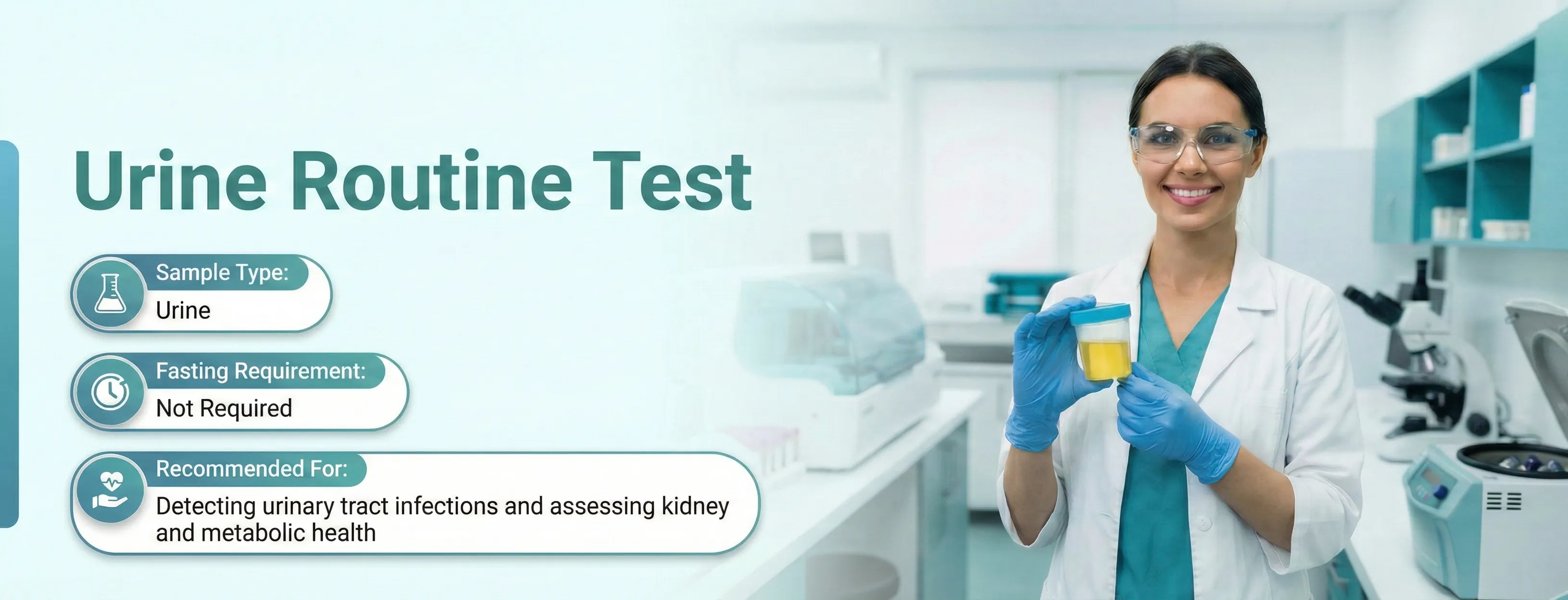
A quick info on Urine Routine Test

Overview
The urine routine test, also known as urinalysis, urine test, urine analysis, or complete urine examination, is a common diagnostic test used to check your urine for signs of infection, kidney disease, diabetes, and other health problems. It is often included in routine health check‑ups, pre‑surgery evaluations, pregnancy profiles, and when you have urinary symptoms such as burning sensation, pain, or frequent urination.
Urine is the liquid waste produced when your kidneys filter the blood; it passes through the ureters to the bladder and exits the body via the urethra. Because urine carries waste and excess substances from the body through the urinary system, it provides important clues about your general health and how well your kidneys and urinary system are working. A urinalysis is usually done on a fresh sample collected in a clean container, most often as a “clean‑catch” midstream sample. The laboratory then examines the urine’s colour and clarity, measures chemical markers such as glucose, protein, and blood, and looks under the microscope for cells, crystals, and bacteria. This quick, non‑invasive test helps doctors detect problems early and guide further treatment.

When and Who Should Get a Urine Routine Test?
- Routine health check in adults, elders, and people with chronic diseases.
- Pre‑surgery or on hospital admission.
- During pregnancy for UTI, protein, sugar, and preeclampsia screening.
- In diabetes or hypertension to detect kidney damage (protein, ketones).
- Known kidney disease to monitor protein/blood in urine and infection.
- Suspected UTI: burning, pain, frequency, urgency, foul‑smelling or cloudy urine.
- Blood in urine.
- Flank/loin or lower abdominal pain suggesting stones or kidney infection.
- Unexplained fever in infants and children.
- Swelling of face/feet or unexplained weight gain (possible nephrotic/nephritic syndrome).
- Symptoms of diabetes: increased urination, thirst, weight loss (sugar, ketones).
- Follow‑up of previous abnormal urine results or after UTI treatment.

What Conditions Can a Urine Routine Test Help Detect?
Urinalysis is often used along with symptoms, medical history, and other diagnostic tests to support diagnosis and monitor various health conditions, including:
- Urinary tract infections (UTIs)
- Kidney diseases
- Kidney stones
- Diabetes
- Liver disorders
- Dehydration
- Proteinuria (protein in urine)
- Haematuria (blood in urine)
- Pregnancy-related complications (such as pre-eclampsia)
- Bladder or urinary system disorders
- Metabolic and systemic disorders

Urine Routine Test Preparation
What to Expect Before the Urine Routine Test
- Drink normal amounts of water; avoid over‑hydration right before the test so that the urine is not too dilute.
- You may sometimes be advised to give a first‑morning sample (more concentrated and informative); confirm this with your doctor.
- Inform your doctor about all medicines and supplements you take (vitamin C, antibiotics, diuretics, etc.), as some can interfere with results.
- Avoid giving urine samples during menstruation; if unavoidable, inform the lab and your doctor so they can interpret results accordingly.
- Avoid strenuous exercises before sample collection (can temporarily increase protein in urine).
What to Expect During the Sample Collection
- You will receive a clean, labelled, screw‑cap container.
- Wash hands thoroughly with soap and water before starting.
- Clean‑catch midstream method: Clean the genital area with wipes, or water and soap. Start urinating into the toilet, let a small amount pass, then without stopping the stream, move the container into position and collect the midstream urine (usually 20–30 mL or fill the container to about half).
- Finish urinating into the toilet and close the container lid properly.
- Throughout the process, avoid touching the inside of the cup or the lid.
- Return the container to the PharmEasy lab executive.
What to Expect After the Urine Routine Test
- In the lab, the sample is assessed for appearance, chemical parameters, and microscopic elements.
- You can resume normal activities immediately; there are no restrictions after giving the sample.
- Results are usually available within a few hours to a day. Your doctor will review them together with your symptoms and other tests.
- If results are abnormal, your doctor may order repeat urinalysis, urine culture, blood tests, imaging, or start treatment (such as antibiotics for UTI).

What are the Parameters and Normal Ranges of Urine Routine Test?
|
Test name |
Normal ranges |
Units |
|---|---|---|
|
Physical examination |
||
|
Volume |
mL |
|
|
Colour |
Pale yellow |
– |
|
Appearance |
Clear |
– |
|
Specific gravity |
1.003–1.030 |
– |
|
pH |
5–8 |
– |
|
Chemical examination (urine dipstick) |
||
|
Urinary protein |
Absent |
mg/dL |
|
Urinary glucose |
Absent |
mg/dL |
|
Urine ketone |
Absent |
mg/dL |
|
Urinary bilirubin |
Absent |
mg/dL |
|
Urobilinogen |
≤0.2 |
mg/dL |
|
Bile salt |
Absent |
– |
|
Bile pigment |
Absent |
– |
|
Urine blood |
Absent |
– |
|
Nitrite |
Absent |
– |
|
Leucocyte esterase |
Absent |
– |
|
Microscopic examination |
||
|
Mucus |
Absent |
– |
|
Red blood cells |
0–2 |
cells/HPF |
|
Urinary leucocytes (pus cells) |
0–5 |
cells/HPF |
|
Epithelial cells |
0–5 |
cells/HPF |
|
Casts |
Absent |
– |
|
Crystals |
Absent |
– |
|
Bacteria |
Absent |
– |
|
Yeast |
Absent |
– |
|
Parasite |
Absent |
– |

Urine Routine Test Result Interpretation
|
Test name |
Interpretation |
|---|---|
|
Volume |
Low or high urine volume may be influenced by hydration status, kidney function, fluid intake, or certain medical conditions. |
|
Colour |
Dark, red, cloudy, or unusual colours may indicate dehydration, medications, food effects, blood, or disease. |
|
Appearance |
Cloudy or turbid urine may suggest infection, crystals, mucus, or excess cells. |
|
Specific gravity |
High values may indicate dehydration, while low values can occur with excess fluid intake or impaired kidney concentrating ability. |
|
pH |
Measures urine acidity or alkalinity. Changes may occur with diet, urinary infections, kidney conditions, or metabolic disorders. |
|
Urinary protein |
Protein is usually absent or present in very small amounts. Presence of protein may indicate kidney disease, infection, or other health conditions. |
|
Urinary glucose |
Presence may suggest diabetes or elevated blood glucose levels. |
|
Urine ketone |
Presence may occur in uncontrolled diabetes, fasting, prolonged vomiting, or low-carbohydrate diets. |
|
Urinary bilirubin |
Presence may indicate liver or bile duct disorders. |
|
Urobilinogen |
Small amounts are normal. Elevated levels may suggest liver disease or increased breakdown of red blood cells. |
|
Bile salt |
Presence may indicate liver dysfunction or bile flow obstruction. |
|
Bile pigment |
Presence may suggest liver or biliary disorders. |
|
Urine blood |
Presence may indicate infection, kidney stones, injury, kidney disease, or other conditions. |
|
Nitrite |
Positive nitrites may indicate bacterial urinary tract infection. |
|
Leucocyte esterase |
Presence suggests white blood cells in urine, often associated with urinary tract infection or inflammation. |
|
Mucus |
Small amounts may occasionally be seen, but increased amounts may indicate irritation or inflammation. |
|
Red blood cells |
Small numbers may be normal. Increased levels can suggest infection, kidney stones, trauma, or urinary tract disorders. |
|
Urinary leucocytes (pus cells) |
Increased white blood cells may indicate infection or inflammation of the urinary tract. |
|
Epithelial cells |
Small numbers can be normal. Increased levels may suggest contamination, infection, or kidney-related conditions. |
|
Casts |
Presence may indicate kidney inflammation or kidney disease. |
|
Crystals |
Small amounts may occur normally, but certain crystals can be associated with kidney stones or metabolic disorders. |
|
Bacteria |
Presence may indicate contamination or urinary tract infection. |
|
Yeast |
Presence may suggest fungal infection. |
|
Parasite |
Presence may indicate parasitic infection affecting the urinary tract. |
Note: The above table provides general interpretations for educational purposes only. Urine test results should always be interpreted by a healthcare professional. Factors such as hydration, diet, medications, and sample collection can affect results, and abnormal findings do not always indicate a medical condition

Urine Routine Test Risks and Limitations
Potential Risks and Complications
- Most people do not feel pain or discomfort; a few may feel mild embarrassment or awkwardness about providing a sample, but since PharmEasy offers doorstep sample collection, you can collect the sample in the comfort and privacy of your home.
Understanding Urine Routine Test Limitations
- Dipstick method for chemical analysis of urine has limited sensitivity and specificity; false positives and negatives are common, so it cannot confirm or rule out disease alone.
- Routine panels cover only a limited range of conditions and miss many renal or systemic disorders.
- Accuracy depends on proper clean‑catch technique and quick processing; poor collection or delayed analysis can distort chemical and microscopic findings.
- Contamination (vaginal secretions, menstrual blood, skin flora) can mimic infection or haematuria (blood in urine).
- It does not replace blood tests or imaging.

Urine Routine Test Price in Kolkata
The urine routine test is priced at around INR 399 in Kolkata, though the exact cost can vary based on offer prices. To better understand the pricing differences, you can compare urine routine test costs across major cities in India.
|
City |
Offer price |
|---|---|
|
399 |
|
|
399 |
|
|
399 |
|
|
399 |
|
|
399 |
|
|
399 |
|
|
399 |
|
|
399 |
|
|
399 |
|
|
399 |

Areas we serve in Kolkata
You can book the Urine Routine Test in Kolkata through PharmEasy with convenient home sample collection across several localities, including :
- Salt Lake
- New Town
- Rajarhat
- Dum Dum
- Lake Town
- Baguiati
- Park Street
- Ballygunge
- Bhowanipore
- Alipore
- Behala
- Tollygunge
- Jadavpur
- Garia
- Kalighat
- Kasba
- Kankurgachi
- Ruby
- Sealdah
- Shyambazar
You can also check service availability during purchase by entering your pin code.

Urine Routine Test Sample Collection: Home vs. Diagnostic Lab
|
Feature |
Home collection (PharmEasy) |
Traditional diagnostic lab |
|---|---|---|
|
Convenience |
High - sample taken from your home or office, privately and discreetly. |
Low - requires traveling and waiting in queues. |
|
Privacy |
Maximum - sample collected at home with full discretion. |
Less private - you may meet people you know at a clinic. |
|
Safety and comfort |
Safe - helps avoid exposure to other patients. |
Moderate - avoids exposure to crowded waiting areas. |
|
Process |
A trained PharmEasy executive visits you with sterile, sealed equipment. |
You must visit the facility during its working hours. |
|
Report access |
Digital - reports are sent directly to your app or email. |
Often requires a second visit for physical copies. |
Was This Test Information Helpful?
Please rate your experience
 Yes Helpful (3)
 Not Helpful
References
Health packages containing 'Urine Routine Test'
 For full-body wellness, go for a comprehensive checkup
People Also Ask
What is a urine routine test (urinalysis)?
Who should get a urinalysis done?
How should I prepare for a urine routine test?
How can I book a urine routine test on PharmEasy in Kolkata?
Does PharmEasy offer home sample collection for urine tests in Kolkata?
What is the price of a urine routine test on PharmEasy in Kolkata?
 4.6 Stars| 7+ Lakhs Ratings & Reviews

Over 10 million happy users PharmEasy Labs
- Because the digital report is available on WhatsApp, there's no need to go back to the lab. Thanks, PharmEasy!
 Sachin sharma11 Jan ‘26
 - Thanks to the coupon discount, the blood test was done at a lower price.Komal04 Jan ‘26
- The lab technician was a good and knowledgeable professional.Rakesh Pandey06 Jan ‘26
- Due to bad weather, it's difficult to reach the lab. But home collection makes things easier.Arjun08 Jan ‘26
- Thanks to the Swasth AI feature, the report is easy to understand.Priya Mehta02 Jan ‘26
- The report is available on the same day. Wow!Vikas Patel05 Jan ‘26
Have any doubts? Ask us.
Ask us anything about the Urine Routine Test in Kolkata - Price & Details to understand it better
Nearby Labs
Lab tests made easy!
- Quick Collection
- Trusted Accuracy
- Hassle-free Services
RB Diagnostics - Howrah
3A, Satyen Bose Road, Bakultala, West Bengal
 grievance-officer@docon.in
 7022000900
Neuberg Diagnostics - AHC - Howrah
107/1, G.T. Road (South), West Bengal
grievance-officer@docon.in7022000900
We provide trusted, expert-curated health content to support better awareness,prevention, and care.
Backed by experienced doctors, medical experts, and strict editorial standards.