

15+ orders placed in your location

100% NABL & ISO Certified Lab • 100% Accurate Reports
Jaanch - PCOD Basic
- SummaryJaanch - PCOD Basic is a diagnostic package designed to assess the presence and severity of Polycystic Ovary Syndrome (PCOS) in girls and women. It includes 65+ parameters and is useful for females experiencing symptoms like irregular periods, weight gain, unwanted body hair, mood swings and difficulty conceiving.Read more
- TestsIncludes 66 tests
- Reports Within40 HrsView Sample Report

 100% NABL & ISO Certified Labs
 - SampleBlood

- Fasting10-12 Hrs

PharmEasy Promises



Know More About The Package


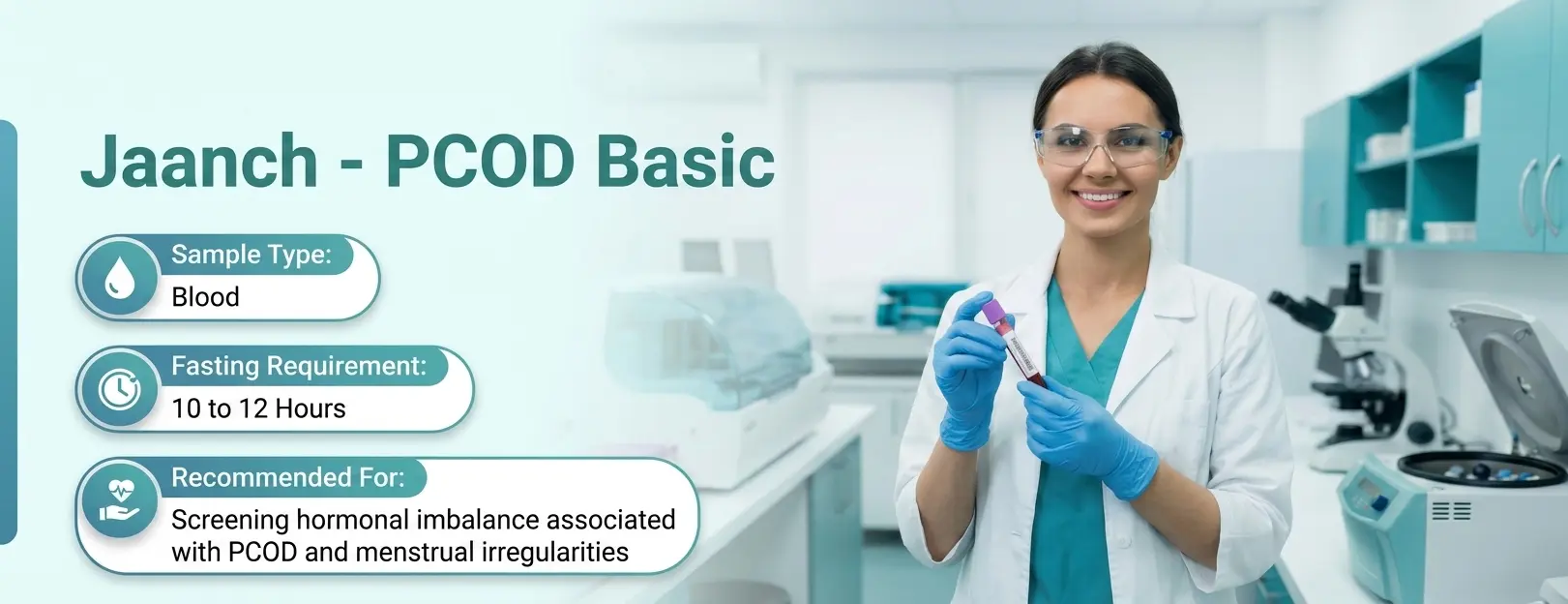
A quick info on Jaanch PCOD Basic

Overview
A Jaanch - PCOD Basic test, also called a PCOD profile test, is a comprehensive blood test that includes multiple parameters to evaluate hormonal balance, blood sugar levels, lipid profile, liver function, kidney function, and blood composition. Each parameter plays an important role in understanding the body’s overall health and in supporting the diagnosis of Polycystic Ovary Disease (PCOD).
PCOD is a common condition caused by an imbalance of reproductive hormones that affects how the ovaries work. In PCOD, eggs may not grow properly or be released regularly during the menstrual cycle. This can lead to irregular periods, difficulty in pregnancy, weight gain, diabetes, heart-related risks, and mood changes like depression.
The PCOD test package evaluates important factors related to hormone balance and metabolic health. It also helps in assessing how organs like the ovaries, pituitary gland, adrenal glands, liver, and pancreas are functioning.
By providing a detailed overview of these systems, the Jaanch – PCOD Basic test supports the diagnosis, monitoring, and management of PCOD to understand this condition better and helps doctors guide clinical decisions.
When and Who Should Get a Jaanch PCOD Basic Done?
A PCOD profile test is recommended for girls and women who have started having periods and show signs that may suggest polycystic ovarian disease or hormonal imbalance, such as:
- Changes in periods, such as missed periods, very late or very early periods, or no periods at all
- Extra hair growth on the face, chin, chest, or other body areas where boys usually have more hair (called hirsutism)
- Pimples or acne on the face, chest, or back
- Hair fall or thinning of scalp hair
- Weight gain or difficulty in losing weight
- Dark patches on the skin, especially around the neck, underarms, groin, or under the breasts
- Small soft skin growths called skin tags that are usually seen on the neck or underarms
.png?dim=48x48&q=75)
How Frequently Should You Take the Jaanch PCOD Basic Test?
You should consider this PCOD test in the following situations:
|
Health Scenario |
Context |
Recommended Frequency |
|---|---|---|
|
Presence of symptoms |
Irregular or absent periods, acne, excess facial/body hair, hair thinning, weight gain, or difficulty losing weight |
As soon as symptoms appear; follow-up as advised by your doctor |
|
Planning pregnancy |
Difficulty conceiving or irregular ovulation |
At the time of planning pregnancy |
|
Ongoing PCOD/treatment monitoring |
Already diagnosed with PCOD and on treatment (hormonal therapy, insulin resistance management, or fertility treatment) |
Periodic monitoring, usually every 6-12 months or as advised by your doctor |

What Conditions Can a Jaanch PCOD Basic Test Help Detect?
The Jaanch PCOD Basic test can help identify the following conditions:
- Insulin resistance and type 2 diabetes: Women with PCOD may have difficulty using insulin properly (insulin resistance), leading to higher blood sugar levels
- High cholesterol: Increased lipid (fat) levels that raise the risk of heart disease and metabolic problems
- Liver-related conditions: Conditions such as fatty liver disease (fat buildup in liver cells), which may affect liver function
- Kidney-related conditions: This can result in reduced kidney function due to underlying health issues such as high blood pressure, diabetes, or heart disease
- Hyperandrogenism (high male sex hormones): Elevated androgen levels may indicate PCOD or other hormonal imbalances
- Hormonal imbalance: Irregular levels of reproductive and metabolic hormones that can affect overall health
- Blood-related conditions (CBC): This test can help detect anaemia, infections, and general blood health status by evaluating components like haemoglobin, red blood cells, and white blood cells
By doing these tests together, doctors can get a clearer picture of hormone balance, metabolic health, and overall health status in women with polycystic ovarian disease. The results may also help identify associated health risks such as overweight or obesity, insulin resistance, type 2 diabetes, high cholesterol, cardiovascular disease, liver problems, and hypertension.
The PCOD blood test cost may vary depending on the lab and the number of parameters included.
.png?dim=48x48&q=75)
Jaanch PCOD Basic Test Preparation
What to Expect Before the Jaanch - PCOD Basic Test
You must fast for 10 to 12 hours before the test. During the fasting period, drink plain water freely. Avoid all food, milk, tea, coffee, juices, and beverages other than water. Avoid smoking and alcohol for at least 24 hours, as both can falsely elevate triglyceride levels. Avoid strenuous exercise in the 24 hours before the test. Continue your regular medications unless your doctor advises otherwise. Morning appointments are strongly recommended.
What to Expect During the Blood Collection
A phlebotomist cleans the skin with an antiseptic, then places an elastic band around your upper arm to make the veins easier to access. A small needle is inserted into the vein - you may feel a brief pinch. Blood is collected into a labelled tube in under a minute.
What to Expect After the Jaanch - PCOD Basic Test
A small cotton swab and bandage are placed over the site to stop any minor bleeding. You can eat and drink immediately after the test. Have a light meal as soon as possible after the fast. If dizzy, sit and relax for a few minutes.

What are the Parameters Included in a Jaanch PCOD Basic Test?
The Jaanch - PCOD Basic Test includes a total of 66 parameters:
Lipid Profile (10)
- Low-Density Lipoprotein (LDL) Direct
- Total Cholesterol (TC)
- High-Density Lipoprotein (HDL)
- Triglycerides (TG)
- Very Low-Density Lipoprotein (VLDL)
- LDL/HDL Ratio
- TC/HDL Ratio
- Non-HDL Cholesterol
- HDL/LDL Ratio
- TG/HDL Ratio
LFT (Liver Function Test) (12)
- Albumin
- Alkaline Phosphatase (ALP)
- Gamma-Glutamyl Transferase (GGT)
- Total Protein (TP)
- Aspartate Aminotransferase (AST/SGOT)
- Alanine Aminotransferase (ALT/SGPT)
- Bilirubin Direct
- Bilirubin Total
- Bilirubin Indirect
- Globulin
- Albumin/Globulin Ratio (A/G Ratio)
- SGOT/SGPT Ratio
Complete Blood Count (CBC) (24)
- Absolute Eosinophil Count (AEC)
- Haemoglobin (Hb)
- Platelet Count
- Red Blood Cell Count (RBC)
- Mean Corpuscular Volume (MCV)
- Mean Corpuscular Haemoglobin (MCH)
- Mean Corpuscular Haemoglobin Concentration (MCHC)
- Total Leukocyte Count (TLC/WBC Count)
- Absolute Lymphocyte Count (ALC)
- Absolute Basophil Count (ABC)
- Packed Cell Volume (PCV)
- Neutrophils
- Lymphocytes
- Monocytes
- Eosinophils
- Basophils
- Absolute Neutrophil Count (ANC)
- Absolute Monocyte Count (AMC)
- Immature Granulocyte Percentage (IG%)
- Red Cell Distribution Width - SD (RDW-SD)
- Nucleated Red Blood Cells Percentage (NRBC%)
- Immature Granulocytes (IG)
- Nucleated Red Blood Cells (NRBC)
- Red Cell Distribution Width - CV (RDW-CV)
Blood Sugar & Insulin (6)
- Fasting Blood Sugar (FBS)
- Glycated Haemoglobin (HbA1c)
- Average Blood Glucose
- Fasting Insulin
- HOMA-IR (Insulin Resistance Index)
- Quantitative Insulin Sensitivity Index
Kidney/Renal Function (5)
- Blood Urea Nitrogen (BUN)
- Creatinine
- BUN/Creatinine Ratio
- Estimated Glomerular Filtration Rate (eGFR)
- Uric Acid
Hormonal Profile (9)
- 17-OH Progesterone
- Dehydroepiandrosterone Sulphate (DHEAS)
- Oestradiol (E2)
- Free Testosterone
- Total Testosterone
- Follicle Stimulating Hormone (FSH)
- Luteinizing Hormone (LH)
- Prolactin
- Thyroid Stimulating Hormone - Ultrasensitive (TSH/UTSH)

Normal Range of Jaanch PCOD Basic Test Parameters
Each parameter in the PCOD panel has its own reference range, which will be provided in your detailed report. The table below highlights the normal values for some important parameters used to assess hormonal and metabolic health.
|
Parameter |
Normal Range |
|---|---|
|
Haemoglobin (CBC) |
12–16 g/dL (Women) |
|
Fasting Blood Sugar (FBS) |
Below 100 mg/dL |
|
HbA1c |
<5.7% |
|
Total Cholesterol (Lipid Profile) |
<200 mg/dL |
|
ALT (LFT) |
7–35 U/L (Women) |
|
Creatinine (Kidney Function) |
0.6–1.1 mg/dL (Women) |
|
TSH (Thyroid) |
0.46 -4.68 µIU/ml |
|
Total Testosterone |
0.198- 2.67 nmol/L (Women) |
|
Free Testosterone |
Women: 18-30 years- 1-5 pg/mL 31-40 years- 1-6 pg/mL 41-50 years- 1-4 pg/mL 51 years and older- Less than 3 pg/mL |
|
DHEAS |
145 to 400 µmol/L |
|
LH |
Follicular phase: 1.9 – 12.5 mIU/mL Mid-cycle peak: 8.7 – 76.3 mIU/mL Luteal phase: 0.5 – 16.9 mIU/mL Postmenopausal: 10.0 – 54.7 mIU/mL |
|
FSH |
Follicular phase: 1.37 – 9.9 IU/L Ovulatory phase: 6.17 – 17.2 IU/L Luteal phase: 1.09 – 9.2 IU/L Postmenopausal: 19.3 – 100.6 IU/L |
|
Prolactin |
Less than 23 ng/ml (Non pregnant women) |
|
Fasting Insulin |
2.6 - 37.6 μIU/ml |
|
HOMA-IR |
<2.5 |
Important Note
- Normal values may differ based on age, laboratory standards, and phase of the menstrual cycle.
- Hormone levels can vary throughout the cycle, which may influence results.
- The PCOD panel is a screening tool and does not confirm a diagnosis on its own.
- Abnormal findings should always be reviewed by a qualified doctor.
.png?dim=48x48&q=75)
Jaanch PCOD Basic Test Result Interpretation
The table explains what each parameter in the PCOD test means, when it is high or low, and how results are interpreted.
|
Test Section |
If Values Are High |
If Values Are Low |
|---|---|---|
|
Haemoglobin |
May mean lung or heart problems, or a condition where the body makes too many red blood cells (polycythaemia) |
May mean anaemia, iron or vitamin deficiency, blood loss, liver disease, or some long-term illnesses |
|
HbA1c / Blood Sugar |
May indicate diabetes, prediabetes, or problems with insulin control |
May indicate low blood sugar (hypoglycaemia), too much medication, or hormone-related issues |
|
Lipid Profile (Cholesterol) |
May increase the risk of heart disease due to unhealthy diet, obesity, diabetes, or thyroid problems |
May suggest poor nutrition or low fat levels in the body |
|
LFT (Liver Function – ALT/AST) |
May indicate liver damage, inflammation, fatty liver, or hepatitis |
May suggest poor liver function or lack of nutrients (less common) |
|
KFT (Kidney Function – Creatinine) |
May indicate kidney disease, dehydration, or kidney damage |
May indicate low muscle mass, malnutrition, or severe liver disease |
|
Thyroid (TSH) |
Usually suggests underactive thyroid (hypothyroidism) |
Usually suggests overactive thyroid (hyperthyroidism) |
|
Testosterone |
May indicate hormonal imbalance, PCOD, or adrenal gland disorders |
May indicate low hormone production due to pituitary, adrenal, or gonadal issues |
|
DHEAS |
May indicate adrenal gland problems or hormonal imbalance such as PCOD |
May indicate adrenal insufficiency or pituitary disorders |
|
LH (Luteinizing Hormone) |
May indicate ovary/testicle problems, PCOD, or thyroid/adrenal issues |
May indicate pituitary or hypothalamus problems, stress, or malnutrition |
|
Prolactin |
May indicate pituitary tumour, thyroid issues, kidney/liver disease, or PCOD |
Rare; may indicate pituitary dysfunction affecting hormone balance |
|
Insulin / HOMA-IR |
May indicate insulin resistance, risk of type 2 diabetes, or metabolic issues |
May indicate pancreas not producing enough insulin or low blood sugar conditions |
Note: These results are not diagnostic. Abnormal values only show a possible risk, and your doctor may suggest more tests to confirm the condition.

Jaanch PCOD Basic Test Risks and Limitations
Testing is generally safe. However, possible risks and limitations may include:
Potential Risks and Complications (Rare):
PCOD test procedure may involve mild pain or slight bruising at the blood collection site, but these usually go away soon.
Understanding Jaanch - PCOD Basic Test Limitations:
- Some tests may require fasting for 8–12 hours before the sample is taken.
- Inform your doctor about all medicines and supplements you are taking, as some may need to be adjusted if advised.
- Hormone levels can change based on the time of the month and the day, as well as other factors, so results may vary.

Related and Follow-up Tests
If any results are not normal, your doctor may suggest these additional tests:
- Pelvic ultrasound to examine the ovaries for cysts
- AMH (Anti-Müllerian Hormone) test to evaluate ovarian function
- Androstenedione and Sex Hormone Binding Globulin (SHBG) tests to assess androgen levels and hormonal balance
- T3, T4, and thyroid antibody tests if TSH is found to be high, to evaluate thyroid function and confirm thyroid-related disorders

Jaanch PCOD Basic Sample Collection: Home vs. Diagnostic Lab
|
Feature |
Home Collection (PharmEasy) |
Traditional Diagnostic Lab |
|---|---|---|
|
Convenience |
High - sample taken from your home or office. |
Low - requires travelling and waiting in queues. |
|
Time Saving |
Maximum - no travel. You pick the time slot. |
Depends on traffic and lab rush. |
|
Safety & Comfort |
Safe - avoids exposure to other sick patients. |
Moderate - crowded waiting areas. |
|
Process |
Professional phlebotomist visits you. |
You must visit the facility during their working hours. |
|
Report Access |
Digital - sent to your app or email. |
Often requires a second visit for physical copies. |
Pro Tip: Book your Jaanch - PCOD Basic Test on PharmEasy. Fast overnight, get your sample collected at home in the morning, and receive your digital report the same day - without stepping out.
Was This Test Information Helpful?
Please rate your experience
 Yes Helpful
  Not Helpful
References
People Also Ask
Can people with PCOD get a false positive pregnancy test?
At what age does PCOD start?
Will PCOD lead to infertility?
How to cure the PCOD problem?
What to avoid during PCOD?
Which seeds are good for the PCOD problem?
Can stress make PCOD worse?
Are irregular periods always due to PCOD?
Can a person still get pregnant if they have PCOD?
 4.6 Stars| 7+ Lakhs Ratings & Reviews

Over 10 million happy users PharmEasy Labs
- Because the digital report is available on WhatsApp, there's no need to go back to the lab. Thanks, PharmEasy!
 Sachin sharma11 Jan ‘26
 - Thanks to the coupon discount, the blood test was done at a lower price.Komal04 Jan ‘26
- The lab technician was a good and knowledgeable professional.Rakesh Pandey06 Jan ‘26
- Due to bad weather, it's difficult to reach the lab. But home collection makes things easier.Arjun08 Jan ‘26
- Thanks to the Swasth AI feature, the report is easy to understand.Priya Mehta02 Jan ‘26
- The report is available on the same day. Wow!Vikas Patel05 Jan ‘26
Have any doubts? Ask us.
Ask us anything about the Jaanch - PCOD Basic to understand it better

We provide trusted, expert-curated health content to support better awareness,prevention, and care.
Backed by experienced doctors, medical experts, and strict editorial standards.