

801+ orders placed in your location

100% NABL & ISO Certified Lab • 100% Accurate Reports
Venereal Disease Research Laboratory (VDRL) Test In Nashik - Price & Details
Venereal disease research laboratory test, Syphilis- VDRL
- SummaryThe Venereal Disease Research Laboratory (VDRL) Test is a blood test used to screen for syphilis by detecting non-specific antibodies produced in response to the infection. It helps identify current or past exposure, especially in individuals at risk due to unprotected sexual contact. No fasting is required, and the test can be done for adults of all genders as advised by a doctor.Read more
- Reports Within36 HrsView Sample Report

 100% NABL & ISO Certified Labs
 - SampleBlood

- AgeAll Age Group
- GenderMale and Female
- FastingNot Required

PharmEasy Promises



Know More About The Test


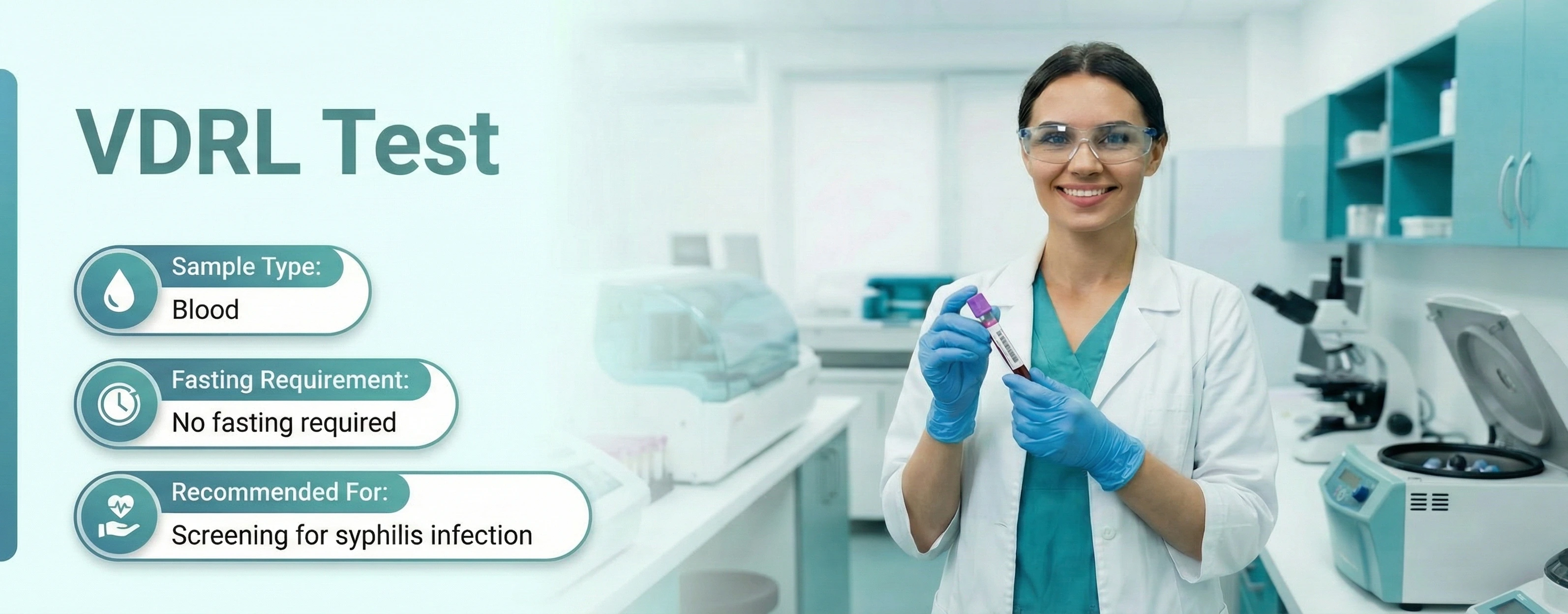
A quick info on VDRL test

Overview
The VDRL (venereal disease research laboratory) test is a blood test used to screen for syphilis, an infection caused by the bacterium treponema pallidum. The test detects antibodies produced by the body’s immune system in response to tissue damage caused by syphilis infection. Syphilis usually develops in four stages: primary, secondary, latent, and tertiary. The primary stage often begins with a painless sore, while the secondary stage may cause a skin rash, swollen lymph nodes, fever, or mouth sores. During the latent stage, symptoms disappear even though the infection remains in the body. If left untreated, it can progress to the tertiary stage, which may damage the brain, nerves, heart, eyes, and other organs. The VDRL test is most sensitive during the secondary stage but may be less accurate very early in the infection or in late-stage disease. It is commonly recommended for people with symptoms of syphilis, those who may have been exposed, pregnant women during routine antenatal care, and individuals at higher risk of sexually transmitted infections. The test requires only a blood sample and does not need fasting or any special preparation. Since VDRL is a screening test, a reactive result should be followed up with a confirmatory test for syphilis diagnosis.

When and Who Should Get a VDRL Test Done?
The VDRL test is recommended in the following situations:
- Symptoms suggestive of syphilis: Symptoms suggestive of primary, secondary, latent and tertiary stages
- Exposure: People who have had sexual contact with someone diagnosed with syphilis.
- STI screening: Individuals undergoing evaluation or screening for other STIs, including HIV.
- Antenatal care: All pregnant women as part of routine antenatal care to prevent congenital syphilis in the baby.
- High risk of exposure: Those with high‑risk sexual behaviour (multiple partners, new partner, unprotected sexual practices, men who have sex with men, sex workers) and those who are sexually active in areas with a high incidence of syphilis.
- Routine screenings: Before certain surgeries, pre‑employment checks, or routine health screenings where STI testing is indicated.
- Treatment monitoring: Patients already treated for syphilis, to monitor treatment response (falling antibody levels).
Early testing and treatment can prevent serious complications and reduce the spread of syphilis.
.png?dim=32x32&q=75?dim=32x32&q=75?dim=32x32&q=75?dim=32x32&q=75?dim=32x32&q=75?dim=32x32&q=75?dim=48x48&q=75)
How Frequently Should You Take the VDRL Test?
|
Who should consider VDRL testing? |
When should you get tested? |
|---|---|
|
Sexually active adults |
At least once every year, or earlier if you develop symptoms, have a new sexual partner, or think you may have been exposed to syphilis. |
|
People living with HIV |
At the time of HIV diagnosis and at least once a year thereafter. More frequent testing (every 3–6 months) may be advised if the risk of exposure continues. |
|
Pregnant women |
During the first prenatal visit. Those at higher risk may need repeat testing at 28–32 weeks of pregnancy and again at the time of delivery. |
|
People with possible exposure to syphilis |
As soon as possible after exposure. If the first test is negative, your doctor may advise repeating it after 6 weeks and 3 months. |
|
People treated for syphilis |
Repeat testing at 3, 6, and 12 months to check if treatment has been successful. |
|
Men who have sex with men (MSM) |
Once a year, or every 3–6 months if there is an ongoing higher risk of infection, such as multiple or anonymous sexual partners. |
Your clinician may adjust timing based on your sexual practices, local syphilis rates, and pregnancy status.

What Conditions Can an VDRL Test Help Detect?
- Syphilis (all stages: primary, secondary, latent, and tertiary): VDRL is primarily a screening test for syphilis infection. It can be falsely negative in very early syphilis or very late (tertiary) disease, so confirmatory treponemal tests (e.g., FTA‑ABS, TP‑PA) are often required.
- Congenital syphilis: VDRL is used as part of screening in newborns and pregnant women to detect or rule out transmission from mother to baby.
- Treatment monitoring: Falling VDRL titres after therapy indicate effective treatment; stable or rising titres suggest treatment failure or reinfection.
- Yaws and other treponemal conditions: Since the test detects non-specific antibodies rather than the syphilis bacterium itself, it may also react to related treponemal infections such as yaws or pinta, which are caused by similar bacteria.
Important note: A positive VDRL result must always be confirmed with a treponemal test before a diagnosis of syphilis is made. Always share your results with a medical professional.
.png?dim=32x32&q=75?dim=32x32&q=75?dim=32x32&q=75?dim=32x32&q=75?dim=32x32&q=75?dim=32x32&q=75?dim=32x32&q=75?dim=32x32&q=75?dim=32x32&q=75?dim=32x32&q=75?dim=32x32&q=75?dim=32x32&q=75?dim=32x32&q=75?dim=48x48&q=75)
VDRL Test Preparation
What to Expect Before the VDRL Test
- No fasting or special preparation is required. You can take the VDRL test at any time of the day.
- Tell your doctor about any medicines you are taking, especially antibiotics, as well as any recent vaccinations or existing medical conditions, particularly autoimmune disorders such as lupus, as these may affect the test result.
- Inform your doctor if you are pregnant or think you may be pregnant. Pregnancy can sometimes lead to a false-positive VDRL result. If syphilis is diagnosed during pregnancy, early treatment is important to help protect both the mother and the baby.
What to Expect During the Blood Collection
- The PharmEasy phlebotomist will arrive at your home at the scheduled time.
- They will use an antiseptic swab to clean the blood collection site on your arm.
- An elastic band will be tied around the upper arm to make the vein stand out. You will be asked to make a fist. They may also gently press the vein.
- A small needle will then be inserted into the vein and blood will be collected in a tube. This may cause a brief pinprick and mild discomfort.
- Once the needle is removed, mild pressure will be applied to the site for a few minutes and then a small bandage will be placed.
- If you have a history of fainting during sample collection or have a fear of needles, let the phlebotomist know. The process will be made more comfortable for you, such as collecting blood while you are in a supine position or by talking with you.
- Breathing slowly, diverting your attention by conversing with a friend or family member, or playing some music can make you more comfortable during the procedure.
What to Expect After the VDRL Test
- The collected sample is taken to the PharmEasy diagnostic laboratory, where it is processed. Once the results are available, a qualified professional checks the report, then it is uploaded to the PharmEasy website from where you can access it.
- Do not remove the bandage for a few hours in order to allow the site to heal properly.
- Do not lift heavy objects or exercise with the arm where the blood draw was done, to reduce the chance of bruising or bleeding.
- Contact your doctor with the report for the interpretation of your results.
Note: If you notice anything unusual at the puncture site, such as persistent bleeding, a rash, or pain, consult your healthcare provider.

What Are the Parameters Included in the VDRL Test?
- VDRL antibody screening: detects antibodies, which are protective proteins produced by your immune system in response to infection. Since antibodies associated with syphilis can remain in the body for an extended period, the test may help indicate a current or previous infection.

VDRL Test Result Interpretation
The primary marker evaluated is the presence of reactive antibodies in your blood sample.
|
Parameter |
Status |
Interpretation |
|---|---|---|
|
VDRL screening marker |
Non-reactive |
No matching antibodies found. A current syphilis infection is unlikely. |
|
Reactive |
Antibodies detected. A confirmatory test may be required to verify the diagnosis. |
Important note: A reactive VDRL result does not prove syphilis; it must always be followed up with a confirmatory treponemal test. Always consult your doctor for interpretation.

VDRL Test Risks and Limitations
Potential Risks and Complications
- Blood sample collection is generally safe, with complications being uncommon. The most common effects are mild pain, slight bruising, or tenderness at the puncture site.
- Some people may feel dizzy or faint during or shortly after the draw. Rarely, a haematoma, blood collecting under the skin, or temporary nerve irritation can occur, particularly if the vein is difficult to access.
- Occasionally, the collected sample may get damaged or become unsuitable for testing during handling or transport. If this happens, you may need to provide another sample to ensure accurate results.
Understanding VDRL Test Limitations
False-positive results (reactive results without syphilis infection)
- Acute infections: Malaria, pneumonia, HIV, and tuberculosis.
- Chronic conditions: Systemic lupus erythematosus, leprosy, and rheumatoid arthritis.
- Other factors: Recent vaccinations, pregnancy, and older age.
False-negative results (non-reactive results despite active infection)
- Testing within the first 3 to 4 weeks after infection, before antibody levels rise enough to be detected.
- Reduced sensitivity in tertiary syphilis, where antibody levels decline.
- Very high antibody concentrations, which can paradoxically cause a false-negative result (prozone effect).
Diagnostic and technical drawbacks
- Measures antibodies rather than the bacterium itself, making confirmation via tests such as TPHA or FTA-ABS mandatory.
- Cannot determine the stage of infection.

VDRL Test Price in Nashik

Areas We Serve in Nashik
You can book the VDRL Test in Nashik through PharmEasy with convenient home sample collection across several localities, including :
- Mahatma Nagar
- Sharanpur
- Panchavati
- Pathardi Phata
- Indira Nagar
- Upnagar
- Cidco
- Satpur
- Ambad
- Ashok Nagar
- Mumbai Naka
- Dwarka
- Savarkar Nagar
- Meri Colony
- Trimurti Chowk
- Kamathwade
- Mhasrul
- Nashik Road
- Deolali
- Gangapur Gaon
You can also check service availability during purchase by entering your pincode.

VDRL Test Sample Collection: Home vs. Diagnostic Lab
|
Feature |
Home collection (PharmEasy) |
Traditional diagnostic lab |
|---|---|---|
|
Convenience |
High - sample taken from your home or office, privately and discreetly. |
Low - requires traveling and waiting in queues. |
|
Privacy |
Maximum - sample collected at home with full discretion. |
Less private - you may meet people you know at a clinic. |
|
Safety and comfort |
Safe - helps avoid exposure to other patients. |
Moderate - avoids exposure to crowded waiting areas. |
|
Process |
A trained phlebotomist visits you with sterile, sealed equipment. |
You must visit the facility during its working hours. |
|
Report access |
Digital - reports are sent directly to your app or email. |
Often requires a second visit for physical copies. |
For a sensitive test like the VDRL, home collection offers complete privacy and discretion. Book on PharmEasy - no fasting required, certified sample collection at your doorstep, and a digital report delivered directly to you.
Was This Test Information Helpful?
Please rate your experience
 Yes Helpful (8)
 Not Helpful
References
People Also Ask
Is the VDRL test sensitive enough to detect syphilis even if I have no symptoms?
Do I need to repeat the VDRL test if my first result is inconclusive?
Can VDRL results change after starting treatment?
Can the VDRL test identify the stage of syphilis?
Can I book the VDRL test online in Nashik?
Is home sample collection available for the VDRL test at PharmEasy Labs in Nashik?
How long does it take to receive VDRL test results in Nashik?
 4.6 Stars| 7+ Lakhs Ratings & Reviews

Over 10 million happy users PharmEasy Labs
- Because the digital report is available on WhatsApp, there's no need to go back to the lab. Thanks, PharmEasy!
 Sachin sharma11 Jan ‘26
 - Thanks to the coupon discount, the blood test was done at a lower price.Komal04 Jan ‘26
- The lab technician was a good and knowledgeable professional.Rakesh Pandey06 Jan ‘26
- Due to bad weather, it's difficult to reach the lab. But home collection makes things easier.Arjun08 Jan ‘26
- Thanks to the Swasth AI feature, the report is easy to understand.Priya Mehta02 Jan ‘26
- The report is available on the same day. Wow!Vikas Patel05 Jan ‘26
Have any doubts? Ask us.
Ask us anything about the Venereal Disease Research Laboratory (VDRL) Test In Nashik - Price & Details to understand it better
Nearby Labs
Lab tests made easy!
- Quick Collection
- Trusted Accuracy
- Hassle-free Services
Medicover Hospitals - AHC - Nashik
Sawata Mali Rd, Parab Nagar, Nashik, Maharashtra 422009, Maharashtra
 grievance-officer@docon.in
 7022000900
Likhitha's Diagnostics & Speciality Lab - Nashik
XQMJ+2CQ, Near Sheetal Apartment, Mumbai Naka, Indira Nagar,, Maharashtra
grievance-officer@docon.in7022000900Health Buddy Diagnostic Pvt Ltd - Nashik
gharpure ghat near Runghta high school near Adhar Aashram Ashok Stambh Nashik 422001, Maharashtra
grievance-officer@docon.in7022000900Health Buddy Diagnostic Pvt Ltd - Nashik
2nd Floor, Krishi Utpanna Bazar Samiti Sankul, Dindori Road, Panchvati, Nashik- 422003, Maharashtra
grievance-officer@docon.in7022000900HealthRoute - Nashik
Anandghan Commercial Complex, 1st Floor, Above PNB Bank, Parihar Chowk, ITI Road, Aundh, Maharashtra
grievance-officer@docon.in7022000900
We provide trusted, expert-curated health content to support better awareness,prevention, and care.
Backed by experienced doctors, medical experts, and strict editorial standards.