

26+ orders placed in your location

100% NABL & ISO Certified Lab • 100% Accurate Reports
Covid-19 RTPCR Test (Coronavirus SARS - CoV2)
Coronavirus RT-PCR test, COVID-RTPCR test, COVID-19 PCR test, RT-PCR test
- SummaryThe COVID-19 RT-PCR Test helps diagnose COVID-19 infection. The test uses samples taken by swabs from the nose and throat to detect the presence of the virus. The RT-PCR test relies on a tiny amount of the virus’s genetic material in a sample and is considered standard for detecting COVID-19 infection. Fasting is not required for this test.Read more
- Reports Within29 HrsView Sample Report

 100% NABL & ISO Certified Labs
 - SampleThroat and Nasal Swab
- AgeAll Age Group
- GenderMale and Female
- FastingNot Required

PharmEasy Promises



Know More About The Test


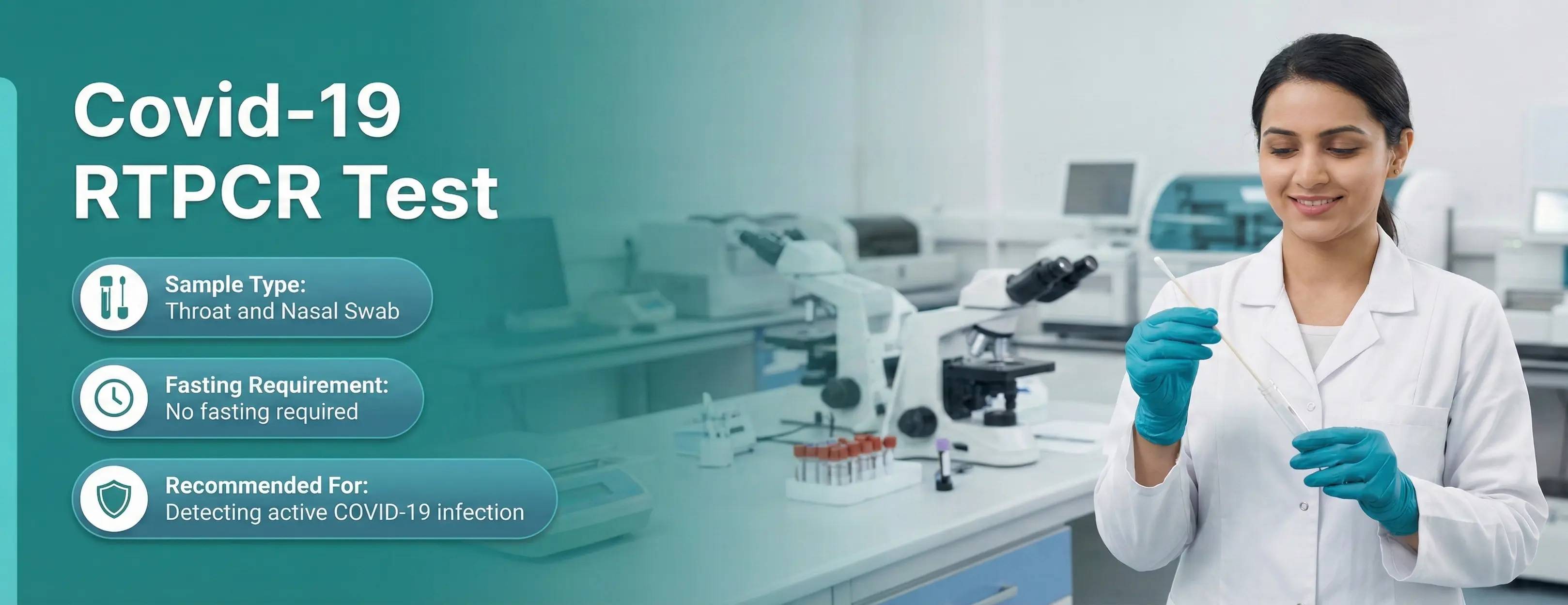
A quick info on Covid-19 RTPCR test

Overview
The COVID-19 RT-PCR test is the gold standard diagnostic test for detecting an active infection caused by the SARS-CoV-2 virus. It is the most accurate, sensitive, and globally accepted method for confirming whether the coronavirus is currently present in a person's body.
Doctors order a COVID-19 RT-PCR test when infection is clinically suspected or epidemiologically indicated. The test works in two key steps: reverse transcription converts the virus's RNA into DNA, and then PCR amplifies this DNA millions of times, making even tiny amounts of viral material detectable. If the virus is present, a fluorescent signal glows, and the result is reported as positive.
The test detects SARS-CoV-2 from a nasal and throat swab, not a blood sample. It monitors the presence of active viruses in the respiratory tract. No blood draw or fasting is needed. Results are available within 6 to 24 hours. It is the test of choice for confirming symptomatic COVID-19, screening high-risk contacts, and fulfilling travel and institutional requirements.
When and Who Should Get a Covid-19 RTPCR Test Done?
The COVID-19 RT-PCR test is used to diagnose a specific condition: active infection with the SARS-CoV-2 coronavirus. A positive result confirms the virus is present and enables your doctor to assess illness severity. Individuals who test positive may experience:
- Mild to moderate COVID-19 illness - fever, cough, fatigue, body aches, sore throat, loss of taste or smell.
- Severe COVID-19 pneumonia - leading to hypoxia (low oxygen), difficulty breathing, and hospitalisation.
- Critical illness - including ICU admission, mechanical ventilation, and multi-organ involvement in high-risk individuals.
- Long COVID (Post-COVID syndrome) - persistent symptoms such as fatigue, brain fog, breathlessness, and joint pain lasting weeks to months after initial recovery.
- Secondary bacterial infections - such as secondary pneumonia or sepsis in hospitalised patients.
- Risk to vulnerable household contacts - including the elderly, immunocompromised, and those with uncontrolled diabetes, cardiovascular disease, chronic kidney disease, or cancer.
Important note: A positive RT-PCR requires immediate isolation, medical consultation, and close monitoring of oxygen levels. If you have difficulty breathing, persistent chest pain, or oxygen saturation below 94%, seek emergency medical attention immediately.
.png?dim=48x48&q=75)
How Frequently Should You Take the Covid-19 RTPCR Test?
The COVID-19 RT-PCR test is not a routine periodic test. It is ordered based on specific clinical or epidemiological situations. The timing of testing relative to exposure or symptom onset is critically important for a reliable result.
|
Situation |
Optimal timing |
If the result is negative |
|---|---|---|
|
Symptomatic - first test |
As soon as symptoms appear, ideally within the first 2 to 5 days when viral load is highest. |
If symptoms persist, repeat in 24 to 48 hours. A very early test may miss the virus. |
|
Asymptomatic contact of a positive case |
5 to 7 days after the last close exposure to allow the incubation period to pass. |
Retest after the 7-day period if any symptoms develop. |
|
Negative rapid antigen test with symptoms |
Immediately, on the same day or the following day. |
Antigen tests can give false negatives early in illness. RT-PCR is the confirmatory test. |
|
Pre-travel or pre-procedure requirement |
As per specific requirement, typically 48 to 72 hours before travel or procedure. |
Follow the guidelines of the destination country, airline, or hospital. |
|
Repeat testing after a positive result |
Not routinely required for mild disease. After 10 to 14 days, if needed for institutional clearance. |
RT-PCR can remain positive for weeks after recovery due to residual viral fragments. |
|
Routine surveillance (healthcare workers) |
As per institutional protocol, typically weekly or bi-weekly during high-transmission periods. |
Continue following institutional infection control protocols. |

What Conditions Can a Covid-19 RTPCR Test Help Detect?
The COVID-19 RT-PCR test is used to diagnose a specific condition: active infection with the SARS-CoV-2 coronavirus. A positive result confirms the virus is present and enables your doctor to assess illness severity. Individuals who test positive may experience:
- Mild to moderate COVID-19 illness - fever, cough, fatigue, body aches, sore throat, loss of taste or smell.
- Severe COVID-19 pneumonia - leading to hypoxia (low oxygen), difficulty breathing, and hospitalisation.
- Critical illness - including ICU admission, mechanical ventilation, and multi-organ involvement in high-risk individuals.
- Long COVID (Post-COVID syndrome) - persistent symptoms such as fatigue, brain fog, breathlessness, and joint pain lasting weeks to months after initial recovery.
- Secondary bacterial infections - such as secondary pneumonia or sepsis in hospitalised patients.
- Risk to vulnerable household contacts - including the elderly, immunocompromised, and those with uncontrolled diabetes, cardiovascular disease, chronic kidney disease, or cancer.
Important note: A positive RT-PCR requires immediate isolation, medical consultation, and close monitoring of oxygen levels. If you have difficulty breathing, persistent chest pain, or oxygen saturation below 94%, seek emergency medical attention immediately.
.png?dim=48x48&q=75)
Covid-19 RTPCR Test Preparation
What to Expect Before the COVID-19 RT-PCR Test
No fasting is required. You can take your regular medications before the test. For the best sample quality, do not eat, drink, smoke, or use mouthwash for at least 30 minutes before the throat swab. Do not use nasal sprays or blow your nose vigorously before the nasal swab. If symptomatic, wear a mask until the swab is collected. Inform the collector of any nasal surgery history or deviated septum.
What to Expect During the Sample Collection
A nasal swab is gently inserted into one or both nostrils and rotated for 10 to 15 seconds; you may feel brief stinging. A throat swab firmly wipes the back of the throat and tonsil area, which may trigger a brief gag reflex. Both swabs are placed into a viral transport medium (VTM) tube, sealed, labelled, and sent to the certified laboratory. The entire collection takes less than 2 minutes.
What to Expect After the Sample Collection
You may feel very brief soreness at the back of the throat or mild nasal irritation, which resolves within minutes. If symptomatic or a high-risk contact, stay at home and isolate until your result is available. Monitor your symptoms, and if you experience breathing difficulty, chest pain, or if your oxygen saturation falls below 94%, seek emergency care immediately; do not wait for your test result.

What are the Parameters Included in a Covid-19 RTPCR Test?
- SARS-CoV-2 RNA detection result - reported as detected (positive) or not detected (negative). Tells you whether the genetic material of SARS-CoV-2 is present in your sample.
- Ct value (cycle threshold value) - how many amplification cycles were needed before the virus was detected. A lower Ct (below 25) indicates higher viral load and greater infectivity. A higher Ct (above 30 to 35) suggests a lower viral load.
- Internal control result - a quality check confirming the sample was adequate, and the test was performed correctly. A valid internal control means a negative result is reliable and not due to a processing error.
- Gene targets detected - the report may specify which viral gene targets (E gene, RdRp gene, N gene, ORF1ab) were detected, useful for clinicians in confirming the result.
Ct values should never be self-interpreted. They vary between laboratories and testing platforms, and only your doctor can accurately interpret what your specific Ct value means clinically.

Normal Range of Covid-19 RTPCR Test Parameters
The RT-PCR test does not produce a numerical value like blood tests. The result is qualitative, reported as detected or not detected. The Ct value provides additional clinical context about viral load.
|
Result |
Ct value (where reported) |
Interpretation |
|---|---|---|
|
Not detected (negative) |
No amplification / Ct above 35-40 (lab-dependent) |
No SARS-CoV-2 RNA detected. Active infection is unlikely. Does not rule out infection if tested very early. |
|
Detected - high viral load |
Ct value below 25 |
High viral RNA present. Active infection with high infectivity. Immediate isolation and medical consultation required. |
|
Detected - moderate viral load |
Ct value 25 to 30 |
Moderate viral load. Consistent with active infection in the symptomatic phase. |
|
Detected - low viral load |
Ct value 30 to 35 |
Lower viral load. May indicate early infection, late-stage recovery, or residual non-viable fragments. |
|
Invalid / Inconclusive |
Internal control failed / No valid result |
Test could not produce a valid result. Repeat testing required. |
Important note: Ct value interpretation varies between laboratories and RT-PCR platforms. Results should always be interpreted by a qualified doctor in the context of your symptoms, exposure history, and the number of days since symptom onset.
.png?dim=48x48&q=75)
Covid-19 RTPCR Test Result Interpretation
The RT-PCR result must always be interpreted in the context of your symptoms, the timing of the test relative to exposure or symptom onset, and your overall health status.
|
Result scenario |
Likely meaning |
Recommended action |
|---|---|---|
|
Positive - symptomatic patient |
Confirms active SARS-CoV-2 infection. |
Isolate immediately. Consult a doctor. Monitor oxygen saturation (SPO2). If SPO2 falls below 94% or breathing becomes difficult, seek emergency care. |
|
Positive - asymptomatic person |
Active infection confirmed even without symptoms. Can still transmit to others. |
Isolate for at least 5 to 7 days. Inform all close contacts. Monitor for symptom development. Consult a doctor. |
|
Negative - symptomatic patient (tested early) |
Viral load may not yet be high enough. False-negative is possible in the first 1 to 2 days. |
Continue home isolation. Repeat RT-PCR after 24 to 48 hours if symptoms persist. |
|
Negative - asymptomatic contact |
Infection unlikely, especially if tested 5 to 7 days after last exposure. |
Remain observant for symptoms for the full 14-day incubation window. |
|
Positive with high Ct value (above 30-35) |
Low viral load. May represent early-stage infection or residual non-infectious viral fragments. |
Correlate with symptoms and timing. The doctor may advise a repeat test in 2 days. |
|
Invalid / Inconclusive result |
Test could not produce a reliable result due to sample quality or processing issues. |
Repeat the test with a new swab sample as soon as possible. |
Disclaimer: This table is for educational purposes only. Interpretation must always be guided by a qualified doctor. Do not self-treat or make isolation decisions based on the test result alone without medical consultation.

Covid-19 RTPCR Test Risks and Limitations
Potential Risks and Discomfort
The test is a safe, non-invasive procedure with no significant health risks beyond brief, minor discomfort during swabbing. The nasal swab may cause brief stinging, watering of the eyes, or sneezing, all of which resolve within seconds. The throat swab may trigger a momentary gag reflex, which passes almost immediately. In very rare cases, individuals with a bleeding disorder or nasal polyps may experience minor spotting; inform the sample collector if you have such conditions.
Understanding COVID-19 RT-PCR Test Limitations
Timing critically affects sensitivity; the test is most accurate between day 3 and day 7 of symptom onset, and testing too early can produce a false-negative. Swab quality also affects accuracy; a superficial sample can produce a false-negative even if the virus is present. A positive RT-PCR can remain positive for 4 to 6 weeks after recovery due to dead, non-infectious viral RNA fragments. The test confirms SARS-CoV-2 but does not identify which variant is causing the infection; variant identification requires whole-genome sequencing. A positive result also does not predict how severe your illness will be.

Related and Follow-up Tests
The RT-PCR confirms the diagnosis of SARS-CoV-2 infection, but managing COVID-19, especially moderate to severe cases, requires additional investigations to assess organ involvement and guide treatment.
|
RT-PCR finding |
Suggested follow-up test |
Why is it ordered |
|---|---|---|
|
Positive RT-PCR |
COVID-19 rapid antigen test |
Faster screening alternative. A positive antigen result does not need RT-PCR confirmation. |
|
Positive RT-PCR (past exposure check) |
COVID-19 antibody test (IgM/IgG) |
Detects antibodies from past infection or vaccination. Not used for active infection. |
|
Positive RT-PCR + any severity |
Often shows low WBC count (lymphopenia) - helps gauge immune involvement and disease severity. |
|
|
Positive RT-PCR + moderate to severe illness |
Inflammation markers that rise significantly in moderate to severe COVID-19. |
|
|
Positive RT-PCR + severe illness |
Key marker for blood clot formation. Elevated D-dimer indicates risk of DVT or pulmonary embolism. |
|
|
Positive RT-PCR + severe illness |
Markers of cytokine storm severity and tissue damage in serious COVID-19. |
|
|
Positive RT-PCR + severe illness |
Chest X-ray and HRCT chest |
Imaging to assess lung involvement. HRCT gives a CT severity score to guide hospitalisation decisions. |
|
Positive RT-PCR + organ symptoms |
KFT, LFT, and cardiac troponin |
Assesses organ involvement, as SARS-CoV-2 can affect kidneys, liver, and heart in severe cases. |
Note: Mild COVID-19 may require no additional tests beyond the RT-PCR. For moderate or severe cases, your doctor will decide which investigations are needed. Never self-order investigations without medical advice.

Covid-19 RTPCR Test Sample Collection: Home vs. Diagnostic Lab
|
Feature |
Home Collection (PharmEasy) |
Traditional Diagnostic Lab |
|---|---|---|
|
Convenience |
High - sample taken from your home or office. |
Low - requires travelling and waiting in queues. |
|
Time Saving |
Maximum - no travel time. You pick the time slot. |
Minimum - depends on traffic and lab rush. |
|
Safety & Comfort |
Safe - avoids exposure to other sick patients. |
Moderate - exposure to crowded waiting areas. |
|
Process |
A professional phlebotomist visits you. |
You must visit the facility during its hours. |
|
Report Access |
Digital - sent directly to your app or email. |
Often requires a second visit for physical copies. |
Pro Tip: For the most stress-free experience, book a Covid-19 RTPCR test on PharmEasy. Enjoy professional service and accurate results without stepping out of your house.

Covid-19 RTPCR Test Price/Cost
A COVID-19 RT-PCR test is generally priced around INR 750. The cost may differ depending on the city and the laboratory selected. For a clearer understanding, you can compare RT-PCR test prices across major cities in India.
|
City |
Offer Price |
|---|---|
|
750 |
|
|
750 |
|
|
750 |
|
|
750 |
|
|
750 |
|
|
750 |
|
|
750 |
|
|
750 |
|
|
750 |
|
|
750 |
Was This Test Information Helpful?
Please rate your experience
 Yes Helpful (59)
 Not Helpful
References
People Also Ask
What is the difference between a COVID-19 RT-PCR test and a rapid antigen test?
How long does it take to get RT-PCR test results?
I tested negative, but I have all the symptoms of COVID-19. What should I do?
What does the Ct value in my RT-PCR report mean?
I have recovered from COVID-19. Why is my RT-PCR still positive?
Is the RT-PCR test safe during pregnancy?
How long should I isolate after a positive RT-PCR result?
What should I do immediately after receiving a positive RT-PCR result?
 4.6 Stars| 7+ Lakhs Ratings & Reviews

Over 10 million happy users PharmEasy Labs
- Because the digital report is available on WhatsApp, there's no need to go back to the lab. Thanks, PharmEasy!
 Sachin sharma11 Jan ‘26
 - Thanks to the coupon discount, the blood test was done at a lower price.Komal04 Jan ‘26
- The lab technician was a good and knowledgeable professional.Rakesh Pandey06 Jan ‘26
- Due to bad weather, it's difficult to reach the lab. But home collection makes things easier.Arjun08 Jan ‘26
- Thanks to the Swasth AI feature, the report is easy to understand.Priya Mehta02 Jan ‘26
- The report is available on the same day. Wow!Vikas Patel05 Jan ‘26
Have any doubts? Ask us.
Ask us anything about the Covid-19 RTPCR Test (Coronavirus SARS - CoV2) to understand it better

We provide trusted, expert-curated health content to support better awareness,prevention, and care.
Backed by experienced doctors, medical experts, and strict editorial standards.