

4+ orders placed in your location

100% NABL & ISO Certified Lab • 100% Accurate Reports
AFB Culture (MGIT)
- Reports Within116 HrsView Sample Report

 100% NABL & ISO Certified Labs
 - SampleSputum
- FastingNot Required

PharmEasy Promises



Know More About The Test


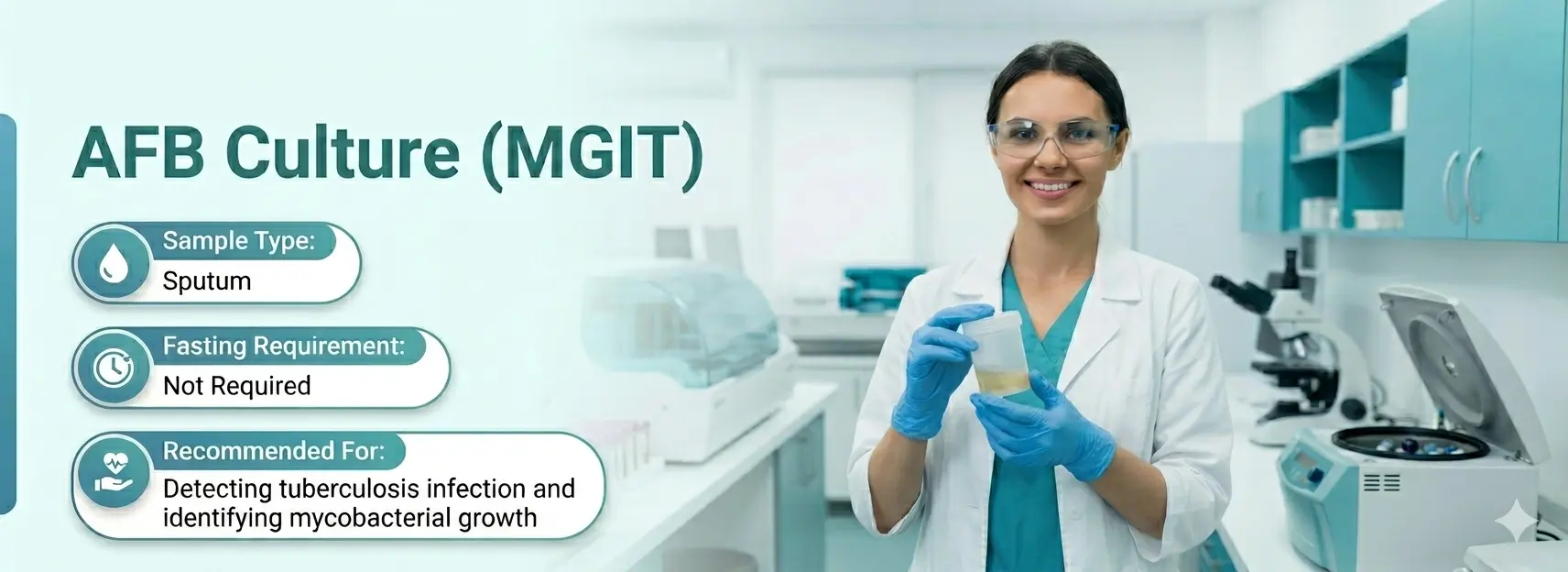
A quick info on AFB Culture (MGIT)

Overview
The Acid-Fast Bacillus (AFB) Culture test is done to detect the presence of Mycobacteria in the body. Mycobacteria cause many types of bacterial infections, including tuberculosis (TB), which most commonly affects the lungs (pulmonary TB) and remains a major public health concern. This spreads through the air when a person with pulmonary TB coughs or sneezes, allowing others to inhale the bacteria. While TB can also affect other parts of the body (extrapulmonary TB), it is generally not infectious.
This test is done to identify the bacteria that cause the infection. If Mycobacterium tuberculosis is detected on the test, the diagnosis of TB is confirmed. The AFB Culture test is performed using the Mycobacterial Growth Indicator Tube (MGIT) method, and if positive, drug susceptibility testing (DST) is carried out to determine whether the bacteria are sensitive or resistant to anti-tubercular drugs. This helps doctors choose the most effective treatment.

When and Who Should Get a AFB Culture Test Done?
Sputum AFB Culture test is advised to be done by the doctor when a person shows symptoms suggestive of TB. Common symptoms where the test is recommended include:
- Cough that lasts 3 weeks or more
- Persistent chest pain
- Cough with expectoration (coughing with mucus), sometimes with blood
- Fever and chills
- Losing weight drastically
- Extreme fatigue
The following categories of individuals need to get an AFB Culture test done:
- People who are suspected of having TB due to a positive TB screening test, abnormal findings on chest X-rays, or the presence of active symptoms.
- People who have a weakened immune system are more prone to developing TB, such as individuals with diabetes, HIV, or those on prolonged corticosteroids.
- People who are at high risk of developing TB, such as those who have been in close contact with someone who already has TB or healthcare workers in TB wards.
- People who have been diagnosed with TB and are undergoing treatment for it, to monitor treatment progress.
.png?dim=48x48&q=75)
How Frequently Should You Take the AFB Culture Test?
The frequency of testing depends on the risk factors of a person. People who are at low risk need not be tested unless there are symptoms and the doctor recommends it. For those at high risk, specific recommendations or a doctor’s advice may be followed in this regard.
|
Health Condition |
Context |
Frequency |
|---|---|---|
|
Suspected TB |
Active symptoms present |
As advised by your doctor |
|
High -risk individuals |
Those who are at continued risk of exposure |
Annual testing may be recommended |
|
Treatment monitoring |
Already diagnosed with TB and on treatment |
To be repeated as required |
Note: Please consult your doctor for assessing your need to take the test if you have any symptoms. Consult immediately if symptoms, even though simple, last longer; negligence of symptoms can worsen the condition over time.

What Conditions Can a AFB Culture Test Help Detect?
AFB test helps to detect:
- TB affecting lungs (pulmonary TB) and TB affecting organs other than the lungs (extrapulmonary TB), such as lymph nodes, kidneys, endometrium, spine, and brain.
- Multidrug-resistant TB (MDR-TB), which is a form of TB that is resistant to two first-line anti-TB drugs, Isoniazid (INH) and Rifampicin (RIF).
- Some other mycobacterial infections, like those from Mycobacterium avium intracellular, which affect people with HIV and weak immune systems.
.png?dim=48x48&q=75)
AFB Culture Test Preparation
Preparations needed before, during, and after the AFB Culture sputum test procedure are:
Before the test
- You don’t need any special preparation, such as fasting before the procedure.
- You may be asked to rinse your mouth with water before collection.
- Usually, an early morning sample is preferred.
- Follow your doctor’s instructions if advised.
During the test
- You will be given a sterile container and asked to expectorate into it to collect a sputum sample.
- If you can’t produce enough sputum, you may be asked to breathe in a salt mist, which will help you cough deeply.
- Multiple samples may be needed to obtain an adequate number of samples.1 (Usually, 2-3 samples will be collected on different days)
After the test
- No recovery time as such is required after the test.
- You may continue with your normal activities.
Rarely, there may be a need for gastric aspiration or bronchoscopy for sample collection. In bronchoscopy, a thin tube is inserted into the airways, and a sample is collected. In gastric aspiration, a tube is passed into the stomach, and a sample is collected.

What are the Parameters Included in a AFB Culture Test?
This test detects the presence and growth of acid-fast bacilli (AFB), which are the bacteria responsible for tuberculosis and related infections. It mainly checks for the following:
- AFB Detection – Detects the presence of Mycobacteria tuberculosis bacteria growing in the sample.
- MGIT Culture is a faster and more sensitive technique for mycobacterial detection. It detects bacterial growth through fluorescence in a liquid medium (light emission if bacterial growth occurs, which consumes oxygen) and delivers results in 2-3 weeks.
- Drug Sensitivity Testing – If Mycobacterium tuberculosis is detected, drug sensitivity testing is usually done to check whether the bacteria are resistant to anti-tubercular drugs and thereby to find out the most effective antibiotic to treat the disease.

Normal Range of AFB Culture Test Parameters
The AFB Culture (MGIT) test is interpreted as positive and negative (qualitative), rather than in numbers (quantitative). The normal range of the AFB Culture test is:
|
Parameter |
Normal Range |
Clinical Insight |
|---|---|---|
|
AFB Culture |
Negative |
Positive: TB or mycobacterial infection |
- AFB Culture Positive – Means active TB infection.
- AFB Culture Negative – No bacteria were detected; clinical symptoms to be checked for confirmation.
Note: AFB Culture is the gold standard for Mycobacterium tuberculosis (MTB) detection. If this test is positive, your doctor may suggest that you start TB treatment as early as possible.
.png?dim=48x48&q=75)
AFB Culture Test Result Interpretation
AFB Culture test report interpretation is based on the growth of bacteria. It can be negative or positive.
- Negative – A negative result means that after completion of the incubation period, no bacterial growth was detected. Negative culture does not exclude the infection, especially if it is an early-stage infection or there is a low bacterial load.
- Positive – A positive result means growth of AFB bacteria was detected.
- Positive for MTB Complex (MTBC)- Suggests active TB infection (pulmonary or extrapulmonary).
- Positive for non-tuberculous Mycobacteria- The presence of these bacteria should be correlated with clinical and radiographic findings.
- Drug Susceptibility Testing- Positive culture is followed by drug susceptibility testing. Results can help identify the most sensitive treatment choice and drug-resistant cases. It may also indicate a requirement for change in therapy for non-responsive cases.
Note: Sometimes the tube gets contaminated. In that case, repeat sample collection might be required.

AFB Culture Test Risks and Limitations
Potential Risks (Rare)
If a sputum sample is taken by coughing into a container, usually, there is no discomfort or associated risk. If any other samples are taken, there could be some discomfort during tube insertion and removal.
Limitations
False negative results are possible. This means that although the AFB Culture test is negative, mycobacterial infection can still be present. If clinical symptoms persist, it necessitates the need for repeat/additional testing. Early-stage infection or low bacterial load may show such results. Also, results are technique sensitive, as different testing techniques may have varying detection capabilities and accuracy. Improper sample collection or contaminated samples may also lead to false negative results.

Related and Follow-up Tests
Related tests: Chest x-rays are important for the evaluation of TB disease. Other than that, a complete blood count (CBC) is done to check for serum Hb level, RBC count, WBC count, platelet count, erythrocyte sedimentation rate (ESR), and C-reactive protein (CRP). Drug susceptibility testing may also be done to check which medicines may be effective for treatment.
Additional tests: TB skin test (Mantoux Tuberculin skin test) and IGRAs (Interferon Gamma Release Assays) may be needed to detect immune responses to specific M. tuberculosis antigens.

AFB Culture Test Sample Collection: Home vs. Diagnostic Lab
|
Feature |
Home Collection (PharmEasy) |
Traditional Diagnostic Lab |
|---|---|---|
|
Convenience |
High - sample taken from your home or office. |
Low - requires travelling and waiting in queues. |
|
Time Saving |
Maximum - no travel time. You pick the time slot. |
Minimum - depends on traffic and lab rush. |
|
Safety & Comfort |
Safe - avoids exposure to other sick patients. |
Moderate - exposure to crowded waiting areas. |
|
Process |
Professional phlebotomist visits you. |
You must visit the facility during their hours. |
|
Report Access |
Digital - sent directly to your app or email. |
Often requires a second visit for physical copies. |
Pro Tip: For the most stress-free experience, book a AFB Culture (MGIT) Test on PharmEasy. Enjoy professional service and accurate results without stepping out of your house.
Was This Test Information Helpful?
Please rate your experience
 Yes Helpful
  Not Helpful
References
People Also Ask
Which organ is mostly affected by TB?
What are the first warning signs of TB?
What are the five causes of TB?
What is the most common AFB infection?
What tests are done to confirm TB?
Is TB curable?
How many tests are needed to confirm AFB?
 4.6 Stars| 7+ Lakhs Ratings & Reviews

Over 10 million happy users PharmEasy Labs
- Because the digital report is available on WhatsApp, there's no need to go back to the lab. Thanks, PharmEasy!
 Sachin sharma11 Jan ‘26
 - Thanks to the coupon discount, the blood test was done at a lower price.Komal04 Jan ‘26
- The lab technician was a good and knowledgeable professional.Rakesh Pandey06 Jan ‘26
- Due to bad weather, it's difficult to reach the lab. But home collection makes things easier.Arjun08 Jan ‘26
- Thanks to the Swasth AI feature, the report is easy to understand.Priya Mehta02 Jan ‘26
- The report is available on the same day. Wow!Vikas Patel05 Jan ‘26
Have any doubts? Ask us.
Ask us anything about the AFB Culture (MGIT) to understand it better

We provide trusted, expert-curated health content to support better awareness,prevention, and care.
Backed by experienced doctors, medical experts, and strict editorial standards.