


19+ orders placed in your location


100% NABL & ISO Certified Lab • 100% Accurate Reports
Coomb's test (Direct)
Direct antiglobulin test, DAT, Direct anti-human globulin test
- SummaryThe Coomb's test (Direct) helps detect antibodies attached to the surface of red blood cells, which may indicate conditions like autoimmune haemolytic anaemia. It is commonly used to investigate unexplained anaemia, transfusion reactions or hemolytic disease of the newborn. A simple blood sample is used for this test, and no fasting is required. There are no age or gender restrictions.Read more
- Reports Within52 HrsView Sample Report100% NABL & ISO Certified Labs
- SampleBlood
- AgeAll Age Group
- GenderMale and Female
- FastingNot Required



PharmEasy Promises




Know More About The Test




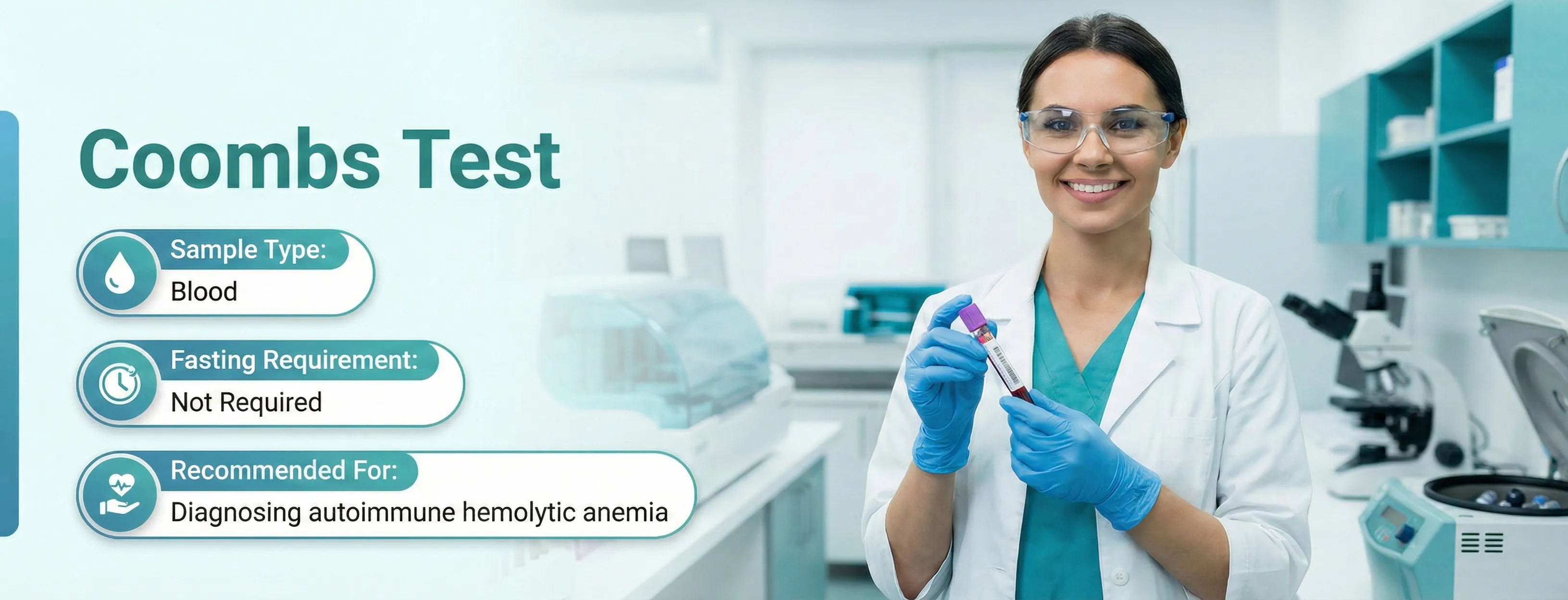
A quick info on Coombs Test


Overview
The Direct Coombs test, also called the direct antiglobulin test (DAT), helps check if antibodies (or other proteins) are attached to your red blood cells (RBCs).
Antibodies are proteins generated by the immune system to help fight infections. But sometimes, the body mistakenly makes antibodies against its own RBCs, which can destroy them and cause health problems.
In the Coombs test procedure, a blood sample is taken, and the RBCs are washed with saline to remove any free antibodies. Then, a special solution called Coombs reagent is added. If antibodies are already attached to the RBCs, agglutination (clumping of cells) occurs, which means the test is positive.
Doctors use this test to detect conditions in which RBCs break down, such as:
- Autoimmune haemolytic anaemia (AIHA)
- Haemolytic disease of the newborn
- Reactions after blood transfusion
When and Who Should Get a Coomb's test (Direct) Test Done?
The Direct Coombs test is recommended for people in whom immune-related destruction of RBCs is suspected due to symptoms such as:
- Signs/symptoms of anaemia or jaundice: Anaemia may cause fatigue, weakness, headache, poor concentration, and loss of appetite. As it worsens, other signs such as pale skin, shortness of breath, dizziness, brittle nails, and sometimes mouth ulcers or heavy menstrual bleeding may be seen. Jaundice may cause yellow skin and eyes, dark urine, pale stools, itching, along with fatigue and weakness.
Individuals who may need this test include:
- People suspected to have AIHA: They have symptoms of anaemia and haemolysis (RBC destruction) that are not caused by other conditions such as iron-deficiency anaemia or haemoglobinopathies (inherited blood disorders in which abnormal or reduced haemoglobin is produced).
- Newborns at risk of haemolytic disease: This is observed as early jaundice, pale skin, poor feeding, and, in severe cases, swelling and enlarged liver or spleen.
- Individuals with a reaction after a blood transfusion: Symptoms include fever, chills, low blood pressure, dark urine, and skin rashes after receiving blood.
- People with drug-induced haemolysis: Individuals who develop sudden fatigue, jaundice, dark urine, and sometimes rapid heartbeats or shortness of breath, after starting a new medication.
.png?dim=48x48&q=75)
How Frequently Should You Take the Coomb's test (Direct) Test?
The Coombs test (Direct) is not done regularly. It is done only when doctors think the body is destroying its own RBCs.
|
Health Scenario |
Context |
Frequency |
|---|---|---|
|
AIHA |
To confirm/monitor the destruction of RBCs |
Once (and then repeated as advised by the doctor) |
|
Haemolytic disease of the newborn |
To check antibody-related RBC destruction in newborns |
Done at birth (repeated if required under doctor’s recommendation) |
|
Blood transfusion reaction |
If a reaction is suspected after a transfusion |
Performed immediately (repeated if needed for confirmation/monitoring) |

What Conditions Can a Coomb's test (Direct) Test Help Detect?
A positive result on the Coombs test indicates that antibodies are attached to your RBCs, causing their destruction. Direct Coombs test positive causes may include:
- AIHA: In this condition, the body attacks and destroys its own RBCs.
- Haemolytic disease of the newborn: The baby’s RBCs are at risk of being destroyed if they are not compatible with the mother (Rh incompatibility).
- Infectious mononucleosis: A viral infection that can sometimes affect RBCs.
- Mycoplasma infection: A bacterial infection that may trigger immune-related RBC destruction.
- Syphilis: A bacterial infection that can affect multiple body systems, including the blood.
- Systemic lupus erythematosus (SLE): An autoimmune disease where the body attacks its own tissues, including RBCs.
- Blood transfusion reaction: A reaction that occurs when mismatched blood is given to an individual.
- Chronic lymphocytic leukaemia (CLL): A type of blood cancer that can affect the immune system and RBCs.
- Drug-induced haemolytic anaemia: A condition in which certain medications, such as penicillin, cephalosporins, methyldopa, and quinidine, trigger the destruction of RBCs by the immune system.
- Other conditions: Certain autoimmune conditions, such as rheumatoid arthritis and ulcerative colitis, as well as some cancers, may affect the immune system and may be associated with a positive Coombs test.
Note: In rare cases, the test can also be weakly positive due to severe liver or kidney disease that does not cause noticeable anaemia symptoms.
.png?dim=48x48&q=75)
Coomb's test (Direct) Test Preparation
What to Expect Before the Coomb's test (Direct) Test
No fasting is required for a standalone Coomb's test (Direct) test. You can eat and drink normally. However, if it is part of a broader package that includes fasting tests, your doctor may advise fasting for 8-12 hours. Avoid strenuous exercise for 24 hours before the test, as intense physical activity can temporarily raise Coomb's test (Direct) levels and affect interpretation. Always inform your doctor about any ongoing medications.
What to Expect During the Blood Collection
A phlebotomist cleans the skin with an antiseptic, then places an elastic band around your upper arm to make the veins easier to access. A small needle is inserted into the vein; you may feel a brief pinch. Blood is collected into a labelled tube in under a minute.
What to Expect After the Coomb's test (Direct) Test
A small cotton swab and bandage are placed over the site to stop any minor bleeding. You can return to normal activities immediately. Minor bruising is normal and disappears quickly. If dizzy,

What are the Parameters Included in a Coomb's test (Direct) Test?
The Direct Coombs test mainly checks for substances attached to RBCs. The key parameter is:
- Presence of antibodies (mainly IgG and other complement proteins like C3d) attached to RBCs.

Normal Range of Coomb's test (Direct) Test Parameters
Unlike many blood tests, the Direct Coombs test does not have a numerical range. The test results are shown as positive or negative.
|
Parameter |
Normal Range |
|---|---|
|
Direct Coombs Test |
Negative (no agglutination) |
Note:
- Results of the Direct Coombs test may vary depending on the patient’s condition and laboratory methods.
- Test results should always be interpreted along with the patient’s symptoms and medical history by a qualified doctor.
.png?dim=48x48&q=75)
Coomb's test (Direct) Test Result Interpretation
The Direct Coombs test results can be understood as shown below:
|
Result |
Interpretation |
|---|---|
|
Negative (No agglutination) |
A negative Direct Coombs test means no antibodies attached to RBCs (normal result). |
|
Positive (Agglutination present) |
A positive Direct Coombs test means that antibodies are attached to RBCs. This may be suggestive of AIHA, haemolytic disease of the newborn, infectious mononucleosis, mycoplasma infection, syphilis, SLE, transfusion reaction, or CLL. |
Note:
- A positive Coombs test does not always confirm a specific disease and should be interpreted with findings on the doctor’s examination (as sometimes old people may have abnormal results without any conditions).
- A negative result does not completely rule out haemolysis. Thus, you should see a doctor if symptoms persist.
- Results should always be evaluated by a doctor along with symptoms, medical history, and other laboratory tests.

Coomb's test (Direct) Test Risks and Limitations
The Direct Coombs test is generally safe, but it has some risks and limitations.
Risks:
- The test requires a blood sample, so there may be mild pain or discomfort at the needle insertion site.
- Bruising or slight bleeding can occur at the puncture site.
- Rarely, there may be infection or dizziness after blood collection.
Note: These are rare and usually resolve on their own.
Limitations:
- A positive result does not always mean a specific disease, and a negative result does not completely rule out haemolysis, so results should be interpreted with the doctor’s examination findings.
- Results may be affected by recent transfusions, medications, or infections.
- The test cannot identify the exact cause of antibody formation, and further testing is needed for diagnosis.

Related and Follow-up Tests
Depending on your symptoms and results, your doctor may recommend additional tests, as follows, to better understand your condition:
- Complete blood count (CBC)
- Peripheral blood smear
- Reticulocyte count
- Serum bilirubin
- Indirect Coombs test (IAT)
- Blood typing and cross-matching
Coomb's test (Direct) Test Sample Collection: Home vs. Diagnostic Lab
|
Feature |
Home Collection (PharmEasy) |
Traditional Diagnostic Lab |
|---|---|---|
|
Convenience |
High - sample taken from your home or office. |
Low - requires travelling and waiting in queues. |
|
Time Saving |
Maximum - no travel time. You pick the time slot. |
Minimum - depends on traffic and lab rush. |
|
Safety & Comfort |
Safe - avoids exposure to other sick patients. |
Moderate - exposure to crowded waiting areas. |
|
Process |
A professional phlebotomist visits you. |
You must visit the facility during its hours. |
|
Report Access |
Digital - sent directly to your app or email. |
Often requires a second visit for physical copies. |
Pro Tip: For the most stress-free experience, book a Coomb's test (Direct) test on PharmEasy. Enjoy professional service and accurate results without stepping out of your house.

Coomb's test (Direct) Test Price/Cost
A Coombs test is generally priced at around INR 299, with variations depending on the city and laboratory. To understand the differences better, you can compare Coombs test prices across major cities in India.
|
City |
Offer Price |
|---|---|
|
Bengaluru |
299 |
|
Chennai |
299 |
|
Delhi |
299 |
|
Hyderabad |
299 |
|
Kolkata |
299 |
|
Lucknow |
299 |
|
Mumbai |
299 |
|
Nagpur |
299 |
|
Patna |
299 |
|
Pune |
299 |
Was This Test Information Helpful?
Please rate your experience


References
People Also Ask
What is the difference between the direct and indirect Coombs test?
What is Rh incompatibility?
What blood types give a positive result on the Coombs test?
Can a Coombs positive be prevented?
Which disease is diagnosed using the Coombs test?
Which drugs cause a positive Coombs test?
Can a positive Coombs test be treated?


Over 10 million happy users PharmEasy Labs
- Because the digital report is available on WhatsApp, there's no need to go back to the lab. Thanks, PharmEasy!Sachin sharma11 Jan ‘26
- Thanks to the coupon discount, the blood test was done at a lower price.Komal04 Jan ‘26
- The lab technician was a good and knowledgeable professional.Rakesh Pandey06 Jan ‘26
- Due to bad weather, it's difficult to reach the lab. But home collection makes things easier.Arjun08 Jan ‘26
- Thanks to the Swasth AI feature, the report is easy to understand.Priya Mehta02 Jan ‘26
- The report is available on the same day. Wow!Vikas Patel05 Jan ‘26


Have any doubts? Ask us.
Ask us anything about the Coomb's test (Direct) to understand it better
Explore More at PharmEasy
Top-Selling Healthcare Products
Top-Searched Medicines


We provide trusted, expert-curated health content to support better awareness,prevention, and care.
Backed by experienced doctors, medical experts, and strict editorial standards.