

45+ orders placed in your location

100% NABL & ISO Certified Lab • 100% Accurate Reports
Chikungunya - IGM
Chikungunya IgM, CHIKM, CHIKV, Chikungunya IgG, CHIKG, ChikV
- SummaryThe Chikungunya IgM Test detects IgM antibodies in the blood to confirm a recent Chikungunya virus infection. It is typically recommended for individuals experiencing sudden fever, joint pain, rash, or fatigue in areas with potential exposure. The test requires a blood sample, does not require fasting, and is suitable for all age groups and genders as advised by a healthcare provider.Read more
- Reports Within15 HrsView Sample Report

 100% NABL & ISO Certified Labs
 - SampleBlood

- AgeAll Age Group
- GenderMale and Female
- FastingNot Required

PharmEasy Promises



Know More About The Test


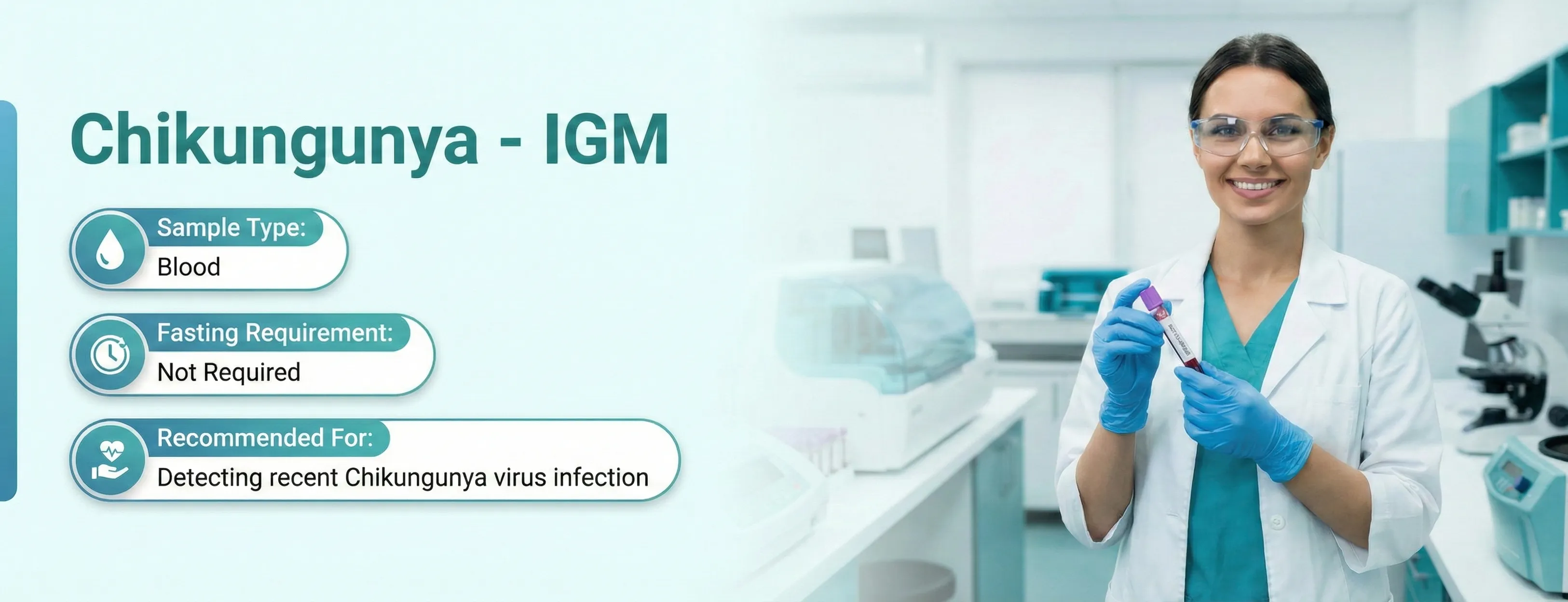
A quick info on Chikungunya - IGM

Overview
The chikungunya test is a blood test that detects IgM antibodies produced by the immune system in response to the chikungunya virus, a mosquito-borne infection that causes a sudden high fever and severe joint pain. The virus is spread mainly by Aedes mosquitoes and belongs to the alphavirus group. The name chikungunya describes the stooped posture that may result from the severe joint pain (arthralgia) associated with the infection.
After the bite of an infected mosquito, symptoms usually appear within 2 to 7 days. The test looks for IgM antibodies, which indicate a recent or ongoing infection. Antibodies to the virus generally appear towards the end of the first week of illness. Because of this, a test done too early can miss the infection; testing after about day 5 of symptom onset gives more accurate results.
Chikungunya is a significant public health concern in India, with many states and union territories considered endemic or experiencing recurring transmission. Most people recover within about a week, although joint pain may persist for months in some. The symptoms overlap with dengue, which is spread by the same Aedes mosquitoes, so testing helps tell them apart. Complications are uncommon but may include inflammation affecting the heart, liver, brain, kidneys, skin, and nerves, with the elderly and newborns at higher risk of severe disease.

When and Who Should Get a Chikungunya-IGM Test Done?
Your doctor may recommend a chikungunya test (IgM) if you have symptoms of the infection, particularly after mosquito exposure or travel to an area where the virus is circulating.
Common Symptoms That May Prompt the Test
- Sudden high fever (up to 104°F/40°C) with flu-like symptoms.
- Severe joint pain and stiffness, often accompanied by muscle and bone pain.
- Severe headache, fatigue, and a sense of being unwell.
- A maculopapular rash (flat red areas with small raised bumps) and, sometimes, mouth ulcers.
- Conjunctivitis (red eyes), nausea, and vomiting.
Testing is advised for people who develop fever with joint pain and have a recent history of mosquito bites, who live in an area where chikungunya is prevalent, or who develop these symptoms after travelling to such an area where an outbreak has been reported. The test is suitable for people of all ages and genders when advised by a doctor.
.png?dim=48x48&q=75)
How Frequently Should You Take the Chikungunya-IGM Test?
Chikungunya is an acute illness, so the test is not done routinely. However, your doctor may repeat it in certain situations:
- If the first test was negative but symptoms persist or worsen, a repeat test on a fresh sample after 5 to 10 days may help detect IgM antibodies that were not yet detectable during the initial test.
- If a previous result is suspected to be a false-negative or false-positive result, your doctor may advise repeating the test or performing additional confirmatory testing, depending on the timing of illness and clinical findings.
- Repeat testing may also be considered if symptoms persist and the initial test was performed very early in the course of illness.

What Conditions Can a Chikungunya-IGM Test Help Detect?
The test mainly helps detect IgM antibodies to the chikungunya virus, indicating a recent infection, and helps distinguish chikungunya from other illnesses with similar symptoms. It supports the diagnosis of:
- Chikungunya fever: the acute viral illness with fever and joint pain.
- Recent or ongoing infection: suggested by the presence of IgM antibodies.
- Differentiation from dengue: which causes similar symptoms and is spread by the same Aedes mosquitoes.
.png?dim=48x48&q=75)
Chikungunya-IGM Test Preparation
The chikungunya test is a simple blood test that needs no special preparation, though timing matters for accuracy.
What to Expect Before the Test?
- No fasting or special preparation is required.
- For accuracy, the test is best done after about day 5 of symptom onset, when IgM antibodies are more likely to be detectable.
- Tell your doctor about your symptoms, their start date, and any recent travel or mosquito exposure.
- Follow any specific instructions if the test is combined with others, such as a dengue test.
What to Expect During the Blood Collection?
A phlebotomist cleans the skin with an antiseptic, then places an elastic band around your upper arm to make the veins easier to access. A small needle is inserted into the vein; you may feel a brief pinch. Blood is collected into a labelled tube in under a minute.
What to Expect After the Test?
A small cotton swab and bandage are placed over the site to stop any minor bleeding. There may be slight soreness at the needle site or mild light-headedness. If you feel dizzy, sit and rest for a few minutes.

What are the Parameters Included in a Chikungunya-IGM Test?
The chikungunya IgM antibody test reports one parameter: IgM antibodies.
- Chikungunya IgM antibody: the early-response antibody indicating a recent or ongoing infection. IgM appears towards the end of the first week and may persist for 3 to 4 months.
The IgM result helps your doctor assess whether the infection is recent, past, or evolving. In the first few days of illness, a different test (viral RNA detection) may be used, as IgM antibodies may not yet be detectable.

Normal Range of Chikungunya-IGM Test Parameters
Results are reported as an index value and classified into bands. The table below shows the typical reference ranges for chikungunya IgM antibodies.
|
Component |
Index value |
Interpretation |
|---|---|---|
|
Chikungunya IgM |
0.79 or less |
Negative - No significant IgM antibody detected. |
|
Chikungunya IgM |
0.80 - 1.09 |
Borderline - Possible IgM antibody; borderline result. |
|
Chikungunya IgM |
1.10 or greater |
Positive - IgM antibody detected, suggestive of a recent chikungunya infection. |
Important note: Reference ranges and index cut-offs vary between laboratories and testing kits. Always refer to the values and interpretation printed on your own report and discuss them with your doctor.
.png?dim=48x48&q=75)
Chikungunya-IGM Test Result Interpretation
Results are reported broadly as chikungunya positive or negative, based on the IgM and IgG antibodies, and must be read together with your symptoms and exposure history.
|
Antibody pattern |
Possible interpretation |
|---|---|
|
IgM positive, IgG negative |
Recent infection. A repeat in 5 to 10 days may confirm IgG seroconversion. Clinical correlation is recommended. |
|
IgM positive, IgG positive |
Recent or past infection, possibly with developing immunity. IgM can persist for several months. |
|
IgM negative, IgG positive |
Past infection. |
|
IgM and IgG negative |
No evidence of infection. If symptoms continue, retest on a fresh sample after 5 to 10 days. |
|
IgM and/or IgG borderline |
Repeat the test in 10 to 14 days. |
Because the very early stage of illness may be antibody-negative, a negative result soon after symptoms start does not rule out chikungunya. Your doctor combines the result with your clinical picture and may use additional testing.
Disclaimer: This information is for educational purposes and provides a risk assessment only. It does not confirm a diagnosis. Always consult your doctor to interpret your chikungunya result correctly.

Chikungunya-IGM Test Risks and Limitations
The chikungunya test is a routine blood draw that is generally very safe, with minor procedural risks and some limitations.
Potential Risks and Complications
Most people feel only a brief pinch. Consult your doctor if you notice:
- Persistent bleeding at the puncture site that does not stop with gentle pressure.
- Redness, swelling, or pain at the needle insertion site.
- Light-headedness that continues after the blood draw; sit and rest before leaving.
Understanding Chikungunya Test Limitations
- Testing too early (before antibodies develop) can give a false-negative result.
- A normal or negative result does not completely rule out chikungunya if symptoms strongly suggest it.
- Symptoms overlap with dengue, so additional tests may be needed to tell them apart.
- Index cut-offs vary between labs and kits, so results may not be directly comparable.

Related and Follow-up Tests
Depending on your symptoms, your doctor may order additional tests alongside or after the chikungunya test.
|
Your situation |
Suggested follow-up test |
Why it is ordered |
|---|---|---|
|
Fever with joint pain |
Dengue test (NS1, IgM) |
Dengue causes similar symptoms and is spread by the same Aedes mosquitoes. |
|
Early illness (first few days) |
Chikungunya RNA (RT-PCR) test |
Detects the virus directly before IgM antibodies form. |
|
Monitoring during illness |
Complete blood count (CBC) |
Assesses blood cell counts and helps differentiate chikungunya from other infections, including dengue. |
|
Persistent high fever |
Malaria and typhoid (Widal) tests |
Rules out other common causes of fever. |
Chikungunya-IGM Test Sample Collection: Home vs. Diagnostic Lab
|
Feature |
Home collection (PharmEasy) |
Traditional diagnostic lab |
|---|---|---|
|
Convenience |
High - sample is taken from your home or office. |
Low - requires travelling and waiting in queues. |
|
Time saving |
Maximum - no travel time. You pick the time slot. |
Minimum - depends on traffic and lab rush. |
|
Safety and comfort |
Safe - avoids exposure to other sick patients. |
Moderate - exposure to crowded waiting areas. |
|
Process |
A professional phlebotomist visits you. |
You must visit the facility during its hours. |
|
Report access |
Digital - sent directly to your app or email. |
Often requires a second visit for physical copies. |
Pro tip: Book your chikungunya test on PharmEasy for safe, at-home sample collection and a secure digital report, which is particularly convenient when fever and joint pain make travelling to a lab difficult.
Was This Test Information Helpful?
Please rate your experience
 Yes Helpful
  Not Helpful
References
People Also Ask
Which test is done for chikungunya?
When should the chikungunya test be done?
What are the main symptoms of chikungunya?
Do platelets decrease in chikungunya?
Does fasting matter for this test?
Can a negative test still mean I have chikungunya?
 4.6 Stars| 7+ Lakhs Ratings & Reviews

Over 10 million happy users PharmEasy Labs
- Because the digital report is available on WhatsApp, there's no need to go back to the lab. Thanks, PharmEasy!
 Sachin sharma11 Jan ‘26
 - Thanks to the coupon discount, the blood test was done at a lower price.Komal04 Jan ‘26
- The lab technician was a good and knowledgeable professional.Rakesh Pandey06 Jan ‘26
- Due to bad weather, it's difficult to reach the lab. But home collection makes things easier.Arjun08 Jan ‘26
- Thanks to the Swasth AI feature, the report is easy to understand.Priya Mehta02 Jan ‘26
- The report is available on the same day. Wow!Vikas Patel05 Jan ‘26
Have any doubts? Ask us.
Ask us anything about the Chikungunya - IGM to understand it better

We provide trusted, expert-curated health content to support better awareness,prevention, and care.
Backed by experienced doctors, medical experts, and strict editorial standards.