


1+ orders placed in your location


100% NABL & ISO Certified Lab • 100% Accurate Reports
ASCA Test - IgA
Anti-Saccharomyces Cerevisiae Antibodies IgA Test, Saccharomyces cerevisiae Antibodies, Anti-Saccharomyces cerevisiae mannan antibodies
- SummaryThe ASCA IgA (Anti-Saccharomyces cerevisiae Antibody IgA) test detects IgA antibodies against the yeast Saccharomyces cerevisiae. It is primarily used to help diagnose Crohn’s disease and differentiate it from ulcerative colitis, both forms of inflammatory bowel disease (IBD). The test is done using a blood sample, and fasting is not required.Read more
- Reports Within36 HrsView Sample Report100% NABL & ISO Certified Labs
- SampleBlood
- AgeAll Age Group
- GenderMale and Female
- FastingNot Required



PharmEasy Promises




Know More About The Test




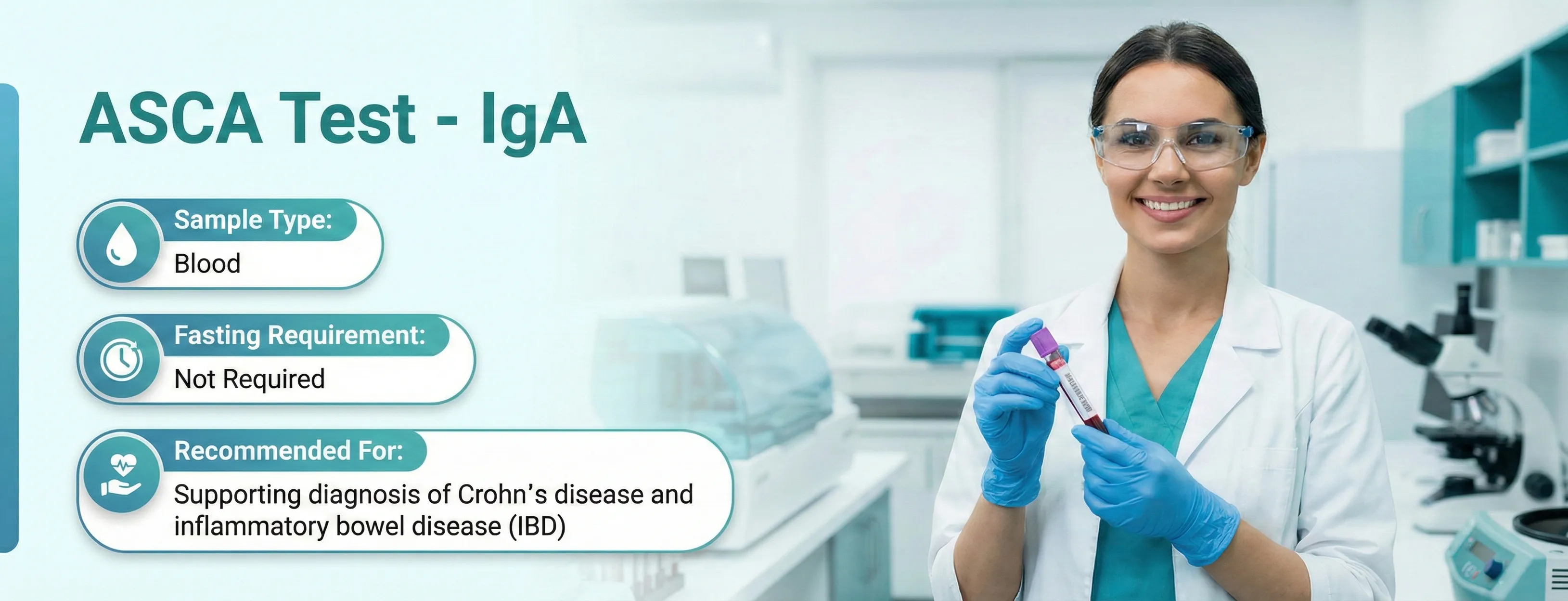
A quick info on ASCA Test - IgA


Overview
ASCA or Anti-Saccharomyces Cerevisiae Antibodies are immune proteins that are present in people who have inflammatory bowel disease. This test helps detect ASCA in the blood.
Saccharomyces Cerevisiae is a common yeast that can be found in food items. The relation between Saccharomyces Cerevisiae and the presence of antibodies and their involvement in bowel disease is not known completely.
IBD is a group of chronic disorders that exists because of certain autoimmune processes. The process is characterised by damaged and swollen tissues in the lining of the intestinal tract. The severity and symptoms of IBD differ from person to person. It can fluctuate over time.
Many of those affected experience flare-ups followed by periods of lessened symptoms or even remission.
There are two common types of IBD: Crohn disease, also known as CD and Ulcerative Colitis, known as UC. Crohn disease is known to affect any part of the intestinal tract, including the mouth till anus. However, it is primarily found in the small intestine or colon, while UC occurs in the colon only.
The proper diagnosis of UC and CD is based on endoscopic testing with the examination of biopsy samples from the intestines. CD and UC both can be found in the colon, and sometimes, it is difficult to distinguish between the two even after using biopsies. When this happens, ASCA IgA testing proves to be helpful as ASCA is frequently found in people with CD as compared to UC.
There are two types of Anti-Saccharomyces Cerevisiae Antibodies produced by the body. They are known as ASCA IgG and ASCA IgA. The testing includes both classes. ASCA IgA will predict the severity of the disease and the need for surgery as an option of treatment.
Symptoms that require ASCA IgA testing include abdominal pain and cramps, fever, fatigue, diarrhoea and even rectal bleeding. Some of the other symptoms include skin, bone, joint and organ-related symptoms. It can also lead to delayed development and growth retardation in children. The test helps with the diagnosis of inflammatory bowel disease.
The ASCA IgA test will be ordered by your health practitioner if he is attempting to distinguish between CD and UC infections in your body. ASCA IgA profile test is an ELISA-based, in-vitro test system for the quantitative analysis of ASCA IgA in the human serum or plasma. The test is completely automated. The antibodies are directed towards mannan in the cell membrane of Saccharomyces Cerevisiae.
If you have any of the symptoms, including abdominal pain, you should immediately rush to your doctor as it is important to diagnose inflammatory bowel diseases in time.
India is seeing a rise in inflammatory bowel diseases. In fact, it even tops the list of bowel diseases amongst Southeast Asian countries. The northern part of the country experiences Ulcerative Colitis, while the southern part of the country experiences Crohn disease. Paediatric IBD is more severe as compared to adult IBD. IBD is common amongst kids in India as well. The direct connection is still unknown, but most medical experts feel that the unhygienic living and cooking conditions lead to IBD in most cases.

Risk Assessment
Intermittent or persistent diarrhoea, abdominal pain due to IBD, Crohn disease, Ulcerative Colitis

What does this test detect?
The ASCA IgA test helps distinguish between Ulcerative Colitis and Crohn disease.
For people with such complaints, amongst other tests, the test is prescribed by the consulting physician. Following a diagnosis, the treatment for IBD is initiated by the consulting physician. This test is prescribed after 15-20 days to monitor and regulate the dosage.

Indications for ASCA-IgA Test
IBD disease is experienced by people who have the following:
- Fatigue
- Fever
- Abdominal pain and cramps
- Rectal bleeding
- Bone, joint, skin and organ-related symptoms
- Delayed development in growth retardation in children
The ASCA IgA profile test is applicable for males and females, both adults and children. You must discuss every symptom in detail with your doctor.
.png?dim=48x48&q=75)
How frequently should you take this test?
ASCA IgA test is included in the quarterly or yearly check-up. This is a test that you will have to take if your body shows any symptoms of IBD. Your doctor will usually assign this test if you show certain symptoms like abdominal pain or diarrhoea. Also, the doctor will ask you to only take this test if the biopsy fails to distinguish between UC and CD.
After that, you might have to take the ASCA IgA test once your medication starts to check if it is working effectively or not.
.png?dim=48x48&q=75)
Test Preparation
Before the Test
Your doctor will likely not request any special precautions before you take the ASCA IgA test. However, if you need to undergo this test along with another that requires fasting or preparation, you may be advised to fast for a specific time. Please contact your doctor for detailed information.
During the Test
During the ASCA IgA test, a blood sample from a vein in your arm will be drawn. Here are the consecutive steps:
- The potential puncture site will be cleansed using antiseptic solution.
- To make your veins stand out prominently, a tourniquet will be tied around your arm.
- A needle will be inserted into a vein to draw the blood. This can be accompanied by a brief pinch.
- The blood will be collected in a vial or small test tube, and a label with your details will be affixed to it.
After the Test
After the blood has been drawn:
- A bandage will be applied to stop the bleeding at the needle-insertion site.
- You may bruise at the puncture site. If you feel lightheaded (unusual side effect), rest for a few minutes till you feel better.
- If you experience persistent bleeding, pain, or if rashes erupt at the puncture site, contact your healthcare provider.

Parameters
The ASCA IgA test helps distinguish between Ulcerative Colitis and Crohn disease. The testing usually includes two different classes of ASCA in the blood, which includes IgA and IgG.
These are the only parameters that are covered in the test. These values give an idea about which kind of bowel disease you have. The results of the ASCA IgA test are often expressed as positive or negative. However, the results are often combined with the p-ANCA test. Based on that, the doctor can confirm the diagnosis.
This test cannot detect changes at the organ level or the changes in the body due to the presence of yeast in the body.

Ranges
The results of the ASCA profile test are expressed as positive or negative. However, a positive result does not diagnose CD, UC or even an IBD for that matter. The results of the ASCA IgA test are often interpreted in conjugation with the results of p ANCA testing.
The normal values and reference ranges of the test may vary from lab to lab. Please refer to the ranges mentioned in the report and consult a doctor to understand the interpretation of lab reports.
.png?dim=48x48&q=75)
Test Result Interpretation
Several tests need to be done together to diagnose the proper disease. However, the results of the ASCA IgA test are often described as positive or negative.
But, when combined with the pANCA test, the values should be:
- If the ASCA IgA test results are positive and pANCA is negative, then the person may have CD disease.
- If the ASCA IgA test results are negative and pANCA is positive, then the person may have UC disease.
A negative result of ASCA and pANCA does not rule out the possibility of IBD. A person with negative results can still have IBD, CD OR UC. The presence of multiple antibodies also indicates a likelihood of aggressive disease. Also, the negative results do not rule out the possibility of the same.
However, you should consult an expert doctor, and he will be able to analyse the problem properly based on your results of the ASCA IgA profile test.

Risks and Limitations
The ASCA IgA test, a commonly performed blood test, carries very few risks of complications. Consult your physician if you experience:
- Persistent bleeding at the puncture site
- Redness, swelling, or pain at the needle insertion site.
Limitations of the test
- Potential inaccuracies due to equipment malfunction or human error
- Misinterpretation of markers which may lead to an inaccurate reading and report.
Was This Test Information Helpful?
Please rate your experience


References
People Also Ask
What is ASCA IgA Elisa?
What do positive ASCA IgG and/or IgA results mean?
What does it mean if Saccharomyces Cerevisiae IgG is high?
Which antibody is positive in Crohn disease?


Over 10 million happy users PharmEasy Labs
- Because the digital report is available on WhatsApp, there's no need to go back to the lab. Thanks, PharmEasy!Sachin sharma11 Jan ‘26
- Thanks to the coupon discount, the blood test was done at a lower price.Komal04 Jan ‘26
- The lab technician was a good and knowledgeable professional.Rakesh Pandey06 Jan ‘26
- Due to bad weather, it's difficult to reach the lab. But home collection makes things easier.Arjun08 Jan ‘26
- Thanks to the Swasth AI feature, the report is easy to understand.Priya Mehta02 Jan ‘26
- The report is available on the same day. Wow!Vikas Patel05 Jan ‘26


Have any doubts? Ask us.
Ask us anything about the ASCA Test - IgA to understand it better
Explore More at PharmEasy
Top-Selling Healthcare Products


We provide trusted, expert-curated health content to support better awareness,prevention, and care.
Backed by experienced doctors, medical experts, and strict editorial standards.