

4487+ orders placed in your location

100% NABL & ISO Certified Lab • 100% Accurate Reports
C-Reactive Protein (CRP) Test - Quantitative
C-Reactive Protein, CRP Test
- SummaryThe C-Reactive Protein (CRP) Quantitative Test measures CRP levels in the blood to assess inflammation linked to infections, autoimmune conditions, or chronic health issues. It uses a blood sample and does not require fasting. There are no gender or age restrictions for this test. It helps monitor disease severity and the effectiveness of ongoing treatment.Read more
- Reports Within7 HrsView Sample Report

 100% NABL & ISO Certified Labs
 - SampleBlood

- AgeAll Age Group
- GenderMale and Female
- FastingNot Required

PharmEasy Promises



Know More About The Test


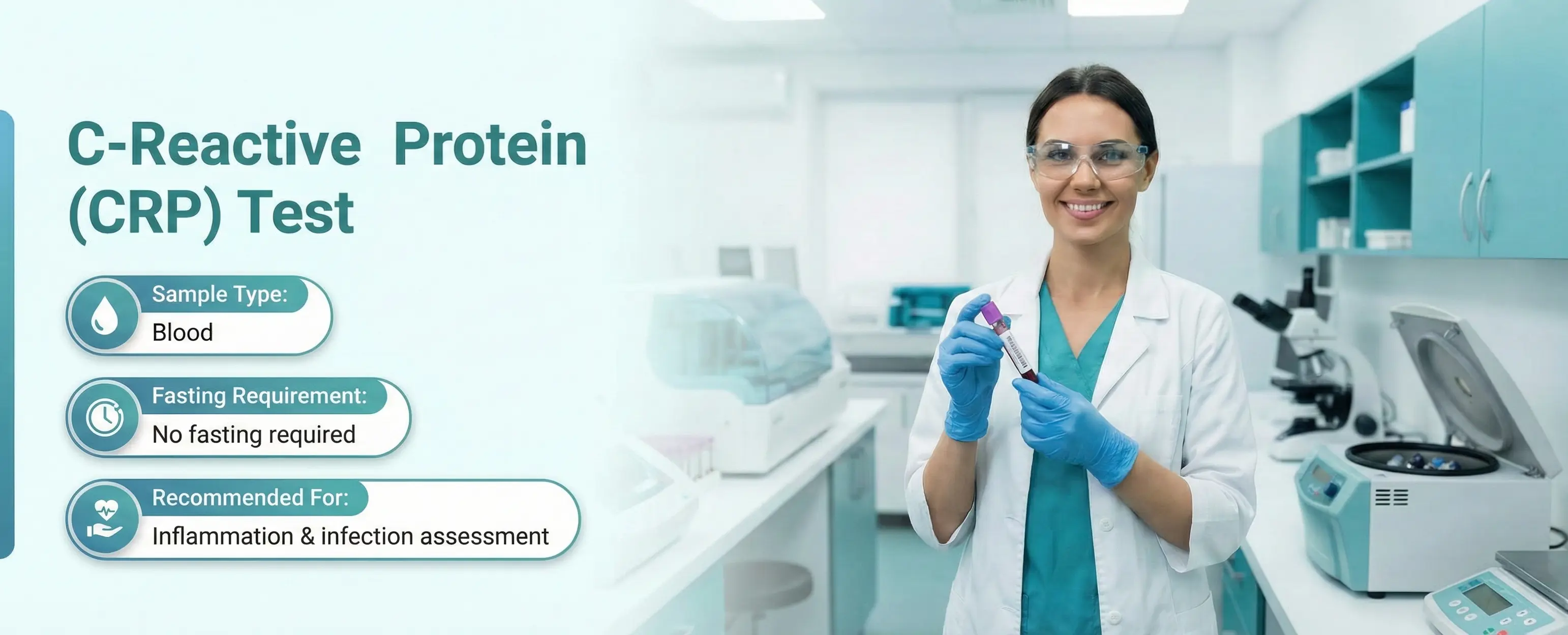
A quick info on CRP test

Overview
The C-Reactive Protein (CRP) Quantitative test is a widely used blood test that measures the exact level of CRP in your blood. CRP is a protein produced by the liver in direct response to inflammation, tissue injury, or infection anywhere in the body. Unlike a standard qualitative CRP test that only tells you whether the protein is present or absent, the quantitative version gives a precise numerical value.
Doctors order a CRP test when infection, injury, fever, or chronic disease is suspected. Because CRP levels can rise within 6 to 12 hours of an inflammatory trigger and fall just as quickly once treatment begins, it is one of the fastest and most reliable real-time monitoring tools available.
The CRP test monitors the liver's inflammatory response and is used to assess infection severity, track chronic inflammatory diseases, and evaluate cardiovascular risk. Results always require professional interpretation alongside your symptoms and clinical history.

When and Who Should Get a CRP Test Done?
A CRP Quantitative test is performed to assess whether inflammation is present in your body and to understand its severity. This helps doctors investigate active symptoms, monitor ongoing conditions, and guide treatment decisions.
This test is usually recommended for:
- Anyone with unexplained high-grade or persistent fever.
- Individuals with sudden joint pain, swelling, stiffness, or muscle soreness.
- Patients with chest pain or symptoms suggestive of a cardiac event (hs-CRP is recommended).
- Patients with a known autoimmune condition like rheumatoid arthritis or lupus - for monitoring disease activity.
- Patients with chronic inflammatory diseases such as Crohn's disease or ulcerative colitis.
- Post-surgical patients - to ensure healing is progressing without infection.
- High-risk individuals who are being assessed for cardiovascular disease risk.
.png?dim=48x48&q=75)
How Frequently Should You Take the CRP Test?
The frequency of a CRP Quantitative test depends entirely on your health condition and your doctor's guidance. Because CRP levels respond very quickly to changes in the body, the timing for repeating the test varies widely.
|
Health Scenario |
Context |
Recommended Frequency |
|---|---|---|
|
Routine Health Check |
Healthy individuals assessing general inflammation or cardiovascular risk. |
Usually, once a year as part of a preventive check-up. |
|
Active Infection Monitoring |
Acute bacterial/ viral infections |
Every 2 to 3 days, to confirm if the condition is improving |
|
Post-Surgical Monitoring |
To check for signs of post-operative infection or complications. |
Every 1 to 2 days in the first week after surgery. |
|
Chronic Inflammatory Disease |
Managing conditions like rheumatoid arthritis, IBD, or lupus. |
Every 1 to 3 months, based on the treatment plan and disease stability. |
|
Cardiovascular Risk Assessment |
High-risk individuals being monitored for heart disease. |
Every 6 to 12 months, or as advised by the cardiologist. |

What Conditions Can a CRP Test Help Detect?
The CRP Quantitative test is a powerful screening and monitoring tool, but it does not confirm any specific disease on its own. Think of it as your body's internal alarm system: when something disrupts your normal balance, CRP levels rise, alerting your doctor that further investigation is needed. Elevated CRP may provide early warnings for:
- Active bacterial or viral infections - CRP rises sharply and quickly, often within hours of infection.
- Chronic inflammatory diseases - such as rheumatoid arthritis and lupus, where persistent inflammation is a hallmark.
- Cardiovascular disease - elevated CRP is linked to increased risk of heart attack and stroke.
- Inflammatory bowel diseases - such as Crohn's disease and ulcerative colitis.
- Post-surgical complications or internal tissue injury - CRP confirms whether healing is on track.
- Sepsis - a life-threatening response to severe infection, where CRP levels are critically elevated.
- Cancers associated with chronic inflammation - such as lymphoma, lung cancer, and colon cancer.
Important Note: Always share your results with a doctor for a proper diagnosis. The CRP test does not confirm any of the above conditions on its own.
.png?dim=48x48&q=75)
CRP Test Preparation
What to Expect Before the CRP Test
No fasting is required for a standalone CRP test. You can eat and drink normally. However, if it is part of a broader package that includes fasting tests, your doctor may advise fasting for 8-12 hours. Avoid strenuous exercise for 24 hours before the test, as intense physical activity can temporarily raise CRP levels and affect interpretation. Always inform your doctor about any ongoing medications.
What to Expect During the Blood Collection
A phlebotomist cleans the skin with an antiseptic, then places an elastic band around your upper arm to make the veins easier to access. A small needle is inserted into the vein; you may feel a brief pinch. Blood is collected into a labelled tube in under a minute.
What to Expect After the CRP Test
A small cotton swab and bandage are placed over the site to stop any minor bleeding. You can return to normal activities immediately. Minor bruising is normal and disappears quickly. If dizzy, sit and rest for a few minutes.

What are the Parameters Included in a CRP Test?
The CRP Quantitative test primarily measures a single key marker in your blood:
- C-Reactive Protein (CRP) level - The precise numerical concentration of CRP in your blood, measured in mg/dL (milligrams per deciliter). This is the main result your doctor will interpret.
CRP levels indicate the presence of infection, injury, or inflammation. When the body is healthy, values stay within normal limits. During active infection or trauma, CRP rises and falls once treatment begins.
The standard CRP test detects moderate to severe inflammation, while the hs-CRP (high-sensitivity) test identifies subtle, low-grade inflammation linked to cardiovascular risk. Your doctor will specify which version is appropriate.

Normal Range of CRP Test Parameters
The results of the CRP Quantitative test act as a starting point for your doctor to evaluate your health.
|
CRP Level |
Result Category |
Indication |
|---|---|---|
|
Below 5 mg/dL |
Normal |
Indicates no significant inflammation in the body. |
|
Above 5 mg/dL |
Elevated |
Indicates the presence of inflammation, which may be associated with infection, injury, or other underlying health conditions. Further clinical evaluation may be required depending on the CRP level and symptoms. |
Important Note: The normal values and reference ranges may vary slightly from lab to lab. Please refer to the ranges mentioned in your specific report and consult your doctor to understand what these numbers mean for your health
.png?dim=48x48&q=75)
CRP Test Result Interpretation
When your CRP level is elevated, it acts as a red flag for your doctor to investigate specific health conditions.
The table below provides a broad overview of the potential conditions associated with different levels of CRP elevation.
|
CRP Level |
Potential Interpretation (May be associated with) |
|---|---|
|
Highly Elevated |
Active bacterial infection (pneumonia, urinary tract infection, septic arthritis), major surgery or trauma, severe burns, Crohn's disease or ulcerative colitis flare, rheumatoid arthritis or other autoimmune flare-up, heart attack or acute cardiovascular event, sepsis or systemic infection. |
|
Moderate Elevation |
Systemic inflammatory conditions, rheumatoid arthritis, systemic lupus erythematosus, autoimmune diseases, malignancies (cancer), myocardial infarction (heart attack), pancreatitis, or bronchitis. |
|
Mildly Elevated |
Viral infection, minor bacterial infection, obesity-related chronic low-grade inflammation, early or well-controlled autoimmune disease, type 2 diabetes with metabolic inflammation, or moderate cardiovascular risk (when measured by hs-CRP). |
|
Normal / Low |
No active infection or significant inflammation detected. A normal CRP result does not rule out all diseases, but suggests the absence of major inflammatory activity at the time of testing. |
Disclaimer: This table is for educational purposes and provides a risk assessment only. These findings do not confirm a diagnosis. Many factors, like age, gender, medications, obesity, and exercise habits, can affect CRP levels. Always consult your doctor to understand how these results relate to your symptoms and overall health.

CRP Test Risks and Limitations
Potential Risks and Complications
The CRP test is a very safe, routine blood draw. Complications are extremely rare, and most people only feel a quick pinch. Consult a doctor if:
- The puncture site does not stop bleeding after applying gentle pressure
- You notice unusual redness, warmth, or lasting pain at the needle site
- You feel persistently lightheaded after the blood draw; sit and rest for a few minutes before leaving.
Understanding CRP Test Limitations
CRP is a nonspecific marker that tells your doctor that inflammation is present, but does not pinpoint the exact cause. This test cannot diagnose a specific disease on its own and must be interpreted alongside your symptoms and other test results. CRP levels can also be raised by factors unrelated to disease, including recent intense exercise, smoking, obesity, pregnancy, and medications such as oral contraceptives, aspirin, or corticosteroids.

Related and Follow-up Tests
If your CRP test results show elevated levels, your doctor may suggest follow-up tests to find the exact source and cause of the inflammation.
|
CRP Finding |
Suggested Follow-up Test |
Why It Is Ordered |
|---|---|---|
|
High CRP (any level) |
Checks if infection or anaemia is contributing to inflammation and assesses overall blood health. |
|
|
Elevated CRP + Chronic Inflammation |
Another inflammation marker that works more slowly than CRP but helps confirm and track chronic inflammation. |
|
|
Very High CRP + Bacterial Infection |
Procalcitonin Test and Blood Culture |
Specific marker for bacterial infection, used alongside CRP to distinguish bacterial from viral infections. |
|
Elevated CRP + Joint Pain or Stiffness |
Ordered if rheumatoid arthritis or another autoimmune condition is suspected. |
|
|
Very High CRP + Sepsis |
Blood Culture |
Identifies the specific organism causing the infection. |
|
Elevated CRP + Heart Disease Risk |
For cardiovascular risk assessment alongside cholesterol and triglyceride levels. |
Note: These follow-up tests help turn a warning signal from your CRP into a clear and actionable diagnosis. Always consult your doctor to decide which additional tests are right for you.

CRP Sample Collection: Home vs. Diagnostic Lab
|
Feature |
Home Collection (PharmEasy) |
Traditional Diagnostic Lab |
|---|---|---|
|
Convenience |
High - sample taken from your home or office. |
Low - requires travelling and waiting in queues. |
|
Time Saving |
Maximum - no travel time. You pick the time slot. |
Minimum - depends on traffic and lab rush. |
|
Safety & Comfort |
Safe - avoids exposure to other sick patients. |
Moderate - exposure to crowded waiting areas. |
|
Process |
A professional phlebotomist visits you. |
You must visit the facility during its hours. |
|
Report Access |
Digital - sent directly to your app or email. |
Often requires a second visit for physical copies. |
Pro Tip: For the most stress-free experience, book a CRP test on PharmEasy. Enjoy professional service and accurate results without stepping out of your house.

CRP Test Price/Cost
The cost of a C-reactive protein (CRP) test is typically around INR 529. The final price may vary depending on factors such as location and the diagnostic laboratory chosen. For a clearer understanding, you may also review and compare CRP test prices across major cities in India.
|
City |
Offer Price |
|---|---|
|
529 |
|
|
529 |
|
|
529 |
|
|
529 |
|
|
529 |
|
|
529 |
|
|
529 |
|
|
529 |
|
|
529 |
|
|
529 |
Was This Test Information Helpful?
Please rate your experience
 Yes Helpful (12)
 Not Helpful
References
People Also Ask
What is the difference between a CRP test and an hs-CRP test?
My CRP is high, but I feel fine. What does this mean?
How quickly does CRP rise after an infection begins?
Can a CRP test tell the difference between a bacterial and a viral infection?
Do I need to fast before a CRP test?
Is a high CRP level dangerous?
Can lifestyle factors affect my CRP levels?
 4.6 Stars| 7+ Lakhs Ratings & Reviews

Over 10 million happy users PharmEasy Labs
- Because the digital report is available on WhatsApp, there's no need to go back to the lab. Thanks, PharmEasy!
 Sachin sharma11 Jan ‘26
 - Thanks to the coupon discount, the blood test was done at a lower price.Komal04 Jan ‘26
- The lab technician was a good and knowledgeable professional.Rakesh Pandey06 Jan ‘26
- Due to bad weather, it's difficult to reach the lab. But home collection makes things easier.Arjun08 Jan ‘26
- Thanks to the Swasth AI feature, the report is easy to understand.Priya Mehta02 Jan ‘26
- The report is available on the same day. Wow!Vikas Patel05 Jan ‘26
Have any doubts? Ask us.
Ask us anything about the C-Reactive Protein (CRP) Test - Quantitative to understand it better

View top questions
( Total 1 Questions asked)What sample is required for a CRP test and is fasting needed?
The CRP test requires a blood sample, and fasting is usually not required unless specifically advised by your doctor.Harsh Raj23 Mar ‘26

We provide trusted, expert-curated health content to support better awareness,prevention, and care.
Backed by experienced doctors, medical experts, and strict editorial standards.