

24+ orders placed in your location

100% NABL & ISO Certified Lab • 100% Accurate Reports
Anti phospholipid Test - IgM
Antiphospholipid antibodies test, Antiphospholipid antibody panel, APL IgM antibodies, APS antibodies, Antiphospholipid IgM test, APLA IgM test
- SummaryThe Anti-Phospholipid IgM Test detects IgM antibodies against phospholipids, which are associated with autoimmune conditions like antiphospholipid syndrome. It is commonly used to investigate unexplained blood clots, recurrent miscarriages, or autoimmune symptoms. This test requires a blood sample, does not require fasting, and is suitable for all age groups and genders, based on a doctor’s recommendation.Read more
- Reports Within22 HrsView Sample Report

 100% NABL & ISO Certified Labs
 - SampleBlood

- AgeAll Age Group
- GenderMale and Female
- FastingNot Required

PharmEasy Promises



Know More About The Test


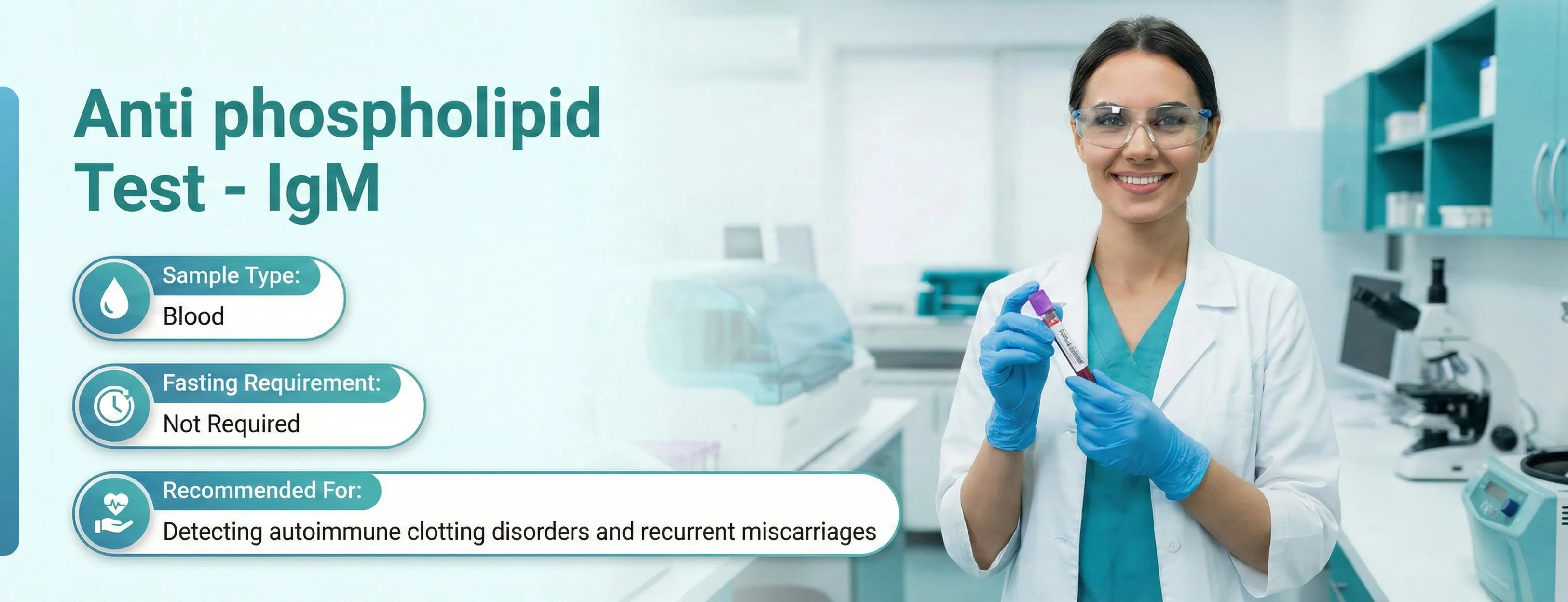
A quick info on Anti phospholipid Test - IgM

Overview
The anti-phospholipid IgM test is a blood test that detects IgM-class antibodies directed against phospholipids, the fat molecules that form part of every cell membrane in the body. Phospholipids help control the movement of substances in and out of cells and play an important role in normal blood clotting. In some people, the immune system mistakenly makes antibodies against their own phospholipids, which can disrupt clotting and other cell functions.
These antiphospholipid antibodies are the hallmark of antiphospholipid syndrome (APS), an autoimmune disorder, also called Hughes syndrome, in which the blood has an increased tendency to clot. The three antibodies most associated with APS are anticardiolipin antibodies, anti-beta-2 glycoprotein I antibodies, and lupus anticoagulant. Each can occur in different classes, of which IgM is one. This test specifically measures the IgM subclass.
By interfering with normal blood flow, antiphospholipid antibodies can promote clots in the veins and arteries. These clots can travel to the lungs, heart, kidneys, or brain, leading to serious problems such as deep vein thrombosis, pulmonary embolism, stroke, heart attack, kidney damage, and pregnancy complications including recurrent miscarriage. APS can occur on its own or alongside other autoimmune conditions such as systemic lupus erythematosus (SLE), and is also linked to certain infections and medications.

When and Who Should Get a Anti phospholipid-IgM Test Done?
Your doctor may recommend this test when there are signs of abnormal clotting, when he/she suspects an autoimmune disorder, or unexplained pregnancy loss or complications. It is often ordered as part of an antiphospholipid antibody panel.
Symptoms and Situations That May Prompt the Test
- Unexplained or repeated blood clots in the veins or arteries (such as deep vein thrombosis).
- Pain, swelling, or discolouration in the legs, or breathing difficulty and chest pain (possible clot in the lungs).
- Recurrent miscarriage - especially in the second and third trimesters - stillbirth, premature labour, or failed IVF.
- Persistent headaches or migraines, or a stroke or heart attack at a younger-than-expected age.
- A low platelet count (thrombocytopenia) or an unexplained prolonged clotting time.
- A known or suspected autoimmune disease such as lupus (SLE).
The test is suitable for both males and females of all ages, though APS (Antiphospholipid syndrome) is more common in women and in older adults. People at higher risk - including smokers, those on prolonged bed rest, pregnant or postpartum women, people on hormone therapy or birth control pills, and those with cancer or kidney disease - may be advised to be tested when clinical signs are present.
.png?dim=48x48&q=75)
How Frequently Should You Take the Anti phospholipid-IgM Test?
How often the test is repeated depends on your result. Because antiphospholipid antibodies must be persistent to be clinically meaningful, a positive result is always confirmed with a repeat test.
|
Health scenario |
Recommended frequency |
|---|---|
|
First positive result |
Repeat after at least 12 weeks to confirm the antibodies are persistent (required to diagnose APS). |
|
Confirmed APS |
Periodically, as advised by your doctor, to monitor antibody levels and treatment. |
|
Negative result with ongoing symptoms |
As advised by your doctor, who may also test other antiphospholipid antibodies. |

What Conditions Can a Anti phospholipid-IgM Test Help Detect?
Raised antiphospholipid IgM antibodies are linked to a range of clotting-related and autoimmune conditions:
|
Condition |
What it involves |
|---|---|
|
Antiphospholipid syndrome (APS) |
The autoimmune clotting disorder this test is primarily used to investigate. |
|
Venous and arterial thrombosis |
Blood clots in the veins (e.g. deep vein thrombosis) and arteries, including pulmonary embolism. |
|
Stroke and heart attack |
Clots affect the brain or heart, sometimes at a young age. |
|
Pregnancy complications |
Recurrent miscarriage, stillbirth, premature labour, and pre-eclampsia. |
|
Associated conditions |
Systemic lupus erythematosus (SLE), thrombocytopenia, and links to infections such as syphilis and HIV. |
.png?dim=48x48&q=75)
Anti phospholipid-IgM Test Preparation
This test needs very little preparation, which makes it simple and convenient.
What to Expect Before the Test
- No fasting is usually required for the anti-phospholipid IgM test.
- If it is combined with other tests, your doctor may advise fasting or specific instructions. Follow those.
- Tell your doctor about all medicines you take, including blood thinners and any of the medicines such as procainamide, penicillin, or phenytoin, which can affect results.
- Always speak with your doctor before the test for personalised guidance.
What to Expect During the Blood Collection
A phlebotomist cleans the skin with an antiseptic, then places an elastic band around your upper arm to make the veins easier to access. A small needle is inserted into the vein; you may feel a brief pinch. Blood is collected into a labelled tube in under a minute.
What to Expect After the Test
A small cotton swab and bandage are placed over the site to stop any minor bleeding. There may be slight soreness at the needle site or mild light-headedness. If you feel dizzy, sit and rest for a few minutes.

What are the Parameters Included in a Anti phospholipid-IgM Test?
This test measures a single parameter: the level of IgM-class antiphospholipid (anticardiolipin) antibodies in your blood, usually reported in IgM phospholipid units.
- Antiphospholipid IgM Antibodies: IgM-class autoantibodies against phospholipids such as cardiolipin. A raised level indicates an autoimmune process that can increase the tendency for the blood to clot.
To diagnose antiphospholipid syndrome, doctors usually combine this with the other antibody classes, anti-beta-2 glycoprotein I, and the lupus anticoagulant test, together forming the antiphospholipid antibody panel.

Normal Range of Anti phospholipid-IgM Test Parameters
The result is reported in IgM units and grouped into categories. The table below shows the typical bands; exact cut-offs depend on the laboratory and method.
|
Result category |
Typical IgM level (units) |
What it means |
|---|---|---|
|
Negative |
Less than 10 AU/mL |
Antiphospholipid IgM antibodies not detected or not clinically significant at the time of testing. |
|
Positive |
More than 10 AU/mL |
Antiphospholipid IgM antibodies detected; may be associated with APS. |
.png?dim=48x48&q=75)
Anti phospholipid-IgM Test Result Interpretation
The result must always be interpreted alongside your symptoms, history, and the other antiphospholipid tests. The IgM class tends to reflect more recent or active antibody activity. The general patterns are:
|
Result |
Possible interpretation |
|---|---|
|
Negative |
Antiphospholipid IgM antibodies not detected. APS is less likely, though your doctor may still check other antibody classes. |
|
Positive |
Suggests an antiphospholipid antibody is present, raising the possibility of APS. Confirmed on a repeat test at least 12 weeks apart. |
A positive antiphospholipid antibody is a risk factor, not a guarantee of clots. It guides your doctor's risk assessment and management, which may include blood thinners in confirmed APS, rather than providing a stand-alone diagnosis.

Anti phospholipid-IgM Test Risks and Limitations
The test is a routine blood draw that is generally very safe, with minor procedural risks and some important limitations.
Potential Risks and Complications
Most people feel only a brief pinch. Consult your doctor if you notice:
- Persistent bleeding at the puncture site that does not stop with gentle pressure.
- Redness, swelling, or pain at the needle insertion site.
- Light-headedness that continues after the blood draw - sit and rest before leaving.
Understanding Anti-Phospholipid IgM Test Limitations
- A positive result can be transient (for example after an infection), so it must be confirmed after at least 12 weeks.
- Antibodies are a risk marker; they cannot predict the timing or severity of blood clots.
- Certain medicines, including procainamide, penicillin, and phenytoin, can interfere with the result.
- APS is diagnosed based on both the clinical context and persistent antiphospholipid antibody positivity, not on the basis of a single laboratory test.

Related and Follow-up Tests
Because this test is part of a wider work-up, your doctor may order additional tests to confirm a diagnosis or assess clotting risk.
|
Your finding |
Suggested follow-up test |
Why it is ordered |
|---|---|---|
|
Positive IgM |
Check the other antibody class; both contribute to APS diagnosis. |
|
|
Suspected APS |
Anti-beta-2 glycoprotein I |
A core antiphospholipid antibody that supports the diagnosis. |
|
Suspected APS |
Lupus anticoagulant test |
Another key test in the antiphospholipid panel. |
|
Symptoms related to bleeding and clotting |
Assesses platelet count and time taken for the blood to clot. |
|
|
Symptoms of autoimmune disorder |
ANA/SLE work-up |
Looks for lupus, which often coexists with these antibodies. |

Anti phospholipid-IgM Test Sample Collection: Home vs. Diagnostic Lab
|
Feature |
Home collection (PharmEasy) |
Traditional diagnostic lab |
|---|---|---|
|
Convenience |
High: sample is taken from your home or office. |
Low: requires travelling and waiting in queues. |
|
Time saving |
Maximum: no travel time. You pick the time slot. |
Minimum: depends on traffic and lab rush. |
|
Safety and comfort |
Safe: avoids exposure to other sick patients. |
Moderate: exposure to crowded waiting areas. |
|
Process |
A professional phlebotomist visits you. |
You must visit the facility during its hours. |
|
Report access |
Digital: sent directly to your app or email. |
Often requires a second visit for physical copies. |
Pro Tip: Book your anti-phospholipid IgM test on PharmEasy for safe, at-home sample collection and a secure digital report - convenient when ordered as part of a larger antiphospholipid panel.
Was This Test Information Helpful?
Please rate your experience
 Yes Helpful
  Not Helpful
References
People Also Ask
What is the anti-phospholipid IgM test used for?
Do I need to fast before the test?
What does a positive result mean?
Why is the test repeated after 12 weeks?
What is the difference between the IgM and IgG antiphospholipid tests?
Can medicines affect the result?
 4.6 Stars| 7+ Lakhs Ratings & Reviews

Over 10 million happy users PharmEasy Labs
- Because the digital report is available on WhatsApp, there's no need to go back to the lab. Thanks, PharmEasy!
 Sachin sharma11 Jan ‘26
 - Thanks to the coupon discount, the blood test was done at a lower price.Komal04 Jan ‘26
- The lab technician was a good and knowledgeable professional.Rakesh Pandey06 Jan ‘26
- Due to bad weather, it's difficult to reach the lab. But home collection makes things easier.Arjun08 Jan ‘26
- Thanks to the Swasth AI feature, the report is easy to understand.Priya Mehta02 Jan ‘26
- The report is available on the same day. Wow!Vikas Patel05 Jan ‘26
Have any doubts? Ask us.
Ask us anything about the Anti phospholipid Test - IgM to understand it better

We provide trusted, expert-curated health content to support better awareness,prevention, and care.
Backed by experienced doctors, medical experts, and strict editorial standards.