

801+ orders placed in your location

100% NABL & ISO Certified Lab • 100% Accurate Reports
Venereal Disease Research Laboratory (VDRL) Test In Surat - Price & Details
Venereal disease research laboratory test, Syphilis- VDRL
- SummaryThe Venereal Disease Research Laboratory (VDRL) Test screens for syphilis, a sexually transmitted infection, by detecting specific antibodies in the blood. It's a useful tool for early diagnosis, especially in individuals with high-risk sexual behavior. A simple blood sample is used for the test, and no fasting is required. There are no age or gender restrictions for taking this test.Read more
- Reports Within36 HrsView Sample Report

 100% NABL & ISO Certified Labs
 - SampleBlood

- AgeAll Age Group
- GenderMale and Female
- FastingNot Required

PharmEasy Promises



Know More About The Test


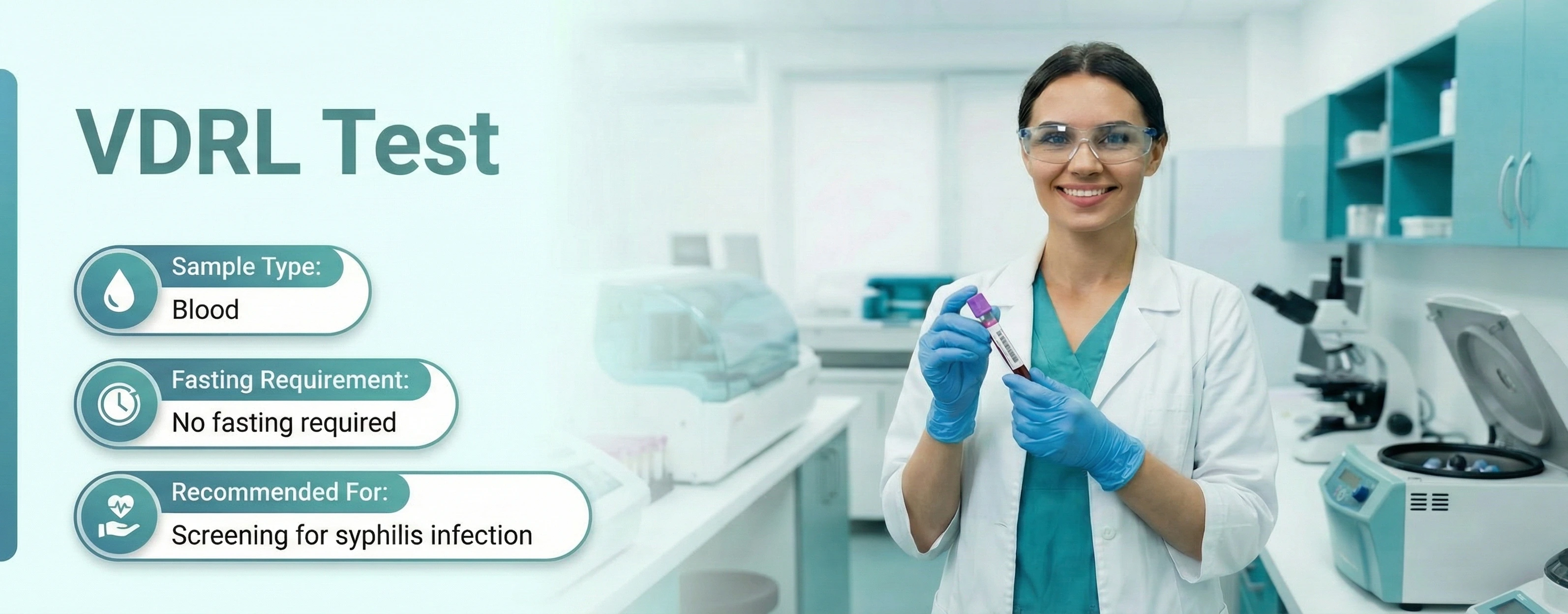
A quick info on VDRL test

Overview
The venereal disease research laboratory (VDRL) test is a blood test used to screen for syphilis, a sexually transmitted infection (STI) caused by the bacterium treponema pallidum. In recent years, syphilis has re-emerged as an important public health concern, with increasing cases reported worldwide. This rise has been linked to changing sexual behaviours, inconsistent condom use, reduced awareness, delayed diagnosis, and missed opportunities for screening and treatment.
The VDRL test detects antibodies produced by the body in response to a syphilis infection rather than detecting the bacteria itself. It is commonly recommended for people with symptoms of syphilis, those who may have been exposed to the infection, and individuals at increased risk of STIs. The test is also a routine part of antenatal care because untreated syphilis during pregnancy can pass to the baby, increasing the risk of miscarriage, stillbirth, premature birth, or congenital syphilis. Early diagnosis and treatment can prevent most of these complications. As the VDRL is a screening test, a reactive result should be confirmed with a more specific test, such as TPHA or FTA-ABS. The test requires only a blood sample and usually does not require fasting or any special preparation.

When and Who Should Get a VDRL Test Done?
Your doctor may recommend a VDRL test if you:
- Exhibit symptoms of syphilis, such as a painless sore, a rash on the palms or soles, or swollen lymph nodes.
- Have had intimacy with someone who has syphilis or think you may have been exposed to the infection.
- Are at increased risk of sexually transmitted infections (STIs), including having multiple sexual partners, a new sexual partner, or having unprotected sex.
- Are pregnant, as syphilis screening is routinely recommended during pregnancy to help protect both the mother and the baby.
- Have another STI, such as HIV or gonorrhoea, as these can occur together.
- Are taking pre-exposure prophylaxis (PrEP), as regular syphilis screening is recommended
- Are living in an area with a high incidence of syphilis and you are sexually active.
- Have undergone treatment for syphilis and need to be monitored for your response to treatment and to ensure antibody levels are decreasing.
- Have to undergo syphilis screening as part of a medical evaluation, such as before blood donation, certain surgical procedures, employment in certain sectors, employment overseas, before marriage, or when advised by your doctor.
Early testing and treatment can prevent serious complications and reduce the spread of syphilis.
.png?dim=32x32&q=75?dim=32x32&q=75?dim=32x32&q=75?dim=32x32&q=75?dim=32x32&q=75?dim=32x32&q=75?dim=48x48&q=75)
How Frequently Should You Take the VDRL Test?
Testing frequency depends largely on individual risk factors and clinical circumstances:
|
Category |
Testing frequency |
|---|---|
|
Low-risk individuals |
Just once for marriage or pre-employment checks, unless new risk factors occur later. |
|
During pregnancy |
Once at the first antenatal visit. Retest at 28 weeks and at delivery if risk factors are high. |
|
Following syphilis treatment |
At 3, 6, and 12 months post-treatment to track declining antibody titres and confirm resolution. |
|
Higher-risk groups |
Annually or more often for those with multiple sexual partners, sex workers, HIV-positive individuals, or partners of a syphilis-positive individual. |
|
Blood donors |
Every donation cycle, as a routine safety measure. |

What Conditions Can an VDRL Test Help Detect?
- Syphilis (primary use): The VDRL test primarily screens for antibodies linked to syphilis, an infection caused by the bacterium treponema pallidum. It can indicate infection across different stages, including primary, secondary, and latent syphilis. VDRL can be reactive in tertiary syphilis, but it is less sensitive at this stage.
- Congenital syphilis: In newborns, the test can help detect infection passed from mother to child during pregnancy, particularly when maternal screening was reactive.
- Yaws and other treponemal conditions: Since the test detects non-specific antibodies rather than the syphilis bacterium itself, it may also react to related treponemal infections such as yaws or pinta, which are caused by similar bacteria.
Important note: A positive VDRL result must always be confirmed with a treponemal test before a diagnosis of syphilis is made. Always share your results with a medical professional.
.png?dim=32x32&q=75?dim=32x32&q=75?dim=32x32&q=75?dim=32x32&q=75?dim=32x32&q=75?dim=32x32&q=75?dim=32x32&q=75?dim=32x32&q=75?dim=32x32&q=75?dim=32x32&q=75?dim=32x32&q=75?dim=32x32&q=75?dim=32x32&q=75?dim=48x48&q=75)
VDRL Test Preparation
What to Expect Before the VDRL Test
- There are no specific diet restrictions before the VDRL test.
- Pregnancy, autoimmune diseases (such as lupus), HIV, hepatitis, tuberculosis, malaria, older age, recent vaccinations, penicillin use, and injection drug use can sometimes affect VDRL test results (according to the CDC syphilis treatment guidelines). Therefore, let your doctor know about any recent sickness, immunisation, pregnancy status, or current medications (especially antibiotics).
- Wear loose-fitting or short-sleeved clothing so the blood sample can be collected easily from your arm.
- Inform the phlebotomist if you have a bleeding disorder or are taking blood-thinning medicines before the blood sample is collected.
What to Expect During the Blood Collection
- The phlebotomist will clean the inside of your elbow with an antiseptic and place a tourniquet around your upper arm to make the vein easier to find. You may be asked to make a gentle fist, but avoid repeatedly pumping your hand, and keep your arm still.
- A sterile needle will be inserted into the vein to collect the blood sample. You may feel a brief pinprick or mild stinging sensation.
- Once enough blood has been collected, the needle will be removed. Gentle pressure will be applied to the site, followed by a small bandage to help stop the bleeding.
What to Expect After the VDRL Test
- After the blood sample is collected, you can return to your usual daily activities immediately. There are no dietary or activity restrictions after the test.
- You may notice mild pain, tenderness, or a small bruise at the blood draw site. These symptoms are common and usually settle on their own within a day or two.
- Your VDRL test report is generally available within 24 hours. If the result is reactive, your doctor may advise a confirmatory test, such as TPHA or FTA-ABS, before confirming the diagnosis and recommending treatment.
Note: If you notice anything unusual at the puncture site, such as persistent bleeding, a rash, or pain, consult your healthcare provider.

What Are the Parameters Included in the VDRL Test?
- VDRL antibody screening: detects antibodies, which are protective proteins produced by your immune system in response to infection. Since antibodies associated with syphilis can remain in the body for an extended period, the test may help indicate a current or previous infection.

VDRL Test Result Interpretation
The primary marker evaluated is the presence of reactive antibodies in your blood sample.
|
Parameter |
Status |
Interpretation |
|---|---|---|
|
VDRL screening marker |
Non-reactive |
No matching antibodies found. A current syphilis infection is unlikely. |
|
Reactive |
Antibodies detected. A confirmatory test may be required to verify the diagnosis. |
Important note: A reactive VDRL result does not prove syphilis; it must always be followed up with a confirmatory treponemal test. Always consult your doctor for interpretation.

VDRL Test Risks and Limitations
Potential Risks and Complications
- The VDRL blood test is safe. Most side effects are mild, temporary, and resolve on their own without any specific treatment.
- You may experience mild pain, tenderness, or slight bruising at the blood draw site. Applying gentle pressure immediately after the test and avoiding heavy lifting with that arm for a few hours may help reduce bruising.
- Some people may feel dizzy or faint during or shortly after the blood sample is collected. If this happens, rest for a few minutes until it passes.
- A small risk of infection exists whenever the skin is punctured. Keeping the bandage on for a few hours and the area clean can help lower this risk.
- Rarely, people taking blood-thinning medicines or those with bleeding disorders may have prolonged bleeding or develop a haematoma (a collection of blood under the skin). Applying firm pressure to the site for a few minutes usually helps control bleeding.
Understanding VDRL Test Limitations
- The VDRL test detects antibodies produced by your body in reaction to the syphilis bacterium rather than the bacterium itself. Therefore, other tests are needed for confirmatory diagnosis.
- False positives: can occur in pregnancy, lupus, HIV, hepatitis, tuberculosis, or malaria.
- False negatives: can occur early in infection, before antibodies build up; in late-stage syphilis, as antibody levels naturally decline; and in very high antibody concentrations (prozone effect).
- Can give reactive results for related infections such as yaws or pinta also.
- Lab-to-lab differences in reference ranges may also affect result interpretation.


VDRL Test Price in Surat

Areas We Serve in Surat
You can book the VDRL Test in Surat through PharmEasy with convenient home sample collection across several localities, including :
- Adajan
- Vesu
- Pal
- Rander
- Dumas
- City Light
- Piplod
- Althan
- Amroli
- Limbayat
- Punagam
- Godadara
- Nanpura
- Sachin
- Varachha
- Katargam
- Sarthana
- Udhna
- Pandesara
- Utran
You can also check service availability during purchase by entering your pincode.

VDRL Test Sample Collection: Home vs. Diagnostic Lab
|
Feature |
Home collection (PharmEasy) |
Traditional diagnostic lab |
|---|---|---|
|
Convenience |
High - sample taken from your home or office, privately and discreetly. |
Low - requires traveling and waiting in queues. |
|
Privacy |
Maximum - sample collected at home with full discretion. |
Less private - you may meet people you know at a clinic. |
|
Safety and comfort |
Safe - helps avoid exposure to other patients. |
Moderate - avoids exposure to crowded waiting areas. |
|
Process |
A trained phlebotomist visits you with sterile, sealed equipment. |
You must visit the facility during its working hours. |
|
Report access |
Digital - reports are sent directly to your app or email. |
Often requires a second visit for physical copies. |
For a sensitive test like the VDRL, home collection offers complete privacy and discretion. Book on PharmEasy - no fasting required, certified sample collection at your doorstep, and a digital report delivered directly to you.
Was This Test Information Helpful?
Please rate your experience
 Yes Helpful (8)
 Not Helpful
References
People Also Ask
Can VDRL testing be done during menstruation?
Is VDRL testing covered under health insurance in India?
Can alcohol consumption affect VDRL results?
How is the VDRL test different from RPR?
Can I book the VDRL test online in Surat?
Is home sample collection available for the VDRL test at PharmEasy Labs in Surat?
How long does it take to receive VDRL test results in Surat?
 4.6 Stars| 7+ Lakhs Ratings & Reviews

Over 10 million happy users PharmEasy Labs
- Because the digital report is available on WhatsApp, there's no need to go back to the lab. Thanks, PharmEasy!
 Sachin sharma11 Jan ‘26
 - Thanks to the coupon discount, the blood test was done at a lower price.Komal04 Jan ‘26
- The lab technician was a good and knowledgeable professional.Rakesh Pandey06 Jan ‘26
- Due to bad weather, it's difficult to reach the lab. But home collection makes things easier.Arjun08 Jan ‘26
- Thanks to the Swasth AI feature, the report is easy to understand.Priya Mehta02 Jan ‘26
- The report is available on the same day. Wow!Vikas Patel05 Jan ‘26
Have any doubts? Ask us.
Ask us anything about the Venereal Disease Research Laboratory (VDRL) Test In Surat - Price & Details to understand it better
Nearby Labs
Lab tests made easy!
- Quick Collection
- Trusted Accuracy
- Hassle-free Services
PharmEasy Labs (Thyrocare powered) - Surat
Kailash Heights, C.T.S No.636, Wing ‘A’, Gujarat
 grievance-officer@docon.in
 7022000900
Universal Pathology Laboratory - Surat
CITY CENTRE, Mai Mandir Rd, opp. MAI MANDIR, Napad,, Gujarat
grievance-officer@docon.in7022000900
Health Buddy Diagnostic Pvt Ltd - Surat
H No 7, 5/H, Dabouli, Near Bharat Chauraha, Kanpur Up-208022, Gujarat
grievance-officer@docon.in7022000900HealthRoute - Surat
5-Ground Floor, Gyandev Complex, Laxmi Market, Gujarat
grievance-officer@docon.in7022000900
We provide trusted, expert-curated health content to support better awareness,prevention, and care.
Backed by experienced doctors, medical experts, and strict editorial standards.