


81+ orders placed in your location


100% NABL & ISO Certified Lab • 100% Accurate Reports
Copper (Cu) Test
Cu test, Copper test, Copper plasma test, Copper serum test, Urine Copper, Blood Coppe,r Free Copper, Hepatic Copper
- SummaryThe Copper test measures the level of copper in the blood, which is essential for iron metabolism, nerve function, and enzyme activity. It helps diagnose Wilson’s disease, copper deficiency, or toxicity. The test is done using a blood sample (sometimes urine), and fasting for 8–12 hours is often recommended for accuracy.Read more
- Reports Within36 HrsView Sample Report100% NABL & ISO Certified Labs
- SampleBlood
- AgeAll Age Group
- GenderMale and Female
- FastingNot Required



PharmEasy Promises




Know More About The Test




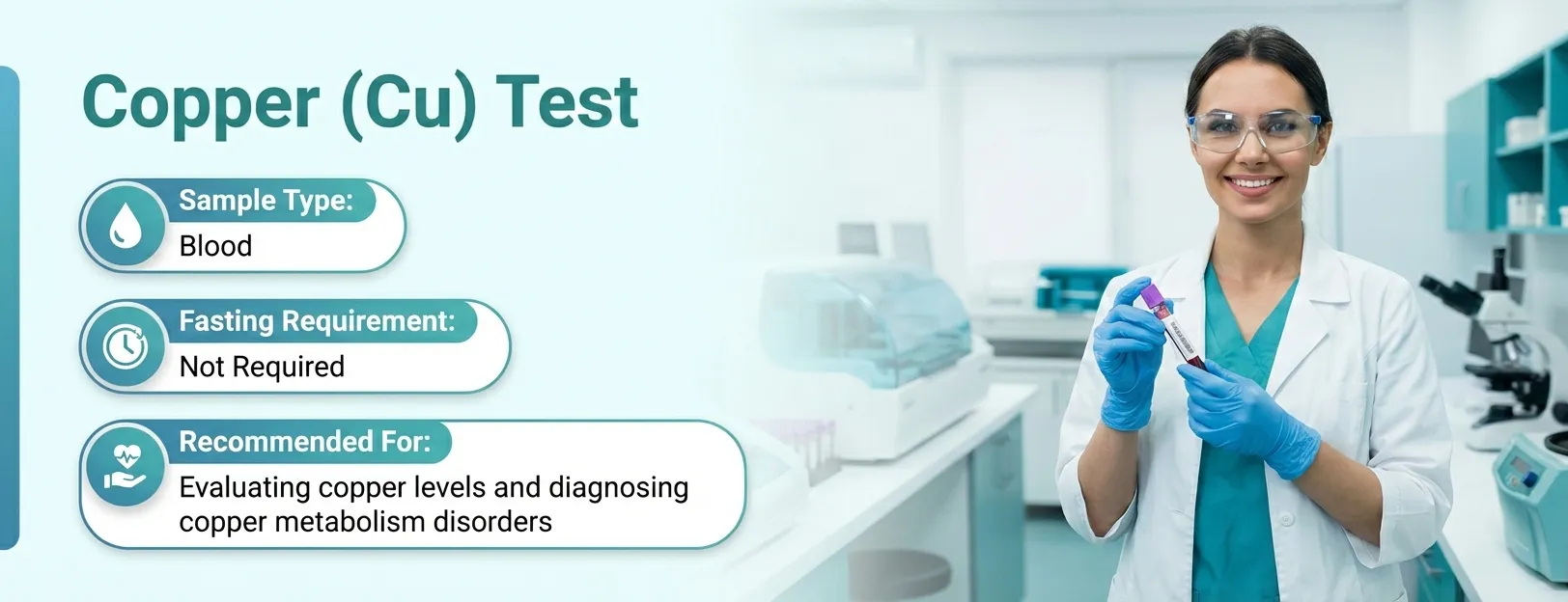
A quick info on Copper (Cu) Test


Overview
The copper (Cu) test is a blood test that measures the amount of copper in your body. Copper is an essential trace mineral: although the body needs only small amounts, it plays a vital role in iron metabolism, energy production inside cells, the formation of connective tissue, the production of the skin pigment melanin, and the healthy functioning of the nervous system. Because copper works as part of many enzymes, both too much and too little can disturb these processes.
An average adult body stores about 50 to 120 mg of copper. Around 95% of the copper in the blood is bound to a protein called ceruloplasmin, with the remaining 5% bound to other proteins such as albumin.
The liver is the centre of copper balance. It stores some copper, binds some to protein, and removes any excess into bile, which leaves the body in stool and urine. When this balance is disturbed, copper levels rise or fall, and a copper test helps reveal the problem.
Doctors most often order a copper test to help diagnose Wilson's disease, a rare inherited disorder that causes copper to build up in the liver, brain, eyes, and other organs, and to assess copper deficiency or copper toxicity. Copper deficiency is also a notable concern in India, where studies suggest that a significant share of certain groups, including some pregnant women and tribal populations, may be affected.

When and Who Should Get a Copper (Cu) Test Done?
Your doctor may recommend a copper test when symptoms suggest either an excess or a deficiency of copper, or when Wilson's disease is suspected.
- Anaemia, nausea, vomiting, and diarrhoea.
- Abdominal pain and jaundice (yellowing of the skin and eyes).
- Fatigue and behavioural changes such as anxiety or irritability.
- Tremors, difficulty walking, or dystonia (involuntary muscle contractions and twisting movements).
- Problems with swallowing or speaking.
- Kayser-Fleischer rings: brown-coloured rings around the cornea of the eyes, a classic sign of Wilson's disease.
- Unusually low neutrophils (a type of white blood cell).
- Anaemia and weakened, brittle bones (osteoporosis).
- Delayed or slow growth in children.
- Abnormal neurological symptoms.
This is not an exhaustive list. Your doctor may also consider other symptoms linked to a copper imbalance. The copper test is usually ordered along with other tests to investigate the underlying cause.
.png?dim=48x48&q=75)
How Frequently Should You Take the Copper (Cu) Test?
If a copper result is abnormally high, your doctor may arrange a repeat test to confirm it. Once copper deficiency or excess is confirmed, further tests are usually ordered to find the cause and to guide treatment.
During treatment, the copper test may be repeated periodically to monitor your response and to help adjust the dose of medication. Your doctor will decide the right schedule based on your diagnosis and progress.

What Conditions Can a Copper (Cu) Test Help Detect?
By measuring copper in the blood, the test helps your doctor assess possible copper deficiency or excess. Urine copper and liver-tissue copper are measured through separate investigations when clinically required:
|
Condition |
What it involves |
|---|---|
|
Wilson's disease |
A rare inherited disorder causing copper to accumulate in the liver, brain, and eyes. The main reason this test is ordered. |
|
Copper deficiency |
Too little copper, which can affect blood cells, bones, growth, and the nervous system. |
|
Copper toxicity (excess) |
Too much copper, which can damage the liver and other organs and, if untreated, can be life-threatening. |
|
Menkes syndrome |
A rare inherited disorder of copper transport, mainly affecting infants. |
|
Liver conditions |
Chronic liver disease or acute hepatitis can reduce copper excretion and alter levels. |
.png?dim=48x48&q=75)
Copper (Cu) Test Preparation
Preparation for a copper test is usually simple, but follow your doctor's specific instructions, especially if it is combined with other tests.
What to Expect Before the Test
- You can usually eat your normal meals before a blood or urine copper test. Some labs may advise a short fast (around 8 to 12 hours). Follow the instructions you are given.
- If the copper test is done with other tests, there may be specific dietary restrictions, so confirm with your doctor.
- Tell your doctor about all medicines and supplements you take, including any containing copper, zinc, or oral contraceptives, as these can affect levels.
- For the most accurate result, always consult your healthcare provider before the procedure.
What to Expect During the Blood Collection
A phlebotomist cleans the skin with an antiseptic, then places an elastic band around your upper arm to make the veins easier to access. A small needle is inserted into the vein; you may feel a brief pinch. Blood is collected into a labelled tube in under a minute.
What to Expect After the Test
A small cotton swab and bandage are placed over the site to stop any minor bleeding. You can eat and drink immediately after the test. If fasting was required, you may have a light meal after the blood sample is collected. There may be slight soreness at the needle site or mild light-headedness. If you feel dizzy, sit and rest for a few minutes.

What are the Parameters Included in a Copper (Cu) Test?
The copper (Cu) test measures a single parameter: the total amount of copper present in the blood. Urine copper and liver-tissue copper require separate investigations. The result is reported as a numerical value, usually in micrograms per decilitre (mcg/dL).
Total copper (Cu) - the overall copper level in your sample. It is interpreted together with ceruloplasmin, the protein that carries most of the copper in the blood, to work out whether a high or low level reflects Wilson's disease, deficiency, or toxicity.
A low ceruloplasmin can mean the body cannot use or remove excess copper, while a high ceruloplasmin may be seen in serious infection, heart disease, rheumatoid arthritis, certain cancers, pregnancy, or with the use of birth control pills.

Normal Range of Copper (Cu) Test Parameters
The table below shows the standard reference ranges for blood copper by age group. Note that levels rise naturally in pregnancy and with the use of oral contraceptives.
|
Group |
Normal range (µg/dL) |
|---|---|
|
Male |
63.5 - 150 µg/dL |
|
Female |
80 - 155 µg/dL |
Important Note: Reference ranges may vary slightly between laboratories. Always refer to the range printed on your own report and consult your doctor for interpretation.
.png?dim=48x48&q=75)
Copper (Cu) Test Result Interpretation
Copper results are most meaningful when read together with ceruloplasmin and, where available, urine and liver copper. The general patterns are:
|
Pattern |
What it may indicate |
|---|---|
|
Low blood copper + high urine copper + low ceruloplasmin + high liver copper |
Suggestive of Wilson's disease (further testing is required; the serum copper test alone cannot confirm the diagnosis). |
|
High blood and urine copper + normal or high ceruloplasmin |
May indicate copper toxicity, or conditions that reduce copper excretion such as cholestatic liver disease, oestrogen exposure, pregnancy, inflammation, etc. |
|
Low blood and urine copper + high ceruloplasmin |
May indicate copper deficiency. |
|
Rising ceruloplasmin and copper during deficiency treatment |
Generally a normal, expected response to treatment. |
Disclaimer: This information is for educational purposes and provides a risk assessment only. It does not confirm a diagnosis. Always consult your doctor to understand how your copper result relates to your overall health.

Copper (Cu) Test Risks and Limitations
The copper test is a routine blood and urine test with minimal risk of complications.
Potential Risks and Complications
Most people feel only a brief pinch. Consult your doctor if you notice:
- Continuous bleeding from the site where blood was drawn.
- Inflammation, swelling, or discomfort at the needle site.
Understanding Copper Test Limitations
- Errors can occur due to faulty equipment or mistakes during sample collection or processing.
- Indicators can be misread, which may lead to an incorrect diagnosis or report if taken in isolation.
- Copper levels are affected by pregnancy, oral contraceptives, and certain conditions, so context matters.
- A single copper value rarely gives the full answer; it is interpreted with ceruloplasmin and other tests.

Related and Follow-up Tests
If your copper result is abnormal, your doctor may recommend additional tests to identify the cause.
|
Your finding |
Suggested follow-up test |
Why it is ordered |
|---|---|---|
|
Abnormal serum copper |
The protein that carries most blood copper; essential for interpreting copper results. |
|
|
Suspected Wilson's disease |
24-hour urine copper |
Helps confirm excess copper excretion seen in Wilson's disease. |
|
Suspected Wilson's disease |
Liver function tests/liver biopsy |
Assesses liver involvement and copper deposition. |
|
Copper imbalance |
Checks for anaemia and low neutrophils linked to copper imbalance. |
|
|
Deficiency suspected |
High zinc intake can cause copper deficiency, so the two are often checked together. |

Copper (Cu) Test Sample Collection: Home vs. Diagnostic Lab
|
Feature |
Home collection (PharmEasy) |
Traditional diagnostic lab |
|---|---|---|
|
Convenience |
High: sample is taken from your home or office. |
Low: requires travelling and waiting in queues. |
|
Time saving |
Maximum: no travel time. You pick the time slot. |
Minimum: depends on traffic and lab rush. |
|
Safety and comfort |
Safe: avoids exposure to other sick patients. |
Moderate: exposure to crowded waiting areas. |
|
Process |
A professional phlebotomist visits you. |
You must visit the facility during its hours. |
|
Report access |
Digital: sent directly to your app or email. |
Often requires a second visit for physical copies. |
Pro Tip: Book your copper test on PharmEasy for safe, at-home sample collection and a secure digital report. If a 24-hour urine sample is needed, the team will guide you on how to collect it correctly.
Was This Test Information Helpful?
Please rate your experience


References
Health packages containing 'Copper (Cu) Test'

People Also Ask
What is the copper test used for?
What is the normal level of copper?
Do I need to fast before the test?
What are the symptoms of copper deficiency?
What happens if there is too much copper in the body?
Is a urine sample needed?


Over 10 million happy users PharmEasy Labs
- Because the digital report is available on WhatsApp, there's no need to go back to the lab. Thanks, PharmEasy!Sachin sharma11 Jan ‘26
- Thanks to the coupon discount, the blood test was done at a lower price.Komal04 Jan ‘26
- The lab technician was a good and knowledgeable professional.Rakesh Pandey06 Jan ‘26
- Due to bad weather, it's difficult to reach the lab. But home collection makes things easier.Arjun08 Jan ‘26
- Thanks to the Swasth AI feature, the report is easy to understand.Priya Mehta02 Jan ‘26
- The report is available on the same day. Wow!Vikas Patel05 Jan ‘26


Have any doubts? Ask us.
Ask us anything about the Copper (Cu) Test to understand it better
Explore More at PharmEasy
Top-Selling Healthcare Products


We provide trusted, expert-curated health content to support better awareness,prevention, and care.
Backed by experienced doctors, medical experts, and strict editorial standards.