

271+ orders placed in your location

100% NABL & ISO Certified Lab • 100% Accurate Reports
Carcinoembryonic Antigen (CEA) Test
Embryonic Carcinoma Antigen, Carcinoembryonic Antigen Blood Test, Immunoenzymatic Assay, Carcinoembryonic Ag, CEA, Carcinoembryonic Antigen
- SummaryThe CEA test measures the level of carcinoembryonic antigen, a protein that may be elevated in certain cancers such as colorectal, lung, breast, or pancreatic cancer. It is mainly used to monitor cancer treatment or help detect recurrence, not for initial diagnosis. The test is performed using a blood sample, and fasting is not required, though your doctor may advise avoiding smoking before the test.Read more
- Reports Within14 HrsView Sample Report

 100% NABL & ISO Certified Labs
 - SampleBlood

- AgeAll Age Group
- GenderMale and Female
- FastingNot Required

PharmEasy Promises



Know More About The Test


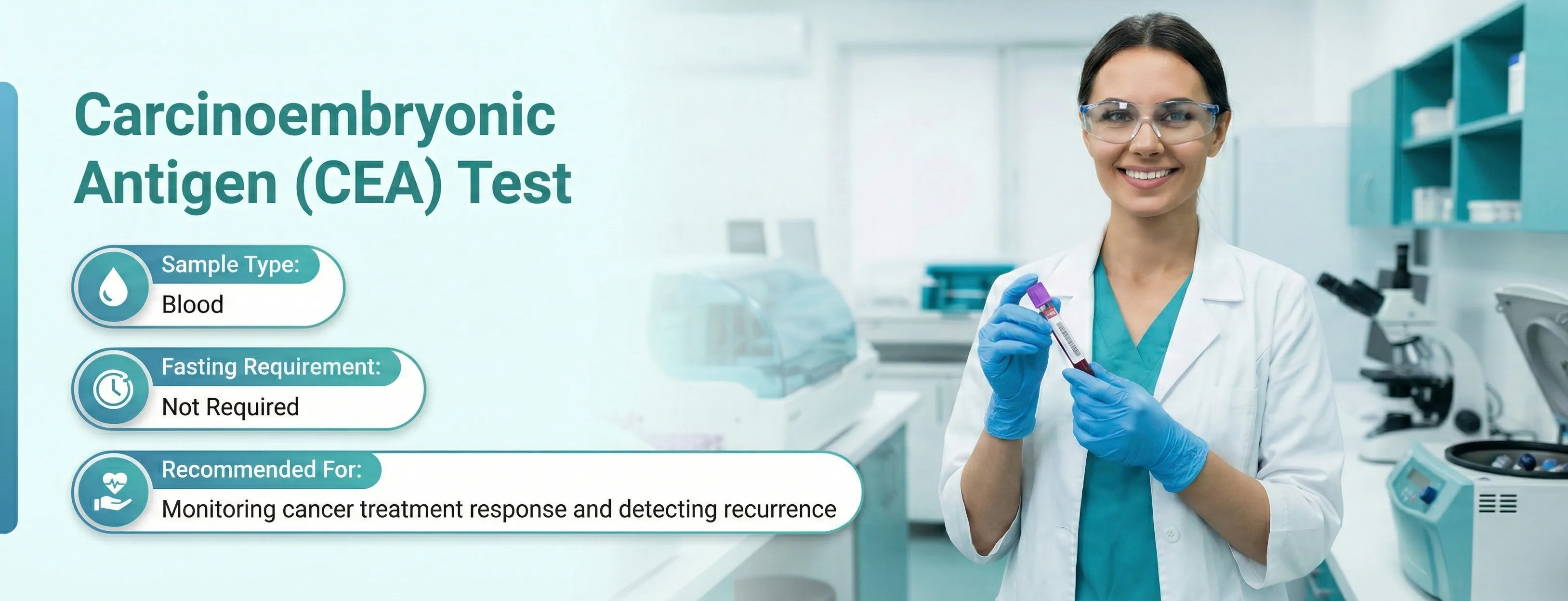
A quick info on Carcinoembryonic Antigen (CEA) Test

Overview
The carcinoembryonic antigen (CEA) test is used to measure the amount of carcinoembryonic antigen in a sample of blood. The test is also known as the CEA assay, CEA blood test, or carcinoembryonic antigen test.
CEA is a tumour marker, which is a substance produced by cancerous or normal cells in response to cancer. Although unborn babies generally have high levels of CEA, the levels are very low or even undetectable in healthy adults. CEA testing is mainly used to monitor different types of cancers, such as colorectal, prostate, ovarian, lung, thyroid, liver, pancreatic, and breast cancer. Thus, this test is used by doctors to check how the disease is progressing and to monitor the treatment.
When and Who Should Get a Carcinoembryonic Antigen (CEA) Test Done?
The CEA test is advised with other specific tests if you have the following symptoms of different cancers:
- A change in bowel habits (such as diarrhoea or constipation) or blood in the stool (colorectal cancer).
- Problems urinating or pain in your lower back, hips, and pelvis (prostate cancer).
- Swelling and pain in the abdomen or pelvis (ovarian cancer).
- Chest pain, bad cough, or trouble breathing (lung cancer).
- Lump in the neck (thyroid cancer).
- Lump near the breast or visible changes in the breast (breast cancer).
The test is also highly recommended for individuals who have already been diagnosed with cancers that usually increase CEA levels, including colorectal cancer, prostate cancer, breast cancer, ovarian cancer, lung cancer, and thyroid cancer.
.png?dim=48x48&q=75)
How Frequently Should You Take the Carcinoembryonic Antigen (CEA) Test?
|
Health scenario |
Context |
Recommended frequency |
|---|---|---|
|
Routine testing |
To monitor CEA levels regularly. |
It is not generally recommended as a routine test. |
|
Individuals with cancer (associated with high CEA levels) |
To see how well the treatment is working and what the chances of recovery are. |
Usually done before treatment, during treatment, and after treatment. The exact timing depends on the type of cancer and the doctor’s recommendation. |
|
Symptomatic individuals |
To check CEA levels and gather more information. |
The test is not a diagnostic test and is used when you have already been diagnosed with cancer. |
|
After cancer treatment |
To check whether the cancer has returned. |
Follow-up testing may be done as recommended by the doctor. |

What Conditions Can a Carcinoembryonic Antigen (CEA) Test Help Detect?
The CEA test is used to monitor and find out whether the treatment is working for the following conditions:
- Colorectal cancer – A cancer that develops in the colon and rectum (part of the digestive system).
- Prostate cancer – This cancer affects the prostate gland (part of the male reproductive system).
- Ovarian cancer –A cancer of the tissues in the ovaries (female reproductive gland).
- Lung cancer – This cancer develops in the lung tissues.
- Thyroid cancer – This is a type of cancer that develops in the thyroid gland.
- Liver cancer – This cancer either starts in the liver or spreads there from another part of the body.
- Pancreatic cancer – A cancer of the pancreatic gland (behind the stomach).
- Breast cancer – A cancer that develops in the breast tissue.
The test can also be used to monitor other conditions in which increased CEA levels are seen. This includes inflammation, cirrhosis (liver disease), and a peptic ulcer (sore in the stomach).
.png?dim=48x48&q=75)
Carcinoembryonic Antigen (CEA) Test Preparation
What to Expect Before the Carcinoembryonic Antigen (CEA) Test
No fasting is required for a standalone Carcinoembryonic Antigen (CEA) test. You can eat and drink normally. However, if it is part of a broader package that includes fasting tests, your doctor may advise fasting for 8-12 hours. Avoid strenuous exercise for 24 hours before the test, as intense physical activity can temporarily raise Carcinoembryonic Antigen (CEA) levels and affect interpretation. Always inform your doctor about any ongoing medications.
What to Expect During the Blood Collection
A phlebotomist cleans the skin with an antiseptic, then places an elastic band around your upper arm to make the veins easier to access. A small needle is inserted into the vein; you may feel a brief pinch. Blood is collected into a labelled tube in under a minute.
What to Expect After the Carcinoembryonic Antigen (CEA) Test
A small cotton swab and bandage are placed over the site to stop any minor bleeding. You can return to normal activities immediately. Minor bruising is normal and disappears quickly. If dizzy, sit and rest for a few minutes.

What are the Parameters Included in a Carcinoembryonic Antigen (CEA) Test?
In the CEA test, the primary parameter being measured is:
- The level of carcinoembryonic antigen in a sample of blood.

Normal Range of Carcinoembryonic Antigen (CEA) Test Parameters
The normal range of the CEA test is indicated in the table below.
|
Test parameter |
Normal range |
|
|---|---|---|
|
Carcinoembryonic antigen |
Non-smokers |
Smokers |
|
<2.50 ng/mL |
<5.00 ng/mL |
|
.png?dim=48x48&q=75)
Carcinoembryonic Antigen (CEA) Test Result Interpretation
The table below provides a general interpretation of the CEA test results based on whether the levels are low or high.
|
Carcinoembryonic antigen |
What it may indicate |
|---|---|
|
Low |
May indicate little or no cancer but does not rule out spread to other parts of the body. |
|
High |
May indicate a large tumour, cancer spread, or certain other conditions. |
Note:
- Some cancers do not produce enough CEA. In such cases, the doctor may need to order additional tests.
- Generally, a decrease in CEA levels over time shows that the treatment is working. If CEA levels rise, it may indicate that the treatment is not working. If the levels drop after treatment but then rise again, it means that the cancer has come back.

Carcinoembryonic Antigen (CEA) Test Risks and Limitations
Like any other medical test, this test also has certain risks and limitations.
Risks:
The CEA test is generally safe and involves minimal risk. You may experience slight pain when the needle is inserted or mild bruising afterwards, which usually resolves spontaneously.
Limitations:
- An increase in CEA levels after treatment does not always mean that the treatment is not working. The doctor will ask for additional tests to find out the underlying cause of high CEA levels.
- Certain conditions affecting the liver, digestion, and breathing can increase CEA levels.

Related and Follow-up Tests
Depending on your symptoms and results, your doctor might recommend certain additional tests to better understand your condition:
- Computed tomography (CT) scans
- Fine needle aspiration
- Karyotype genetic test
- Lactate dehydrogenase (LDH) test
- Sentinel lymph node biopsy
- Tumour marker test
- Colonoscopy
- Sigmoidoscopy

Carcinoembryonic Antigen (CEA) Test Sample Collection: Home vs. Diagnostic Lab
|
Feature |
Home Collection (PharmEasy) |
Traditional Diagnostic Lab |
|---|---|---|
|
Convenience |
High - sample taken from your home or office. |
Low - requires travelling and waiting in queues. |
|
Time Saving |
Maximum - no travel time. You pick the time slot. |
Minimum - depends on traffic and lab rush. |
|
Safety & Comfort |
Safe - avoids exposure to other sick patients. |
Moderate - exposure to crowded waiting areas. |
|
Process |
A professional phlebotomist visits you. |
You must visit the facility during its hours. |
|
Report Access |
Digital - sent directly to your app or email. |
Often requires a second visit for physical copies. |
Pro Tip: For the most stress-free experience, book a Carcinoembryonic Antigen (CEA) test on PharmEasy. Enjoy professional service and accurate results without stepping out of your house.

Carcinoembryonic Antigen (CEA) Test Price/Cost
A CEA test is generally priced at around INR 749, with the exact cost depending on the city and the laboratory selected. To better understand how prices differ, you can compare CEA test rates across major cities in India.
|
City |
Offer Price |
|---|---|
|
Bengaluru |
749 |
|
Chennai |
749 |
|
Delhi |
749 |
|
Hyderabad |
749 |
|
Kolkata |
749 |
|
Lucknow |
749 |
|
Mumbai |
749 |
|
Nagpur |
749 |
|
Patna |
749 |
|
Pune |
749 |
Was This Test Information Helpful?
Please rate your experience
 Yes Helpful (1)
 Not Helpful
References
People Also Ask
What is a high CEA level?
What level of CEA indicates cancer?
How often should the CEA test be done?
How long do I stop smoking before the CEA test?
Are both the CEA test and the CT scan done after chemotherapy?
Why is the CEA test done after a transplant?
How to prepare for the test?
What does a high level of CEA mean?
 4.6 Stars| 7+ Lakhs Ratings & Reviews

Over 10 million happy users PharmEasy Labs
- Because the digital report is available on WhatsApp, there's no need to go back to the lab. Thanks, PharmEasy!
 Sachin sharma11 Jan ‘26
 - Thanks to the coupon discount, the blood test was done at a lower price.Komal04 Jan ‘26
- The lab technician was a good and knowledgeable professional.Rakesh Pandey06 Jan ‘26
- Due to bad weather, it's difficult to reach the lab. But home collection makes things easier.Arjun08 Jan ‘26
- Thanks to the Swasth AI feature, the report is easy to understand.Priya Mehta02 Jan ‘26
- The report is available on the same day. Wow!Vikas Patel05 Jan ‘26
Have any doubts? Ask us.
Ask us anything about the Carcinoembryonic Antigen (CEA) Test to understand it better

We provide trusted, expert-curated health content to support better awareness,prevention, and care.
Backed by experienced doctors, medical experts, and strict editorial standards.