

592+ orders placed in your location

100% NABL & ISO Certified Lab • 100% Accurate Reports
Lipase Test
Serum lipase Test, LPS, Total lipase test
- SummaryThe Lipase test measures the level of lipase, an enzyme produced by the pancreas that helps digest fats. It is primarily used to help diagnose pancreatitis and other pancreatic disorders. The test is performed using a blood sample, and fasting for 8–10 hours is usually recommended for accurate results.Read more
- Reports Within15 HrsView Sample Report

 100% NABL & ISO Certified Labs
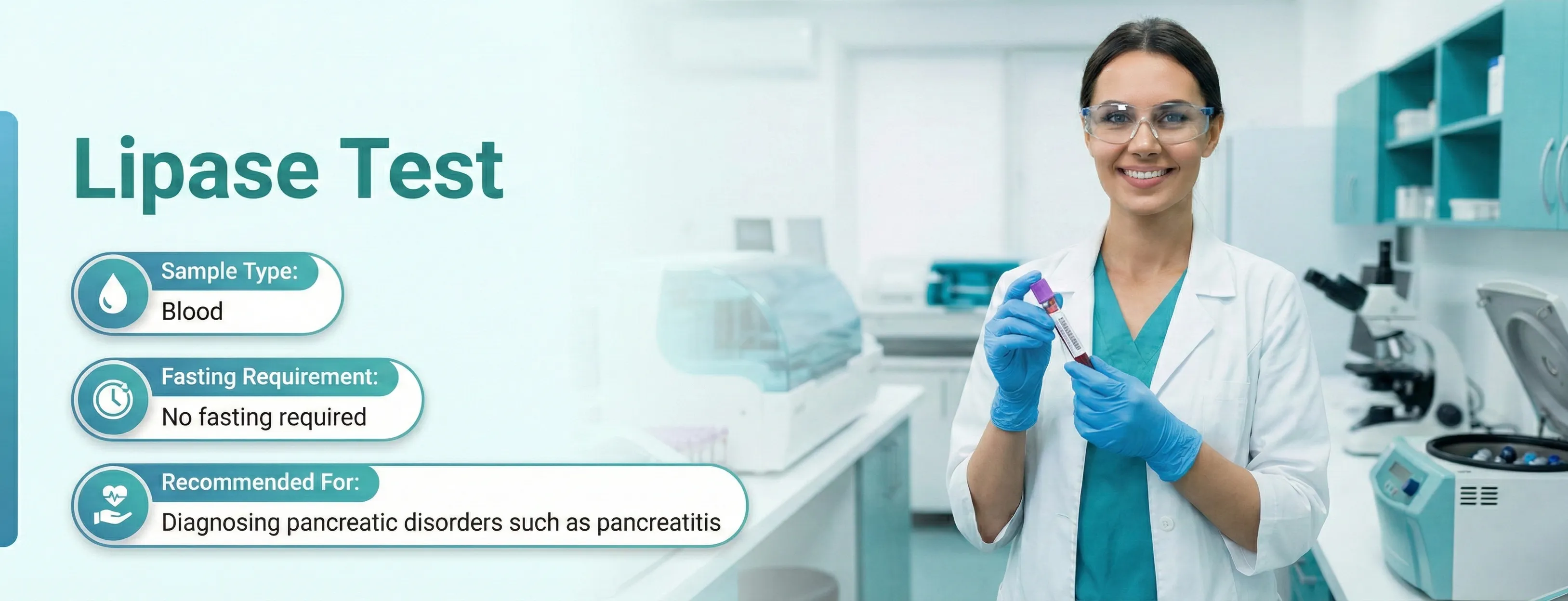
 - SampleBlood

- AgeAll Age Group
- GenderMale and Female
- FastingNot Required

PharmEasy Promises



Know More About The Test


A quick info on Lipase Test

Overview
A Lipase test is used to measure the amount of lipase in a blood sample. The test is also known as a serum lipase test or LPS test.
Lipase is a digestive enzyme (a substance that speeds up chemical reactions in living organisms), and is used to break down fats in your body. Most of the lipase in your body is produced by your pancreas, salivary glands, and stomach. High levels of lipase occur when the pancreas is damaged or in conditions such as pancreatitis (inflammation of the pancreas). It can also occur in other conditions like pancreatic cancer, a blocked pancreatic tube, peptic ulcers, and gallbladder disease. Therefore, doctors recommend this test for early diagnosis and treatment of pancreatic conditions that may become serious if left untreated.

When and Who Should Get a Lipase Test Done?
The Lipase test is advised if you are experiencing the following symptoms of a pancreatic disorder:
- Inflamed belly
- Fever
- Rapid heartbeat
- Nausea and vomiting
- Jaundice (yellowing of skin and eyes)
- Sudden or severe abdominal pain
- Abdominal tenderness
- Loss of appetite
- Bloating
- Unexplained weight loss
- Foul-smelling stools
The following categories of people are at high risk for abnormal lipase levels:
- Individuals with eating disorders - Patients suffering from eating disorders have elevated lipase levels that may or may not be associated with pancreatitis.
- Individuals with cystic fibrosis - Cystic fibrosis is a genetic disease that affects the lungs, intestines, pancreas, and other organs. Serum pancreatic lipase activity is significantly altered and usually lowered in patients with cystic fibrosis.
- Individuals consuming an excessive amount of alcohol - Individuals with a history of long-term alcohol intake may have higher levels of serum lipase.
.png?dim=48x48&q=75)
How Frequently Should You Take the Lipase Test?
|
Health Scenario |
Context |
Recommended frequency |
|---|---|---|
|
Routine screening |
To check for pancreatic disorders and initiate appropriate treatment |
Lipase test is not a routine test and recommended only when there are symptoms of a pancreatic disorder |
|
Individuals suffering from pancreatitis |
To aid in diagnosis and to check for severity of disease |
Regular testing is generally not recommended in patients diagnosed with chronic or acute pancreatitis |
|
High risk individuals |
Individuals with eating disorder, alcohol use disorder, or cystic fibrosis |
As per physician's advice |
|
Symptomatic individuals |
To diagnose pancreatic disorders and start necessary treatment |
As per physician's advice |

What Conditions Can a Lipase Test Help Detect?
Although the lipase blood test cannot directly diagnose any disorder, it can be used to help diagnose and monitor certain conditions, such as:
- Acute pancreatitis - This occurs when digestive enzymes are activated within the pancreas leading to its damage.
- Chronic pancreatitis - This refers to a long-term disease characterised by inflammation of the pancreas.
- Cystic fibrosis - This is a genetic (received from parents) disease that affects your lungs, intestines, pancreas, and other organs.
- Crohn’s disease – This is a chronic inflammatory bowel disease (IBD) in which the immune system causes inflammation in the digestive tract. It can affect any part of the gastrointestinal tract, from the mouth to the anus, but it most commonly affects the end of the small intestine and the beginning of the large intestine.
- Celiac disease – This is an autoimmune disease in which eating gluten triggers the immune system to damage the lining of the small intestine.
- Pancreatic cyst – A fluid-filled sac within or on the pancreas.
- Peritonitis – Peritonitis is inflammation of the peritoneum (the thin membrane that lines the inside of the abdomen and covers many abdominal organs).
- Infarcted bowel – A condition in which a portion of the intestine loses its blood supply.
.png?dim=48x48&q=75)
Lipase Test Preparation
What to Expect Before the LipaseTest
No fasting is required for a standalone Lipase test. You can eat and drink normally. However, if it is part of a broader package that includes fasting tests, your doctor may advise fasting for 8-12 hours. Avoid strenuous exercise for 24 hours before the test, as intense physical activity can temporarily raise Lipase levels and affect interpretation. Always inform your doctor about any ongoing medications.
What to Expect During the Blood Collection
A phlebotomist cleans the skin with an antiseptic, then places an elastic band around your upper arm to make the veins easier to access. A small needle is inserted into the vein; you may feel a brief pinch. Blood is collected into a labelled tube in under a minute.
What to Expect After the Lipase Test
A small cotton swab and bandage are placed over the site to stop any minor bleeding. You can return to normal activities immediately. Minor bruising is normal and disappears quickly. If dizzy, sit and rest for a few minutes.

What are the Parameters Included in a Lipase Test?
In the serum lipase test, the primary parameter being measured is:
- The level of lipase in the blood.

Normal Range of Lipase Test Parameters
The Lipase test normal range is indicated in the table below.
|
Test parameter |
Normal range |
|---|---|
|
Lipase levels in the blood |
5.0–60.0 U/L |
Note: The normal range may vary a little depending on the laboratory and individual health conditions.
.png?dim=48x48&q=75)
Lipase Test Result Interpretation
|
Lipase levels in the blood |
Interpretation |
|---|---|
|
More than 60.0 U/L |
High levels of lipase: This may indicate pancreatic diseases such as acute pancreatitis, pancreatic cancer, a blocked pancreatic duct, peptic ulcer disease (including perforated peptic ulcer), gallbladder disease, diabetes, chronic liver disease, acute or chronic kidney failure, salivary gland disorders, small bowel obstruction, intestinal infarction, and other gastrointestinal conditions. |
|
5.0–60.0 U/L |
This indicates normal levels of lipase in the blood |
|
Less than 5.0 U/L |
This may indicate damage to the pancreatic cells responsible for producing lipase in conditions like cystic fibrosis and chronic pancreatitis. |
Note:
- The results should always be interpreted along with the patient’s medical history, clinical symptoms, and serum amylase levels.
- Serum lipase levels are usually normal in patients with elevated serum amylase who have peptic ulcer, salivary adenitis (inflammation of the salivary gland), inflammatory bowel disease (inflammation of the digestive tract), intestinal obstruction, and macroamylasaemia (a condition in which amylase binds to proteins in the blood, causing high blood amylase levels on lab tests).

Lipase Test Risks and Limitations
Risks:
- The Lipase test is generally safe. You may experience slight pain, bruising, or discomfort when the needle is inserted. However, mild bruising is usually uncommon and heals quickly without treatment.
Limitations:
- Certain medicines, such as codeine, diuretics, opiates, cholesterol medications, and birth control pills, can have an impact on your lipase levels.
- Kidney disease may elevate serum lipase.

Related and Follow-up Tests
Depending on your symptoms and results, your doctor may recommend certain additional tests to better understand your condition. These may include:
- Amylase blood test (Serum amylase) -
- Sweat chloride test (to rule out cystic fibrosis)
- Blood glucagon test
- Stool elastase test
- Abdominal ultrasound
- Upper gastrointestinal (GI) endoscopy
- Colonoscopy
- Endoscopic retrograde cholangiopancreatography (ERCP)

Lipase Test Sample Collection: Home vs. Diagnostic Lab
|
Feature |
Home Collection (PharmEasy) |
Traditional Diagnostic Lab |
|---|---|---|
|
Convenience |
High - sample taken from your home or office. |
Low - requires travelling and waiting in queues. |
|
Time Saving |
Maximum - no travel time. You pick the time slot. |
Minimum - depends on traffic and lab rush. |
|
Safety & Comfort |
Safe - avoids exposure to other sick patients. |
Moderate - exposure to crowded waiting areas. |
|
Process |
A professional phlebotomist visits you. |
You must visit the facility during its hours. |
|
Report Access |
Digital - sent directly to your app or email. |
Often requires a second visit for physical copies. |
Pro Tip: For the most stress-free experience, book a Lipase test on PharmEasy. Enjoy professional service and accurate results without stepping out of your house.
Was This Test Information Helpful?
Please rate your experience
 Yes Helpful
  Not Helpful
References
Health packages containing 'Lipase Test'
 For full-body wellness, go for a comprehensive checkup
People Also Ask
What happens if lipase is high?
How to fix high lipase levels?
What are the first signs of a bad pancreas?
Can pancreatic problems be cured?
What are three diseases that affect the pancreas?
What exercise is good for pancreatitis?
How should I prepare for the test?
What should I eat for a healthy pancreas?
Do abnormal lipase levels mean I have pancreatitis?
What is the function of the lipase enzyme?
Popular Tests
 Explore the most booked tests in your location
 4.6 Stars| 7+ Lakhs Ratings & Reviews

Over 10 million happy users PharmEasy Labs
- Swasth AI feature was really good, it explained the lab report in very easy and understanding manner
 Vivek Sinha29 Oct ‘25
 - Liked the coupon discount and cheaper price, without any quality compromise.Ishita Chatterjee30 Nov ‘25
- Labs open early but still get crowded. Home testing saved me that early morning stress and I was way more relaxed.Neha Kapoor09 Sep ‘25
- if I had to go to the lab, I would’ve skipped my breakfast and rushed. Home testing happened calmly at home.Arjun Verma03 Dec ‘25
- going to the lab means hunting for parking first. With home sample pick-up I didn’t have to deal with that headache at all.Kavya Iyer25 Nov ‘25
- During weekends, in Mumbai the labs are full. Home testing helped me avoid all that chaos, and I could continue my work from home in between.Rohan Sharma07 Oct ‘25
Have any doubts? Ask us.
Ask us anything about the Lipase Test to understand it better

We provide trusted, expert-curated health content to support better awareness,prevention, and care.
Backed by experienced doctors, medical experts, and strict editorial standards.