

318+ orders placed in your location

100% NABL & ISO Certified Lab • 100% Accurate Reports
Complete Vitamins Profile
- SummaryThe Complete Vitamin Profile test procedure is a screening and diagnostic package that includes tests for both fat-soluble and water-soluble vitamins to detect vitamin deficiencies or excesses that your body needs to reduce health risks, improve immunity and preserve overall health.Read more
- TestsIncludes 14 tests
- Reports Within31 HrsView Sample Report

 100% NABL & ISO Certified Labs
 - SampleBlood

- FastingNot Required

PharmEasy Promises



Know More About The Package
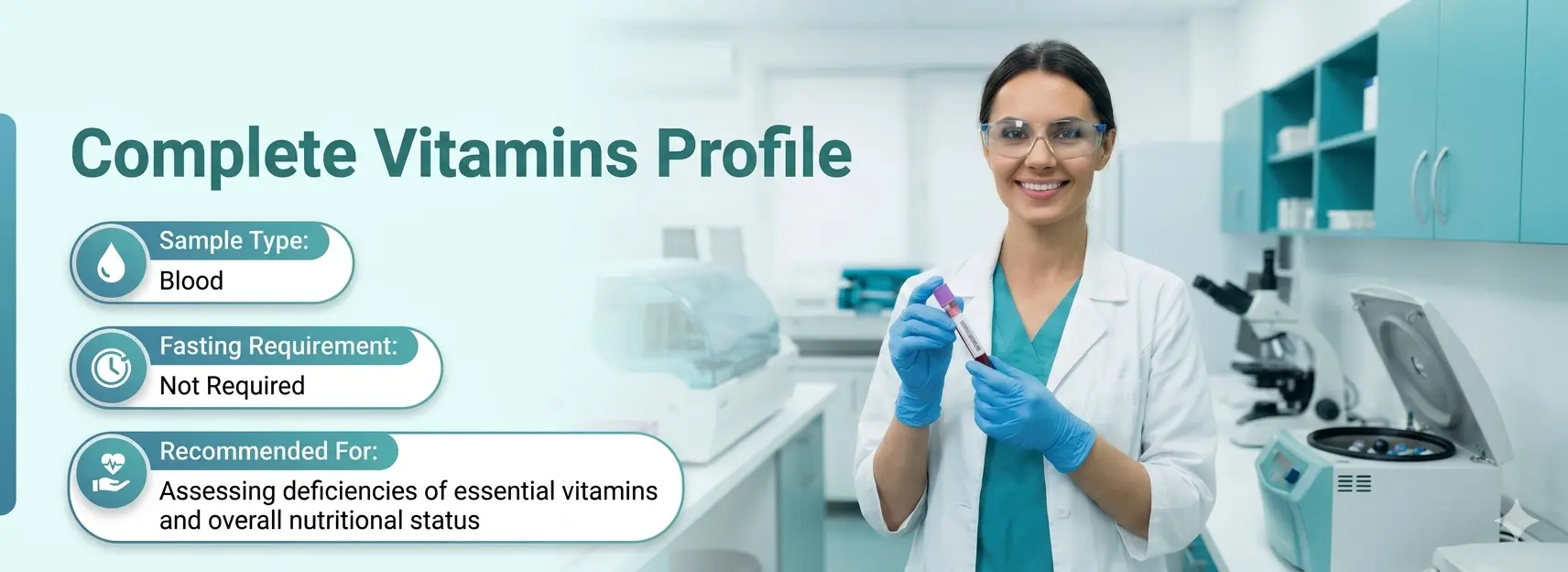
A quick info on Complete Vitamins Profile

Overview
The Complete Vitamins Profile is a targeted blood test package on PharmEasy that screens for deficiencies across all 14 key vitamins - covering 2 panels: Fat Soluble Vitamin Profile (Vitamin A, D, E, K, Beta-Carotene, and Coenzyme Q10) and Vitamin B Complex Profile (B1, B2, B3, B5, B6, B7, B9, and B12).
Vitamin deficiencies are among the most under-diagnosed health conditions in India. Symptoms like fatigue, hair loss, nerve tingling, mood disturbances, and bone pain are often dismissed as lifestyle issues - when the true cause is a correctable deficiency.
Unlike basic packages that test only Vitamin D and B12, this profile covers the full vitamin spectrum. Suitable for all adults. Fasting for 8 to 10 hours is recommended.

Why Choose the Complete Vitamins Profile Over Basic Vitamin Tests?
While most basic health packages include only Vitamin D and occasionally Vitamin B12, the Complete Vitamins Profile goes far beyond by covering every essential vitamin across both fat-soluble and water-soluble categories.
Remember, a little extra from your pocket can help you stay safe and preventive.
|
Feature / Marker |
Complete Vitamins Profile (14 Parameters) |
Basic Vitamin Tests (Limited) |
|---|---|---|
|
Fat-Soluble Vitamins (A, D, E, K) |
✅ |
❌ |
|
Beta-Carotene (Vitamin A Precursor) |
✅ |
❌ |
|
Coenzyme Q10 |
✅ |
❌ |
|
Full Vitamin B Complex (B1-B12) |
✅ |
❌ |
|
Neurological Risk Assessment |
✅ |
⚠️ |
|
Clinical Interpretation |
✅ |
❌ |
✅Included ❌ Not Included / Limited scope ⚠️ Basic / Standard values only
Pro Tip: Basic tests tell you if you're low on one or two vitamins. The Complete Vitamins Profile tells you the full picture - so your doctor can address the root cause of your symptoms, not just guess.

Who Should Book the Complete Vitamins Profile?
This package is recommended for:
- Vegetarians and vegans are at the highest risk of Vitamin B12, B2, B3, and fat-soluble vitamin deficiencies due to limited dietary sources from animal products.
- Adults with chronic fatigue, weakness, or low energy - vitamin deficiencies (especially B1, B2, B3, B12, CoQ10, and Vitamin D) are among the most common correctable causes of persistent tiredness.
- Individuals with hair loss, brittle nails, or skin problems - often linked to Biotin (B7), Vitamin A, or Vitamin E deficiency.
- People with nerve symptoms - tingling or numbness in hands and feet, memory issues, or mood disturbances - may indicate a Vitamin B1, B6, B9, or B12 deficiency.
- Anyone with bone pain, muscle weakness, or frequent fractures - indicating Vitamin D or Vitamin K deficiency affecting calcium metabolism.
- Pregnant women or those planning pregnancy - Folic Acid (B9) deficiency before and during early pregnancy is the leading preventable cause of neural tube defects (spina bifida).
- Elderly individuals - who absorb fat-soluble vitamins and B12 less efficiently as stomach acid production declines with age.
- Patients on long-term medications - including metformin (depletes B12), statins (depletes CoQ10), antiepileptics, and proton pump inhibitors (PPIs), which interfere with vitamin absorption.
- Those with malabsorption conditions - including celiac disease, Crohn's disease, irritable bowel syndrome, or those who have had bariatric surgery.
.png?dim=48x48&q=75)
How to Prepare for the Complete Vitamins Profile?
Fasting Requirements
Fasting for 8 to 10 hours before the test is recommended for the most accurate results. This is particularly important for fat-soluble vitamin measurements, as recent fat intake can temporarily affect blood levels. During the fasting period:
- You may drink plain water freely - staying hydrated is important.
- Avoid all food, milk, tea, coffee, juices, and all beverages other than water.
- Avoid smoking and alcohol for at least 24 hours before the test.
- Continue taking your regular prescribed medications unless your doctor advises otherwise.
- Morning appointments are strongly recommended - fast overnight and get tested first thing in the morning for maximum convenience.
Vitamin Supplements and Medications - Critical
This is the most important preparation step for the Complete Vitamins Profile:
- Stop all vitamin and mineral supplements for at least 48 to 72 hours before the test. Taking supplements close to the test time will give falsely elevated readings, masking a true deficiency.
- Inform your doctor about all current medications - especially metformin (depletes B12), statins (depletes CoQ10), antiepileptics (affect B6, B9, B12), proton pump inhibitors or antacids (impair B12 absorption), and oral contraceptives (affect B6 and B9 levels).
- Biotin supplements (B7) can interfere with multiple lab assays - stop biotin supplementation for at least 72 hours before the test.
- Do not stop any prescription medication without your doctor's advice.
Blood Sample Collection
This package requires a single blood sample only - no urine sample is needed. A certified PharmEasy phlebotomist will visit your home at your chosen time slot and collect the blood sample from a vein in your arm. The entire process takes under 5 minutes. Blood samples for vitamin testing must be protected from light and kept cool during transport - the PharmEasy phlebotomist handles this with standard cold-chain protocols.

What's Included in This Package?
The Complete Vitamins Profile covers 2 test panels and 14 individual parameters, all from a single blood sample:
|
Test Panel |
No. of Parameters |
Sample Type |
|---|---|---|
|
Fat-Soluble Vitamin Profile |
6 |
Blood |
|
Vitamin B Complex Profile |
8 |
Blood |
|
TOTAL |
14 |
Blood |

Complete List of 14 Parameters with Normal Ranges
Below is the complete list of all 14 parameters included in the Complete Vitamins Profile, organised by panel.
1. Fat-Soluble Vitamin Profile - 6 Parameters
Fat-soluble vitamins (A, D, E, K) are stored in the body's fatty tissues and liver. Unlike water-soluble vitamins, they can accumulate to toxic levels if over-supplemented. This panel also includes Beta-Carotene (the plant-based Vitamin A precursor) and Coenzyme Q10 (a cellular energy antioxidant). All are measured from a fasting blood sample to ensure accuracy.
|
Parameter |
Normal Range |
What It Detects / Why It Matters |
|---|---|---|
|
Vitamin A (Retinol) |
0.30 - 1.05 mg/L |
Essential for night vision, immune function, skin integrity, and reproductive health. Deficiency causes night blindness and immune suppression. Toxicity causes liver damage and birth defects. |
|
Vitamin D (25-OH Vitamin D Total) |
30 - 100 ng/mL (Sufficient) |
Regulates calcium and phosphorus absorption for bone health. Deficiency leads to rickets (children), osteomalacia (adults), immune dysfunction, and depression. Extremely prevalent in India. |
|
Vitamin E (Alpha-Tocopherol) |
5.0 - 20.0 mg/L |
The body's primary fat-soluble antioxidant. Protects cells from oxidative damage. Deficiency causes nerve damage, muscle weakness, and immune dysfunction. Important for skin and eye health. |
|
Vitamin K (Phylloquinone) |
0.10 - 2.20 ng/mL |
Essential for blood clotting (coagulation) and bone mineralisation. Deficiency causes easy bruising, prolonged bleeding, and increased fracture risk. Found in dark green leafy vegetables. |
|
Beta-Carotene |
0.037 - 0.19 mg/dL |
The plant-derived precursor that converts to Vitamin A in the body. Acts as a powerful antioxidant. Low levels indicate poor dietary intake of fruits and vegetables and increased oxidative stress. |
|
Coenzyme Q10 (CoQ10) |
0.75 - 3.0 µg/mL |
A naturally occurring antioxidant essential for cellular energy production. Low levels are associated with heart failure, chronic fatigue, statin-induced muscle pain, and accelerated ageing. |
2. Vitamin B Complex Profile - 8 Parameters
The 8 B vitamins are water-soluble and not stored in the body - they must be replenished through diet daily. They work synergistically: a deficiency in one B vitamin often impairs the function of others. Together, they support energy metabolism, nerve function, red blood cell production, DNA synthesis, and mood regulation. Vegetarians, vegans, and the elderly are at particularly high risk of B vitamin deficiencies.
|
Parameter |
Normal Range |
What It Detects / Why It Matters |
|---|---|---|
|
Vitamin B1 (Thiamine) |
2.5 - 7.5 µg/dL |
Converts carbohydrates into energy for nerves and muscles. Deficiency (Beriberi) causes nerve damage, muscle weakness, and in severe cases, heart failure or Wernicke's encephalopathy. Risk group: alcoholics and those with a poor diet. |
|
Vitamin B2 (Riboflavin) |
0.6 - 2.6 µg/dL |
Essential for energy metabolism and maintaining healthy skin, eyes, and nerves. Deficiency causes cracked lips, an inflamed tongue, skin rashes, and sensitivity to light. |
|
Vitamin B3 (Niacin) |
0.50 - 8.45 µg/mL |
Supports energy metabolism, DNA repair, and cardiovascular health. Deficiency (Pellagra) causes dermatitis, diarrhoea, and dementia. Also important for lowering LDL cholesterol and raising HDL. |
|
Vitamin B5 (Pantothenic Acid) |
0.20 - 1.80 µg/mL |
Required for synthesising coenzyme A - essential for fat, carbohydrate, and protein metabolism. Deficiency is rare but causes fatigue, depression, irritability, and numbness in the hands and feet. |
|
Vitamin B6 (Pyridoxine) |
5 - 50 µg/L |
Critical for brain development, neurotransmitter synthesis (serotonin, dopamine), and immune function. Deficiency causes depression, confusion, peripheral neuropathy, and anaemia. High-dose supplementation can itself cause nerve damage. |
|
Vitamin B7 (Biotin) |
200 - 500 pg/mL |
Essential for the metabolism of fats, carbohydrates, and proteins. Important for hair, nail, and skin health. Deficiency causes hair thinning, brittle nails, skin rashes, and neurological symptoms. |
|
Vitamin B9 (Folic Acid / Folate) |
3.0 - 17.0 ng/mL |
Critical for DNA synthesis, red blood cell production, and neural tube development in pregnancy. Deficiency causes megaloblastic anaemia and, in pregnant women, severe foetal neural tube defects like spina bifida. |
|
Vitamin B12 (Cobalamin) |
200 - 900 pg/mL |
Essential for nerve function, red blood cell production, and DNA synthesis. Deficiency is extremely common in vegetarians and vegans. Causes megaloblastic anaemia, peripheral neuropathy, memory loss, and irreversible nerve damage if untreated. |
Important Note: All 14 parameters are tested from a single blood draw. Normal ranges may vary slightly between laboratories. Vitamin levels can be affected by recent supplementation - stop all vitamin supplements for at least 48 to 72 hours before the test, unless your doctor advises otherwise. Always consult your doctor to understand your complete report.
Sample Collection: Home vs. Diagnostic Lab
|
Feature |
Home Collection (PharmEasy) |
Traditional Diagnostic Lab |
|---|---|---|
|
Convenience |
Maximum - phlebotomist comes to your home at your chosen time. |
Requires travel, waiting in queues, often when fasting. |
|
Time Saving |
No travel time. Done before your day begins. |
Depends on distance, traffic, and lab rush hours. |
|
Safety & Comfort |
Safe - avoids exposure to sick patients in crowded waiting areas. |
Moderate - shared spaces with other patients. |
|
Process |
Certified phlebotomist with sterile sealed collection kit. |
You must visit during their working hours. |
|
Reports |
Digital - sent to your PharmEasy app or email within 24 to 48 hours. |
May require a second visit. |
|
NABL Certification |
Yes - all PharmEasy partner labs are NABL and ISO certified. |
Varies by lab - always confirm before booking. |
Pro Tip: PharmEasy's home sample collection is free with this package. A certified phlebotomist handles everything - you just need to be fasted, supplement-free for 48 to 72 hours, and available at your chosen slot.
Was This Test Information Helpful?
Please rate your experience
 Yes Helpful (5)
 Not Helpful
People Also Ask
What is the difference between fat-soluble and water-soluble vitamins?
Why should I stop vitamin supplements before the test?
Who is most at risk of vitamin deficiencies in India?
Can vitamin deficiencies be the cause of my chronic fatigue?
What does a Coenzyme Q10 (CoQ10) deficiency mean?
Why is Folic Acid (B9) so important in pregnancy?
How often should I repeat the Complete Vitamins Profile?
Can I eat or drink anything before the test?
 4.6 Stars| 7+ Lakhs Ratings & Reviews

Over 10 million happy users PharmEasy Labs
- Because the digital report is available on WhatsApp, there's no need to go back to the lab. Thanks, PharmEasy!
 Sachin sharma11 Jan ‘26
 - Thanks to the coupon discount, the blood test was done at a lower price.Komal04 Jan ‘26
- The lab technician was a good and knowledgeable professional.Rakesh Pandey06 Jan ‘26
- Due to bad weather, it's difficult to reach the lab. But home collection makes things easier.Arjun08 Jan ‘26
- Thanks to the Swasth AI feature, the report is easy to understand.Priya Mehta02 Jan ‘26
- The report is available on the same day. Wow!Vikas Patel05 Jan ‘26
Have any doubts? Ask us.
Ask us anything about the Complete Vitamins Profile to understand it better

We provide trusted, expert-curated health content to support better awareness,prevention, and care.
Backed by experienced doctors, medical experts, and strict editorial standards.