


1013+ orders placed in your location


100% NABL & ISO Certified Lab • 100% Accurate Reports
Blood Group Test
Blood Typing Test, ABO Typing Test
- SummaryThe Blood Group Test determines an individual’s blood group type based on the ABO and Rh systems, identifying whether you are A, B, AB, or O and Rh-positive or negative. Knowing your blood group is essential for safe blood transfusions, pregnancy care, and medical emergencies. This test uses a blood sample, requires no fasting, and is suitable for individuals of all age groups.Read more
- Reports Within17 HrsView Sample Report100% NABL & ISO Certified Labs
- SampleBlood
- AgeAll Age Group
- GenderMale and Female
- FastingNot Required



PharmEasy Promises




Know More About The Test




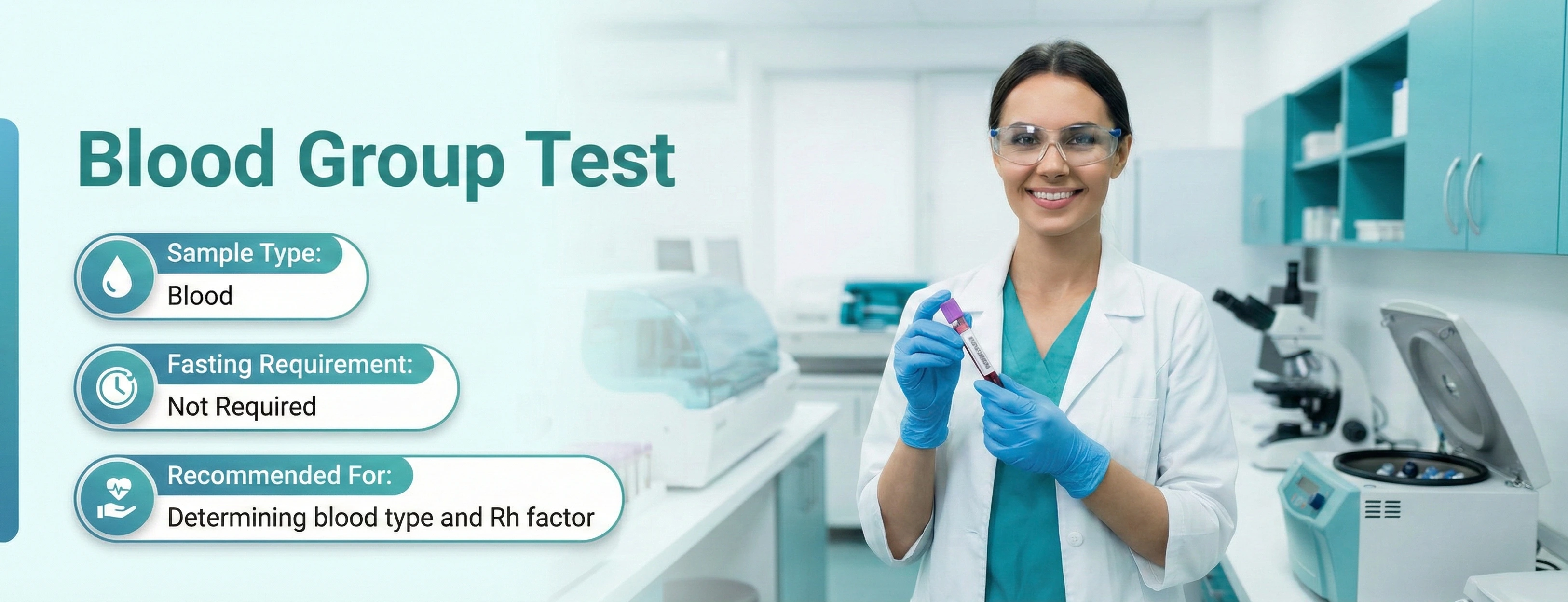
A quick info on Blood Group Test


Overview
A blood group test is a key diagnostic tool used to identify your specific blood type. Knowing your blood group is important, as it determines how your body will react to blood transfusions and is essential for safe surgical planning and prenatal care.
This test identifies the immunological compatibility of your blood. It detects the presence or absence of specific antigens (proteins) on the surface of your red blood cells, as well as the Rh factor (a specific protein), to ensure medical interventions are performed safely.

When and Who Should Get a Blood Group Test Done?
While everyone should ideally know their blood group, this test is specifically recommended for:
- Planning for a major or minor surgical procedure.
- Preparing for a voluntary blood donation.
- Experiencing symptoms of severe anaemia requiring a transfusion.
- Sustaining a significant injury involving blood loss.
Your doctor may recommend this test to you if you are in any of the following groups:
- Expectant mothers: To check for Rh incompatibility with the foetus.
- Organ/tissue donors and recipients: To ensure tissue matching.
- Frequent transfusion patients: Individuals with chronic conditions like thalassaemia or sickle cell anaemia.
- General check-up: Individuals who do not yet have their blood group documented for emergency records.
.png?dim=48x48&q=75)
How Frequently Should You Take the Blood Group Test?
Since your blood type is determined by your genetics and does not change over time, most people only need to take this test once in their lifetime to establish a permanent medical record. However, in certain situations, your doctor might recommend this test as follows:
|
Health scenario |
Context |
Recommended frequency |
|---|---|---|
|
General documentation |
For healthy individuals with no record. |
Once in a lifetime (blood type does not change). |
|
Pregnancy |
Initial prenatal screening. |
Once per pregnancy. |
|
Pre-surgery |
Preparation for elective or emergency surgery. |
Before every procedure (to verify records). |
|
Blood donation |
Screening before every donation. |
At each donation event. |

What Conditions Can a Blood Group Test Help Detect?
The blood group test is not used to diagnose a disease, but rather to identify your biological status for:
- ABO blood group: Identifying whether you are Type A, B, AB, or O. This information helps prevent serious transfusion reactions by ensuring compatible blood is used during transfusions.
- Rh factor status: Determining if you are Rh-positive or Rh-negative, which is critical during pregnancy to prevent Rh incompatibility.
- Transfusion compatibility: Mapping which blood types you can safely receive or donate.
Important note: Always share your results with a doctor for proper analysis.
.png?dim=48x48&q=75)
Blood Group Profile Test Preparation
Before the Test
- No fasting required: You can eat and drink normally before this test. While special preparation is generally not needed for a blood group test, if you are undergoing this alongside other diagnostic tests, your doctor may advise you to fast or avoid certain foods.
- Hydration: Drink enough water to make the vein easier to access and ensure a smooth collection process.
- Medication: You can continue your regular medications as usual. However, inform your doctor before the test to receive personalised guidance and discuss any specific clinical requirements.
During the Test
When undergoing the blood group test, a blood sample will be taken from a vein in your arm.
Here is what you can expect during the test:
- Collection:The area where the needle will be inserted will be cleaned with an antiseptic solution first. A tourniquet band will be tied to your arm to make your veins more visible.
- The draw:A needle will be inserted into a vein to draw the blood. This process may cause a brief pinch lasting a few seconds. The blood will be collected in a vial or small test tube, which will be labelled with your name and other details.
- Duration: The entire process usually takes less than five minutes.
After the Test
Following the blood collection:
- Pressure and protection: Apply firm pressure to the site with a cotton ball for about a minute to prevent bruising, then place a bandage over the insertion site to stop any further bleeding.
- Activity and observation: You can usually resume your daily activities immediately. While feeling dizzy is uncommon, if you do feel slightly lightheaded, sit down for a few minutes, have a light snack, or rest until you feel steady.
- Post-test care: There may be minor bruising at the puncture site. However, you should contact your doctor if you notice persistent bleeding, unusual pain, or the development of a rash at the site.

What are the Parameters Included in a Blood Group Test?
The blood group test identifies your specific blood type by analysing the presence of A antigens, B antigens, and the Rh protein on the surface of your red blood cells.
|
Parameter |
Status |
Interpretation |
|---|---|---|
|
ABO typing |
A/B/AB/O |
Determines your primary blood group based on how your cells react to A and B antibodies. |
|
Rh factor |
Positive (+)/Negative (-) |
Identifies the presence (positive) or absence (negative) of the Rh protein. |
|
Final blood type |
1 of 8 categories |
Your definitive blood group, such as A+, B-, O+, or AB-, for medical records. |
How Your Blood Type Is Determined:
The samples are processed on a fully automated Matrix Automax analyser using gel column agglutination technology.
To ensure high accuracy, the laboratory follows a multi-step process to verify your results:
- Step 1 (forward grouping): Your blood is mixed with anti-A and anti-B reagents. If the cells clump together, it indicates the presence of the corresponding A or B antigen on the cell surface.
- Step 2 (reverse grouping): Your serum is mixed with known Type A and Type B red blood cells to confirm the antibodies your body naturally produces.
- Step 3 (Rh typing): Your red blood cells are tested for the Rh(D) antigen. If the antigen is present, your blood type is Rh-positive (+); if absent, it is Rh-negative (−).
.png?dim=48x48&q=75)
Blood Group Test Result Interpretation
The 8 Possible Blood Groups
The combination of your ABO group and your Rh factor results in one of these eight specific blood types. Each type is unique and determines who you can safely receive blood from or donate blood to.
|
Blood group |
Rh factor |
Final result (blood type) |
Can donate red cells to |
Can receive red cells from |
|
Type A |
Positive (+) |
A Positive (A+) |
A+, AB+ |
A+, A-, O+, O- |
|
Type A |
Negative (-) |
A Negative (A-) |
A+, A-, AB+, AB- |
A-, O- |
|
Type B |
Positive (+) |
B Positive (B+) |
B+, AB+ |
B+, B-, O+, O- |
|
Type B |
Negative (-) |
B Negative (B-) |
B+, B-, AB+, AB- |
B-, O- |
|
Type AB |
Positive (+) |
AB Positive (AB+) |
AB+ only |
All blood groups |
|
Type AB |
Negative (-) |
AB Negative (AB-) |
AB+, AB- |
AB-, A-, B-, O- |
|
Type O |
Positive (+) |
O Positive (O+) |
O+, A+, B+, AB+ |
O+, O- |
|
Type O |
Negative (-) |
O Negative (O-) |
All blood groups |
O- only |
Quick Tips:
- O negative: Considered the "universal donor" because this blood type can be given to patients of almost any other blood group in emergencies.
- AB positive: Considered the "universal recipient" because individuals with this type can generally receive blood from any other blood group safely.
- Genetic nature: Your blood group is inherited from your parents and will stay the same throughout your life.
- Rh factor compatibility: Generally, Rh-positive individuals can receive both Rh-positive and Rh-negative blood, while Rh-negative individuals should typically only receive Rh-negative blood to avoid an immune reaction.
Important note: Blood transfusion compatibility is not determined solely by the ABO and Rh systems. Healthcare providers also consider other blood group antigens, such as Kell, Duffy, and Kidd, perform compatibility testing (cross-matching), and evaluate the patient's clinical situation. Therefore, the terms "universal donor" and "universal recipient" are useful general guidelines for red blood cell transfusions but may not apply in every medical circumstance.

Blood Group Test Risks and Limitations
- Temporary bruising: Some patients may experience slight soreness or a small bruise at the puncture site.
- Clumping (agglutination) interferences: In very rare cases, certain underlying medical conditions or cold-reacting antibodies can interfere with test clarity, requiring a retest.
- Human error: While automated systems are highly accurate, mislabelling of samples remains a rare but practical risk in a clinical setting.
- Need for confirmation in complex cases: Individuals with recent blood transfusions, bone marrow transplants, or specific blood disorders may have atypical results that require confirmatory testing.

Related and Follow-up Tests
If a blood group test is performed as part of a wider diagnostic workup, such as during pregnancy or before surgery, the next steps your doctor may recommend include:
- Antibody screening: To check whether your blood contains antibodies that might react against certain red blood cell antigens.
- Cross-matching: Performed before a blood transfusion to confirm that the donor's blood is compatible with the recipient's blood to avoid any adverse reaction.

Blood Group Test Sample Collection: Home vs. Diagnostic Lab
|
Feature |
Home Collection (PharmEasy) |
Traditional Diagnostic Lab |
|---|---|---|
|
Convenience |
High - sample taken from your home or office. |
Low - requires travelling and waiting in queues. |
|
Time Saving |
Maximum - no travel time. You pick the time slot. |
Minimum - depends on traffic and lab rush. |
|
Safety & Comfort |
Safe - avoids exposure to other sick patients. |
Moderate - exposure to crowded waiting areas. |
|
Process |
A professional phlebotomist visits you. |
You must visit the facility during its hours. |
|
Report Access |
Digital - sent directly to your app or email. |
Often requires a second visit for physical copies. |
Pro Tip: For the most stress-free experience, book a Blood Group test on PharmEasy. Enjoy professional service and accurate results without stepping out of your house.
Was This Test Information Helpful?
Please rate your experience


References
People Also Ask
Does my blood group change as I get older?
Can I get a blood group test if I have a cold or fever?
Why is it important for pregnant women to know their Rh factor?
What is the "universal donor" type?
Does the test require a large amount of blood?
Is there a "best" blood type to have?
Can I find out my blood type through my diet or lifestyle?
How long does it take to get the results?


Over 10 million happy users PharmEasy Labs
- Painless sample collection was surprised for me. nice experience thanks pharmeasyRaghav Sharma16 Feb ‘25
- i am happy with ServiceSuvankar Senapati14 Feb ‘25
- The sample collector was polite and efficientRakhi Mishra22 Feb ‘25
- Christopher the technician is awesome in his workJoseph Fernandez02 Feb ‘25
- Very good experience and will definately suggest pharmeasy among friends and relativesRemya Radhakrishnan16 Feb ‘25
- Sample collection technician good one time collectionZaheer Ahmad26 Sep ‘25


Have any doubts? Ask us.
Ask us anything about the Blood Group Test to understand it better


We provide trusted, expert-curated health content to support better awareness,prevention, and care.
Backed by experienced doctors, medical experts, and strict editorial standards.