

1142+ orders placed in your location

100% NABL & ISO Certified Lab • 100% Accurate Reports
Total Protein Test
Total Protein Test, Serum Protein Test, A/G Ratio Test, Albumin to Globulin Ratio Test
- SummaryThe Total Protein test measures the overall amount of albumin and globulin in the blood, helping assess liver function, kidney health, and nutritional status. It is performed using a blood sample, and fasting is not required, though some doctors may advise it for specific evaluations.Read more
- Reports Within8 HrsView Sample Report

 100% NABL & ISO Certified Labs
 - SampleBlood

- AgeAll Age Group
- GenderMale and Female
- FastingNot Required

PharmEasy Promises



Know More About The Test


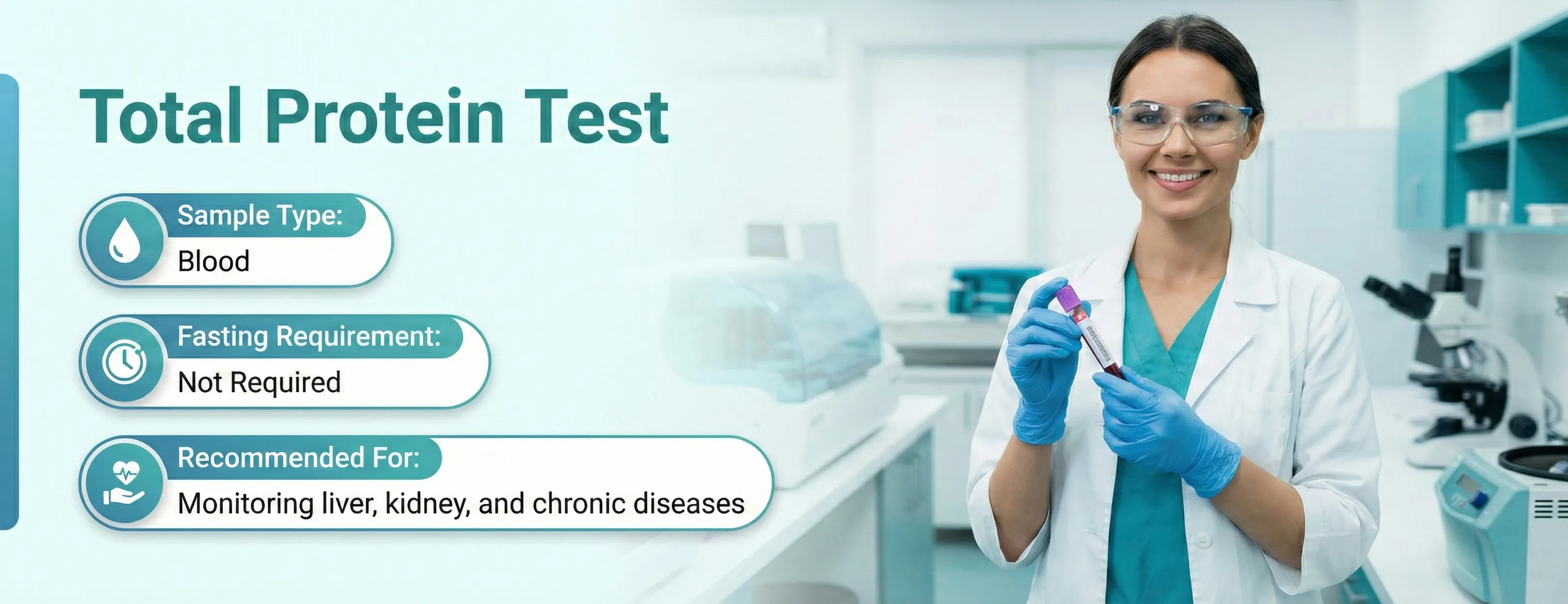
A quick info on Total Proteins Test

Overview
The total protein test measures the levels of major proteins, mainly plasma proteins, present in the blood.
Plasma proteins are produced by the liver and secreted into the bloodstream. These proteins help maintain fluid balance, immune function, clotting, and transport various substances, such as nutrients, medications, and supplements, throughout the body.
The total protein test provides a comprehensive assessment of your liver and kidney health by measuring plasma protein parameters, such as albumin protein, globulin protein, and the albumin/globulin ratio.

When and Who Should Get a Total Protein Test Done?
The total protein test is used to monitor liver and kidney function and help detect nutritional deficiencies. It also helps evaluate underlying autoimmune conditions or chronic infections in the body.
It may be included as part of a comprehensive metabolic panel in your routine health check-up, or your doctor may order it for you, if required.
The following symptoms may prompt a total protein test:
- Fatigue or weakness
- Frequent urination
- Jaundice
- Unexplained weight loss
- Swelling in the abdomen, legs, or feet
- Nausea and vomiting
- Brittle nails
- Hair loss or dry skin
- Reduced immunity
You should consider getting this test if you fall under the following groups:
- Chronic conditions like diabetes or high blood pressure
- Family history of liver or kidney disease
- Pregnant women
- Gastrointestinal problems
- Autoimmune disorders
.png?dim=48x48&q=75)
How Frequently Should You Take the Total Protein Test?
The total protein test is often part of a routine health check-up and is included in a comprehensive metabolic panel.
- For routine check-ups or healthy individuals, this test is recommended once a year.
- For monitoring liver or kidney conditions or for high-risk groups, such as people with diabetes, high blood pressure, your doctor may recommend this test every 3 to 6 months.
- For pregnant women with no other medical conditions, it is recommended once every trimester.

What Conditions Can a Total Protein Test Help Detect?
The total protein test helps detect various possible conditions, such as:
- Liver conditions - helps in the detection of liver cirrhosis or hepatitis
- Kidney disorders - helps in the diagnosis of kidney dysfunction or nephrotic syndrome
- Autoimmune disorders - coeliac disease, Crohn's disease
- Blood disorders - such as multiple myeloma, or leukaemia
- Chronic infections or inflammation - due to HIV, hepatitis B, or hepatitis C infection
- Malnutrition - a poor diet or malabsorption leads to low protein levels in the blood
- Dehydration - causes high protein levels in the blood
.png?dim=48x48&q=75)
Total Protein Test Preparation
What to Expect Before the Test
No fasting is usually required for the test. However, if this test is part of a wider panel, overnight fasting may be required. Consult your doctor for any special instructions before the test.
Note: Always inform your doctor about any medications or supplements you are taking before the test, as they can interfere with test results.
What to Expect During Sample Collection
A blood sample is required for this test. It is collected using the routine blood sample collection procedure explained below:
- An elastic band is tied around the upper arm for increased blood flow in the veins.
- A needle is inserted into a vein in the inner arm, and blood is drawn out.
- A bandage is placed over the puncture site to stop bleeding.
What to Expect After the Test
You may feel dizzy for a few seconds after sample collection. Sit and relax for recovery.
Note: Consult your doctor if you notice anything unusual, such as persistent bleeding, a rash, or pain at the puncture site.

What are the Parameters Included in a Total Protein Test?
A total protein test measures four parameters:
- Total protein in the blood - It measures the total proteins in the blood and is indicative of hypoproteinemia (low protein) or hyperproteinemia (high protein).
- Albumin protein - Albumin is the most abundant plasma protein in the blood and helps maintain fluid balance by preventing leakage of fluid from blood vessels. It is indicated as hypoalbuminemia or hyperalbuminemia.
- Globulin - Globulin protein in blood is responsible for immune function. It is indicated as hyperglobulinemia or hypoglobulinemia.
- Albumin/globulin ratio in the blood - It is an important ratio to consider, which is almost equal to 1. If the ratio is less than or more than 1, it is suggestive of liver/ kidney disorders, plasma cell disorders, etc.

Normal Range of Total Protein Test Parameters
Normal serum protein levels can vary with age. Refer to the table below to understand normal ranges:
In adults and the elderly population
|
Type of protein |
Conventional unit in g/dL |
SI unit in g/L |
|---|---|---|
|
Total protein |
5.7-8.2 g/dL |
57-82 g/L |
|
Albumin |
3.5-5.2 g/dL |
35-52 g/L |
|
Globulin |
2.5-3.4 g/dL |
25-34 g/L |
|
Albumin/Globulin Ratio |
1 |
1 |
Note: Normal values and reference ranges of the test may vary depending on the technology used for testing. Please refer to the ranges mentioned in the report and consult a doctor to understand the interpretation of lab reports.
.png?dim=48x48&q=75)
Total Protein Test Result Interpretation
|
Level |
Potential interpretation (may be associated with) |
|---|---|
|
Low [hypoproteinemia] |
|
|
High [hyperproteinemia] |
|
Disclaimer: This table shows the potential association of total protein levels with the above conditions, but one should not reach any conclusion or diagnosis without a doctor’s guidance.

Total Protein Test Risks and Limitations
Potential Risks and Complications
The total protein test is performed using a safe, routine blood sample collection procedure with little to no risk. Consult your doctor if you notice anything unusual, such as persistent bleeding, pain, or a rash at the puncture site.
Understanding Test Limitations
The following factors can affect total protein test results:
- Hydration levels can affect protein levels.
- The test is non-specific and cannot diagnose a condition on its own.
- Inaccurate procedure or equipment can affect results.
- Illnesses or medications can affect results.

Related and Follow-up Tests
- Liver function test - Measure all enzymes and proteins formed by the liver to assess liver function.
- Serum albumin test - Measures the albumin levels in the blood to assess liver and kidney health.
- Protein electrophoresis - Identifies abnormalities in protein fractions and helps detect monoclonal gammopathies and certain protein disorders.
- Urine protein test - Measures protein excretion in the urine to assess kidney function.
- CRP [C- reactive protein] test - Measures inflammation in the body.
- Kidney function test - Assesses of kidney health and function.

Total Protein Test Sample Collection: Home vs. Diagnostic Lab
|
Feature |
Home Collection (PharmEasy) |
Traditional Diagnostic Lab |
|---|---|---|
|
Convenience |
High - sample taken from your home or office. |
Low - requires travelling and waiting in queues. |
|
Time Saving |
Maximum - no travel time. You pick the time slot. |
Minimum - depends on traffic and lab rush. |
|
Safety & Comfort |
Safe - avoids exposure to other sick patients. |
Moderate - exposure to crowded waiting areas. |
|
Process |
A professional phlebotomist visits you. |
You must visit the facility during its hours. |
|
Report Access |
Digital - sent directly to your app or email. |
Often requires a second visit for physical copies. |
Pro Tip: For the most stress-free experience, book a Total Protein test on PharmEasy. Enjoy professional service and accurate results without stepping out of your house.
Was This Test Information Helpful?
Please rate your experience
 Yes Helpful
  Not Helpful
References
Health packages containing 'Total Protein Test '
 For full-body wellness, go for a comprehensive checkup
People Also Ask
What is the total protein blood test for?
Do I need to fast before the test?
What organs do abnormal protein levels in the blood affect?
Does water affect blood protein levels?
What is the albumin/globulin ratio in the total protein test?
What are the signs of protein deficiency?
Is swelling in my body linked to protein deficiency?
 4.6 Stars| 7+ Lakhs Ratings & Reviews

Over 10 million happy users PharmEasy Labs
- Because the digital report is available on WhatsApp, there's no need to go back to the lab. Thanks, PharmEasy!
 Sachin sharma11 Jan ‘26
 - Thanks to the coupon discount, the blood test was done at a lower price.Komal04 Jan ‘26
- The lab technician was a good and knowledgeable professional.Rakesh Pandey06 Jan ‘26
- Due to bad weather, it's difficult to reach the lab. But home collection makes things easier.Arjun08 Jan ‘26
- Thanks to the Swasth AI feature, the report is easy to understand.Priya Mehta02 Jan ‘26
- The report is available on the same day. Wow!Vikas Patel05 Jan ‘26
Have any doubts? Ask us.
Ask us anything about the Total Protein Test to understand it better
Explore More at PharmEasy
Top-Selling Healthcare Products
Top-Searched Medicines

We provide trusted, expert-curated health content to support better awareness,prevention, and care.
Backed by experienced doctors, medical experts, and strict editorial standards.