

77+ orders placed in your location

100% NABL & ISO Certified Lab • 100% Accurate Reports
Immunoglobulin A Test - IgA
Total Immunoglobulins, Immunoglobulin A, IgA, Immunoglobulins, Quantitative, Gamma-Globulins, Quantitative, IgA single test, Immune Competence, Immunoglobulin A (IgA), Serum
- SummaryThe IgA test measures the level of Immunoglobulin A, an antibody that plays a crucial role in immune function, particularly in the respiratory and gastrointestinal tracts. It helps diagnose immune deficiencies, autoimmune disorders, and some infections. The test is done using a blood sample, and fasting is not required.Read more
- Reports Within35 HrsView Sample Report

 100% NABL & ISO Certified Labs
 - SampleBlood

- AgeAll Age Group
- GenderMale and Female
- FastingNot Required

PharmEasy Promises



Know More About The Test


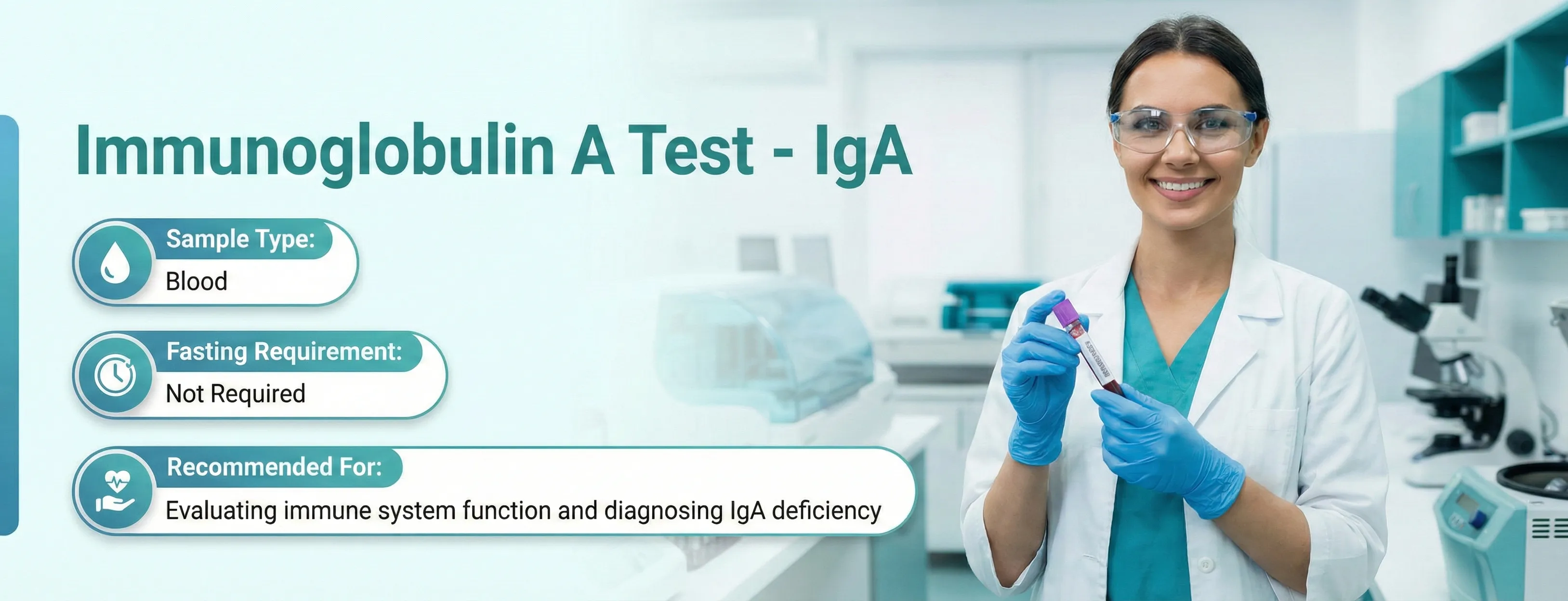
A quick info on Immunoglobulin A Test - IgA

Overview
The immunoglobulin A (IgA) test is a blood test that measures the level of IgA, one of the antibodies your immune system uses to defend the body against infection. Immunoglobulins are proteins made by plasma cells and lymphocytes that recognise and help destroy foreign invaders such as bacteria and viruses. There are five main types: IgA, IgD, IgE, IgG, and IgM, and each has its own role.
IgA is especially important at the body's mucosal surfaces: the linings that come into contact with the outside world. It is found in the gut, saliva, tears, breast milk, and the respiratory tract, where it forms a first line of defence and helps prevent germs from taking hold. IgA makes up roughly 10 to 15% of all the antibodies in the body.
Doctors order an IgA test to help diagnose problems with the immune system. The test is also useful in investigating recurrent infections of the lungs, sinuses, intestines, or stomach, and in conditions such as coeliac disease and IgA nephropathy, a kidney disease in which IgA builds up in the kidneys.

When and Who Should Get a Immunoglobulin A-IgA Test Done?
Your doctor may recommend an IgA test when there are signs of an immune system disorder, recurrent infections, or suspected abnormal antibody production.
- Recurrent infections of the lungs, sinuses, intestines, or stomach.
- Persistent or chronic diarrhoea.
- Recurrent fevers with no obvious cause.
- Suspected immune deficiency, including selective IgA deficiency.
- Autoimmune conditions such as rheumatoid arthritis, lupus, or coeliac disease.
- Suspected IgA nephropathy (a kidney condition).
- Assessment of immune function in people living with HIV/AIDS.
The IgA test is suitable for people of any age and gender. It is often ordered together with IgG and IgM as part of a full immunoglobulin assessment.
.png?dim=48x48&q=75)
How Frequently Should You Take the Immunoglobulin A-IgA Test?
The IgA test is ordered when there are signs of chronic inflammation, recurrent infections, or suspected abnormal immunoglobulin production. When monitoring an ongoing condition, your doctor may repeat it from time to time to follow the course of your illness or your response to treatment.

What Conditions Can a Immunoglobulin A-IgA Test Help Detect?
By measuring IgA, the test helps your doctor assess immune function and investigate a range of conditions:
|
Finding |
What it may indicate |
|---|---|
|
High IgA |
Autoimmune disease (rheumatoid arthritis, lupus, coeliac disease), inflammatory bowel disease, chronic infections, liver disease, or plasma cell disorders such as IgA multiple myeloma and monoclonal gammopathy (MGUS). |
|
Low IgA |
Selective IgA deficiency, other primary or secondary immunodeficiency disorders, certain medications, protein-losing conditions, or HIV/AIDS. |
|
Very low/absent IgA |
Increased risk of infections, allergies, and autoimmune conditions, and a rare risk of transfusion reactions. |
.png?dim=48x48&q=75)
Immunoglobulin A-IgA Test Preparation
Your IgA result is interpreted with your age, symptoms, and other tests. The general patterns are:
|
Result |
Possible interpretation |
|---|---|
|
High IgA |
It may be linked to autoimmune disorders (rheumatoid arthritis, lupus, coeliac disease), inflammatory bowel disease, chronic infections, liver disease, or plasma cell disorders such as IgA multiple myeloma and monoclonal gammopathy (MGUS). |
|
Low IgA |
May be linked to selective IgA deficiency, other primary or secondary immunodeficiency disorders, certain medications, protein-losing conditions, HIV/AIDS, or selective IgA deficiency. Increased risk of infections, allergies, and autoimmune conditions, and a rare risk of transfusion reactions. |
A high or low IgA level is a clue, not a diagnosis. Your doctor will combine it with other immunoglobulins and specific tests, for example, coeliac antibodies, kidney tests, or protein studies, to identify the underlying cause.
Disclaimer: This information is for educational purposes and provides a risk assessment only. It does not confirm a diagnosis. Always consult your doctor to understand how your IgA result relates to your overall health.

What are the Parameters Included in a Immunoglobulin A-IgA Test?
The IgA test measures a single parameter: the level of immunoglobulin A in your blood, reported in mg/dL. The result is a number rather than a positive or negative.
- Immunoglobulin A (IgA): the antibody that protects mucosal surfaces such as the gut, airways, saliva, and tears. A higher- or lower-than-normal value indicates a possible disorder of the immune system.
To build a fuller picture of immune function, your doctor often orders IgA together with IgG and IgM as a complete immunoglobulin profile.

Normal Range of Immunoglobulin A-IgA Test Parameters
BRI : Adult : 0.40 - 3.50 g/L
Important note: Reference ranges may vary between laboratories. Always refer to the range printed on your own report and consult your doctor for interpretation.
.png?dim=48x48&q=75)
Immunoglobulin A-IgA Test Result Interpretation
Your IgA result is interpreted with your age, symptoms, and other tests. The general patterns are:
|
Result |
Possible interpretation |
|---|---|
|
High IgA |
It may be linked to autoimmune disorders (rheumatoid arthritis, lupus, coeliac disease), inflammatory bowel disease, chronic infections, liver disease, or plasma cell disorders such as IgA multiple myeloma and monoclonal gammopathy (MGUS). |
|
Low IgA |
May be linked to selective IgA deficiency, other primary or secondary immunodeficiency disorders, certain medications, protein-losing conditions, HIV/AIDS, or selective IgA deficiency. Increased risk of infections, allergies, and autoimmune conditions, and a rare risk of transfusion reactions. |
A high or low IgA level is a clue, not a diagnosis. Your doctor will combine it with other immunoglobulins and specific tests, for example, coeliac antibodies, kidney tests, or protein studies, to identify the underlying cause.
Disclaimer: This information is for educational purposes and provides a risk assessment only. It does not confirm a diagnosis. Always consult your doctor to understand how your IgA result relates to your overall health.

Immunoglobulin A-IgA Test Risks and Limitations
The IgA test is a routine blood draw that is generally very safe, with minor procedural risks and some limitations.
Potential Risks and Complications
Risks from a blood test are very low; most people feel only slight pain or bruising at the needle site, which settles quickly. Consult your doctor if you notice:
- Persistent bleeding at the puncture site that does not stop with gentle pressure.
- Redness, swelling, or pain at the needle insertion site.
- Light-headedness that continues after the blood draw - sit and rest before leaving.
Understanding IgA Test Limitations
- A high or low IgA level alone does not diagnose a specific disease; further tests are needed.
- Results can be affected by infections, medicines, and other conditions present at the time.
- IgA is best interpreted alongside IgG and IgM as part of a full immunoglobulin profile.
- Reference ranges differ between labs, so results may not be directly comparable.

Related and Follow-up Tests
If your IgA result is abnormal, your doctor may recommend additional tests to find the cause.
|
Your finding |
Suggested follow-up test |
Why it is ordered |
|---|---|---|
|
Abnormal IgA |
Assesses the other antibody classes for a complete picture of immune function. |
|
|
Suspected coeliac disease |
Tissue transglutaminase (tTG) IgA test and total IgA |
A key coeliac test that relies on IgA; also needs total IgA to be valid. |
|
Suspected IgA nephropathy |
Kidney function tests, and urine routine, and urine protein/albumin assessment |
Checks for kidney involvement and protein or blood in the urine. |
|
Recurrent infections |
Assesses overall immune and blood cell status. |
|
|
Suspected myeloma |
Looks for abnormal antibody production by plasma cells. |

Immunoglobulin A-IgA Test Sample Collection: Home vs. Diagnostic Lab
|
Feature |
Home collection (PharmEasy) |
Traditional diagnostic lab |
|---|---|---|
|
Convenience |
High - sample is taken from your home or office. |
Low - requires travelling and waiting in queues. |
|
Time saving |
Maximum - no travel time. You pick the time slot. |
Minimum - depends on traffic and lab rush. |
|
Safety and comfort |
Safe - avoids exposure to other sick patients. |
Moderate - exposure to crowded waiting areas. |
|
Process |
A professional phlebotomist visits you. |
You must visit the facility during their hours. |
|
Report access |
Digital - sent directly to your app or email. |
Often requires a second visit for physical copies. |
Pro tip: Book your IgA test on PharmEasy for safe, at-home sample collection and a secure digital report, which is convenient when it is ordered as part of a full immunoglobulin profile.
Was This Test Information Helpful?
Please rate your experience
 Yes Helpful
  Not Helpful
References
People Also Ask
What is the IgA test used for?
Do I need to fast before the test?
What does a low IgA level mean?
What does a high IgA level mean?
Why is total IgA important for coeliac testing?
What is the normal range for IgA?
Popular Tests
 Explore the most booked tests in your location
 4.6 Stars| 7+ Lakhs Ratings & Reviews

Over 10 million happy users PharmEasy Labs
- Because the digital report is available on WhatsApp, there's no need to go back to the lab. Thanks, PharmEasy!
 Sachin sharma11 Jan ‘26
 - Thanks to the coupon discount, the blood test was done at a lower price.Komal04 Jan ‘26
- The lab technician was a good and knowledgeable professional.Rakesh Pandey06 Jan ‘26
- Due to bad weather, it's difficult to reach the lab. But home collection makes things easier.Arjun08 Jan ‘26
- Thanks to the Swasth AI feature, the report is easy to understand.Priya Mehta02 Jan ‘26
- The report is available on the same day. Wow!Vikas Patel05 Jan ‘26
Have any doubts? Ask us.
Ask us anything about the Immunoglobulin A Test - IgA to understand it better

We provide trusted, expert-curated health content to support better awareness,prevention, and care.
Backed by experienced doctors, medical experts, and strict editorial standards.