

14+ orders placed in your location

100% NABL & ISO Certified Lab • 100% Accurate Reports
Allergy Comprehensive Profile (By Phadia)
- SummaryThe Allergy Comprehensive Profile (by Phadia) is a blood test that screens for allergies to a wide range of common foods, environmental allergens, animal dander, and molds. This panel tests for sensitivities to more than 30 allergens, including egg, milk, fish, wheat, peanut, soybean, chicken, shrimp, nuts, gluten, house dust, dust mites, cockroaches, grass pollens, molds, pet dander, and more. Allergic reactions may present as sneezing, nasal congestion, itchy or watery eyes, skin rashes, hives, abdominal discomfort, nausea, coughing, wheezing, or breathlessness. Using gold-standard ImmunoCAP technology, this test accurately pinpoints the specific allergen or allergens causing your symptoms, enabling doctors to recommend targeted avoidance strategies, dietary modifications, and effective treatment plans.Read more
- TestsIncludes 31 tests
- Reports Within48 HrsView Sample Report

 100% NABL & ISO Certified Labs
 - SampleBlood

- FastingNot Required

PharmEasy Promises



Know More About The Package


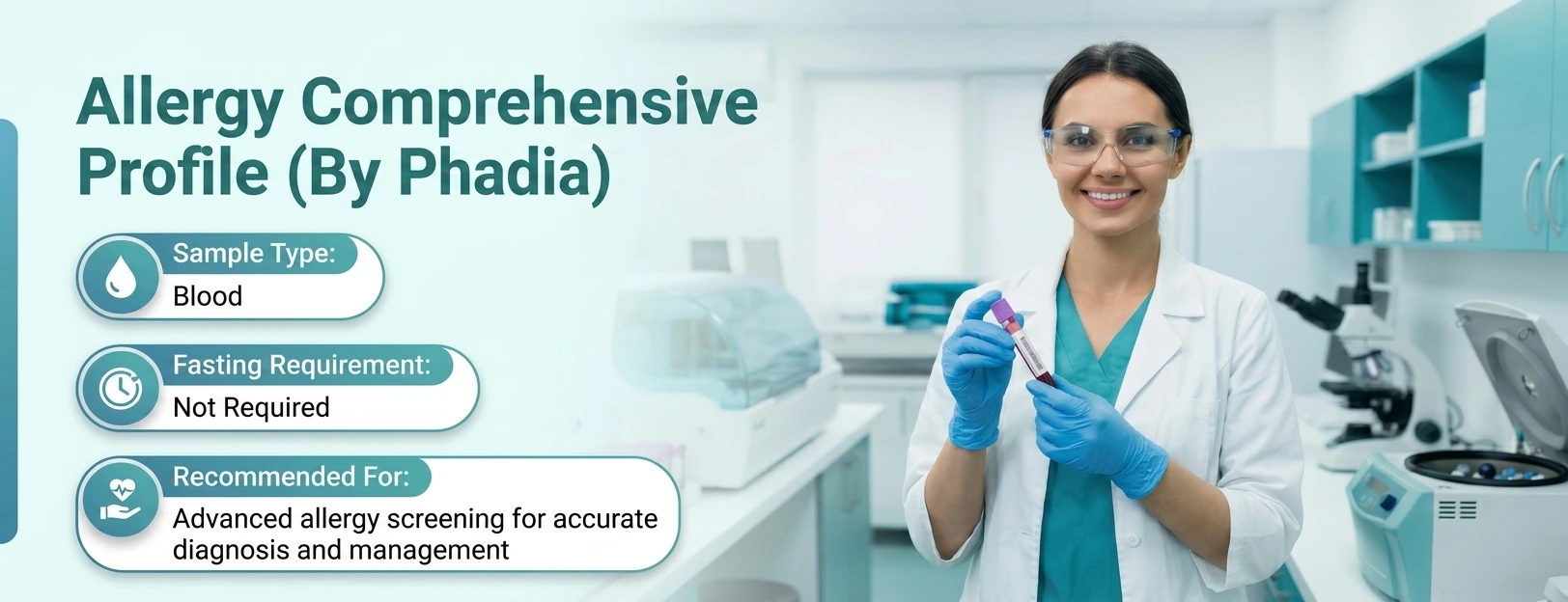
A quick info on Allergy Comprehensive Profile (By Phadia)

Overview
An allergy occurs when the body’s immune system (which normally protects you from infections) mistakenly overreacts to certain substances called allergens. These reactions can be mild in some people, but in others, they can become serious and even life-threatening.
The most common allergens include milk, eggs, peanuts, tree nuts (such as almonds and walnuts), fish, shellfish, soy, wheat, sesame, pollen, animal dander (tiny skin flakes shed by animals), dust mites (microscopic organisms found in household dust), cockroaches, and aspergillus (a common fungus found in the environment). The allergy comprehensive profile checks how your body reacts to common allergens. It measures specific immunoglobulin E (IgE) antibodies, which are linked to allergic sensitisation. Higher levels of IgE may help assess reaction to certain allergens.
This test evaluates different types of allergens, providing a more comprehensive assessment of allergies. The test is also known as the allergy comprehensive test, comprehensive allergy panel test, or allergy blood test.

When and Who Should Get a Allergy Comprehensive Profile Test Done?
This test is usually recommended when there are signs that your body may be reacting to certain allergens. It helps identify possible triggers, such as food and environmental allergens, for an allergic reaction and supports further diagnosis.
You may need this test if you have:
- Skin symptoms like hives (itchy, raised rashes), redness, or swelling.
- Digestive issues like vomiting, diarrhoea, stomach cramps, or nausea.
- Breathing problems like coughing, wheezing, or shortness of breath.
- Reactions like itching or tingling in the mouth.
- A history of severe symptoms, such as swelling in the throat leading to difficulty breathing, a drop in blood pressure, and loss of consciousness after eating a certain food.
- A history of sneezing or red, itchy eyes after coming into contact with pets, dust, pollen, or other environmental triggers.
These symptoms usually appear within a few minutes to a few hours after exposure to the allergen. In some very rare cases, the reaction may be delayed by 4 to 6 hours or even longer.
Who should consider this test?
This test should be considered in individuals with:
- Repeated symptoms after eating specific foods.
- A history of allergies, asthma, or eczema (a skin condition causing irritation and redness).
- Suspected food allergies in children or those unable to undergo skin testing.
- Skin allergy symptoms when skin testing is not suitable due to skin conditions or medications.
- A family history of allergies (such as an older sibling with an allergy).
- People with pets or those planning to get pets.
- Seasonal allergy symptoms, especially in late spring or summer (pollen allergy).
.png?dim=48x48&q=75)
How Frequently Should You Take the Allergy Comprehensive Profile Test?
|
Health scenario |
Context |
Recommended frequency |
|---|---|---|
|
Suspected food allergy |
The patient develops symptoms after eating a specific food |
When symptoms first occur |
|
Initial diagnosis |
History suggests possible food or environmental allergy |
Once for evaluation |
|
Monitoring resolution (children) |
Known allergy (e.g., to milk, egg, soy, wheat) |
Repeat testing as advised by a doctor |
|
Persistent allergies |
Often long-term allergies |
Retesting if advised by a doctor |
|
Test results are inconclusive |
Low-to-moderate probability of allergy |
Refer for specialist evaluation and further testing |
|
Dust mite allergy |
Symptoms occur throughout the year if dust mites are present in pillows, bedcovers, and mattresses |
Testing as needed based on current symptoms, past history of allergies, home environment, and circumstances |

What Conditions Can a Allergy Comprehensive Profile Test Help Detect?
This test can help identify different types of allergic reactions, such as:
- IgE-mediated allergies: These occur when a person is exposed to allergens, such as certain foods or environmental triggers, such as dust and some types of fungi or grasses, and the body produces IgE antibodies against these triggers. Symptoms usually appear within minutes to 2 hours after contact with the allergen and may include hives, swelling, breathing problems, or vomiting.
- Anaphylaxis: This is a severe allergic reaction with high IgE levels where airway swelling makes breathing difficult and may affect blood pressure and consciousness. It requires immediate medical attention.
- Food allergies: The test can help identify IgE-mediated food allergies (that involve the immune system) and distinguish them from non-allergic conditions. If allergy testing is negative, healthcare providers may consider other causes of symptoms, such as food intolerance (for example, lactose intolerance).
- Allergic bronchopulmonary aspergillosis (ABPA): This is an allergic reaction to the fungus aspergillus, which mainly affects the lungs, especially in people with asthma.
Elevated IgE levels may support the diagnosis when interpreted with clinical evaluation.
.png?dim=48x48&q=75)
Allergy Comprehensive Profile Test Preparation
What to Expect Before the Allergy Comprehensive Profile Test
No fasting is required for a standalone Allergy Comprehensive Profile test. You can eat and drink normally. However, if it is part of a broader package that includes fasting tests, your doctor may advise fasting for 8-12 hours. Avoid strenuous exercise for 24 hours before the test, as intense physical activity can temporarily raise Allergy Comprehensive Profile levels and affect interpretation. Always inform your doctor about any ongoing medications.
What to Expect During the Blood Collection
A phlebotomist cleans the skin with an antiseptic, then places an elastic band around your upper arm to make the veins easier to access. A small needle is inserted into the vein; you may feel a brief pinch. Blood is collected into a labelled tube in under a minute.
What to Expect After the Allergy Comprehensive Profile Test
A small cotton swab and bandage are placed over the site to stop any minor bleeding. You can return to normal activities immediately. Minor bruising is normal and disappears quickly. If dizzy, sit and rest for a few minutes.

What are the Parameters Included in a Allergy Comprehensive Profile Test?
This test includes the following 31 parameters:
- Egg white
- Wheat
- Almond
- Brazil nut
- Hazelnut
- Peanut
- Lentil
- Soybean
- Allergy Cat Dander (By Phadia)
- Allergy Horse Dander (By Phadia)
- Allergy Dog Dander (By Phadia)
- Allergy Bermuda Grass (By Phadia)
- Allergy Milk (By Phadia)
- Allergy Timothy Grass (By Phadia)
- Allergy Meadow Grass (By Phadia)
- Allergy Johnson Grass (By Phadia)
- Allergy Bahia Grass (By Phadia)
- Allergy House Dust (By Phadia)
- Allergy House Dust Mite - D. pteronyssinus (By Phadia)
- Allergy House Dust Mite - D. farinae (By Phadia)
- Allergy German Cockroach (By Phadia)
- Allergy Aspergillus fumigatus (By Phadia)
- Allergy Aspergillus niger (By Phadia)
- Allergy Aspergillus terreus (By Phadia)
- Allergy Aspergillus flavus (By Phadia)
- Allergy Alternaria alternata (By Phadia)
- Allergy Gluten (By Phadia)
- Allergy Shrimp (By Phadia)
- Allergy Fish Cod (By Phadia)
- Allergy Rye Grass (By Phadia)
- Allergy Chicken (By Phadia)

Normal Range of Allergy Comprehensive Profile Test Parameters
This test measures specific IgE (immunoglobulin E) levels in the blood to identify possible allergies. There is no single “normal range” for all allergens. However, in general:
- Low IgE levels suggest a low likelihood of allergy.
- Higher IgE levels indicate an allergic reaction.
The following table gives reference values for some common food allergens (IgE blood test).
|
Allergen |
Normal / Low range |
|---|---|
|
Milk |
< 0.35 kU/L |
|
Egg |
< 0.35 kU/L |
|
Peanut |
< 0.35 kU/L |
|
Fish |
< 0.35 kU/L |
|
Soy |
< 0.35 kU/L |
|
Wheat |
< 0.35 kU/L |
.png?dim=48x48&q=75)
Allergy Comprehensive Profile Test Result Interpretation
The results of this test are based on specific IgE levels in the blood. These results help indicate whether your body may be reacting to certain foods, but they must always be interpreted along with your symptoms and medical history.
|
Test result |
What It may indicate |
|---|---|
|
IgE < 0.35 kU/L |
Lower likelihood of an IgE-mediated allergy; this result may help rule out an allergy. If the individual’s medical history is highly suggestive of an allergy, further evaluation (such as a physician-supervised oral food challenge) may be necessary before confirming the absence of an allergy. |
|
IgE > 0.35 kU/L |
Increased likelihood of sensitisation to the allergen. However, an elevated specific IgE level alone is not sufficient to diagnose a clinical allergy. Correlation with symptoms and, when appropriate, further evaluation may be required to establish the diagnosis. |

Allergy Comprehensive Profile Test Risks and Limitations
The allergy comprehensive profile test is generally safe and involves only a simple blood sample collection. However, you may feel slight pain or discomfort when the needle is inserted into a vein. Some people may develop mild bruising at the needle insertion site. These effects are usually temporary and resolve on their own without any treatment.
Understanding Allergy Comprehensive Profile Test Limitations
This test has certain limitations and should not be used alone to diagnose an allergy. The results must always be interpreted along with your symptoms and medical history. In some cases, the test may show a positive result even when you do not have actual symptoms, which is known as sensitisation, and does not always mean a true allergy. On the other hand, false-negative results can also occur, where the test fails to detect an existing allergy. Additionally, the level of IgE in the blood does not indicate how severe an allergic reaction may be. Another important limitation is that this test mainly detects IgE-mediated allergies and may not identify non-IgE-mediated food allergies. Therefore, further testing and clinical evaluation are often required for an accurate diagnosis.

Related and Follow-up Tests
If test results are unclear or symptoms persist, your doctor may recommend any of the following tests or diagnostic approaches, as appropriate:
- Skin prick test (SPT): To check immediate allergic reactions.
- Oral food challenge (OFC): This is a confirmatory test for diagnosing food allergies and is done under medical supervision.
- Exclusion diet: This involves removing suspected foods and reintroducing them gradually.
- Component-resolved diagnostics: Detailed IgE testing for specific food proteins.
- Sputum test: To check for and analyse Aspergillus spores.
- Basophil activation test (BAT): A blood test that measures how immune cells (basophils) react to allergens. It shows a functional allergic response and can be used even if you are taking allergy medications.
- Nasal provocation test: A test where the nasal lining (inner mucosa of the nose) is exposed to a suspected allergen (such as dust mites) to observe symptoms and confirm its clinical relevance.

Allergy Comprehensive Profile Test Sample Collection: Home vs. Diagnostic Lab
|
Feature |
Home Collection (PharmEasy) |
Traditional Diagnostic Lab |
|---|---|---|
|
Convenience |
High - sample taken from your home or office. |
Low - requires travelling and waiting in queues. |
|
Time Saving |
Maximum - no travel time. You pick the time slot. |
Minimum - depends on traffic and lab rush. |
|
Safety & Comfort |
Safe - avoids exposure to other sick patients. |
Moderate - exposure to crowded waiting areas. |
|
Process |
A professional phlebotomist visits you. |
You must visit the facility during its hours. |
|
Report Access |
Digital - sent directly to your app or email. |
Often requires a second visit for physical copies. |
Pro Tip: For the most stress-free experience, book a Allergy Comprehensive Profile test on PharmEasy. Enjoy professional service and accurate results without stepping out of your house
Was This Test Information Helpful?
Please rate your experience
 Yes Helpful
  Not Helpful
References
People Also Ask
What 8 foods cause most food allergies?
Which foods cause minimal allergies?
Which food allergy causes itching?
Can I have a positive test but no symptoms?
Can medicines cause allergic reactions similar to food allergies?
 4.6 Stars| 7+ Lakhs Ratings & Reviews

Over 10 million happy users PharmEasy Labs
- Because the digital report is available on WhatsApp, there's no need to go back to the lab. Thanks, PharmEasy!
 Sachin sharma11 Jan ‘26
 - Thanks to the coupon discount, the blood test was done at a lower price.Komal04 Jan ‘26
- The lab technician was a good and knowledgeable professional.Rakesh Pandey06 Jan ‘26
- Due to bad weather, it's difficult to reach the lab. But home collection makes things easier.Arjun08 Jan ‘26
- Thanks to the Swasth AI feature, the report is easy to understand.Priya Mehta02 Jan ‘26
- The report is available on the same day. Wow!Vikas Patel05 Jan ‘26
Have any doubts? Ask us.
Ask us anything about the Allergy Comprehensive Profile (By Phadia) to understand it better

We provide trusted, expert-curated health content to support better awareness,prevention, and care.
Backed by experienced doctors, medical experts, and strict editorial standards.