

265+ orders placed in your location

100% NABL & ISO Certified Lab • 100% Accurate Reports
Lipoprotein (A) Test
Cholesterol Lp (a) Test, Lp (a) Test, Cholesterol Lp (a) Test, VLDL Cholesterol Test, HDL Cholesterol Test
- SummaryThe Lipoprotein (a), or Lp(a), test measures the level of Lipoprotein (a) in the blood—a type of LDL (bad cholesterol) linked to an increased risk of heart disease and stroke, regardless of other cholesterol levels. The test is done using a blood sample, and fasting is not required, though some doctors may recommend it if combined with other lipid tests. Read more
- Reports Within6 HrsView Sample Report

 100% NABL & ISO Certified Labs
 - SampleBlood

- AgeAll Age Group
- GenderMale and Female
- FastingNot Required

PharmEasy Promises



Know More About The Test


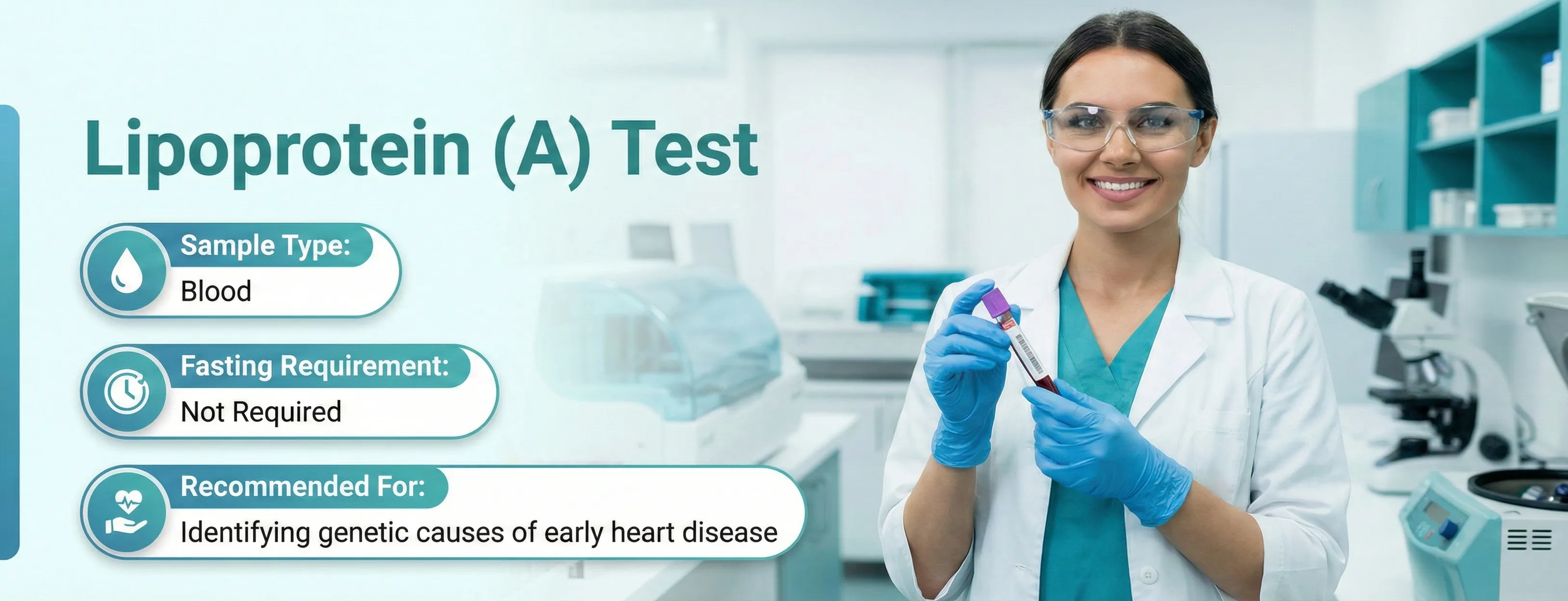
A quick info on Lipoprotein (A) Test

Overview
The lipoprotein(a) test, often written as Lp(a), is a blood test that measures the amount of a specific cholesterol-carrying particle called lipoprotein(a) in your blood. Lipoproteins are combinations of protein and fat that transport cholesterol through the bloodstream. Lp(a) is a particular form of LDL - the so-called bad cholesterol - and a high level is linked to a higher risk of heart disease, heart attack, and stroke.
What makes Lp(a) important is that it is an independent risk factor for cardiovascular disease. In other words, your Lp(a) can be high and add to your heart risk even when your standard cholesterol numbers, including total cholesterol, LDL, HDL, and triglycerides, look normal. High Lp(a) promotes the build-up of fatty plaque in the artery walls (atherosclerosis), which narrows the arteries and reduces blood flow to the heart and brain.
Unlike most cholesterol, Lp(a) levels are largely determined by your genes. They tend to stay fairly constant through life and are not strongly affected by diet, exercise, or most cholesterol medicines, including statins. For this reason, the Lp(a) test is especially useful for people with a personal or family history of early heart disease, or with high cholesterol despite a healthy lifestyle. It is not a routine cholesterol test, but it adds valuable information about long-term cardiovascular risk.

When and Who Should Get a Lipoprotein (A) Test Done?
Your doctor may recommend an Lp(a) test to refine your cardiovascular risk assessment, particularly when standard cholesterol tests do not fully explain your risk.
- Heart disease that occurs despite normal results on standard lipid tests.
- High cholesterol that persists despite a healthy diet and lifestyle.
- A family history of premature heart disease.
- A family history of high Lp(a) or inherited high cholesterol (familial hypercholesterolaemia).
- Other risk factors such as type 2 diabetes, obesity, or increasing age.
- A personal history of a heart attack or stroke that requires a more complete cardiovascular risk assessment.
The Lp(a) test is applicable to children, adults, and all genders when advised by a doctor. It is most valuable for people with a strong family history of premature cardiovascular disease, or those whose heart risk seems higher than their standard cholesterol numbers suggest.
.png?dim=48x48&q=75)
How Frequently Should You Take the Lipoprotein (A) Test?
Since Lp(a) is genetically determined and stays fairly stable, it does not need frequent repeating like routine cholesterol. The table below gives general screening guidance, which your doctor will tailor to your risk.
|
Age group/situation |
General screening guidance |
|---|---|
|
Children with a strong family history |
A first test between ages 9 and 11, and again between 17 and 21; some may be tested earlier. |
|
Children with identified risk factors |
1 to 3 years after the risk is detected. |
|
Adults with risk factors |
As advised, often every 1 to 3 years depending on the specific risk factors. |
|
Men 20-45 / Women 20-55 (no risk) |
Around every 4 to 6 years as part of general cholesterol screening. |
|
Men 45-65 / Women 55-65 (no risk) |
Every 1 to 2 years. |
|
Seniors above 65 |
Annually, with or without risk factors. |

What Conditions Can a Lipoprotein (A) Test Help Detect?
A high Lp(a) level signals an increased risk of conditions driven by atherosclerosis - the build-up of cholesterol plaque in the arteries. The test helps assess the risk of:
- Coronary artery disease (CAD): narrowing of the arteries supplying the heart, which can lead to a heart attack.
- Heart attack (myocardial infarction): high Lp(a) adds to the plaque burden that can block blood flow to the heart.
- Stroke: atherosclerosis linked to high Lp(a) can reduce or block blood flow to the brain.
- Atherosclerosis: the underlying hardening and narrowing of arteries from cholesterol plaque.
- Aortic valve disease: high Lp(a) is also associated with calcification of the aortic valve.
.png?dim=48x48&q=75)
Lipoprotein (A) Test Preparation
The Lp(a) test needs little preparation, which makes it convenient.
What to Expect Before the Test
- No special preparation or fasting is usually needed for a standalone Lp(a) test.
- If it is booked with a full lipid profile or other tests, your doctor may ask you to fast or avoid certain foods. Follow those instructions.
- Tell your doctor about your current and past medications during your consultation.
- Always consult your doctor before the test for specific guidance.
What to Expect During the Blood Collection
A phlebotomist cleans the skin with an antiseptic, then places an elastic band around your upper arm to make the veins easier to access. A small needle is inserted into the vein; you may feel a brief pinch. Blood is collected into a labelled tube in under a minute.
What to Expect After the Test
A small cotton swab and bandage are placed over the site to stop any minor bleeding. There may be slight soreness at the needle site or mild light-headedness. If you feel dizzy, sit and rest for a few minutes.

What are the Parameters Included in a Lipoprotein (A) Test?
The lipoprotein(a) test measures a single parameter: the level of lipoprotein(a) particles in your blood, reported in mg/dL. Unlike a standard cholesterol test, which measures the cholesterol carried inside LDL particles, this test counts the Lp(a) particles specifically.
- Lipoprotein(a): a genetically determined, LDL-like particle. A higher level is an independent marker of increased risk for heart disease and stroke, even when other lipid values are normal.
Because Lp(a) only captures one aspect of cholesterol health, your doctor will usually interpret it alongside a full lipid profile (total cholesterol, LDL, HDL, and triglycerides) to assess your overall cardiovascular risk.

Normal Range of Lipoprotein (A) Test Parameters
The table below shows the reference interpretation for Lp(a). A lower value is more favourable.
|
Lp(a) level (mg/dL) |
Interpretation |
|---|---|
|
Less than 30 mg/dL |
Normal: no added cardiovascular risk from Lp(a). |
|
Greater than 30 mg/dL |
High: associated with an increased risk of cardiovascular disease. |
Important Note: Reference ranges and reporting units can vary between laboratories (some report Lp(a) in nmol/L rather than mg/dL). Always refer to the range printed on your own report and consult your doctor for interpretation.
.png?dim=48x48&q=75)
Lipoprotein (A) Test Result Interpretation
A high Lp(a) level is associated with a greater risk of heart disease, mainly because Lp(a) contributes to atherosclerosis - the accumulation of cholesterol plaque that narrows the arteries. A high result therefore suggests your overall cholesterol-related cardiovascular risk is raised.
Because Lp(a) is largely determined by your genes, it is not easily lowered by lifestyle changes or most cholesterol medicines. Where Lp(a) is high, doctors generally focus on aggressively controlling all the other modifiable risk factors - LDL cholesterol, blood pressure, blood sugar, smoking, and weight - to reduce overall risk. Some newer therapies, such as PCSK9 inhibitors and niacin, can lower Lp(a) by around 25 to 40%, but they are used selectively.
Disclaimer: This information is for educational purposes and provides a risk assessment only. It does not confirm a diagnosis. Always consult your doctor to understand how your Lp(a) result relates to your overall health.

Lipoprotein (A) Test Risks and Limitations
The Lp(a) test is a routine blood draw that is generally very safe, with only minor procedural risks and a few limitations.
Potential Risks and Complications:
Most people feel only a brief pinch. Consult your doctor if you notice:
- Persistent bleeding at the puncture site that does not stop with gentle pressure.
- Redness, swelling, or pain at the needle insertion site.
- Light-headedness that continues after the blood draw. Sit and rest before leaving.
Understanding Lipoprotein(a) Test Limitations:
- Temporary conditions such as fever, infection, recent weight loss, or pregnancy can affect the result.
- There are currently few widely used treatments that specifically lower Lp(a), so a high value mainly guides risk management rather than direct treatment.
- Reporting units and reference ranges differ between labs, so results may not be directly comparable.
- Lp(a) measures only one aspect of cardiovascular risk and should be interpreted with a full lipid profile.

Related and Follow-up Tests
If your Lp(a) is high, your doctor may recommend further tests to complete your cardiovascular risk assessment.
|
Your finding |
Suggested follow-up test |
Why it is ordered |
|---|---|---|
|
High Lp(a) |
Provides total cholesterol, LDL, HDL, and triglycerides for a full lipid picture. |
|
|
High Lp(a) |
Counts atherogenic particles, refining cardiovascular risk. |
|
|
High Lp(a) with risk factors |
Diabetes strongly affects heart risk and is often assessed alongside lipids. |
|
|
High overall risk |
ECG and 2D echocardiogram |
Assesses the heart directly when cardiovascular disease is suspected. |
|
Strong family history |
Measures vascular inflammation, adding to risk assessment. |

Lipoprotein (A) Test Sample Collection: Home vs. Diagnostic Lab
|
Feature |
Home collection (PharmEasy) |
Traditional diagnostic lab |
|---|---|---|
|
Convenience |
High: sample is taken from your home or office. |
Low: requires travelling and waiting in queues. |
|
Time saving |
Maximum: no travel time. You pick the time slot. |
Minimum: depends on traffic and lab rush. |
|
Safety and comfort |
Safe: avoids exposure to other sick patients. |
Moderate: exposure to crowded waiting areas. |
|
Process |
A professional phlebotomist visits you. |
You must visit the facility during its hours. |
|
Report access |
Digital: sent directly to your app or email. |
Often requires a second visit for physical copies. |
Pro Tip: Book your lipoprotein(a) test on PharmEasy for safe, at-home sample collection and a quick digital report, providing a convenient way to add this once-in-a-lifetime genetic marker to your heart-health profile.
Was This Test Information Helpful?
Please rate your experience
 Yes Helpful (1)
 Not Helpful
References
Health packages containing 'Lipoprotein (A) Test'
 For full-body wellness, go for a comprehensive checkup
People Also Ask
What is the lipoprotein(a) test used for?
What is a normal Lp(a) level?
Do I need to fast before the test?
Can I lower my Lp(a) with diet and exercise?
How often do I need this test?
Does a high Lp(a) mean I will have a heart attack?
 4.6 Stars| 7+ Lakhs Ratings & Reviews

Over 10 million happy users PharmEasy Labs
- Because the digital report is available on WhatsApp, there's no need to go back to the lab. Thanks, PharmEasy!
 Sachin sharma11 Jan ‘26
 - Thanks to the coupon discount, the blood test was done at a lower price.Komal04 Jan ‘26
- The lab technician was a good and knowledgeable professional.Rakesh Pandey06 Jan ‘26
- Due to bad weather, it's difficult to reach the lab. But home collection makes things easier.Arjun08 Jan ‘26
- Thanks to the Swasth AI feature, the report is easy to understand.Priya Mehta02 Jan ‘26
- The report is available on the same day. Wow!Vikas Patel05 Jan ‘26
Have any doubts? Ask us.
Ask us anything about the Lipoprotein (A) Test to understand it better

We provide trusted, expert-curated health content to support better awareness,prevention, and care.
Backed by experienced doctors, medical experts, and strict editorial standards.