

127+ orders placed in your location

100% NABL & ISO Certified Lab • 100% Accurate Reports
Cancer Antigen 15.3 (CA 15.3) Test
Cancer antigen 15 - 3, CA153, MUC-1, Mucin-Like Carcinoma-Associated Antigen, Serum 15-3, MUC-1, CA153, CA Breast, Cancer Antigen Breas
- SummaryThe CA 15.3 test measures the level of Cancer Antigen 15.3, a protein often elevated in breast cancer, especially in advanced or metastatic cases. It helps in monitoring treatment response and detecting recurrence, but is not used for initial diagnosis. The test is done using a blood sample, and fasting is not required. Read more
- Reports Within20 HrsView Sample Report

 100% NABL & ISO Certified Labs
 - SampleBlood

- Age18+ Years
- GenderFemales
- FastingNot Required

PharmEasy Promises



Know More About The Test


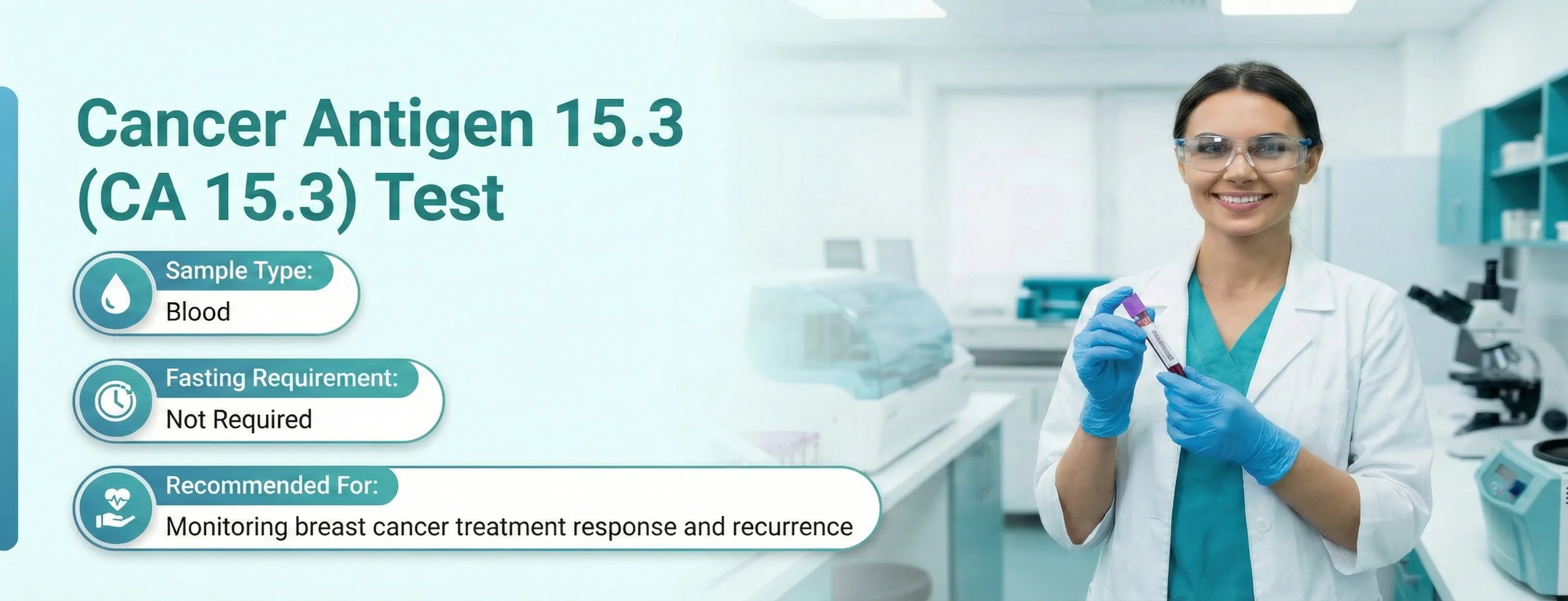
A quick info on Cancer Antigen 15.3 (CA 15.3) Test

Overview
The CA 15.3 test (cancer antigen 15-3 test) measures the level of a protein called cancer antigen 15-3 in the blood. This protein, also known as MUC-1, is produced by normal breast cells, but many people with breast cancer produce it in larger amounts. For this reason, CA 15-3 is widely used as a tumour marker, a substance whose level in the blood can reflect the presence and activity of a cancer.
It is important to understand what CA 15-3 does and does not do. The antigen itself does not cause cancer; it is released by tumour cells into the bloodstream, particularly as a breast tumour grows or spreads. The CA 15.3 test is mainly used to monitor how well breast cancer treatment is working and to detect a recurrence (return) of cancer after treatment. It is not used as a first screening test to diagnose breast cancer.
CA 15-3 levels are raised in about 80% of women whose breast cancer has spread (metastasised) to other parts of the body, such as the bones or liver, and in fewer women with early-stage disease or small tumours. Because the level can also rise in other cancers and in some non-cancerous conditions, the result is always interpreted alongside a physical examination, other blood tests and imaging.

When and Who Should Get a Cancer Antigen 15.3 Test Done?
The CA 15.3 test is mainly used in people already diagnosed with breast cancer, to guide and monitor care. Your doctor may recommend it in the following situations:
- To monitor the response to treatment in women being treated for breast cancer.
- To check for recurrence in women with a history of breast cancer.
- To help assess prognosis and the likelihood of cancer returning.
- To monitor disease activity in metastatic (spread) breast cancer.
- To help guide decisions about which treatment or combination of therapies to use.
This test is primarily relevant for adult women with breast cancer or a history of it, and is ordered by a cancer specialist (oncologist) or gynaecologist. While breast cancer can affect men too, CA 15-3 is used far less often in men. It is not recommended as a routine screening test for people without a breast cancer diagnosis.
.png?dim=48x48&q=75)
How Frequently Should You Take the Cancer Antigen 15.3 Test?
As a tumour marker used for monitoring, the CA 15.3 test is repeated over time so that trends - rather than a single value - can be tracked. It is usually repeated every 2 to 3 months during and after treatment, depending on the situation and your doctor's advice.
Women with a history of breast cancer may need more frequent testing to watch for recurrence. The exact schedule is decided by your oncologist based on your stage, treatment, and response.

What Conditions Can a Cancer Antigen 15.3 Test Help Detect?
The CA 15.3 test mainly relates to breast cancer, helping with monitoring rather than diagnosis. A raised level may be associated with:
|
Finding |
What it may indicate |
|---|---|
|
Raised CA 15-3 |
Active or advanced breast cancer, particularly disease that has spread (metastasised) to bone, liver, or other sites. |
|
Rising CA 15-3 over time |
Possible breast cancer recurrence or a poor response to current treatment. |
|
Falling CA 15-3 over time |
A favourable response to breast cancer treatment. |
|
Raised CA 15-3 (non-breast causes) |
Other cancers (such as lung, colon, or prostate) and some benign conditions, which can cause false positives. |
.png?dim=48x48&q=75)
Cancer Antigen 15.3 Test Preparation
The CA 15.3 test needs no special preparation, which makes it simple and convenient.
What to Expect Before the Test
- No fasting is required. You can eat and drink normally beforehand.
- If the test is combined with other tests that need fasting, follow those specific instructions.
- Tell your doctor about your treatment, medicines, and any other conditions, as these help with result interpretation.
- For monitoring, it helps to use the same lab over time so results are directly comparable.
What to Expect During the Blood Collection
A phlebotomist cleans the skin with an antiseptic, then places an elastic band around your upper arm to make the veins easier to access. A small needle is inserted into the vein; you may feel a brief pinch. Blood is collected into a labelled tube in under a minute.
What to Expect After the Test
A small cotton swab and bandage are placed over the site to stop any minor bleeding. There may be slight soreness at the needle site or mild light-headedness. If you feel dizzy, sit and rest for a few minutes.

What are the Parameters Included in a Cancer Antigen 15.3 Test?
The CA 15.3 Test measures a single parameter - the level of cancer antigen 15-3 (MUC-1) in the blood, reported in units per millilitre (U/mL).
- Cancer antigen 15-3 (CA 15-3 / MUC-1) - a protein shed by breast tumour cells. A higher level can reflect active or advanced breast cancer, while a falling level over time can reflect a good response to treatment.
Because no single marker is perfect, your doctor interprets CA 15-3 together with your clinical examination, imaging, and sometimes other markers to make decisions about your care.

Normal Range of Cancer Antigen 15.3 Test Parameters
The CA 15.3 Test measures a single parameter - the level of cancer antigen 15-3 (MUC-1) in the blood, reported in units per millilitre (U/mL).
- Cancer antigen 15-3 (CA 15-3 / MUC-1) - a protein shed by breast tumour cells. A higher level can reflect active or advanced breast cancer, while a falling level over time can reflect a good response to treatment.
Because no single marker is perfect, your doctor interprets CA 15-3 together with your clinical examination, imaging, and sometimes other markers to make decisions about your care.
.png?dim=48x48&q=75)
Cancer Antigen 15.3 Test Result Interpretation
CA 15-3 results are best understood as a trend over time rather than a single number, and always in the context of your overall care.
|
Result pattern |
Possible interpretation |
|---|---|
|
Higher than normal/rising |
May indicate that breast cancer is active, has spread, or is not responding well to treatment. Often prompts imaging to investigate. |
|
Within normal range |
Reassuring, but does not rule out cancer, as some breast cancers do not raise CA 15-3. |
|
Falling over time |
Generally suggests a favourable response to treatment and better recovery. |
Several non-cancer conditions and other cancers can cause a raised (false-positive) CA 15-3, which is why the result is never used alone. Your oncologist combines it with examination, scans, and other tests before drawing conclusions.
Disclaimer: This information is for educational purposes and provides a risk assessment only. It does not confirm a diagnosis. Always consult your doctor to understand how your CA 15-3 result relates to your overall health.

Cancer Antigen 15.3 Test Risks and Limitations
The CA 15.3 test is a routine blood draw that is generally very safe, with minor procedural risks and some important limitations.
Potential Risks and Complications
Most people feel only a brief pinch. Consult your doctor if you notice:
- dedness that continues after the blood draw. Sit and rest before leaving.
Understanding CA 15.3 Test Limitations
- It is not a screening or diagnostic test, it cannot be used to diagnose breast cancer on its own.
- Not all breast cancers raise CA 15-3, so a normal level does not exclude cancer.
- Other cancers and benign conditions can raise the level, causing false-positive results.
- Values differ between testing methods, so trends should be tracked using the same lab and method.

Related and Follow-up Tests
CA 15-3 is rarely used alone. Your doctor may order additional tests to complete the assessment.
|
Your situation |
Suggested follow-up test |
Why it is ordered |
|---|---|---|
|
Monitoring breast cancer |
Another marker sometimes tracked alongside CA 15-3 in breast cancer. |
|
|
Suspected recurrence |
Imaging (PET-CT, bone scan, ultrasound) |
Looks directly for active or spread disease. |
|
New breast symptoms |
Mammography/breast ultrasound and biopsy |
The correct way to investigate and diagnose breast cancer. |
|
Treatment monitoring |
Assesses general health and organ function during therapy. |

Cancer Antigen 15.3 Test Sample Collection: Home vs. Diagnostic Lab
|
Feature |
Home collection (PharmEasy) |
Traditional diagnostic lab |
|---|---|---|
|
Convenience |
High: sample is taken from your home or office. |
Low: requires travelling and waiting in queues. |
|
Time saving |
Maximum: no travel time. You pick the time slot. |
Minimum: depends on traffic and lab rush. |
|
Safety and comfort |
Safe: avoids exposure to other sick patients. |
Moderate: exposure to crowded waiting areas. |
|
Process |
A professional phlebotomist visits you. |
You must visit the facility during its hours. |
|
Report access |
Digital: sent directly to your app or email. |
Often requires a second visit for physical copies. |
Pro Tip: Book your CA 15.3 test on PharmEasy for safe, at-home sample collection and a secure digital report, which may be convenient and comfortable for patients managing ongoing breast cancer follow-up.
Was This Test Information Helpful?
Please rate your experience
 Yes Helpful
  Not Helpful
References
People Also Ask
What is the CA 15.3 test used for?
What is the normal range for CA 15.3?
Does a high CA 15.3 mean I have breast cancer?
Can CA 15.3 be normal if I have breast cancer?
Do I need to fast before the test?
Why is the test repeated regularly?
 4.6 Stars| 7+ Lakhs Ratings & Reviews

Over 10 million happy users PharmEasy Labs
- Because the digital report is available on WhatsApp, there's no need to go back to the lab. Thanks, PharmEasy!
 Sachin sharma11 Jan ‘26
 - Thanks to the coupon discount, the blood test was done at a lower price.Komal04 Jan ‘26
- The lab technician was a good and knowledgeable professional.Rakesh Pandey06 Jan ‘26
- Due to bad weather, it's difficult to reach the lab. But home collection makes things easier.Arjun08 Jan ‘26
- Thanks to the Swasth AI feature, the report is easy to understand.Priya Mehta02 Jan ‘26
- The report is available on the same day. Wow!Vikas Patel05 Jan ‘26
Have any doubts? Ask us.
Ask us anything about the Cancer Antigen 15.3 (CA 15.3) Test to understand it better

We provide trusted, expert-curated health content to support better awareness,prevention, and care.
Backed by experienced doctors, medical experts, and strict editorial standards.