




What Happens When Your Body Doesn’t Get Enough Sleep?
By Dr. Vishesh Bharucha +2 more

Medically reviewed by Dr. Vishesh Bharucha
Last updated: Sep 28, 2026 Published on: Mar 19, 2022


Get,

to manage your symptom
Get your,

4 Cr+ families
benefitted

OTP sent to 9988776655



You’ve successfully subscribed to receive
doctor-approved tips on
Whatsapp

Get ready to feel your best.


Register to Avail the Offer
Send OTPBy continuing, you agree with our Privacy Policy and Terms and Conditions
Hi There,
Sign up on PharmEasy now!!


Trusted by 4 crore+ families

OTP sent to 9988776655
You have unlocked 25% off on medicines


Code: NU25

By Dr. Vishesh Bharucha +2 more
Table of Contents
Have you been depriving yourself of one of the most important components of your physical well-being? Have you ever experienced sleep deprivation effects the next day but brushed them off and never paid heed to its after-effects? Are you even aware of what lack of sleep can do to your body in the long-term?
Lack of sleep not just affects your mental fitness but even your physical well-being. It jeopardizes your personality in various indirect ways. Let us see what it may lead to.
Although sleep requirement varies with age and individual factors, if you sleep for less than at least 7 to 9 hours a day, you are generally not sleeping adequately. Inadequate sleep may lead to the following:
Lack of sleep negatively affects both short- and long-term memory.
When you deprive your mind and body of enough sleep, your concentration span, creativity skills and problem-solving capacity take a toll1.
Effects of less sleep lead to erratic mood swings, anxiety, and even depression, in the worst cases.

One of the major effects of sleeplessness is an increased risk of car accidents and other mishaps, or injuries taking place during the day2.

Lack of sleep could weaken the immune system and may make you more prone to infections. It may also reduce how well you respond to vaccines3.

The risk of high blood pressure may increase when a person does not get enough sleep. Inadequate sleep could also reduce insulin sensitivity and affect blood sugar regulation, increasing the risk of high blood sugar levels and type 2 diabetes4.
Lack of sleep leads to weight gain as the chemicals that send signals to your brain that your stomach is full are caught off guard and don’t function properly. As a result, you tend to eat despite already being full1,3.

Lack of sleep can lower sex drive in some people3.
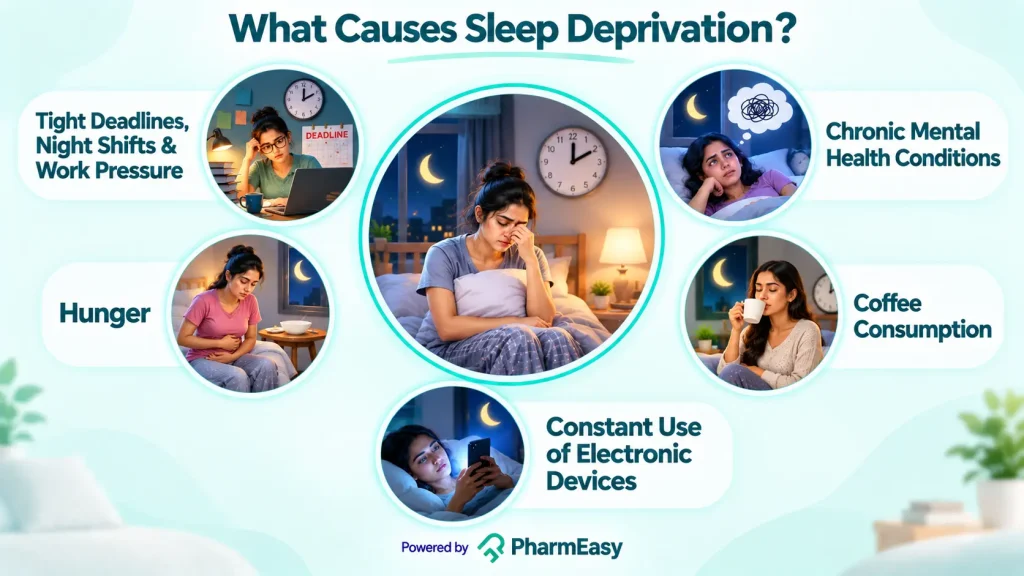
Sometimes lack of sleep is related to a much deeper root cause that we may not identify immediately. If you observe a pattern wherein you cannot get enough hours in to make up for your sleep, then it’s important to recognize and act on the reasons that may be keeping you from leading a healthy lifestyle. Here are some of the most common reasons causing sleep deprivation:
Decrease in REM (Rapid eye movement) sleep leads to cognitive dysfunction which further leads to memory loss in adults. Similarly in babies and children most of the bodily growth occurs in sleep10.
Dr. M.G. Kartheeka, MBBS, MD(Pediatrics)
What are some of the prominent signs that you’re depriving your body of adequate sleep?
Overworking your body and keeping it deprived of sleep for long leads to obvious signs of fatigue. These are3:
Sleeping for at least 6-8 hours is very important for a variety of physical and mental health reasons, especially during night as it helps synchronise the circadian rhythm of your body with the environment11.
Dr. Ashish Bajaj, M.B.B.S., M.D. in Clinical Pharmacology and Toxicology
If not getting sleep is a perpetual habit that troubles you, you need to find a way out to make up for your backlog of sleep in order to stay away from weariness, health problems and other related issues.
Now the question here is how to do this. While catching up on all your sleep is not something you can achieve overnight, a proper routine can help you get back on track in just a few weeks.
You can do this by adding an extra hour or two to your daily quota of sleep. Also, do not keep yourself awake deliberately. Avoid having large meals before dinner9 and go to bed as soon as you start feeling tired or sleepy. Make sure your bedding and room atmosphere are comfortable for sleeping. While you might end up sleeping for 10 hours as a result of the initial phases, your routine will reach normalcy in a while.
Also Read: Tips To Sleep Better At Night
Chronic insufficient sleep can be associated with adverse metabolic, cardiovascular, cognitive and mental-health outcomes. Having known the possible side effects of less sleep, make sure that you’re not deliberately awake way past your bedtime, inviting these long-term health problems. Go to bed and wake up on time to remain active all day and keep health issues at bay.
Yes. Staying awake for around 30 hours can significantly impair attention, reaction time, decision-making, and coordination, increasing the risk of errors and accidents. It is important to prioritise sleep and avoid driving or operating machinery when severely sleep-deprived.
Consult a doctor if sleep problems occur regularly, affect your daytime functioning, or leave you excessively sleepy despite having enough time to sleep. Persistent sleep difficulties may sometimes be related to an underlying sleep or health condition.
The best way to recover is to allow sufficient time for sleep and gradually return to a consistent sleep schedule. Avoid relying on caffeine or energy drinks to replace sleep and seek medical advice if sleep deprivation persists.
Yes. Severe or prolonged sleep deprivation can cause perceptual disturbances, including hallucinations, particularly after extended periods without sleep. If hallucinations occur, medical evaluation is advisable, especially if they persist after adequate sleep.
Creatine is not an established treatment for sleep deprivation, and there is currently insufficient evidence to recommend a specific timing or dose for this purpose. Early research suggests it may modestly support some aspects of cognitive performance during sleep loss, but more research is needed.
1. Ramos AR. Sleep Deprivation, Sleep Disorders, and Chronic Disease. Prev Chronic Dis. 2023;20. doi:10.5888/pcd20.230197 https://pmc.ncbi.nlm.nih.gov/articles/PMC10487788/
2. Sleep Deprivation and Deficiency – How Sleep Affects Your Health. NHLBI, NIH. June 15, 2022. Accessed September 9, 2026. https://www.nhlbi.nih.gov/health/sleep-deprivation/health-effects
3. Sleep deprivation. Accessed September 9, 2026. http://www.betterhealth.vic.gov.au/health/conditionsandtreatments/sleep-deprivation
4. Direksunthorn T. Sleep and Cardiometabolic Health: A Narrative Review of Epidemiological Evidence, Mechanisms, and Interventions. Int J Gen Med. 2025;18:5831-5843. doi:10.2147/IJGM.S563616 https://pubmed.ncbi.nlm.nih.gov/41035532/
5. Ramos AR. Sleep Deprivation, Sleep Disorders, and Chronic Disease. Prev Chronic Dis. 2023;20. doi:10.5888/pcd20.230197 https://pmc.ncbi.nlm.nih.gov/articles/PMC10487788/
6. Gomes S, Ramalhete C, Ferreira I, Bicho M, Valente A. Sleep Patterns, Eating Behavior and the Risk of Noncommunicable Diseases. Nutrients. 2023;15(11):2462. doi:10.3390/nu15112462 https://pubmed.ncbi.nlm.nih.gov/37299426/
7. AlShareef SM. The impact of bedtime technology use on sleep quality and excessive daytime sleepiness in adults. Sleep Sci. 2022;15(Spec 2):318-327. doi:10.5935/1984-0063.20200128 https://pmc.ncbi.nlm.nih.gov/articles/PMC8906383/
8. Chaudhary NS, Grandner MA, Jackson NJ, Chakravorty S. Caffeine consumption, insomnia, and sleep duration: Results from a nationally representative sample. Nutr Burbank Los Angel Cty Calif. 2016;32(11-12):1193-1199. doi:10.1016/j.nut.2016.04.005 https://pubmed.ncbi.nlm.nih.gov/27377580/
9. Sleep Deprivation and Deficiency – Healthy Sleep Habits. NHLBI, NIH. March 24, 2022. Accessed September 9, 2026. https://www.nhlbi.nih.gov/health/sleep-deprivation/healthy-sleep-habits
10. Hyndych A, El-Abassi R, Mader EC Jr. The Role of Sleep and the Effects of Sleep Loss on Cognitive, Affective, and Behavioral Processes. Cureus. 2025 May 16;17(5):e84232. doi: 10.7759/cureus.84232. PMID: 40525051; PMCID: PMC12168795. https://pmc.ncbi.nlm.nih.gov/articles/PMC12168795/
11. Desai D, Momin A, Hirpara P, Jha H, Thaker R, Patel J. Exploring the Role of Circadian Rhythms in Sleep and Recovery: A Review Article. Cureus. 2024 Jun 3;16(6):e61568. doi: 10.7759/cureus.61568. PMID: 38962617; PMCID: PMC11221196. https://pmc.ncbi.nlm.nih.gov/articles/PMC11221196/
Disclaimer: The information provided here is for educational/awareness purposes only and is not intended to be a substitute for medical treatment by a healthcare professional and should not be relied upon to diagnose or treat any medical condition. The reader should consult a registered medical practitioner to determine the appropriateness of the information and before consuming any medication. PharmEasy does not provide any guarantee or warranty (express or implied) regarding the accuracy, adequacy, completeness, legality, reliability or usefulness of the information; and disclaims any liability arising thereof.
Links and product recommendations in the information provided here are advertisements of third-party products available on the website. PharmEasy does not make any representation on the accuracy or suitability of such products/services. Advertisements do not influence the editorial decisions or content. The information in this blog is subject to change without notice. The authors and administrators reserve the right to modify, add, or remove content without notification. It is your responsibility to review this disclaimer regularly for any changes.
 7
7  1
1Comments

Leave your comment...
You may also like

























Comments