




How Does Junk Food Damage Your Body?
By Dr. Nikita Toshi +2 more

Medically reviewed by Dr. Mehul Choksi
Last updated: Sep 1, 2026 Published on: Nov 26, 2017


Get,

to manage your symptom
Get your,

4 Cr+ families
benefitted

OTP sent to 9988776655



You’ve successfully subscribed to receive
doctor-approved tips on
Whatsapp

Get ready to feel your best.


Register to Avail the Offer
Send OTPBy continuing, you agree with our Privacy Policy and Terms and Conditions
Hi There,
Sign up on PharmEasy now!!


Trusted by 4 crore+ families

OTP sent to 9988776655
You have unlocked 25% off on medicines


Code: NU25

By Dr. Nikita Toshi +2 more
Table of Contents
It is a known fact that eating too much junk food can be detrimental to your health and cause serious repercussions in the future. There are many chronic health conditions like obesity, high blood sugar, cholesterol, and blood pressure that can directly be linked to the consumption of junk food1.
In this blog, we unravel the impact of junk foods on health and their long-term impact on your body with Dr Mehul Choksi.

Dr Mehul Choksi is one of the leading Consultant gastroenterologists practicing in Mumbai. He is proficient and has successfully handled many Gastroenterology procedures like Gastroscopic biopsies, Endoscopic sclerotherapy, endoscopic variceal ligation, Snare polypectomy, and PEG tube placement among many others.
It’s important to know the impact junk food has on our health to understand the severity of the situation. Food like burgers, pizza, and French fries can be had once a while and should be restricted to one time a day.
Foods like these contain high levels of sugar, fat, and salt which together and even individually can lead to conditions like diabetes, obesity, and heart disease2 if not kept in check.
”A person can have junk food once in a while but whatever junk food is planned to be consumed should have been freshly prepared and served hot.”
You can clearly find that junk food does more harm than good to the body. This is mainly due to the fact that these junk foods have less or no presence of necessary nutrients and also have low satiation levels. This means that you would end up overeating something which is of low nutritional value.
”Long-term intake can lead to constipation and vital nutrient, vitamin and mineral deficiencies.”
Nowadays, we can see kids and the younger generation increasingly indulging in fast food. Regularly eating junk food might create various health problems like malnutrition, dental problems, etc. I would highly recommend restraining your kids from having junk food more often5.
Dr. Siddharth Gupta, B.A.M.S, M.D (Ayu)
The impact of junk food can be seen quite visibly among the younger generations, especially the teenagers and pre-teens as they get overly influenced by the marketing commercials seen on television. You can often see groups of young teenagers in fast food joints eating a whole assortment of unhealthy food on a regular basis.
This has led to a drastic increase in obesity and a decrease in their daily nutritional intake, which further complicates their health. Gastroenterologists see many cases of teenage obesity, high cholesterol, and atherosclerosis on a daily basis due to these bad food choices.
Since foods high in sugar and salt are known to elevate serotonin levels in the body, it also leads to constant mood swings and anxiety-like symptoms every time the sugar levels in your body crash4.
They also experience loss in concentration and extreme fatigue coupled with a drop in cognitive senses. Unlike the elderly who would have specific ailments pertaining to digestion and processing of junk food and its contents, the teenagers would also have to cope with mental ailments and cognitive disabilities if exposed to too much junk food.
”Junk food is harmful because it contains a high level of calories from sugar or fat without the presence of fibre, protein, vitamins or minerals.”
Having junk food constantly might have adverse effects on your kid’s mental health. It is been studied that kids who eat junk food frequently might experience psychological distress and show violent behaviour6.
Dr. Rajeev Singh, BAMS
Junk food tastes delectable due to the high amounts of sugar and salt present in it. Consuming it too much is sure to have negative effects on your health and has the potential to cause irreversible damage to your vital organs.
Only permissible levels of junk food are advisable
These permissible limits are subjective to the amount of physical activity and exercise one does during the day.
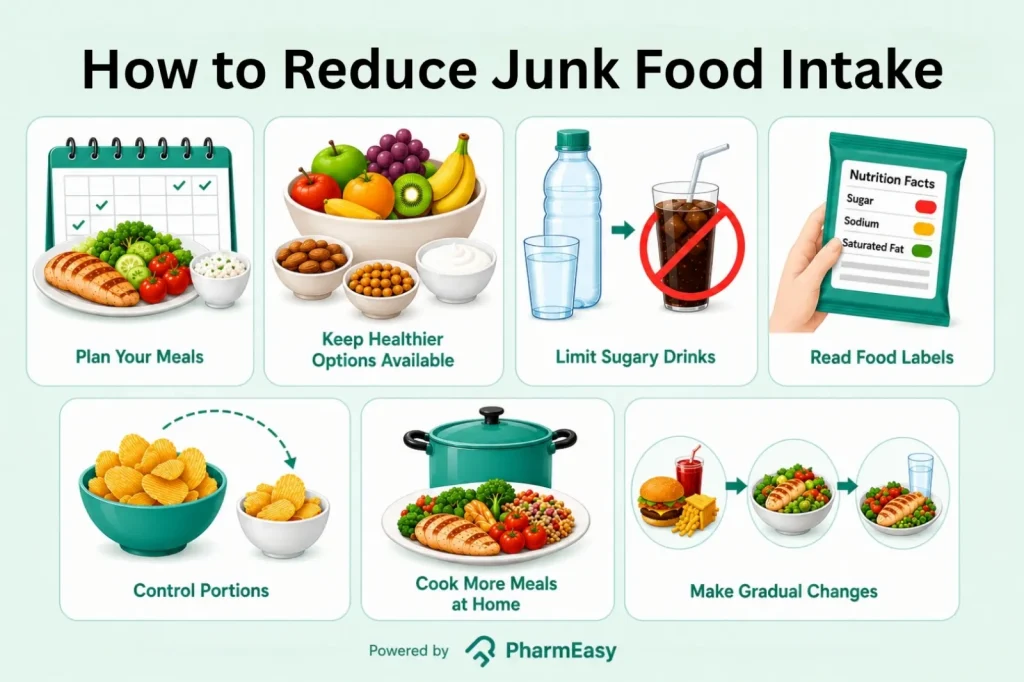
Reducing junk food does not mean you have to eliminate it completely. Making gradual changes and choosing more nutritious foods can help improve your overall diet and make healthier eating habits easier to maintain.
The goal is not to follow a perfect diet but to make nutritious foods the regular choice and keep highly processed foods as an occasional part of the diet.
It is not necessary to completely avoid favourite foods. Instead, highly processed, fried or sugary options can be replaced with foods that provide more fibre, protein, vitamins and minerals.
These simple swaps can help improve overall diet quality while still allowing room for occasional treats.
Also Read: 17 Protein-Rich Foods For a Healthy Life
Junk food may be the most preferred food but definitely not the healthiest. It is very important that you know how much is too much for your body. Consuming permissible amounts accordingly on an occasional basis should be the way to devour junk food.
Eating too much junk food can increase your intake of calories, added sugars, unhealthy fats and sodium while providing fewer essential nutrients and fibre. Regularly eating large amounts may contribute to weight gain, digestive problems and high blood pressure
Start by keeping healthier snacks readily available and limiting highly processed foods at home. Eating regular, balanced meals with protein, fibre and healthy fats can also help reduce cravings.
Snacks containing protein and fibre can help you feel full for longer. Options include Greek yoghurt with fruit, nuts, roasted chickpeas, or an apple with peanut butter.
It is better to limit foods rather than completely avoid specific foods. Highly processed foods high in added sugar, excess sodium, and unhealthy fats, such as sugary drinks, processed meats and deep-fried foods, are best consumed occasionally.
Yes, eating greasy, spicy or heavily processed foods may trigger diarrhoea in some people, especially if they irritate the digestive system. Food contaminated with harmful bacteria can also cause diarrhoea and other symptoms.
Disclaimer: The information provided here is for educational/awareness purposes only and is not intended to be a substitute for medical treatment by a healthcare professional and should not be relied upon to diagnose or treat any medical condition. The reader should consult a registered medical practitioner to determine the appropriateness of the information and before consuming any medication. PharmEasy does not provide any guarantee or warranty (express or implied) regarding the accuracy, adequacy, completeness, legality, reliability or usefulness of the information; and disclaims any liability arising thereof.
Links and product recommendations in the information provided here are advertisements of third-party products available on the website. PharmEasy does not make any representation on the accuracy or suitability of such products/services. Advertisements do not influence the editorial decisions or content. The information in this blog is subject to change without notice. The authors and administrators reserve the right to modify, add, or remove content without notification. It is your responsibility to review this disclaimer regularly for any changes.
 5
5  2
2Comments

Leave your comment...
You may also like
























Comments