

14+ orders placed in your location

100% NABL & ISO Certified Lab • 100% Accurate Reports
Interleukin 6 (IL6) Test
IL6, Interleukin 6, Cytokine, IL-6
- SummaryThe IL-6 test measures the level of Interleukin 6, a cytokine involved in inflammation and immune response. Elevated levels may indicate infections, autoimmune diseases, sepsis, or inflammatory conditions like COVID-19 complications. The test is performed using a blood sample, and fasting is not required.Read more
- Reports Within13 HrsView Sample Report

 100% NABL & ISO Certified Labs
 - SampleBlood

- AgeAll Age Group
- GenderMale and Female
- FastingNot Required

PharmEasy Promises



Know More About The Test


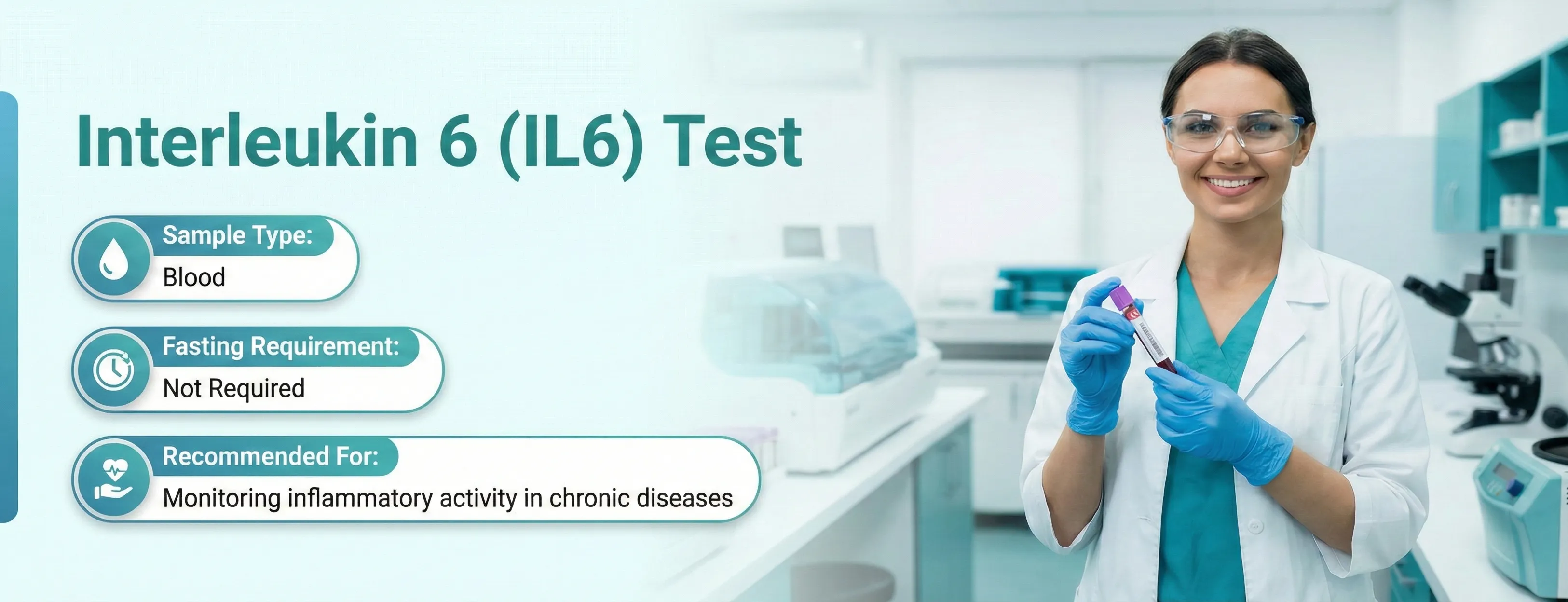
A quick info on Interleukin 6 (IL6) Test

Overview
The interleukin 6 (IL-6) test measures the level of IL-6, a cytokine, or signalling protein, that plays a central role in the body's inflammatory and immune responses. When the body faces infection, injury, trauma, burns, or other stress, immune cells release IL-6 as part of the inflammatory cascade. It helps trigger the acute-phase response that mobilises the body's defences, and it is one of the most useful markers of immune system activation.
IL-6 has wide-ranging effects. It helps direct the immune response, supports the production of blood cells (white cells, red cells, and platelets), and acts as a pyrogen, meaning it can cause fever. Its levels rise in many situations - infections, sepsis, autoimmune diseases such as rheumatoid arthritis and systemic lupus erythematosus (SLE), cardiovascular disease, diabetes, and some cancers. Long-term overexpression of IL-6 has been linked to several chronic conditions.
One important modern use of IL-6 is in COVID-19. IL-6 is an early marker of a cytokine storm, an excessive inflammatory response, and helps doctors judge the severity of infection and decide whether a patient may need hospital admission. Because IL-6 is a non-specific marker, a raised level shows that inflammation is present but does not, by itself, identify the cause. It is most useful when interpreted alongside the clinical picture and other tests, and it is often used to gauge the severity of inflammation and to monitor how a condition is responding to treatment.
When and Who Should Get a Interleukin 6 (IL6) Test Done?
Your doctor may recommend an IL-6 test when there are signs of significant acute or chronic inflammation, or to assess the severity of certain conditions.
Acute Inflammatory Signs That May Prompt the Test
- High fever, increased heart rate, and excessive sweating.
- Breathlessness, severe body pain, or muscle soreness.
- A sudden rash or hives, or swelling of the mouth, tongue, or lips.
- Dizziness.
Chronic Inflammatory Signs That May Prompt the Test
- Persistent pain, frequent exhaustion, and muscle or joint stiffness.
- Low-grade fever, chills, and frequent headaches.
- Nausea, indigestion, insomnia, or unexplained weight loss.
The IL-6 test is used in conditions such as COVID-19, sepsis, uncontrolled diabetes, cancer, bacterial or viral infections, rheumatoid arthritis, atherosclerosis, irritable bowel syndrome, tissue injury, and autoimmune diseases. It applies to males and females of all ages.
.png?dim=48x48&q=75)
How Frequently Should You Take the Interleukin 6 (IL6) Test?
IL-6 responds very quickly to inflammation, so it is often repeated to track how a condition is evolving. Levels begin to rise within 2 to 4 hours of an inflammatory process and start to fall after about 24 hours if the body is recovering.
If IL-6 does not fall as expected, the test is repeated; if it keeps rising, doctors may repeat it daily. In COVID-19, IL-6 may be checked on alternate days or twice a week until levels gradually return to normal.

What Conditions Can a Interleukin 6 (IL6) Test Help Detect?
As a marker of immune activation, IL-6 helps assess the presence and severity of inflammation across many conditions:
|
Category |
Examples |
|---|---|
|
Infections and sepsis |
Bacterial and viral infections, sepsis, and COVID-19 (cytokine storm). |
|
Autoimmune disease |
Rheumatoid arthritis and systemic lupus erythematosus (SLE). |
|
Cardiovascular and metabolic |
Atherosclerosis, cardiovascular disease, stroke, and diabetes. |
|
Cancers |
Certain cancers, including links to Kaposi's sarcoma and multiple myeloma. |
|
Tissue stress |
Trauma, burns, and tissue injury. |
.png?dim=48x48&q=75)
Interleukin 6 (IL6) Test Preparation
The IL-6 test needs no special preparation, which makes it simple and convenient, including when repeated monitoring is required.
What to Expect Before the Test
- No special preparation or fasting is usually required.
- If it is combined with another test that needs preparation, follow that specific instruction.
- Tell your doctor about your medicines (including NSAIDs), sleep, and any conditions, as some factors can affect IL-6.
- Always speak with your doctor before the test for guidance.
What to Expect During the Blood Collection
A phlebotomist cleans the skin with an antiseptic, then places an elastic band around your upper arm to make the veins easier to access. A small needle is inserted into the vein; you may feel a brief pinch. Blood is collected into a labelled tube in under a minute.
What to Expect After the Test
A small cotton swab and bandage are placed over the site to stop any minor bleeding. There may be slight soreness at the needle site or mild lightheadedness. If you feel dizzy, sit and rest for a few minutes.

What are the Parameters Included in a Interleukin 6 (IL6) Test?
The IL-6 test measures a single parameter: the level of interleukin-6 in your blood, reported in pg/mL. The result reflects the degree of inflammatory activity in the body.
- Interleukin-6 (IL-6): a cytokine released during inflammation. A normal level suggests little active inflammation, while a raised level indicates the body is responding to infection, injury, or another inflammatory process.
Because IL-6 is non-specific, it is often used together with other inflammation markers, such as C-reactive protein (CRP) and with tests aimed at finding the underlying cause.

Normal Range of Interleukin 6 (IL6) Test Parameters
The table below shows the typical reference range for IL-6.
|
Parameter |
Normal range |
|---|---|
|
Interleukin-6 (IL-6) |
0 - 16.4 pg/mL |
|
Elevated IL-6 |
Above the reference range: indicates active inflammation. |
Important Note: IL-6 is a non-specific marker and does not diagnose any single disease. Reference ranges vary between laboratories, so always refer to the range printed on your own report and interpret it with your clinical history.
.png?dim=48x48&q=75)
Interleukin 6 (IL6) Test Result Interpretation
Your IL-6 result reflects the level of inflammation and is interpreted alongside your symptoms and other tests.
|
Result |
Possible interpretation |
|---|---|
|
Within normal range |
Mild active inflammation; generally reassuring in the right clinical context. |
|
Elevated |
Active inflammation - the body may be fighting infection, healing from injury, or responding to a chronic or autoimmune condition. |
|
Markedly high / rising |
Suggests a strong inflammatory response; in severe illness such as COVID-19, this can indicate greater severity and the need for closer care. |
Disclaimer: This information is for educational purposes and provides a risk assessment only. It does not confirm a diagnosis. Always consult your doctor to understand how your IL-6 result relates to your overall health.

Interleukin 6 (IL6) Test Risks and Limitations
The IL-6 test is a routine blood draw that is generally very safe, with minor procedural risks and some important limitations.
Potential Risks and Complications
Most people feel only a brief pinch. Consult your doctor if you notice:
- Persistent bleeding at the puncture site that does not stop with gentle pressure.
- Redness, swelling, or pain at the needle insertion site.
- Light-headedness that continues after the blood draw; sit and rest before leaving.
Understanding IL-6 Test Limitations
- IL-6 is non-specific, an elevated level may confirm inflammation but cannot identify the cause.
- Levels change quickly, so timing and repeat testing matter for interpretation.
- NSAIDs, lack of sleep, and obesity can affect the result.
- Reference ranges differ between labs, so results may not be directly comparable.

Related and Follow-up Tests
IL-6 is rarely used alone. Your doctor may order additional tests to find the cause of inflammation or assess severity.
|
Your situation |
Suggested follow-up test |
Why it is ordered |
|---|---|---|
|
Raised IL-6 |
Another inflammation marker often used alongside IL-6. |
|
|
Suspected infection |
Helps assess infection and, with procalcitonin, bacterial sepsis. |
|
|
Severe COVID-19 |
Part of the panel used to assess COVID-19 severity. |
|
|
Autoimmune features |
Investigates autoimmune causes of inflammation. |
|
|
Chronic inflammation |
A simple, complementary marker of ongoing inflammation. |
Interleukin 6 (IL6) Test Sample Collection: Home vs. Diagnostic Lab
|
Feature |
Home collection (PharmEasy) |
Traditional diagnostic lab |
|---|---|---|
|
Convenience |
High - Sample is taken from your home or office. |
Low - Requires travelling and waiting in queues. |
|
Time saving |
Maximum - No travel time. You pick the time slot. |
Minimum - Depends on traffic and lab rush. |
|
Safety and comfort |
Safe - Avoids exposure to other sick patients. |
Moderate - Exposure to crowded waiting areas. |
|
Process |
A professional phlebotomist visits you. |
You must visit the facility during its working hours. |
|
Report access |
Digital - Sent directly to your app or email. |
Often requires a second visit for physical copies. |
Pro Tip: Book your IL-6 test on PharmEasy for safe, at-home sample collection and a secure digital report - convenient when inflammation needs to be monitored over time.
Was This Test Information Helpful?
Please rate your experience
 Yes Helpful
  Not Helpful
References
People Also Ask
What is the IL-6 test used for?
What is the normal range for IL-6?
Does a high IL-6 mean I have a specific disease?
Why is IL-6 important in COVID-19?
Do I need to fast before the test?
How quickly does IL-6 change?
 4.6 Stars| 7+ Lakhs Ratings & Reviews

Over 10 million happy users PharmEasy Labs
- Because the digital report is available on WhatsApp, there's no need to go back to the lab. Thanks, PharmEasy!
 Sachin sharma11 Jan ‘26
 - Thanks to the coupon discount, the blood test was done at a lower price.Komal04 Jan ‘26
- The lab technician was a good and knowledgeable professional.Rakesh Pandey06 Jan ‘26
- Due to bad weather, it's difficult to reach the lab. But home collection makes things easier.Arjun08 Jan ‘26
- Thanks to the Swasth AI feature, the report is easy to understand.Priya Mehta02 Jan ‘26
- The report is available on the same day. Wow!Vikas Patel05 Jan ‘26
Have any doubts? Ask us.
Ask us anything about the Interleukin 6 (IL6) Test to understand it better

We provide trusted, expert-curated health content to support better awareness,prevention, and care.
Backed by experienced doctors, medical experts, and strict editorial standards.