




Health Benefits of Parijat Leaves and Flowers
By Dr. Raghuveer +2 more

Medically reviewed by Dr. Raghuveer
Last updated: Sep 8, 2026 Published on: Sep 4, 2020


Get,

to manage your symptom
Get your,

4 Cr+ families
benefitted

OTP sent to 9988776655



You’ve successfully subscribed to receive
doctor-approved tips on
Whatsapp

Get ready to feel your best.


Register to Avail the Offer
Send OTPBy continuing, you agree with our Privacy Policy and Terms and Conditions
Hi There,
Sign up on PharmEasy now!!


Trusted by 4 crore+ families

OTP sent to 9988776655
You have unlocked 25% off on medicines


Code: NU25
Comments
Leave your comment here

By Dr. Raghuveer +2 more
Table of Contents
According to mythological stories, Parijat is a heavenly tree brought to earth by Lord Krishna. Parijat is a small shrub that has fragrant flowers with seven to eight petals arranged on an orangish-red stem. Parijat flower loses its brightness during the daytime and blooms at night, so commonly known as night jasmine. These beautiful flowers are used in many spiritual activities. Parijat plant is also used in traditional medicine as it is believed to have several health benefits. In this blog, we’ll have a look at its potential health benefits, possible side effects and how the plant can be used.
In Ayurveda, the whole Parijat plant is said to have various healing properties. From leaves to roots, it has several uses.
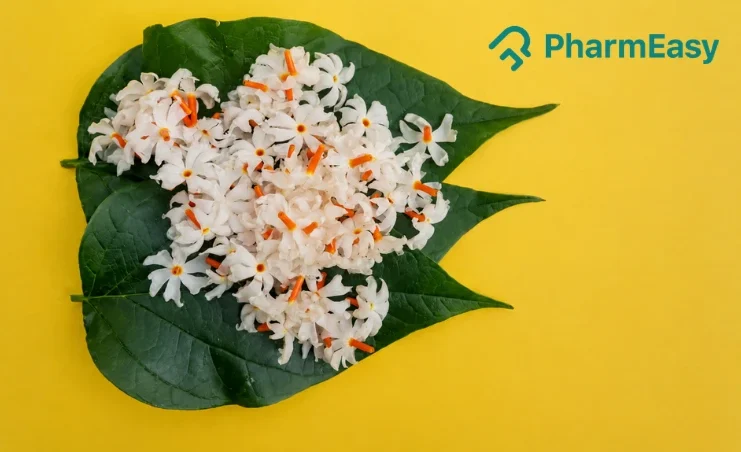
Parijat is a versatile plant used in Ayurveda for its health benefits. Due to its potential medicinal properties, it has become a matter of interest for research. This antioxidant, medicinal plant is said to have numerous health benefits, from alleviating pain to reducing fever.

Parijat is known to be a great antipyretic. It is used in various types of fever, including malaria, dengue, and chikungunya fevers. Parijat leaf and bark extract are very useful in ameliorating fever instantly. Some studies have found that Parijat leaves are very beneficial for the treatment of the symptoms of fevers like malaria4.
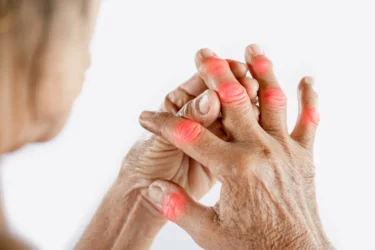
Parijat plant extracts are said to have anti-inflammatory properties due to the presence of flavonoids which can help relieve swelling and discomfort in arthritis, joint pain and sciatica. Parijat leaves and flowers added to specific essential oils and are found to be beneficial in the treatment of arthritic knee pain4,5.

Tea made from Parijat leaves and flowers can help reduce cough, cold, and symptoms of respiratory issues like bronchitis. Studies show that the ethanol extract of the Parijat plant is an excellent bronchodilator and helps relieve discomfort in asthma5.
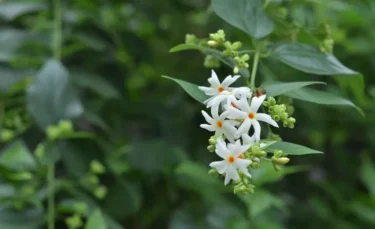
Parijat oil is said to have antifungal and antibacterial properties. It helps to inhibit germs like E. coli. Staph infection, and some fungal infections. It can also be used to treat various fungal infections of the skin5.
Parijat is known for its antioxidant and anti-inflammatory properties that have been used traditionally for ages. In my experience, due to these properties, Parijat may be used as an anti-venom in case of snakebites as well11.
Dr. Siddharth Gupta, B.A.M.S, M.D (Ayu)

Parijat flowers and leaves can stimulate immune cells to fight infections and strengthen immunity due to the presence of several phytochemicals in them6.

An important potential health benefit of Parijat is the regulation of blood sugar levels. Studies suggest that Parijat flower extract has a potent anti-diabetic effect due to its glycoside arbortristoside-A and the various flavonoids which help lower blood sugar by enhancing insulin secretion, improving glucose tolerance, and enhancing antioxidant defense mechanisms7.

Topical application of Parijat extracts can help fight dandruff and hair lice. Flowers of Parijat work as a hair tonic and are used to strengthen the hair, avoid hair fall and other scalp-related problems. Parijat is also used for promoting skin healing and fighting acne owing to its antioxidant and antimicrobial activities5,8.
Apart from the above benefits, Parijat is also used in ayurveda for the following3,9:
While Parijat is extensively used in ayurvedic preparations, scientific research on its health effects is still in the initial phases. Further large-scale human trials are needed to confirm its properties and benefits in humans.
From my perspective, Parijat is a potential medicine for various skin diseases. To support this, I recently came across an article that says the extracts from the flowers and seeds of Parijat have shown anti-inflammatory and antioxidant properties, making it a potential aid for skin ailments11.
Dr Rajeev Singh, BAMS
Parijat leaves and flowers can be used in a few different ways9:
Several plants may appear visually similar, and incorrect identification can lead to unintended side effects or ineffective use. Proper sourcing from reputable herbal providers helps ensure safety10.
Also, it’s important to consult a certified ayurvedic practitioner to understand the correct dosage for you and not consider it as a replacement for any ongoing/needed medical therapy.
Also Read: Pathimugam (Sappanwood) Water: Benefits, Uses, Side Effects & More
Parijat should be used cautiously and in moderation. There can be a few side effects of Parijat seen in some individuals3,5:
It is best to consult your healthcare provider before including Parijat in your routine diet, especially if you have any medical conditions or are on any medications.
Parijat has long been used in traditional medicine for several purposes. While early research suggests that the plant may offer various health benefits, more long-term scientific studies are needed to fully understand its effectiveness and safety. As with any herbal remedy, it is advisable to consult a qualified healthcare professional before using Parijat for therapeutic purposes, especially if you are pregnant, breastfeeding, have an existing medical condition, or are taking any medications.
They are typically prepared as herbal decoctions or extracts rather than eaten raw, as preparation methods may influence both safety and effectiveness.
In traditional practices, the flowers are valued for their mild calming aroma and are sometimes used in herbal infusions intended to promote relaxation and restful sleep.
In traditional practices, Parijat leaves are more commonly used in herbal decoctions aimed at supporting joint comfort and general wellness, while the flowers are often associated with calming infusions and aromatic uses. The difference mainly lies in their traditional applications rather than clearly proven clinical distinctions.
It may be incorporated alongside balanced nutrition, regular physical activity, and stress management practices. However, relying solely on herbal remedies without addressing broader lifestyle factors may limit overall benefits.
1. Uses of Nyctanthes arbor-tristis L. – National Innovation Foundation-India. Accessed July 13, 2026. https://nif.org.in/NYCTANTHES-ARBOR
2. Meshram MM, Rangari SB, Kshirsagar SB, Gajbhiye S, Sahane MRT and RS. NYCTANTHES ARBOR-TRISTIS A HERBAL PANACEA Pr | INTERNATIONAL JOURNAL OF PHARMACEUTICAL SCIENCES AND RESEARCH. Published online August 1, 2012. Accessed July 13, 2026. https://ijpsr.com/bft-article/nyctanthes-arbor-tristis-a-herbal-panacea-pr/?view=fulltext
3. Tripathi A, Srivastava S. Medicinal Properties of Harsingar (Nyctanthes Arbor-tristis Linn.): A Review. Published online January 1, 2021:3406. Available from: https://www.researchgate.net/publication/349604305_Medicinal_Properties_of_Harsingar_Nyctanthes_Arbor-tristis_Linn_A_Review
4. Godse CS, Tathed PS, Talwalkar SS, et al. Antiparasitic and disease- modifying activity of Nyctanthes arbor-tristis Linn. in malaria: An exploratory clinical study. J Ayurveda Integr Med. 2016;7(4):238-248. doi:10.1016/j.jaim.2016.08.003. https://pubmed.ncbi.nlm.nih.gov/27914754/
5. Rani C, Chawla S, Mangal M, Mangal A, Kajla S, Dhawan A. Nyctanthes arbor-tristis Linn. (night jasmine): A sacred ornamental plant with immense medicinal potential. Indian Journal of Traditional Knowledge. 3: 427-435. Indian J Tradit Knowl. 2011;3:427-435. Available from: https://www.researchgate.net/publication/261988496_Nyctanthes_arbor-tristis_Linn_night_jasmine_A_sacred_ornamental_plant_with_immense_medicinal_potential_Indian_Journal_of_Traditional_knowledge_3_427-435
6. Puri A, Saxena R, Saxena RP, Saxena KC, Srivastava V, Tandon JS. Immunostimulant activity of Nyctanthes arbor-tristis L. Journal of ethnopharmacology. 1994 Mar 1;42(1):31-7. Available from: https://pubmed.ncbi.nlm.nih.gov/8046941/
7. Nanu R, Raghuveer I, Chitme HR, Chandra R. Antidiabetic activity of Nyctanthes arbortristis. Pharmacognosy Magazine. 2008 Oct 1;4(16):335-40. Available from: https://www.researchgate.net/publication/259450869_Antidiabetic_activity_of_Nyctanthes_arbortristis
8. Aggarwal A, Mehta DK, Bhardwaj A, Das R. Nyctanthes arbor-tristis: A Multifaceted Medicinal Plant in Traditional and Contemporary Medicine. Planta Med. 2026;92(4):440-464. doi:10.1055/a-2706-7358. Available from: https://pubmed.ncbi.nlm.nih.gov/41213599/
9. Bhatt H, Chamoli RT, Thapliyal S, Saini N, Dobhal S. Harsingar: The holistic healer – uncovering the medicinal benefits of the Parijat flower. J Pharmacogn Phytochem. 2024;13(6):30-34. doi:10.22271/phyto.2024.v13.i6a.15162. Available from: https://www.researchgate.net/publication/385692549_Harsingar_The_holistic_healer_-_uncovering_the_medicinal_benefits_of_the_Parijat_flower
10.Agrawal J, Pal A. Nyctanthes arbor-tristis Linn–a critical ethnopharmacological review. J Ethnopharmacol. 2013;146(3):645-658. doi:10.1016/j.jep.2013.01.024. Available from: https://pubmed.ncbi.nlm.nih.gov/23376280/
11. Chakraborty R, Datta (De) S. A brief overview on the health benefits of Nyctanthes arbor-tristis Linn.-A wonder of mother nature. Indo Global J Pharm Sci. 2022;12:197-204. doi:10.35652/IGJPS.2022.12024. Available from: https://igjps.com/index.php/IGJPS/article/view/193/24
Disclaimer: The information provided here is for educational/awareness purposes only and is not intended to be a substitute for medical treatment by a healthcare professional and should not be relied upon to diagnose or treat any medical condition. The reader should consult a registered medical practitioner to determine the appropriateness of the information before consuming any medication. PharmEasy does not provide any guarantee or warranty (express or implied) regarding the accuracy, adequacy, completeness, legality, reliability, or usefulness of the information; and disclaims any liability arising thereof.
Links and product recommendations in the information provided here are advertisements of third-party products available on the website. PharmEasy does not make any representation on the accuracy or suitability of such products/services. Advertisements do not influence the editorial decisions or content. The information in this blog is subject to change without notice. The authors and administrators reserve the right to modify, add, or remove content without notification. It is your responsibility to review this disclaimer regularly for any changes.
 107
107  6
6Comments

Leave your comment...

View all comments(10)
You may also like






















Can u describe how to use parijat flower for our hair ?
My mother is taking parijat leaves karhaa for 3 to 4 days but yesterday she experienced shivering and a fever of 100.5 degree F. What could be the cause?
Hello,
Parijat leaves’ karha has shown benefits in people suffering from fever. However, every herb or recipe may not suit everyone. If your mother is experiencing a fever after consuming parijat leaf karha for few days, it could also be a coincidence. Kindly discontinue the karha and consult your doctor if the fever persists or worsens. Wish you good health.
Thank you for your feedback, glad you liked it.
My wife is 33 weeks of pregnant, Can she take for parijat leaves as Kadha?
Can I take the powder of Parijat leaves for joint pains?
“My mum is my doctor”actually we don’t have enough money to pay doctor’s fee so she spend some time on YouTube to get knowledge of these kind of herbs..
For the past couple of years she kept on repeating the benefits of harsingar,parijit… But I never gave it a shot so today finally I decided ok Rahul let’s Google it and my whole world went upside down I went crazy
Thank you, glad you liked it. Stay tuned for more such articles.
इतने सारे लाभ हैं पारिजात से ….मैंने भी एक पौधा लगाया था ,इस समय पुष्प आ रहे हैं…मनमोहक सुगन्ध …धन्यवाद लाभप्रद जानकारी के लिए…
In my view, parajit leave also use full to control cholesterol
ketan chauhah