

20+ orders placed in your location

100% NABL & ISO Certified Lab • 100% Accurate Reports
Anti Chlamydia Antibody Test - IgM
Chlamydia Trachomatis IgM
- SummaryThe Anti-Chlamydia IgM test detects IgM antibodies against Chlamydia trachomatis, indicating a recent or active Chlamydia infection. It helps diagnose sexually transmitted infections (STIs) or reproductive tract infections. The test is done using a blood sample, and fasting is not required.Read more
- Reports Within62 HrsView Sample Report

 100% NABL & ISO Certified Labs
 - SampleBlood

- AgeAll Age Group
- GenderMale and Female
- FastingNot Required

PharmEasy Promises



Know More About The Test


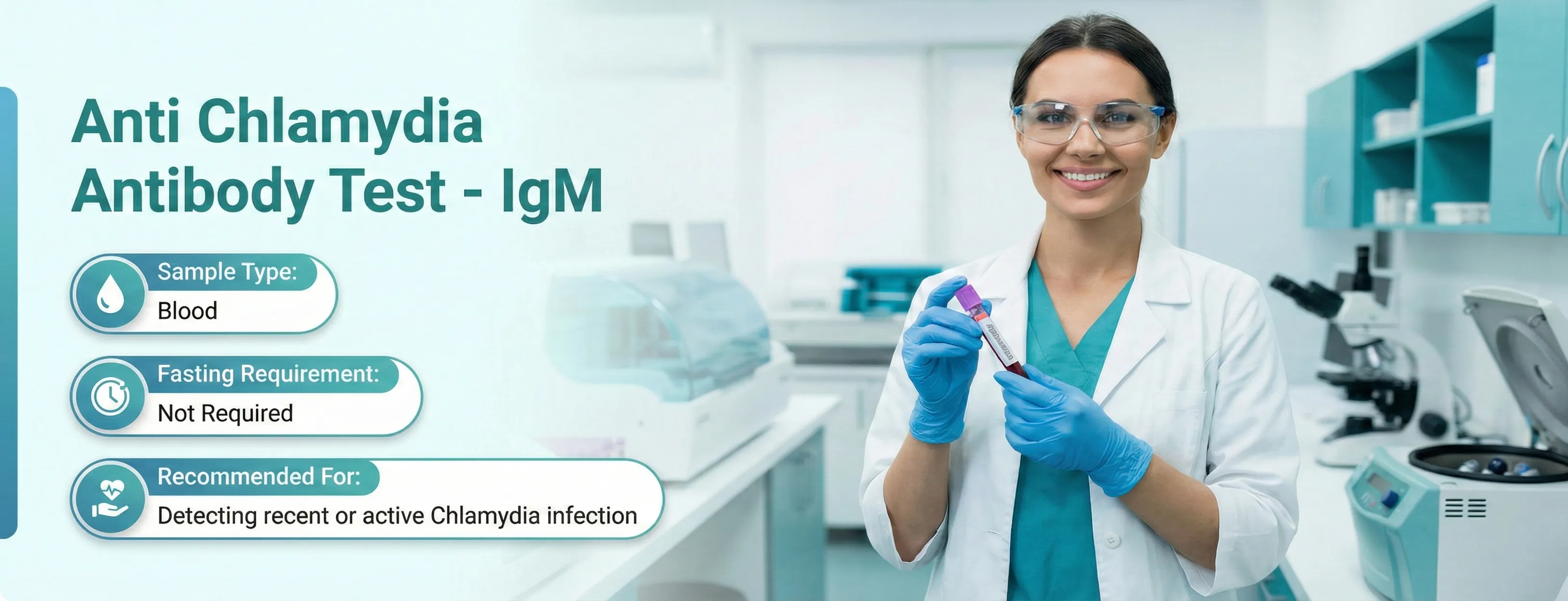
A quick info on Anti Chlamydia Antibody Test - IgM

Overview
The anti-chlamydia antibody IgM test is a blood test that looks for IgM-class antibodies against chlamydia trachomatis, the bacterium responsible for chlamydia, one of the most common sexually transmitted infections (STIs). When the body is exposed to this bacterium, the immune system makes antibodies against it. IgM antibodies are the first to appear and usually indicate a recent or active infection.
Chlamydia spreads through vaginal, oral, or anal sex with an infected person. A key challenge is that most people with chlamydia have no symptoms at all, so they can carry and pass on the infection without knowing. Left untreated, chlamydia can lead to serious complications, including infertility in women and inflammation of the urethra in men. The good news is that the infection is usually easy to treat with antibiotics once it is identified.
The anti-chlamydia IgM test helps determine whether you have been exposed to the bacterium recently. A timely result allows early treatment, helps prevent complications, and supports safer sexual health for you and your partner. It is one of several tools doctors use, and it is usually interpreted alongside your symptoms, sexual history, and other tests.

When and Who Should Get a Anti Chlamydia Antibody-IgM Test Done?
Your doctor may recommend this test if you are at risk of a chlamydia infection or have symptoms that could be linked to an STI. Because chlamydia is often silent, testing is frequently based on risk rather than symptoms.
Common Reasons the Test Is Recommended
- If you are sexually active and have more than one partner.
- If you have had unprotected sex recently.
- If you have been diagnosed with HIV infection.
- If you are pregnant, as part of antenatal screening for infections.
- If you have symptoms such as unusual genital discharge, pain when passing urine, or pelvic pain.
- If a current or recent partner has been diagnosed with chlamydia.
The test is suitable for adults of all genders. It is especially relevant for sexually active people with risk factors, and for pregnant women, where an untreated infection can affect the baby. Your doctor will advise whether this antibody test or a direct test (such as a swab-based NAAT) is most appropriate for your situation.
.png?dim=48x48&q=75)
How Frequently Should You Take the Anti Chlamydia Antibody-IgM Test?
The test helps assess whether you have been exposed to chlamydia trachomatis in the recent past. You may need to repeat it if you have symptoms of chlamydia infection, a new exposure, or if the first test was done too soon after possible exposure.
Sexually active people with ongoing risk factors, such as new or multiple partners, may benefit from regular STI screening as advised by their doctor, even in the absence of symptoms.

What Conditions Can a Anti Chlamydia Antibody-IgM Test Help Detect?
The test mainly helps assess recent exposure to chlamydia trachomatis. Detecting and treating chlamydia early helps prevent its complications, which can include:
- Pelvic inflammatory disease (PID): infection spreading to the uterus and fallopian tubes in women, which can cause lasting damage.
- Infertility: untreated chlamydia is an important and preventable cause of infertility in women.
- Urethritis: inflammation of the urethra, more noticeable in men.
- Ectopic pregnancy: tubal damage from infection raises this risk.
- Pregnancy and newborn complications: untreated infection can affect the baby during delivery.
.png?dim=48x48&q=75)
Anti Chlamydia Antibody-IgM Test Preparation
This test needs no special preparation, but timing matters because antibodies take time to develop after exposure.
What to Expect Before the Test?
- No fasting or special preparation is required from your end.
- For accurate results, wait at least 2 to 4 weeks after a possible exposure, as the immune system needs time to produce IgM antibodies.
- Tell your doctor about your symptoms, sexual history, and any recent treatment, as these guide interpretation.
- Follow any specific instructions if the test is combined with others.
What to Expect During the Blood Collection?
A phlebotomist cleans the skin with an antiseptic, then places an elastic band around your upper arm to make the veins easier to access. A small needle is inserted into the vein; you may feel a brief pinch. Blood is collected into a labelled tube in under a minute.
What to Expect After the Test?
A small cotton swab and bandage are placed over the site to stop any minor bleeding. There may be slight soreness at the needle site or mild light-headedness. If you feel dizzy, sit and rest for a few minutes.

What are the Parameters Included in a Anti Chlamydia Antibody-IgM Test?
The test measures a single parameter: the presence or absence of IgM-class antibodies against chlamydia trachomatis in your blood. The result is reported qualitatively, as positive or negative, rather than as a number.
- Chlamydia trachomatis IgM antibodies: early-response antibodies that suggest recent exposure to the bacterium. IgM typically develops about two weeks after infection and can remain detectable for 2 to 4 months.
Because there are three antibody classes (IgM, IgG, and IgA), your doctor may also order chlamydia IgG to help distinguish recent from past exposure, and may recommend a direct test to confirm an active infection.

Normal Range of Anti Chlamydia Antibody-IgM Test Parameters
This test reports only whether chlamydia antibodies are present or absent. It cannot, on its own, diagnose a chlamydia infection.
|
Test result |
Interpretation |
|---|---|
|
Negative |
No significant chlamydia trachomatis IgM antibodies detected. |
|
Positive |
Chlamydia trachomatis IgM antibodies detected, suggesting recent exposure. |
Important note: Exact cut-off values and reporting can vary between laboratories. Always refer to the result and reference comment printed on your own report and discuss it with your doctor.
.png?dim=48x48&q=75)
Anti Chlamydia Antibody-IgM Test Result Interpretation
Results should always be interpreted with your symptoms and history. Here is what each result generally means:
|
Result |
Possible interpretation |
|---|---|
|
Positive |
Your body has produced antibodies, usually from recent or past exposure. You can be positive even without symptoms (asymptomatic infection). False-positives can occasionally occur. |
|
Negative |
You have likely not been exposed, or were exposed but did not become infected. A false-negative is possible if tested too early (before 4 weeks), so retesting may be advised. |
Importantly, this test cannot tell you whether you are immune to chlamydia, or whether you might spread the infection to others. A positive result should be followed up with your doctor, who may confirm an active infection with direct testing before starting antibiotics.
Disclaimer: This information is for educational purposes and provides a risk assessment only. It does not confirm a diagnosis. Always consult your doctor for the correct interpretation and the right treatment.

Anti Chlamydia Antibody-IgM Test Risks and Limitations
The test is a routine blood draw that is generally very safe, with only minor procedural risks and some important limitations.
Potential Risks and Complications
Most people feel only a brief pinch. Consult your doctor if you notice:
- Persistent bleeding at the puncture site that does not stop with gentle pressure.
- Redness, swelling, or pain at the needle insertion site.
- Light-headedness that continues after the blood draw; sit and rest before leaving.
Understanding Anti-Chlamydia IgM Test Limitations
- Antibodies take 2 to 4 weeks to develop, so early testing can miss a recent infection (false-negative).
- False-positives can occur, and some people who were exposed may never develop antibodies.
- The test cannot confirm an active infection, indicate immunity, or predict whether you can transmit the infection.
- A direct test (urine NAAT or swab) is usually preferred to diagnose an active genital chlamydia infection.

Related and Follow-up Tests
Depending on your result and symptoms, your doctor may recommend additional tests.
|
Your situation |
Suggested follow-up test |
Why it is ordered |
|---|---|---|
|
Positive IgM |
Helps distinguish recent from past exposure. |
|
|
Suspected active infection |
Chlamydia NAAT (urine or swab) |
Directly detects the bacterium to confirm a current infection. |
|
STI risk assessment |
Screens for other sexually transmitted infections, which are often checked together. |
|
|
Female pelvic symptoms |
Gonorrhoea test and pelvic ultrasound |
Look for co-infection and complications such as PID. |

Anti Chlamydia Antibody-IgM Test Sample Collection: Home vs. Diagnostic Lab
|
Feature |
Home collection (PharmEasy) |
Traditional diagnostic lab |
|---|---|---|
|
Convenience |
High - sample is taken from your home or office. |
Low - requires travelling and waiting in queues. |
|
Time saving |
Maximum - no travel time. You pick the time slot. |
Minimum - depends on traffic and lab rush. |
|
Safety and comfort |
Safe - avoids exposure to other sick patients. |
Moderate - exposure to crowded waiting areas. |
|
Process |
A professional phlebotomist visits you. |
You must visit the facility during its hours. |
|
Report access |
Digital - sent directly to your app or email. |
Often requires a second visit for physical copies. |
Pro tip: Book your anti-chlamydia IgM test on PharmEasy for private, at-home sample collection and a confidential digital report, a discreet, comfortable option for sexual-health testing.
Was This Test Information Helpful?
Please rate your experience
 Yes Helpful
  Not Helpful
References
People Also Ask
What does a chlamydia IgM-positive result mean?
Do I need to fast before the test?
How long do chlamydia IgM antibodies stay positive?
Can this test confirm I have chlamydia?
Can I have a negative result and still be infected?
Is my result confidential?
Popular Tests
 Explore the most booked tests in your location
 4.6 Stars| 7+ Lakhs Ratings & Reviews

Over 10 million happy users PharmEasy Labs
- Swasth AI feature was really good, it explained the lab report in very easy and understanding manner
 Vivek Sinha29 Oct ‘25
 - Liked the coupon discount and cheaper price, without any quality compromise.Ishita Chatterjee30 Nov ‘25
- Labs open early but still get crowded. Home testing saved me that early morning stress and I was way more relaxed.Neha Kapoor09 Sep ‘25
- if I had to go to the lab, I would’ve skipped my breakfast and rushed. Home testing happened calmly at home.Arjun Verma03 Dec ‘25
- going to the lab means hunting for parking first. With home sample pick-up I didn’t have to deal with that headache at all.Kavya Iyer25 Nov ‘25
- During weekends, in Mumbai the labs are full. Home testing helped me avoid all that chaos, and I could continue my work from home in between.Rohan Sharma07 Oct ‘25
Have any doubts? Ask us.
Ask us anything about the Anti Chlamydia Antibody Test - IgM to understand it better

We provide trusted, expert-curated health content to support better awareness,prevention, and care.
Backed by experienced doctors, medical experts, and strict editorial standards.