




Malaria: Types, Symptoms, Causes and Treatment
By Dr. Vishesh Bharucha +2 more

Medically reviewed by Dr. Avinav Gupta
Last updated: Aug 18, 2026 Published on: Mar 25, 2022


Get,

to manage your symptom
Get your,

4 Cr+ families
benefitted

OTP sent to 9988776655



You’ve successfully subscribed to receive
doctor-approved tips on
Whatsapp

Get ready to feel your best.


Register to Avail the Offer
Send OTPBy continuing, you agree with our Privacy Policy and Terms and Conditions
Hi There,
Sign up on PharmEasy now!!


Trusted by 4 crore+ families

OTP sent to 9988776655
You have unlocked 25% off on medicines


Code: NU25
Comments
Leave your comment here

By Dr. Vishesh Bharucha +2 more
Table of Contents
Malaria is one of the most dreaded diseases. It is widespread across more than 90 countries, particularly in sub-Saharan Africa, South Asia, and regions of South America. It occurs when the malaria parasite, Plasmodium, infects the female mosquito, Anopheles1. When the malaria mosquito bites humans, within a period of 10 to 15 days, the malaria symptoms start to occur2.
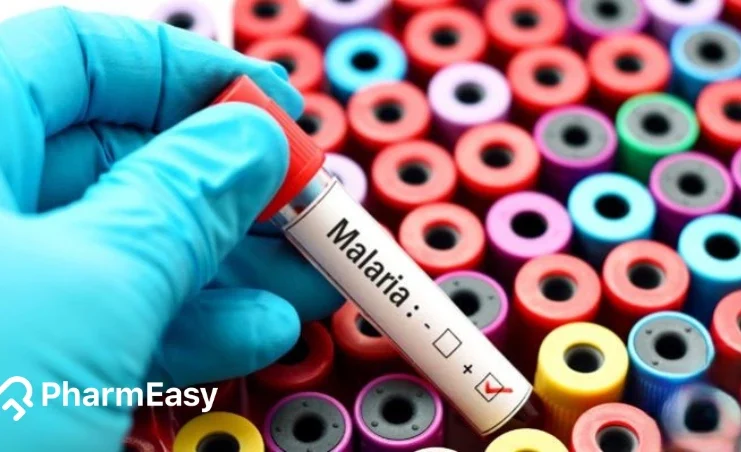
Malaria symptoms vary depending on the subspecies of the Plasmodium that has infected the Anopheles mosquito. Based on the malarial parasite involved, there are four different types of malaria. Each of these types have a different severity of symptoms and needs to be treated differently.
In this blog, we will discuss in detail about malaria; its type, symptoms and treatment. These will help you better understand this infection and know when to act promptly.
India carries a significant share of the malaria burden in the South-East Asia region, though cases have declined considerably over the past decade due to sustained control efforts. The disease is not evenly spread across the country; transmission tends to cluster in certain states and districts.
The highest-burden regions include the eastern and central states of Odisha, Chhattisgarh, Jharkhand, and Madhya Pradesh, along with parts of Maharashtra. The Northeastern states, including Assam, Meghalaya, Mizoram, Tripura, and Arunachal Pradesh, also report substantial malaria activity10.
Within these states, transmission is concentrated in forested, hilly, tribal, rural, and high-rainfall areas. Such regions often combine dense vegetation, water collection sites that allow mosquitoes to breed, and limited access to healthcare, which together create favourable conditions for the disease to spread. Both Plasmodium vivax and Plasmodium falciparum circulate in India, with their relative proportions varying by region. Plasmodium vivax accounts for a large proportion of reported malaria cases, while Plasmodium falciparum is associated with a higher risk of severe disease and complications. Understanding where malaria is common can help travellers and residents take timely precautions.
This is the most common kind of malaria. It is the most widely distributed kind, found all across the globe. More than half of malaria infections found across India are of this type. It may be present in dormant stages and its presence can lead to recurrent episodes of the disease.
More often than not, it does not prove fatal but can be severely debilitating. Common symptoms of this kind of malarial disease include fever and chills, diarrhoea, severe fatigue and flu-like symptoms3.
This is one of the least common types of malaria. It is found mostly in western countries of Africa. Rarely, it is also observed in areas of Philippines, Indonesia, and Papua New Guinea. The symptoms include high fevers and shaking chills, headache, cough, diarrhoea, abdominal/joint pain, and body aches. This malaria disease can be recurring as the parasite rests in the patient’s liver and can stay dormant for years. Relapse may occur at any time during this period, with red blood cells being attacked, and the symptoms appearing again. Among all the types of malaria, this one is dangerous, if not deadly4.
This is the deadliest subtype of malaria in the world. This subspecies of the parasite is found in Africa, Southeast Asia, and South America. Unlike the above species, this species does not cause liver-stage relapses.
The patient feels the malaria symptoms like nausea, fatigue, body aches, enlarged spleen, pain in the abdomen, muscles, and joints, fever, headaches, anaemia and specific neurological symptoms like confusion and seizures. The severity of this malaria disease are such that it needs to be checked for, diagnosed and treated in time to prevent fatalities. It can cause significant harm to the brain and the nervous system. Paralysis and convulsions can also occur in this malaria.
If you are travelling to any of the above areas, take your antimalaria medications to prevent this disease5. Additionally, malaria vaccines such as RTS,S/AS01 and R21/Matrix-M are now available to protect children against P. falciparum infection2.
This is the least common kind of malaria. Fever and chills are the usual malaria symptoms. Sub-Saharan Africa and the southwest Pacific are where the malaria parasite causing this kind of malaria is common. It may persist in the bloodstream at low levels for extended periods, causing chronic infection, but it does not remain in dormant form in the liver1,6.
| Feature | P. falciparum | P. vivax | P. ovale | P. malariae |
|---|---|---|---|---|
| Geographic distribution1 | Africa, Southeast Asia, South America | Worldwide, the most common type in India | Mainly West Africa; rarely Asia-Pacific | Sub-Saharan Africa, the southwest Pacific |
| Severity | Most severe | Usually mild to moderate, but severe | Usually mild | Usually mild |
| Can it come back after recovery? | Does not relapse, but reinfection can occur | Yes | Yes | No (but can persist at low levels in blood for years) |
| Key symptoms/complications | Fever, anaemia, organ involvement, cerebral malaria, seizures, and confusion | Fever, chills, fatigue, flu-like illness, recurrent episodes | fatigue, flu-like illness, recurrent episodes, fever, chills, headache, body aches | Fever, chills; chronic low-grade infection |
| Fatality risk2 | High if untreated | Low, rarely fatal | Low | Low |
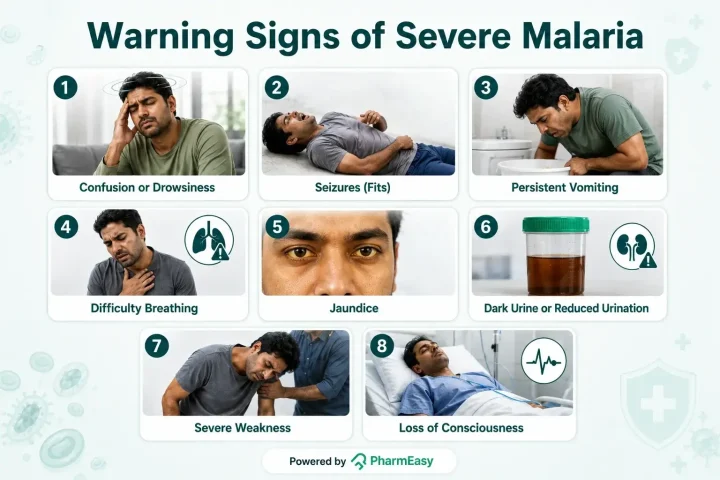
Most malaria infections can be treated effectively when diagnosed early. However, malaria, particularly P. falciparum, can sometimes progress rapidly and become life-threatening. Recognising the warning signs of severe malaria can help you or a loved one get help in time.
Children, pregnant women, older adults, and people with weakened immune systems may be at higher risk of severe malaria and should seek medical evaluation promptly if malaria is suspected.
Seek immediate medical care if a person with suspected or confirmed malaria develops any of the following11:
These signs may indicate that the infection is affecting vital organs such as the brain, lungs, or kidneys. Do not wait for symptoms to improve on their own.
Severe malaria is a medical emergency and requires urgent hospital treatment. If you notice any of these signs, seek emergency care without delay.
Various regimens are followed in the treatment of malaria, depending on the type and drug resistance in humans. Some common ones include7:
Note: Primaquine should be used with caution in G6PD-deficient patients.
While you may think it’s impossible to avoid getting bitten by a mosquito, malaria prevention methods are widely known and accepted. Here are a few8,9:
If you can avoid travelling to an area where malaria is common, then do that. This may mean changing your travel plans, but if you can’t avoid it follow the below-mentioned precautions.
There are standard medications you can take if you are planning to travel to a country where malaria is a risk.
A good way of protecting yourself is to wear clothing that covers the skin of your arms and legs. Additionally, you can also use mosquito-specific repellent sprays as well as topical creams and lotions. Look for the following ingredients in repellents for protection from mosquitoes:
Use mosquito nets to cover your sleeping area and install screens on doors and windows to keep mosquitoes out. For extra protection, use permethrin-treated nets and clothing, or apply 0.5% permethrin spray to gear such as boots, pants, socks, and tents.
If you are travelling to an area where malaria is common, your doctor may recommend preventive medication, known as chemoprophylaxis, taken before, during, and for a period after your trip. Because no preventive measure is fully protective on its own, these medicines are used alongside mosquito-bite prevention. Commonly used options include8:
The right choice depends on several factors, including your destination, how long you will be travelling, your medical history and any existing conditions, and the local drug-resistance patterns in the area. For this reason, you should consult a doctor or a travel-health clinic well before departure, ideally a few weeks ahead, so the medication can be started at the correct time. This blog does not provide dosages; medication and timing should always be decided by a healthcare professional.
Vaccines are now an important addition to malaria prevention. Two vaccines have been recommended by the World Health Organization for use in children living in regions where Plasmodium falciparum malaria is common13:
These vaccines are intended primarily to reduce severe P. falciparum malaria and deaths in young children, the group at most risk. Both have been shown to meaningfully lower the risk of malaria when delivered as part of routine childhood immunisation in endemic areas.
It is important to understand that these vaccines reduce risk but do not provide complete protection, and they are not a replacement for other measures. Children and families should continue to use mosquito nets, repellents, and other bite-prevention methods, and seek prompt treatment if malaria is suspected. Vaccine availability and rollout vary by country, so local health authorities can advise on what is offered in a given area.
Also Read: What Is Hantavirus? Symptoms, Causes, & Effective Prevention
While malaria is usually a non-fatal disease, some types may be dangerous and require prompt recognition and treatment. Knowing the types of malaria and their severity allows you to act immediately if you notice any symptoms.
Depending upon the type, several antimalarial medicines are available for treatment, used in various permutations and combinations with other drugs. Yet, the cornerstone of management remains taking adequate precautions to prevent the occurrence of these infections in the first place.
Also Read: Tuberculosis: Types, Causes, Treatment and Prevention
Disclaimer: The information provided here is for educational/awareness purposes only and is not intended to be a substitute for medical treatment by a healthcare professional and should not be relied upon to diagnose or treat any medical condition. The reader should consult a registered medical practitioner to determine the appropriateness of the information and before consuming any medication. PharmEasy does not provide any guarantee or warranty (express or implied) regarding the accuracy, adequacy, completeness, legality, reliability or usefulness of the information; and disclaims any liability arising thereof.
 22
22  3
3Comments

Leave your comment...

View all comments(1)
You may also like
























Nice