



How India Became The Biggest Exporter Of Generic Medicine?
By Dr. Nikita Toshi +2 more

Medically reviewed by Dr. Avinav Gupta
Last updated: Jul 9, 2026 Published on: Aug 26, 2022


Get,

to manage your symptom
Get your,

4 Cr+ families
benefitted

OTP sent to 9988776655



You’ve successfully subscribed to receive
doctor-approved tips on
Whatsapp

Get ready to feel your best.


Register to Avail the Offer
Send OTPBy continuing, you agree with our Privacy Policy and Terms and Conditions
Hi There,
Sign up on PharmEasy now!!


Trusted by 4 crore+ families

OTP sent to 9988776655
You have unlocked 25% off on medicines


Code: NU25

By Dr. Nikita Toshi +2 more
Table of Contents
The demand for affordable healthcare has been rising steadily across the world. As the burden of chronic diseases grows and healthcare costs increase, governments and individuals are looking for practical ways to make treatment more accessible.
Generic medicines have emerged as one of the most effective solutions to this challenge. They contain the same active ingredients as branded medicines and are required to meet applicable regulatory standards before they can be approved and used7.

India has played a significant role in supplying affordable generic medicines to countries across different regions. Over the decades, the Indian pharmaceutical industry has grown considerably and today supplies medicines to both developing nations and high-income countries alike.
This article covers what generic medicines are, how they are approved and regulated in India, why India is recognised globally as one of the largest suppliers of generic medicines, which countries import from India, and the challenges and opportunities that lie ahead for India’s pharmaceutical exports.
Generic medicines contain the same active ingredients as branded medicines. When a branded medicine is first developed, it applies for a patent, which expires after a certain period of time, and the originating company gets a chance to recoup its research investment. After the patent of a branded medicine expires, it can be manufactured as a generic medicine after getting approval and abiding by safety and quality guidelines. These may be manufactured by the same company or by other firms.
The manufacture and marketing of generic medicines is governed by a structured regulatory process. A generic medicine can only be produced once the patent on the original reference medicine has expired. Patent expiry allows other manufacturers to legally produce the same active ingredient and seek regulatory approval to sell it1.
In India, the Central Drugs Standard Control Organisation (CDSCO) is the national authority responsible for regulating medicines, including generic medicine. The CDSCO evaluates applications from manufacturers seeking approval to manufacture and market generic medicines, ensuring they meet applicable quality, safety and efficacy standards under the Drugs and Cosmetics Act2.
All pharmaceutical manufacturers in India are required to comply with Good Manufacturing Practices (GMP). These internationally recognised guidelines govern the complete manufacturing process, including raw material sourcing, production, testing, packaging and storage3.
GMP compliance helps ensure that medicines are produced consistently and meet required quality standards across all batches.
Generic medicines are generally required to demonstrate bioequivalence with the reference branded medicine. This testing assesses whether the generic product delivers the active ingredient into the body at a comparable rate and extent to the reference product4.
It is important to note that individual responses to any medicine may vary. Generic medicines, like all medicines, should be taken only as prescribed by a registered medical practitioner.
For medicines intended for export, Indian manufacturers may also need to comply with the regulatory standards of the destination country. Depending on the market, this may include approvals from the US FDA, European Medicines Agency (EMA), Medicines and Healthcare products Regulatory Agency (MHRA), or WHO prequalification.
This layered regulatory compliance is a key reason why Indian generic medicines are accepted across both domestic and regulated international markets.
One of India’s biggest strengths is the export of generic medicines to countries looking for affordable medicines.
India plays a significant role in helping reduce healthcare costs in countries like Latin America and many more. They encourage the entry of Indian pharma companies into their countries to make generic medicines more accessible.
Some Indian pharma companies have set up manufacturing plants in Brazil, Mexico and Argentina. The success and positive perception of Indian pharmaceuticals largely helped in enhancing the overall image of India.
India is one of the largest exporters of generic medicines in the world by volume,supplying medicines to more than 200 countries and territories.. Generic medicines are more affordable because manufacturers generally do not have to repeat the extensive research and clinical development undertaken for the original branded medicine. India’s role is immense in lowering healthcare costs in developed countries like the US and the UK. Western NGOs and foundations also buy generic medicines from India.
Although generics provide safe and effective alternatives to branded drugs at lower costs through an abbreviated approval pathway, they must still meet stringent regulatory requirements for quality, safety, and effectiveness, including bioequivalence studies where applicable, before they are approved for marketing.
Dr. Ashish Bajaj, M.B.B.S., M.D. in Clinical Pharmacology and Toxicology
India is widely referred to as the “Pharmacy of the World.” This recognition has come from the country’s ability to produce and supply large volumes of generic medicines to countries across Asia, Africa, Europe, Latin America and North America over several decades5.
India has a large number of pharmaceutical manufacturing units spread across the country. Many of these facilities hold approvals from international regulatory bodies, including the US Food and Drug Administration (FDA), the European Union regulatory authorities, the UK’s Medicines and Healthcare products Regulatory Agency (MHRA) and the World Health Organisation (WHO).
WHO-prequalified manufacturing facilities in India supply medicines to international health programmes and global procurement agencies. This helps ensure that medicines meet applicable quality standards required by these organisations.
One of the key reasons for India’s prominence in generic medicine export is the comparatively lower cost of manufacturing. Access to a skilled pharmaceutical workforce, an established supplier network, and lower production costs allow Indian companies to supply medicines at competitive prices in international markets.
This affordability has been central to India’s ability to supply medicines where they are most needed, particularly in countries managing limited healthcare budgets.
During the COVID-19 pandemic, India supplied vaccines and essential medicines to a large number of countries. This demonstrated India’s role as a dependable, large-scale pharmaceutical supplier during a period of significant global demand.
Indian generic medicines reach countries at different stages of economic development. Developing countries benefit from affordable treatment options. Developed countries use Indian generics to help manage rising healthcare costs.
International health organisations, NGOs and global foundations have also sourced medicines from India to support healthcare access in lower-income regions.
The combination of manufacturing scale, international regulatory approvals, competitive pricing and an experienced pharmaceutical workforce has helped build India’s reputation as a significant contributor to global medicine access.
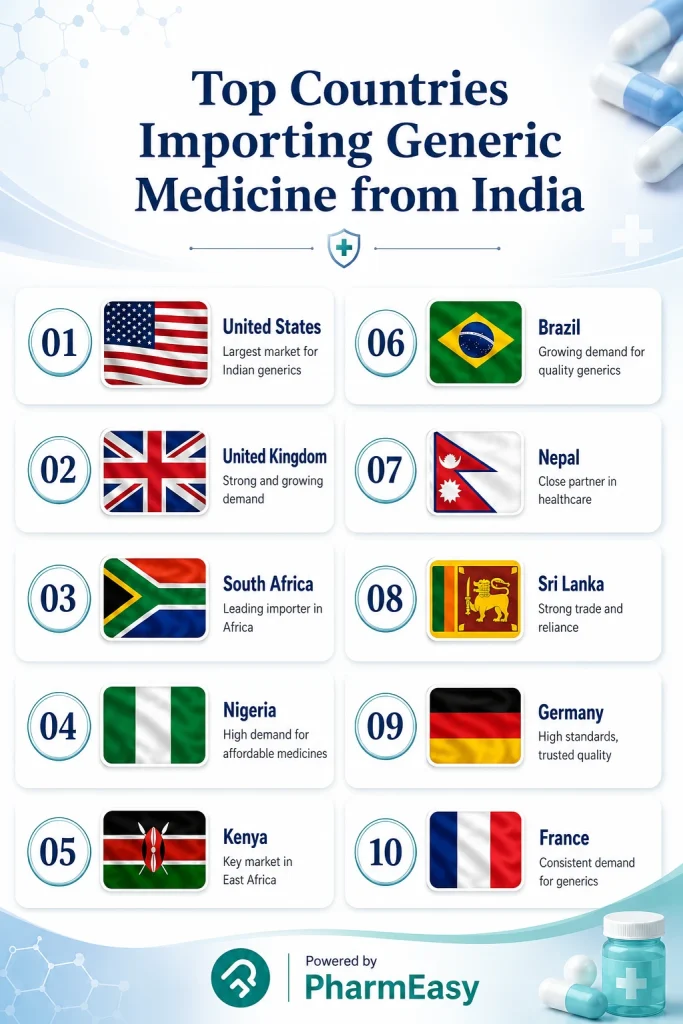
India exports generic medicines to a large number of countries across different regions. A combination of affordable pricing, manufacturing capacity and international regulatory compliance has made Indian pharmaceutical exports an important part of the global healthcare supply chain.
Some of the major importing regions and countries include:
Countries import from India primarily due to competitive pricing, reliable supply, established manufacturing capacity and the regulatory approvals held by Indian facilities. India’s ability to supply medicines consistently at scale has made it a dependable partner in global pharmaceutical supply chains.
India’s pharmaceutical industry has built a strong position in global medicine supply. However, like any industry operating in a competitive and regulated environment, it faces a number of challenges alongside the opportunities ahead6.
India’s generic medicine export industry has demonstrated the ability to adapt and grow across decades. With continued investment in quality, regulatory compliance, supply chain resilience and innovation, the sector is well placed to meet the growing global demand for affordable medicines.
The Indian Government has launched the Pradhan Mantri Bhartiya Janaushadhi Pariyojana (PMBJP) under which PMBJP Kendras across the country will make quality generic medicines and implants accessible at affordable prices and also generate employment.
The COVID pandemic highlighted the importance of reliable pharmaceutical supply chains and increased global demand for medicines, including generic medicines.. Countries are keen to use more generic medicines in the long run to cut down the cost of healthcare.
The Jan Aushadhi initiative in India aims to make quality medicines available to the citizens of the country at affordable prices through dedicated stores selling generic medicines. These medicines are available at lower prices and are approved to meet the required standards for quality, safety, and effectiveness.
Awareness and accessibility of generic medicines is a positive step towards boosting exports. More production of generic medicines is encouraged in several ways by the government.
Generic medicines are low in cost but as effective and safe as branded medicines. Generic medicine in India is being widely used, the PMBJP aims to spread more awareness among people. The pharmaceutical industry of the country has shown tremendous progress and adapted to a changing environment which will help in achieving more success in generic medicine export from India.
1. U.S. Food and Drug Administration. What is the approval process for generic drugs? [Internet]. Silver Spring (MD): U.S. Food and Drug Administration; [cited 2026 Jul 3]. Available from: https://www.fda.gov/drugs/generic-drugs/what-approval-process-generic-drugs
2. Bhatt A, Rautela A. CDSCO: pharmaceutical regulatory authority of India [Internet]. International Journal of Pharmaceutical Sciences; 2025 [cited 2026 Jul 3]. Available from: https://www.ijpsjournal.com/article/CDSCO+pharmaceutical+regulatory+authority+of+India
3. World Health Organization. Good manufacturing practices [Internet]. Geneva: World Health Organization; [cited 2026 Jul 3]. Available from: https://www.who.int/teams/health-product-policy-and-standards/standards-and-specifications/norms-and-standards/gmp
4. U.S. Food and Drug Administration. Bioequivalence [Internet]. Silver Spring (MD): U.S. Food and Drug Administration; [cited 2026 Jul 3]. Available from: Available from: https://www.fda.gov/animal-veterinary/abbreviated-new-animal-drug-applications/bioequivalence
5. U.S. Food and Drug Administration. India’s unique opportunity and important responsibility as the pharmacy to the world [Internet]. Silver Spring (MD): U.S. Food and Drug Administration; [cited 2026 Jul 3]. Available from: https://www.fda.gov/news-events/fda-voices/indias-unique-opportunity-and-important-responsibility-pharmacy-world
6. Manak S, Inder D. Generic drugs in India: regulations, challenges, and reforms: an overview. J Integr Med Res [Internet]. 2025 Jul;3(3):140–147. Available from: https://journals.lww.com/imed/fulltext/2025/07000/generic_drugs_in_india__regulations,_challenges,.2.aspx?__cf_chl_f_tk=OPByRwXLUV0fSbHUQ8F8vE5hTpgMGkHeRaNT6MCxzqI-1783070121-1.0.1.1-e2MF_PwfRPf8ZYAHNriIgjxbpPyeC1EcjJrlYTAt0Sw
7. Central Drugs Standard Control Organisation (CDSCO). CDSCO approved drugs/vaccines/r-DNA/blood product [Internet]. New Delhi: Directorate General of Health Services, Ministry of Health and Family Welfare, Government of India; [cited 2026 Jul 3]. Available from: https://www.cdscoonline.gov.in/CDSCO/cdscoDrugs/
Disclaimer: The information provided here is for educational/awareness purposes only and is not intended to be a substitute for medical treatment by a healthcare professional and should not be relied upon to diagnose or treat any medical condition. The reader should consult a registered medical practitioner to determine the appropriateness of the information and before consuming any medication. PharmEasy does not provide any guarantee or warranty (express or implied) regarding the accuracy, adequacy, completeness, legality, reliability or usefulness of the information; and disclaims any liability arising thereof.
Links and product recommendations in the information provided here are advertisements of third-party products available on the website. PharmEasy does not make any representation on the accuracy or suitability of such products/services. Advertisements do not influence the editorial decisions or content. The information in this blog is subject to change without notice. The authors and administrators reserve the right to modify, add, or remove content without notification. It is your responsibility to review this disclaimer regularly for any changes.
 11
11 
Comments

Leave your comment...
You may also like
























Comments