




Coconut Oil in the Belly Button: Benefits, Uses, Myths & Safety
By Dr. Nayana Shetty +2 more

Medically reviewed by Dr. Nayana Shetty
Last updated: Sep 11, 2026 Published on: Apr 19, 2024


Get,

to manage your symptom
Get your,

4 Cr+ families
benefitted

OTP sent to 9988776655



You’ve successfully subscribed to receive
doctor-approved tips on
Whatsapp

Get ready to feel your best.


Register to Avail the Offer
Send OTPBy continuing, you agree with our Privacy Policy and Terms and Conditions
Hi There,
Sign up on PharmEasy now!!


Trusted by 4 crore+ families

OTP sent to 9988776655
You have unlocked 25% off on medicines


Code: NU25

By Dr. Nayana Shetty +2 more
Table of Contents
For centuries, traditional practices like Ayurveda have revered the navel as a powerful focal point for healing and vitality. Today, coconut oil is a game-changer in the health and wellness scene. It’s been used for centuries for its amazing benefits. People also rub it on the belly button, which is said to boost health. In this article, we’re going to explore the science behind this ancient trick and how it may benefit your health.
Many people believe that applying coconut oil to the belly button offers unique health benefits. While this practice has roots in traditional healing systems such as Ayurveda, scientific evidence suggests that its effects are primarily related to the skin rather than the body as a whole.
Before we get into why coconut oil works, we need to know why the belly button is chosen.
The belly button is a natural depression in the skin. Like other areas of the body, the skin around the navel can absorb small amounts of topical substances. However, there is no scientific evidence that the belly button is a special absorption point that delivers oils directly to internal organs or throughout the body.
Coconut oil has fats. These fats, called medium-chain fatty acids (MCFAs), are easily absorbed by our body via the skin4. The skin absorbs the MCFAs in coconut oil. These fats then make their way into your bloodstream. Plus, they keep your skin well-fed and moist.
Did you know?

Coconut oil may help keep the skin around the belly button soft and hydrated by improving moisture retention. However, these benefits come from applying coconut oil to the skin, not because the belly button has special absorption properties.

Some people believe that applying coconut oil to the belly button boosts metabolism and promotes fat loss. However, there is currently no scientific evidence that topical application of coconut oil reduces belly fat or increases calorie burning.

In some traditional practices, coconut oil is believed to support reproductive health. However, no clinical studies have shown that applying coconut oil to the belly button improves fertility or balances reproductive hormones.

Coconut oil compounds show mild anti-inflammatory activity in lab studies, and Ayurvedic tradition holds that navel oiling relaxes nearby muscles2. But no clinical research has tested coconut oil for dysmenorrhea specifically. Frequent or severe cramps are worth flagging to a doctor rather than managing with a home remedy alone.

Coconut oil has antifungal and antibacterial properties, so it may be able to get rid of harmful bugs that cause stomach pain7. The MCFAs are said to aid digestion. Thus, it may be good for managing an upset stomach. Taking it orally will be more beneficial. However, there is no evidence that applying coconut oil to the belly button improves digestion or relieves an upset stomach

Coconut oil contains lauric acid, a medium-chain fatty acid that has demonstrated antibacterial and antifungal activity in laboratory studies3. While these findings suggest it may help support skin hygiene, more human studies are needed to confirm its effectiveness when applied to the belly button.

Preclinical studies suggest that coconut oil contains compounds with anti-inflammatory properties, which may help soothe minor skin irritation when applied topically4. However, there is currently limited clinical evidence to show that applying coconut oil to the belly button provides significant anti-inflammatory benefits in humans.
Scientists have suggested that certain components of coconut oil, like lauric acid, ketone bodies, and MCTs, might work in a way that could help with Alzheimer’s disease. This idea has gained more support recently however more research is needed on this topic8.
Dr. Siddharth Gupta, BAMS, MD (Ayu)
Note: Coconut oil should not replace medical treatment for skin infections, abdominal pain, digestive disorders, or hormonal conditions. If symptoms persist or worsen, consult a doctor for appropriate evaluation.
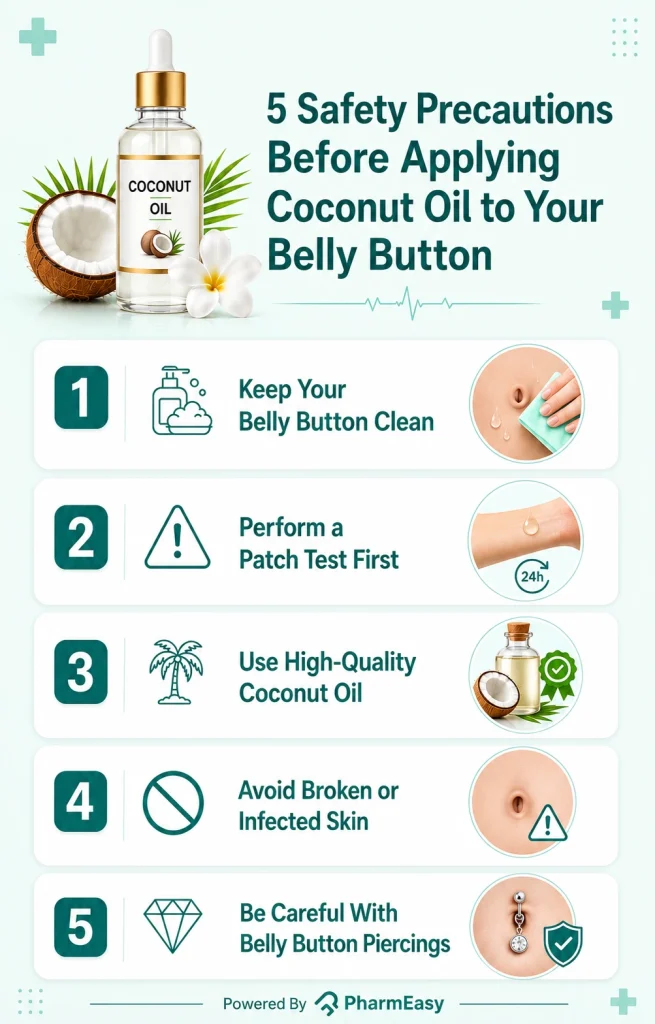
Applying coconut oil to the belly button is generally considered safe for most people when used externally. However, like any topical product, it may not be suitable for everyone. Following a few precautions can help reduce the risk of skin irritation or infection.
The belly button can trap sweat, dead skin cells, lint, and moisture, creating an environment where bacteria or fungi may grow.
Therefore, the first step to keep your belly button clean is to . Be sure to remove any dirt or lint.
Before regular use, apply a small amount to your inner arm or wrist and wait 24 hours. This helps rule out an allergic reaction, especially for those with sensitive skin or a coconut/tree-nut allergy.
Opt for virgin, cold-pressed, or organic coconut oil, as these varieties are minimally processed and retain more of their naturally occurring compounds. Avoid refined coconut oils with added fragrances, preservatives, or other additives, as they may increase the risk of skin irritation, especially for people with sensitive skin
Applying oil over an infected or damaged area may trap moisture and delay healing. If you notice persistent pain, discharge, swelling, or a foul smell from the belly button, seek medical evaluation rather than self-treating with coconut oil.
Avoid applying coconut oil to newly pierced navels until the piercing has fully healed, unless advised by your piercer or healthcare provider.
It’s a lesser-known fact that the connection between the navel and the body’s organs was documented as far back as the Inner Canon of the Yellow Emperor (Huangdi Neijing), an ancient Chinese medical text dating from the late Warring States period (475–221 BC) to the Han dynasty (202 BC–220 AD)9
Dr Rajeev Singh, BAMS
Although coconut oil is generally safe for topical use, some people may experience mild side effects.
While applying coconut oil to the belly button is generally safe for topical use, certain symptoms may indicate an underlying condition that requires medical attention. Consult a doctor if you experience:
Also Read: Health Benefits of Coconut Oil for Skin and Hair
Rubbing coconut oil on your belly button can seem odd. But this old trick might provide potential health benefits. Though it’s generally safe, discussing it with a doctor before starting is always important. Be sure to follow the tips we shared here. If you are allergic, stop using coconut oil and visit a doctor right away. You can try using alternative oils if you have an allergy.
For the best effects, try using coconut oil on your belly button once a day or every other day, preferably before sleep.
Yes, you can. Other oils like almond, sunflower, and olive are also good.
Generally, yes. But it’s best to talk to your healthcare provider first.
Everyone is different, but some people see better skin, digestion, and wellness in a few weeks.
Coconut oil has benefits for everyone. However, talk to your child’s doctor before trying new things.
Disclaimer: The information provided here is for educational/awareness purposes only and is not intended to be a substitute for medical treatment by a healthcare professional and should not be relied upon to diagnose or treat any medical condition. The reader should consult a registered medical practitioner to determine the appropriateness of the information before consuming any medication. PharmEasy does not provide any guarantee or warranty (express or implied) regarding the accuracy, adequacy, completeness, legality, reliability, or usefulness of the information; and disclaims any liability arising thereof.
Links and product recommendations in the information provided here are advertisements of third-party products available on the website. PharmEasy does not make any representation on the accuracy or suitability of such products/services. Advertisements do not influence the editorial decisions or content. The information in this blog is subject to change without notice. The authors and administrators reserve the right to modify, add, or remove content without notification. It is your responsibility to review this disclaimer regularly for any changes.
 59
59  7
7Comments

Leave your comment...
You may also like
























Comments